Wars · VI. The high empire and the third-century emergencies
W057 Trajan's Dacian wars
Battles and sieges
Fall of Sarmizegetusa Regia 106 ADTrajan reopened the contest with Decebalus, whose kingdom had survived Domitian's wars. The first campaign forced a settlement in AD 102. Renewed hostilities led to the second war, the capture of the royal center around Sarmizegetusa Regia and Decebalus' death.
River crossings, engineered routes, mountain positions and the ability to supply substantial forces were central. Trajan's Column presents these operations as an ordered imperial achievement, but its scenes form a monumental narrative rather than a literal strip map of every march.
Command, forces and military problem
| Field | Dossier |
|---|---|
| Roman leadership | Trajan and senior imperial commanders |
| Opposing or rival parties | Decebalus and the Dacian kingdom |
| Forces and capabilities | Legions, auxiliaries, engineers, river crossings and defended mountain approaches |
| Operational problem | Break a kingdom in two wars and turn conquest into a sustainable province. |
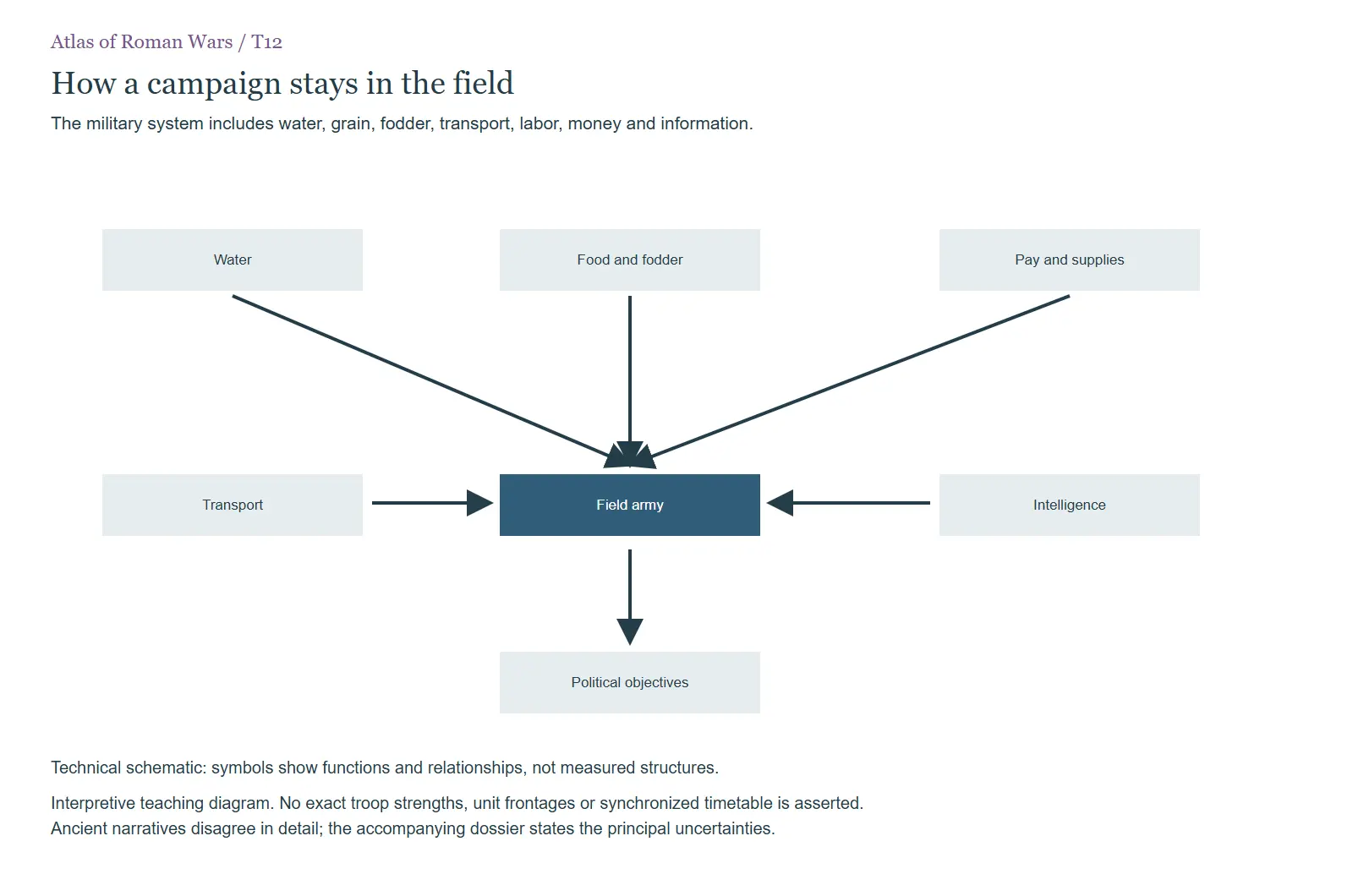
Extended campaign study
The account below develops the operations and their interpretation. Reported numbers and reconstructed tactical details retain the uncertainties described in the dossier.
The Unfinished Kingdom
The war was inherited before it was chosen. Trajan — legate of Upper Germany at his adoption in 97, on the Danube through 98–99 reorganizing roads, fleets, and the towpath cut into the Iron Gates gorge whose inscription still overhangs the river — prepared the reckoning with the deliberation of a man who had decided the arcanum of 89 must be reversed in public: the subsidies stopped; the concentration assembled, perhaps nine or ten legions' worth with auxilia and the new specialist units the Column shows (Moorish horse under their prince Lusius Quietus, Syrian archers, the armored cataphracti answering the Sarmatian fashion); and in March 101 the emperor crossed the Danube on twin pontoon bridges with the largest Roman field force since the civil wars. Of this war the writing has perished — Trajan's own commentaries survive in one clause, inde Berzobim, deinde Aizi processimus, five Latin words of an emperor's prose left like a single vertebra of a vanished spine — and the reconstruction that follows reads, as the Proem warned, the stone: the Column's spiral, unwound scene by scene as the campaign's storyboard; the Adamclisi trophy's brutal provincial metopes; and the archaeology of the siege-works in the mountains.
The first war (101–102) taught both commanders the shape of the second. Trajan advanced methodically up the Banat corridor — the Column's opening spirals are all engineering, ramparts and bridges and forts rising in ordered sequence, the army building its way toward an enemy who declines to appear — and met the Dacian main strength at the second battle of Tapae, at the approaches to the Iron Gates of Transylvania: a bloody, storm-broken Roman victory the tradition marks with the emperor tearing his own wardrobe into bandages, and with a thunderstorm the Dacians read as their sky-god's displeasure. Decebalus answered with the war's masterstroke: as winter closed the passes, he loosed the war across the frozen lower Danube — Dacians and Sarmatian Roxolani cataphracts pouring into Moesia behind the emperor's front, the counterstroke of a king who had studied his enemy's habit of assuming winter belonged to Rome. Trajan's response was the campaign's decision: the field force shipped and marched east down the river at winter speed, the invasion caught and broken in two battles — the second, near the future Nicopolis, remembered in the name the emperor gave the city he founded on the field — and at Adamclisi in the Dobruja, where the fighting reached an intensity the metopes render with none of the Column's classical composure: chain-scythed Sarmatian riders, Dacian falx-men in wolf-standards, legionaries in the reinforced arm-guards and crossed helmet-bracing the falx had taught the armories to issue. The campaign of 102 converted the winter's victory into siege-progress up the Olt and through the passes; the mountain forts of the Orăștie ring began to fall to escalade and blockade — the Column shows the auxilia doing the assault-work, legions building — and Decebalus sued. The peace of 102 was Flavian in form and Trajanic in content: the king kept his throne and lost his war-making apparatus — walls to be razed, engineers and deserters surrendered, foreign policy Roman — and a permanent bridgehead remained: the stone piers of the great bridge Apollodorus of Damascus threw across the Danube at Drobeta, twenty piers over a kilometer of river, the longest bridge the ancient world ever built, whose stumps still stand in the water and whose meaning required no inscription. A bridge is a promise of return.
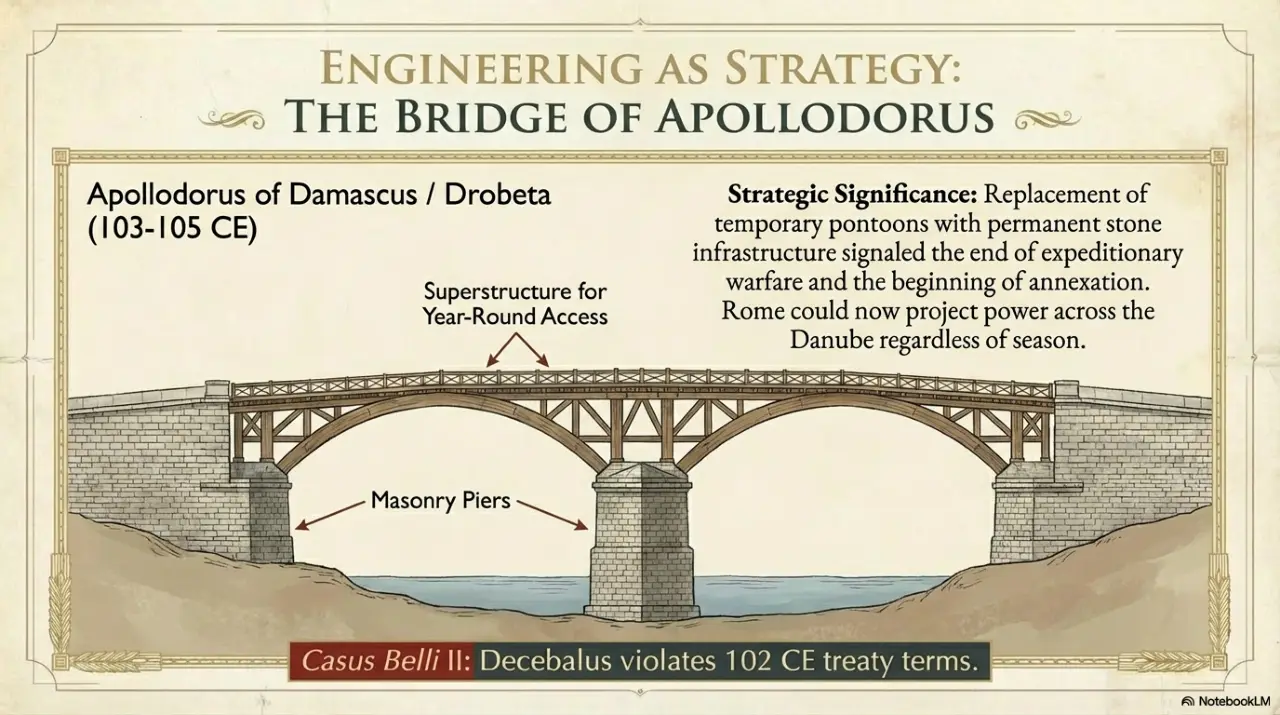
The Second War and the End of Dacia (105–106)
Both parties treated the peace as an armistice, and the sources — Dio's epitome here supported by the Column's second spiral — assign the breach to the king: the walls rebuilt, the deserters re-welcomed, the Iazyges attacked, the neighboring peoples pressed into a final coalition, and in 105 the war reopened with a Dacian surprise offensive that overran the Roman garrisons north of the river and, in the tradition Dio preserves, came within one forged safe-conduct of ending it — the captured Roman officer Longinus, held as a bargaining counter against the emperor's advance, closing the question by poison procured through his own freedman, a suicide the compendium sets beside Regulus in its small ledger of the discipline of captives. Trajan came back in 106 with the bridge under his feet and the patience gone. The second war was conquest, not chastisement: the Orăștie mountain ring reduced fortress by fortress — Costești, Blidaru, Piatra Roșie, the excavated burn-layers dating themselves to the season — the capital Sarmizegetusa Regia invested, its water-line cut (the Column shows the pipes being broken), stormed and razed to its foundations so thoroughly that its site reverted to forest until modern archaeology; the king's flight north with his cavalry, the Roman pursuit, and the end the compendium can document as it can document almost nothing else in this reign, because the man who made the capture wrote it on his tomb. Tiberius Claudius Maximus, a Philippi-born cavalryman risen through two wars to duplicarius, ran Decebalus down with his troop at the forest's edge; the king, ringed, drew the curved sica across his own throat; Maximus took the head and the right hand to the emperor at Ranisstorum, was decorated a second time, and retired at last in Macedonia under a stele — recovered at Grammeni in 1965 — that carves the scene in relief above the career: the rider, the falling king, the reaching hand.
Outcome and critical assessment
Result and caution: Rome established a Dacian province, with major extraction and settlement. The royal Sarmizegetusa and the later Roman colony Ulpia Traiana Sarmizegetusa are distinct places and must not share one undifferentiated map marker. Conventional numerical claims about captured gold, prisoners and deaths are not adopted as measured totals.
Historical record: IR-VII, chapter 1; Dio, book 68 in epitome; monumental evidence discussed in the manuscript. The atlas does not claim a new archaeological reading of the Column.