Wars · VI. The high empire and the third-century emergencies
W058 Trajan's Parthian war
Battles and sieges
Trajan's capture of Ctesiphon 116 ADThe Armenian succession and Roman ambitions in the East preceded Trajan's invasion. Armenia was annexed, Roman armies advanced through Mesopotamia, and Ctesiphon was captured. The advance to the Persian Gulf supplied a dramatic image of imperial reach.
Holding the conquests proved more difficult. Rebellion, divided commitments and the resistance of places such as Hatra exposed the gap between an advancing field army and durable administration. Trajan's death in AD 117 was followed by Hadrian's withdrawal from major eastern acquisitions.
Command, forces and military problem
| Field | Dossier |
|---|---|
| Roman leadership | Trajan and his commanders |
| Opposing or rival parties | Arsacid royal and regional forces; local resistance to occupation |
| Forces and capabilities | Large expeditionary armies with river support and extended garrison commitments |
| Operational problem | Hold what an advancing army can capture and suppress revolts without dispersing beyond support. |
Campaign geography and operational plates
Trajan in Armenia and Mesopotamia
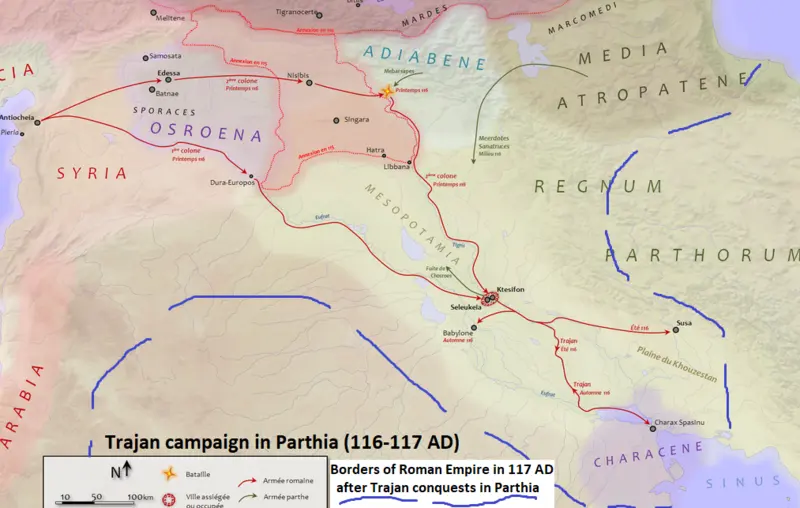
The movement from Armenia into Mesopotamia extended the campaign along major rivers and into a dense landscape of defended cities. The map makes the distance from established Syrian bases visible. Territorial coloring records the reconstruction of an ambitious and short-lived settlement, not proof of uniform or durable Roman control behind every advancing force.
Extended campaign study
The account below develops the operations and their interpretation. Reported numbers and reconstructed tactical details retain the uncertainties described in the dossier.
The Parthian War of Trajan
The operations, as far as the fragments carry them: 113–114, Armenia entered from the Cappadocian bases Vespasian had built, the crowned nephew Parthamasiris presenting himself at Elegeia to receive his diadem back in the Neronian choreography — and receiving instead annexation, the kingdom declared a province, the prince dead days later "attempting escape" in the phrase the compendium has learned across six volumes to grade; 115, the descent into Mesopotamia, Nisibis and Batnae taken, Edessa's client-king Abgar charmed into submission by his own son's diplomacy, northern Mesopotamia organized as a second new province while the Parthian realm, deep in one of its dynastic civil wars, could not concentrate; 116, the maximum year — the Tigris crossed on a prefabricated boat-bridge hauled overland in sections from Nisibis, Adiabene overrun as a third province (Assyria, the shortest-lived name in the imperial roster), the twin capitals Seleucia and CTESIPHON taken, the Arsacid golden throne captured with the king's daughter, the emperor sailing the lower rivers to the Persian Gulf — where, watching a merchantman clear for India, he spoke the sentence Dio preserved as the whole campaign's epitaph: that were he younger, he would have crossed to the Indus as Alexander had. He was the first and last Roman ruler to stand on that shore.
The recoil began before the fleet had left the Gulf. The conquest had been a raid wearing a province's paperwork — garrisons thin, communications enormous, the Parthian field armies traded space rather than dying — and in 116 the whole occupied East rose at once behind the emperor: the Parthian counteroffensive under the king's nephew Sanatruces and son Osroes's generals retaking the Tigris line, Seleucia and Edessa and Nisibis in revolt, a Roman column destroyed with its general Maximus, the sixty-three-year-old Trajan reduced to firefighting — Lusius Quietus, the Moorish prince whose horsemen the Column had celebrated, storming Nisibis and burning Edessa; Seleucia burned by two other columns; and at Ctesiphon, in the war's most naked scene, the emperor of Rome personally crowning a Parthian client-king, Parthamaspates, before the assembled armies — annexation converted in twelve months to the puppet-diplomacy the annexation had been launched to transcend.
Outcome and critical assessment
Result and caution: the campaign achieved striking victories but not a permanent Roman possession of all the territories claimed. An "empire at AD 117" map should distinguish occupation, provincial claims, client arrangements and enduring control. The capture of Ctesiphon is not equivalent to the destruction of the Arsacid state.
Historical record: IR-VII, chapter 2; Dio, book 68; campaign tables. The manuscript is an editorial framework, not an independently surveyed border record.