Wars · V. The early Principate: conquest and provincial war
W056 Domitian's German and Danubian wars
Battles and sieges
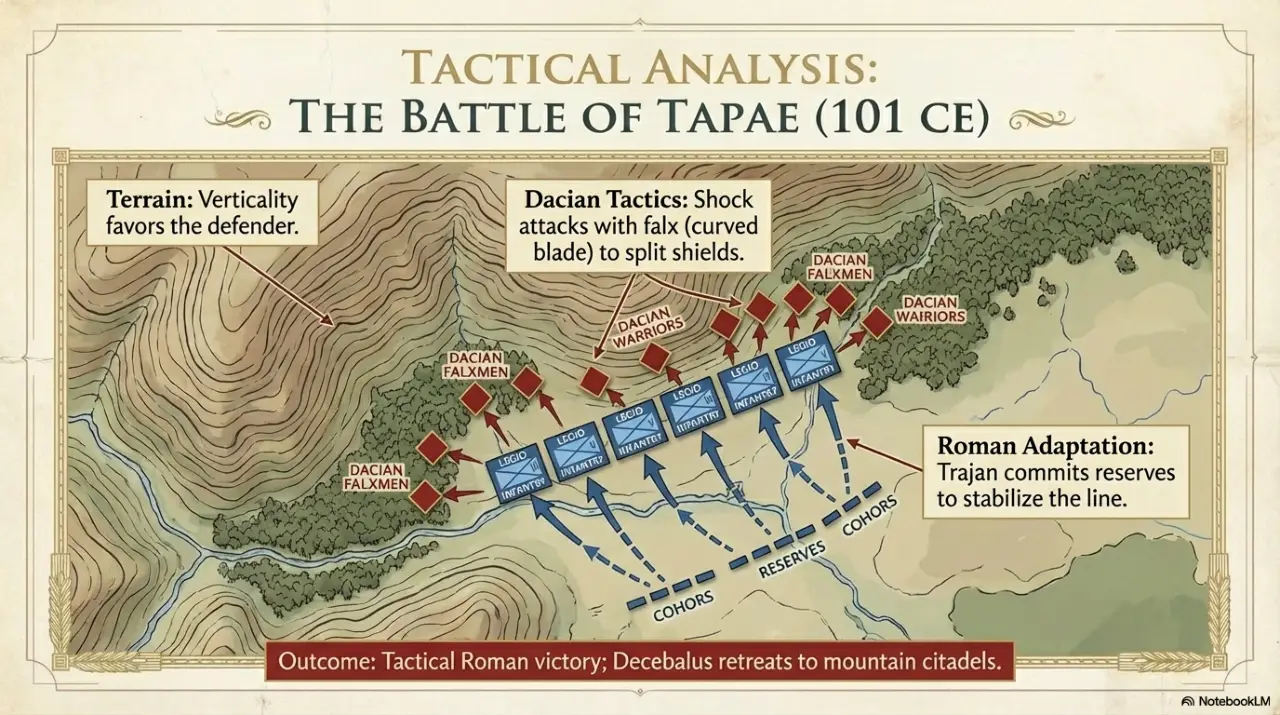
Tapae under Domitian 88 ADThe campaign against the Chatti in AD 83 combined military operations with changes to Rome's frontier position. On the Danube, Dacian attacks produced a more dangerous crisis. The defeat of Cornelius Fuscus was followed by renewed Roman operations, including the victory of Tettius Julianus at Tapae in AD 88.
Other pressures involving Marcomanni, Quadi and Sarmatians complicated Roman choices. The agreement with Decebalus in AD 89 preserved his kingdom and included Roman support or payments, a settlement later hostile writers used against Domitian.
Command, forces and military problem
| Field | Dossier |
|---|---|
| Roman leadership | Domitian, Fuscus, Tettius Julianus and regional commanders |
| Opposing or rival parties | Chatti, Decebalus and other Danubian powers in distinct conflicts |
| Forces and capabilities | Several frontier armies facing simultaneous operations and reverses |
| Operational problem | Balance theaters and negotiate when a successful battle does not remove other threats. |
Extended campaign study
The account below develops the operations and their interpretation. Reported numbers and reconstructed tactical details retain the uncertainties described in the dossier.
Vespasian: The Army Rebuilt (70–79)
The reconstruction was designed by men who had just read the year 69 as a engineer reads a collapse, and its first principle was that the failure had been structural. Vespasian and Mucianus disbanded outright the four legions whose record the civil war and the Batavian oath had made unsalvageable — I Germanica, IV Macedonica, XV Primigenia, XVI Gallica struck from the list, their numbers, like the Varian three, never reissued — and reconstituted the salvageable under new titles and new stations; the Rhine garrison was rebuilt with legions owing nothing to the Rhine's recent history, and the army's whole geography was reshuffled on the principle, stated by no source and legible in every posting, that no army group should again ripen into a faction: legions rotated away from provinces where they had grown roots, no more than two wintering together where four had brewed Vitellius. The deeper reform reached the auxilia, whose national blocs under native princes had given Civilis his instrument: the Batavian cohorts were re-formed, renumbered, and posted to Britain and the Danube — soldiering on, tribute-free, but far from home — and the pattern became system: auxiliary regiments henceforth recruited increasingly wherever they were stationed rather than where they were raised, officered by Roman equestrians rather than tribal notables, their ethnic names fading into administrative labels; the empire had learned to dilute what it could not do without. The fiscal reconstruction was of a piece — the census of 73–74, the reclaimed public lands, the provincial revenues rebased, the notorious ingenuities down to the urine-tax that produced, when Titus wrinkled his nose at it, the coin held to his face and the reign's motto: pecunia non olet, money does not smell — because the army reform's real substrate was solvency: the donative-auction of 69 was to be foreclosed by a treasury that could always outbid a usurper. On the frontiers the reign's signature was the quiet closure of strategic reentrants: in the East, Cappadocia converted from unarmed procuratorial province to a two-legion command facing Armenia, the client-kingdoms of Commagene and Lesser Armenia absorbed, the Euphrates road fortified — the eastern limes founded in a decade without a battle the sources thought worth narrating; and in the southwest angle of Germany, the reoccupation beyond Rhine and upper Danube of the Black Forest salient — the Agri Decumates — shortening the frontier's dog-leg and opening the lateral road between the army groups, the first installment of the policy Domitian's wars would complete.
Domitian: The Chattan War and the Dacian Emergency (81–89)
Domitian has descended to posterity through the senatorial tradition that survived him — Tacitus's and Pliny's generation, writing their acquittals after his murder — and the narrative's method requires the warning before the wars: the reign's military record must be read through sources committed to its contempt, against a documentary and archaeological record that persistently contradicts them. The Chattan war of 83, the emperor's first, is the test case: the literary tradition preserved it as theater — a manufactured campaign, slaves dressed as prisoners, a triumph Tacitus's Germania mocks in a clause — while the ground records the largest engineering advance of the century: the Taunus and Wetterau salients driven through the Chatti's approach-country, the watchtower chains and palisade traces of the earliest limes proper, the forts at the passes, and behind them the conversion, by the middle 80s, of the old military commands of the Rhine into the formal provinces of Upper and Lower Germany — the German project of Drusus ending, seventy years after the Teutoburg, not at the Elbe but as two tax-districts and a fortified line, which was the version that lasted. Moesia was split into two consular provinces and the Danube's garrison began the climb — five legions toward nine — that would make it, within a generation, the heaviest frontier on earth; and in 88 the methodical counterstroke under Tettius Julianus came through the Iron Gates pass to Tapae, on the approaches to the Dacian capital, and broke Decebalus's army in the field.
The kill was forfeited to the year 89: on the first of January the legate of Upper Germany, Antonius Saturninus, proclaimed himself at Mainz with two legions and the savings-deposits of their strongbox, in compact with the Chatti across the river — and the revolt collapsed in eleven days by the empire's oldest weather: the Rhine broke up early, the Chatti could not cross the moving ice, and the loyalist army of Lower Germany under Lappius Maximus destroyed the usurper at the Rhine — after which Lappius burned Saturninus's correspondence unread, the Pompeian gesture of Book V repeated under the monarchy, this time to save not the guilty but the emperor from what he would do with the names; Domitian, arriving with the Guard and his own suspicions, supplied the executions regardless, and the army reforms that followed wrote 69's lesson into regulation at last: no two legions to share a camp again — the great double fortresses broken up empire-wide — and the soldiers' deposit-funds capped below usurpation-financing size.
The Pannonian Wars and the End (89–96)
The Danube's other nations filled the reign's last decade. Two army-measures of the reign outlasted every verdict on it: the pay-raise of 84 — the first since Julius Caesar, a third added to the legionary's three hundred sesterces a year, the professional army's wage finally repriced after a hundred and thirty years of inflation and mutiny-arithmetic — and the frontier itself as the reign left it: the palisade going up, the towers intervisible, the auxiliary forts strung at day's-march intervals from the North Sea to the Black Sea, the empire's edge become the empire's largest built object.
Outcome and critical assessment
Result and caution: Rome did not annex Dacia under Domitian. The policy must be assessed in a setting of simultaneous frontier demands rather than only through later accounts of imperial vanity. Avoid confusing this battle at Tapae with Trajan's later campaign at the same named approach. Precise frontier installations require site-specific dating.
Historical record: IR-VI, chapter 8; Dio, book 67 in epitome; Tacitus, contextual references; campaign tables.