Wars · IV. The Republic at war with itself
W043 The wars after Caesar: Mutina, Philippi and Perusia
Caesar's assassination did not restore an uncontested Republican government. Antony's conflict with the senate and Octavian produced the campaign around Mutina in 43 BC. The subsequent triumviral settlement joined former opponents in extraordinary power and proscriptions.
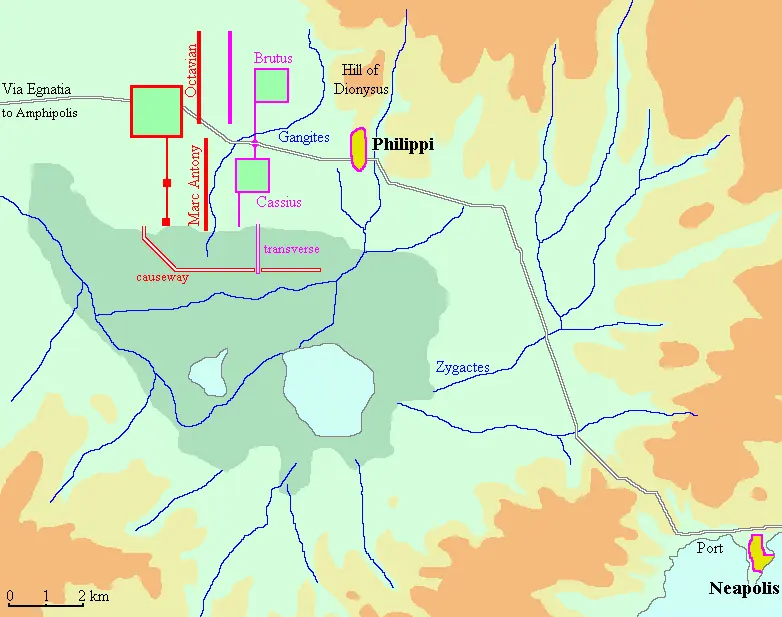
At Philippi in 42 BC, Antony and Octavian defeated the forces of Brutus and Cassius in two major battles. Veteran settlement and struggles within the victorious coalition then contributed to the Perusine War of 41–40 BC, involving Lucius Antonius and Fulvia against Octavian. Siege, land confiscation and civilian distress belonged to the same political landscape as the famous field battles.
Command, forces and military problem
| Field | Dossier |
|---|---|
| Roman leadership | Antony, Octavian and allied commanders in changing coalitions |
| Opposing or rival parties | Brutus, Cassius, Lucius Antonius and other Roman rivals in distinct phases |
| Forces and capabilities | Veteran armies, fleets, city defenses and competing recruitment systems |
| Operational problem | Convert battlefield advantage into authority while managing land, veterans and coalition breakdown. |
Extended campaign study
The account below develops the operations and their interpretation. Reported numbers and reconstructed tactical details retain the uncertainties described in the dossier.
The Ides, the Proscription, and Philippi (44–42 BC)
What Rome could not classify it killed. The honors avalanche of 45–44 — the perpetual dictatorship voted in February 44, the month renamed, the statue among the kings', the temple to his Clemency, the person declared sacrosanct with the tribunes' own inviolability — assembled around Caesar every ornament of monarchy except the name, and the name was tested too, at the Lupercalia of the fifteenth of February, when Antony three times offered the diadem and Caesar, reading the crowd's groan against its scattered claque, three times refused it to applause and ordered the crown inscribed to Jupiter: whether rehearsal, trial-balloon, or renunciation, no source knew then and none knows now. The conspiracy that answered numbered above sixty — Cassius the organizing hatred, Brutus the legitimating name, descendant of the Brutus who expelled the kings, Caesar's pardoned favorite and, the gossip insisted, more; Decimus Brutus the trusted intimate; the mass a compound of pardoned Pompeians and disappointed Caesarians — and it fixed on the Senate's meeting of the fifteenth of March, three days before the dictator's departure for the Parthian war that would have put him beyond reach at the head of sixteen legions. The omens the tradition demands were all supplied and all overridden: Spurinna's warning of the Ides, Calpurnia's dream of the collapsing pediment, the sacrifices without heart, and Decimus in the doorway at the last, laughing his friend past his wife's terror to the Senate's own business. In the portico of Pompey's theater — the Senate met that day, the coincidence beyond any dramatist's nerve, in the hall Pompey built, beneath Pompey's statue — Tillius Cimber gave the signal by dragging the toga from Caesar's neck; Casca struck first and badly; and the pack closed, twenty-three wounds, the victim fighting with his stylus until, seeing Brutus's blade among the rest, he spoke — if he spoke; Suetonius and Dio transmit it as what some reported — the Greek that has outlived the Latin the stage later gave him, kai su, teknon: you too, child; then drew the toga over his face and fell, with whatever the universe intended by it, at the base of Pompey's statue, which was wet with him. The liberators, marching to the Capitol with their caps of liberty, discovered within days that they had freed nothing: the constitution they had killed for had no army, and the dead man had two — his veterans, and his will. The testament read at Antony's instance gave the people Caesar's gardens and three hundred sesterces a man, and adopted as son and principal heir the sickly eighteen-year-old grand-nephew Gaius Octavius, studying at Apollonia; the funeral in the Forum, worked by Antony's oration and the mechanical wax effigy rotated above the bier displaying the twenty-three wounds, became a riot that cremated the dictator on an improvised pyre of benches and drove the liberators from Rome within the month.
The two years that followed defy compression and receive it. Antony and the young Caesar collided first as rivals for the Caesarian inheritance — the war of Mutina in April 43, where the Senate under Cicero's Philippic leadership yoked Octavian to both consuls against Antony and won two battles at the cost of both consuls, leaving the nineteen-year-old in sole command of the victorious armies precisely as Cicero's epigram had proposed to prevent — the young man is to be praised, honored, and removed; the pun (tollendum: exalted, or eliminated) was reported to its subject, and answered in August when Octavian marched his eight legions on Rome and took the consulship at nineteen with a kinsman as colleague. In November 43, on an island in a river near Bononia, Antony, Octavian, and Lepidus merged their armies and their proscription lists into the Triumvirate for the Constitution of the State — the Sullan instrument revived as a board, established by the lex Titia as a magistracy: terror was now constitutional.
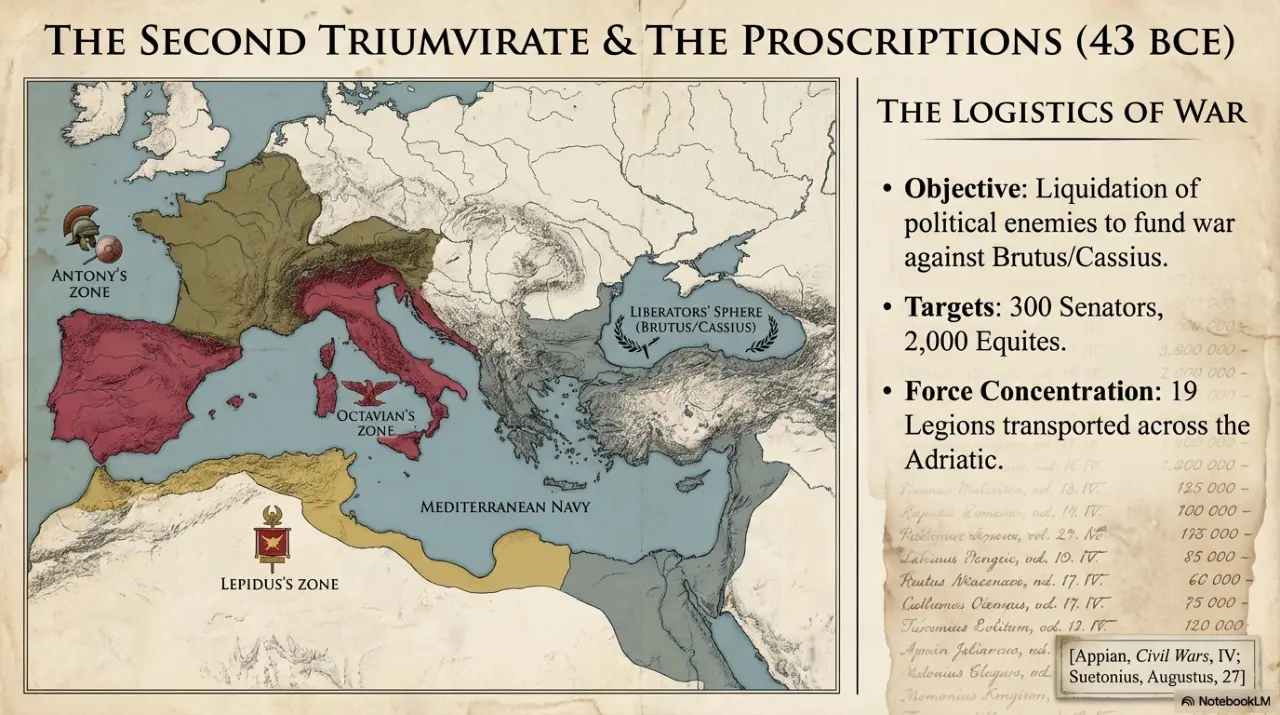
The lists ran to some three hundred senators and two thousand equestrians, each dynast selling kin to buy enemies — Lepidus his brother, Antony his uncle — and the estates funding the forty-three legions the eastern war required; the most famous name was purely Antony's price. Cicero, who had aimed the Philippics at his head knowing the stake, was overtaken in his litter near his Formian villa on the seventh of December 43, and forbade his slaves the fight they offered: he put his head out of the litter to the sword of the tribune Herennius with — the detail the tradition would not surrender — the request that he do it properly. The head and the hands that wrote the Philippics went to Rome, where Antony had them nailed to the Rostra — the platform of forty years of the greatest oratory in the Latin language — and where, Dio records, Fulvia took the head first upon her knees and drove her hairpins through the tongue. Strategy again forbade the stronger position to fight, and politics again overrode strategy. In the first battle of the third of October, Brutus's wing stormed Octavian's camp — the young Caesar absent from his own tent, warned, he later wrote, by a friend's dream, and hiding three days in the marshes by one account he never quite suppressed — while Antony stormed Cassius's; and Cassius, myopic on his hill, mistaking Brutus's victorious cavalry in the dust for enemy and his sent rider Titinius's welcoming captors for capture, retired into his tent with his freedman Pindarus and the sword — the tradition remembered it as the one he had used on the Ides — and was found beheaded; Titinius, riding back with the good news to the body, killed himself over it. Brutus buried "the last of the Romans" secretly, held the ground three weeks against every logic of his advantage while blockade did his work, and was compelled — the sources agree his own officers and the ghost-fearing rankers forced it — to the second battle of the twenty-third of October, which was pure attrition and broke his line by mid-afternoon. He withdrew with four legions to the hills, tested his friends' willingness one by one through the night — the quotation Dio preserves, the tragedian's couplet on Virtue, wretched Virtue, thou wert but a name, and I served thee as real — clasped the sword with Strato of Epirus at dawn and ran upon it. Antony covered the body with his own scarlet cloak; the head, shipped for the base of Caesar's statue, went down — Dio's justice — in a storm at sea. The Republic had no third army. What remained was the division of the world among its executors, and the ten years it took the world to discover that it could have only one.
Tactical illustrations
Outcome and critical assessment
Result and caution: the assassins' main military challenge ended, but the victorious coalition remained unstable. These are not three phases of a perfectly coordinated single campaign. Later Augustan and hostile traditions distribute responsibility unevenly; political labels such as "Liberators" record claims of legitimacy rather than a neutral constitutional verdict.
Historical record: IR-V, chapter 8; Appian, Civil Wars 3–5; Dio, books 45–48.