Wars · IV. The Republic at war with itself
W042 Caesar's civil war and the wars of the Caesarian corpus
Caesar's crossing into Italy opened war with Pompey and the senatorial coalition. The rapid Italian campaign and Ilerda in 49 BC were followed by the Adriatic struggle: Caesar suffered a setback at Dyrrhachium before defeating Pompey at Pharsalus in 48. Pompey's flight and murder in Egypt led into a separate Alexandrian crisis.
Caesarian operations continued against Pharnaces at Zela, against opponents in Africa culminating at Thapsus in 46, and in Iberia culminating at Munda in 45 BC. Naval movement, local rulers, provincial recruitment and control of ports made this a Mediterranean civil war rather than an Italian contest exported as an afterthought.
Command, forces and military problem
| Field | Dossier |
|---|---|
| Roman leadership | Caesar and his legates |
| Opposing or rival parties | Pompey and successive anti-Caesarian coalitions; local royal forces in connected theaters |
| Forces and capabilities | Roman armies on both sides, fleets, African and eastern allies |
| Operational problem | Defeat an opponent with Mediterranean resources while supplying armies across several theaters. |
Egypt: a civil war within another political crisis
Pompey's murder on reaching Egypt removed Caesar's principal rival without giving Caesar a peaceful or uncontested position there. The struggle within the Ptolemaic monarchy drew him into urban and royal conflict at Alexandria. Limited forces, access to the harbor, communications and the possibility of relief shaped his options. The Alexandrian war should not be described as the effortless afterthought of a victory at Pharsalus.
The eventual defeat of the opposing royal forces and the establishment of Cleopatra's position gave Caesar an eastern settlement before he moved to other crises. The conventional account of Zela and the defeat of Pharnaces belongs to that rapid sequence. The famous compression of the campaign into a triumphal phrase is political representation, not a substitute for its local causes and operations.
Africa: Thapsus and the remaining coalition
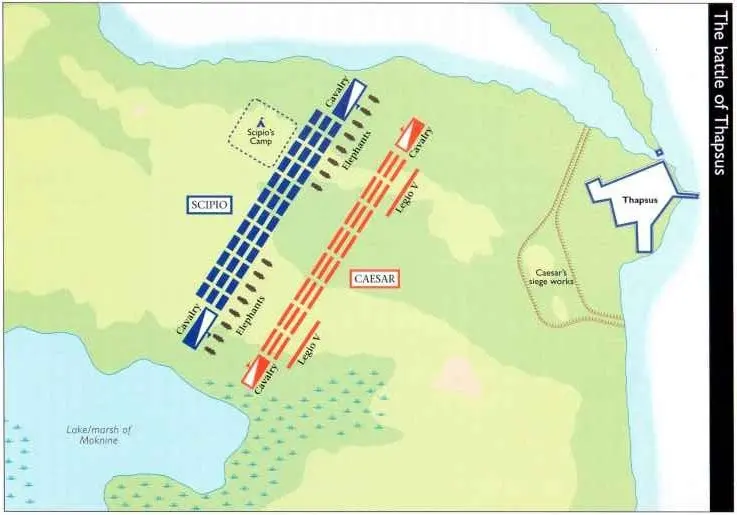
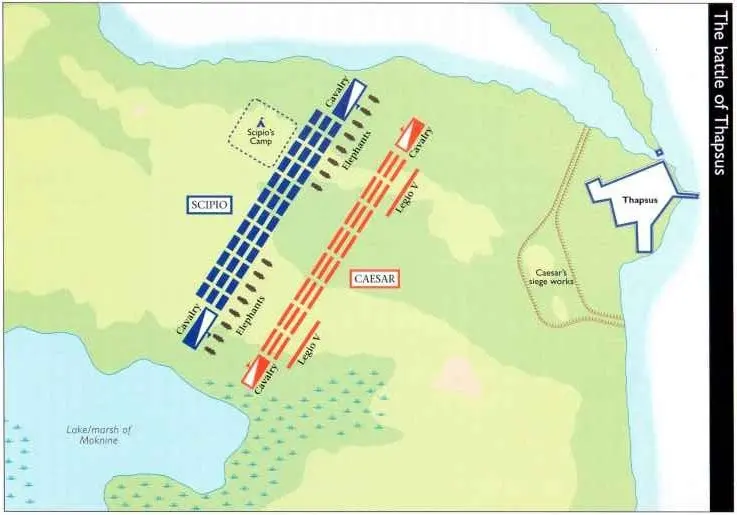
Anti-Caesarian leaders could still draw on provincial resources and the support of Juba's Numidian monarchy. Caesar's landing therefore began a serious campaign in which cavalry, supplies, access to towns and the ability to concentrate mattered. Victory at Thapsus in 46 BC broke the principal field resistance, but its consequences included the deaths and dispersal of opponents, the fate of allied rulers and further political settlement.
The command decisions and precise tactical sequence are known through partisan traditions, including the anonymous African War. Elephants belong to the account, but the exact explanation of their performance should not be derived from a modern picture alone. The resulting expansion of Roman control in Africa was also a change in the distribution of land, authority and revenue.
Iberia: the final major campaign
Pompey's sons and their allies rebuilt resistance in the peninsula. The fighting culminating at Munda in 45 BC was a major renewed danger rather than a ceremonial cleanup. Veteran loyalties, local support, defended towns and difficult choices about when to force battle sustained the opposition.
Caesar's victory established military supremacy without reconciling the Republican elite to his rule. The interval between victory and assassination demonstrates the difference between defeating organized armies and resolving the political problem from which those armies had arisen. Munda's disputed exact location is retained as an uncertainty; a campaign map can orient southern Iberia without pretending to certify its fighting ground.
Campaign geography and operational plates
The Mediterranean geography of Caesar’s civil war
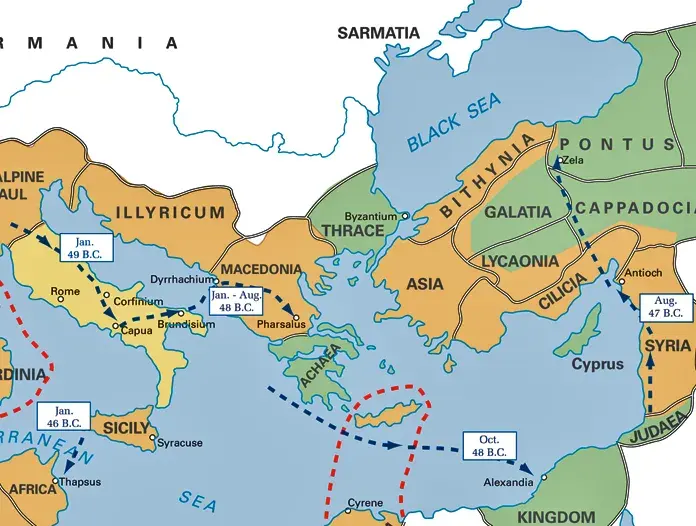
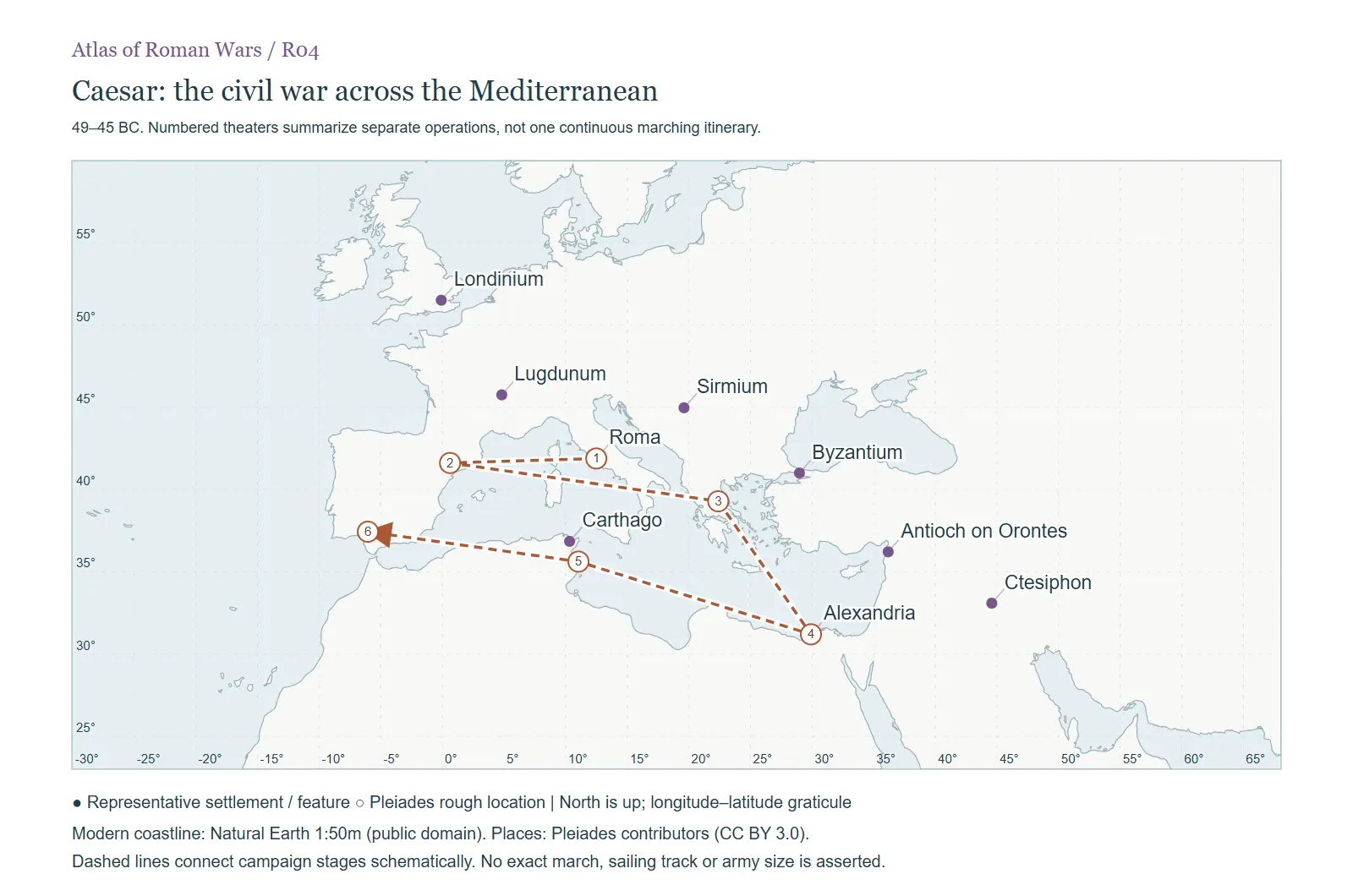
The separation of Italy, the Adriatic, Greece, Africa and Iberia explains the repeated need to move armies by sea and secure ports. The dotted connections are a guide to theater changes. They should be compared with the separate Ilerda, Dyrrhachium, Pharsalus, African and Spanish narratives rather than read as one continuous expedition.
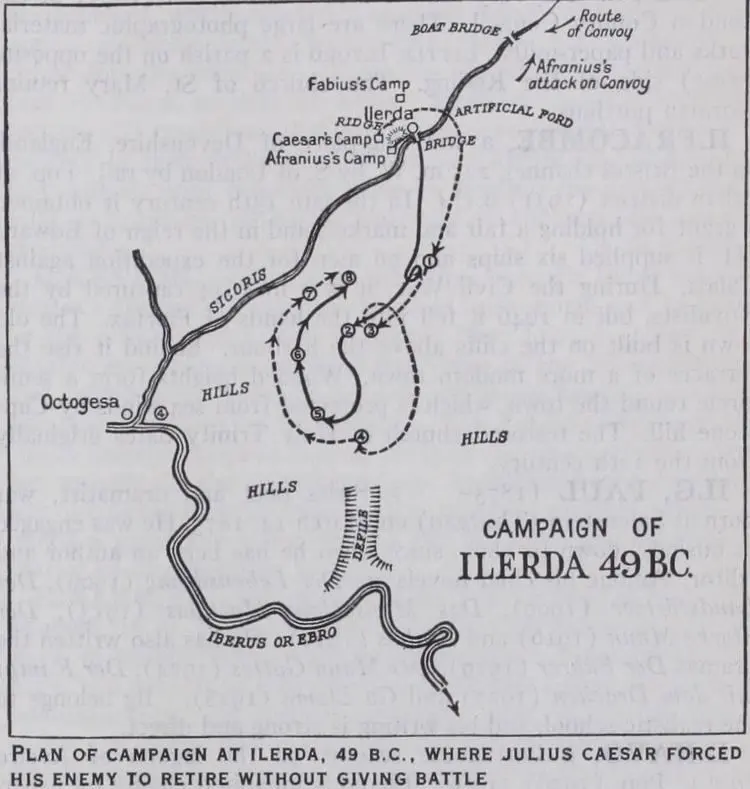
Ilerda: crossings, engineering and the control of movement
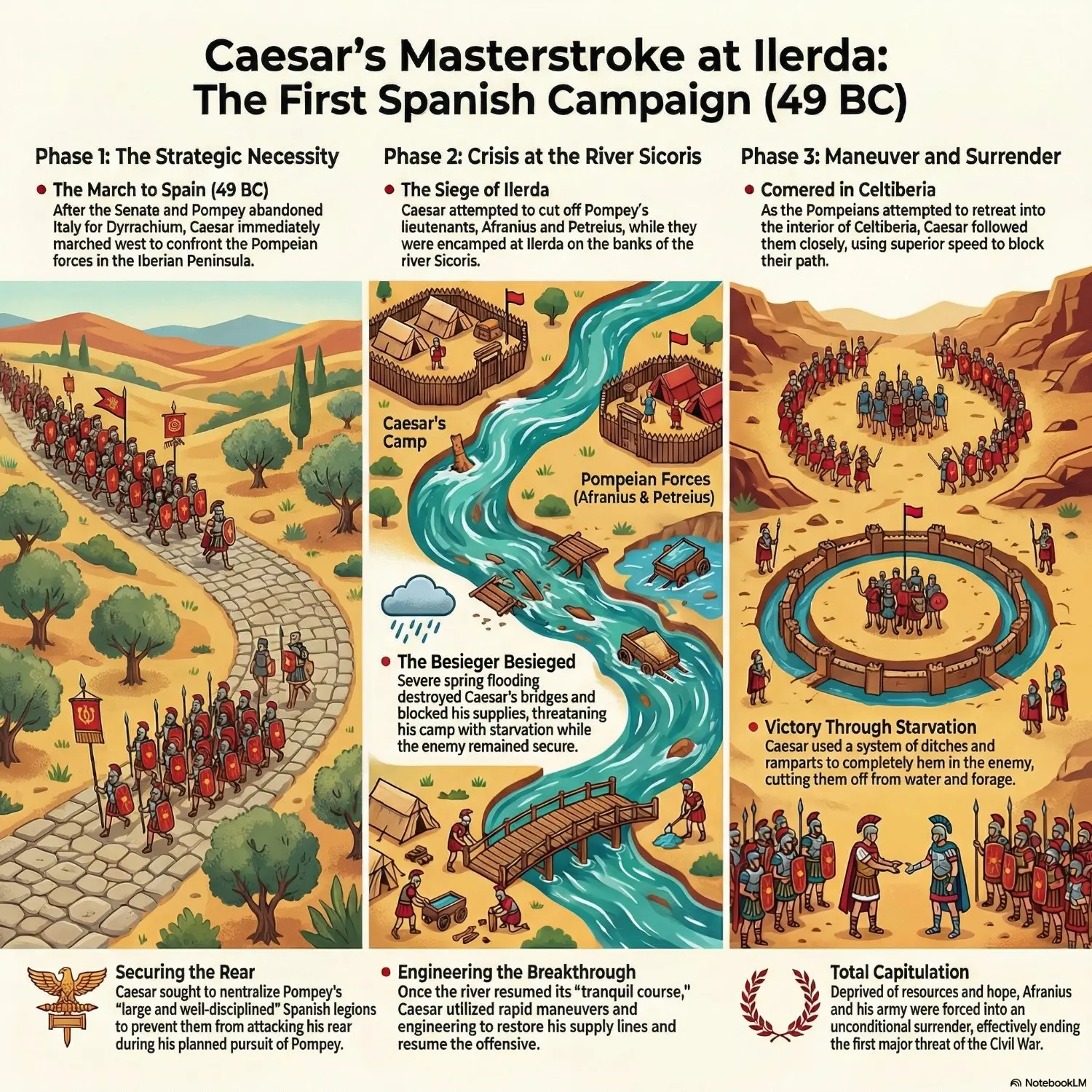
The river problem altered where an army could move, obtain supplies and challenge its opponent. The graphic explains why engineering and maneuver could determine a campaign without a final set-piece battle. The order of operations should be checked against the narrative rather than inferred from the attractive geometric regularity of the camps and bridges.
Pharsalus: cavalry pressure and an infantry response
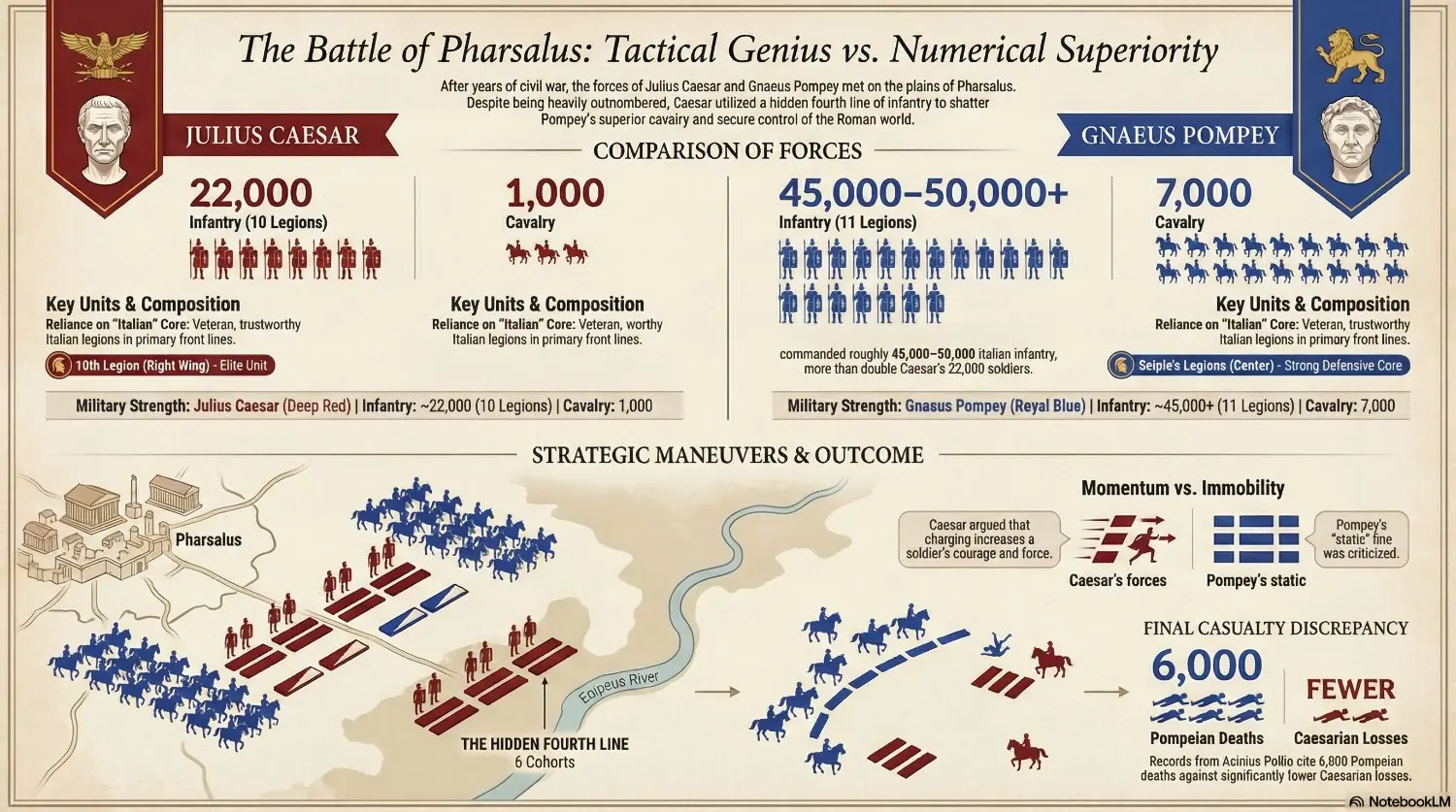
The key tactical relationship is the interaction of Pompey's cavalry effort with the force Caesar held for a response. The visual comparison should not obscure how much the numerical reconstruction depends on partisan accounts. The discrepancy between victory claims and reported losses belongs to the critical reading of the battle, not to a verified casualty ledger.
Extended campaign study
The account below develops the operations and their interpretation. Reported numbers and reconstructed tactical details retain the uncertainties described in the dossier.
The Rubicon and the Sixty Days (49 BC)
The mechanics of the final breach can be stated with the brevity the participants denied it. Caesar's command expired; his enemies intended his prosecution the hour he became a private citizen — for the acts of 59, for anything, the charge being the pretext and the destruction the object, as Cato did not trouble to conceal; his protection was to pass from proconsulship to a second consulship without the gap in which the courts could seize him, and the "ratchet of 50" was the closing, one by one, of every legal path to that continuity. The tribune Curio, Caesar's purchased genius of that year, forced the Senate in December to divide on the naked question — that both Caesar and Pompey lay down their commands together — and it carried three hundred and seventy to twenty-two: the Republic's governing class, offered peace by supermajority, was then overridden within days by the twenty-two, the consul Marcellus riding unauthorized to Pompey's villa to place a sword in his hand and the defense of the state upon him. On the night of the tenth of January Caesar, with the Thirteenth Legion — five thousand men against the Republic — halted at the provincial boundary stream south of Ravenna, spoke to his officers of what the crossing meant (Asinius Pollio was present, and the tradition descends from him), quoted his Menander in Greek — let the die be flown — and crossed the Rubicon. Italy fell in sixty days, mostly by embrace: the towns opened, the levies changed sides, and at Corfinium, where Domitius Ahenobarbus — Caesar's designated successor in Gaul — was surrendered by his own garrison after three days, the war revealed its new weapon: the captured senators dismissed unharmed with their money, the soldiers enrolled, and the policy stated in Caesar's extant letter to his agents as a conscious doctrine — let this be the new method of conquering, to fortify ourselves with mercy and generosity. The clementia Caesaris was strategy before it was virtue, an instrument aimed at Sulla's memory; it emptied Pompey's Italian position within weeks. Pompey, who had boasted he need only stamp his foot for legions and now declined to defend Rome, Italy, or a treasury he forgot in his haste, executed the one maneuver of genius left to him — the evacuation of the government, the Senate, and his army from Brundisium to Greece under Caesar's siege, trading the peninsula for the sea, the East that was his clientele, and time; Caesar, shipless, entered a Rome emptied of legitimacy, broke the tribune Metellus from the treasury door with the observation that killing him would be easier than saying so, took the reserve, and marched — characteristically — away from his enemy, west against the enemy's army: the seven legions of Pompeian Spain. The campaign of Ilerda that summer was won, after a flood-crisis that nearly starved the besieger, almost without a battle: out-entrenched, out-marched, and cut from water on the arid plateau above the Ebro, the armies of Afranius and Petreius were surrounded, fraternized with, and dissolved — the soldiers discharged or enrolled, the generals dismissed to fight again, no man executed; Massilia fell to Trebonius and the young Decimus Brutus's improvised fleet after a siege the city's Greek dignity adorned; and the year's ledger carried one Caesarian catastrophe, in Africa, where Curio — the tribune of 50, now commanding two legions of former Pompeians — was lured by feigned retreat into the Bagradas plain, enveloped by King Juba's Numidian horse, and died refusing rescue, saying he could not face Caesar having lost the army Caesar gave him; the legions were butchered or executed by the king, the worst Caesarian field-loss of the entire war, and the account against Numidia was opened that Thapsus would close.
Pharsalus, and the Death of Pompey (48 BC)
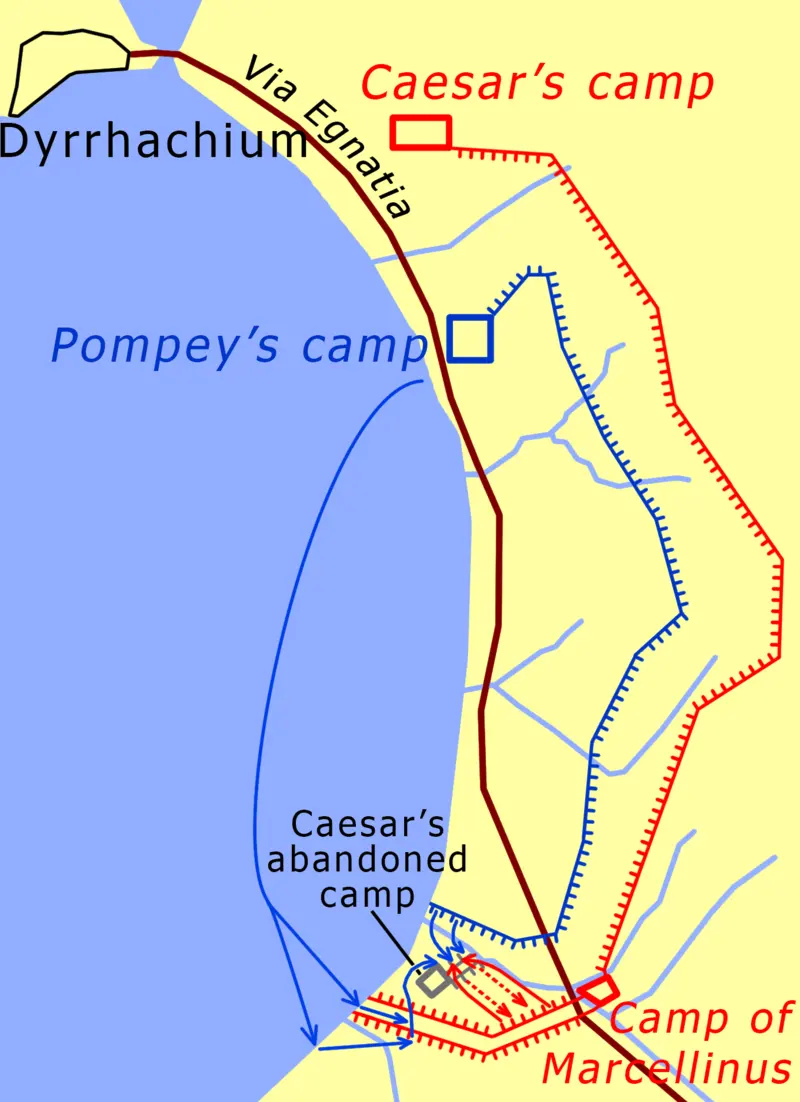
The eastern campaign began with the war's greatest gamble: Caesar in January 48 threw seven under-strength legions across a winter sea held by Bibulus's five hundred ships — the blockader dying at his post of the exposure — and, when the transports could not return for the rest, was penned for months on the barren Epirote coast, the famous night-attempt to recross alone in a fishing smack (you carry Caesar and his fortune) belonging to the tradition here, until Antony forced the second convoy over. What followed at Dyrrachium was Alesia inverted and instructive: Caesar, besieging a larger army with a smaller — seventeen miles of contravallation against Pompey's fifteen, the counter-fortification duel running months — was breached at the sea-flank in July, lost a thousand veterans in the panic, and was saved by his opponent's caution from losing the war; his own verdict, preserved by Plutarch, closed the episode: today the victory was the enemy's, if the enemy had possessed a victor. The retreat into Thessaly that should have been a death-march became instead the war's decision, because Pompey's camp — the senators auditing their general, quarreling over Caesar's priesthood and the proscription-lists to come, Domitius proposing the trial, after victory, of every senator who had stayed neutral — required a battle their commander's whole strategy of attrition forbade, and required it of him daily until he yielded. On the ninth of August 48, in the plain of Pharsalus, some twenty-two thousand Caesarian legionaries stood against forty-five thousand, and Pompey's tactical conception was entirely sound: his infantry to hold, his seven-thousand-strong cavalry under Labienus — Caesar's own great marshal of Gaul, the one senior officer who had gone over, and gone over from conviction — to sweep Caesar's thousand horse and take the veteran line in flank and rear.
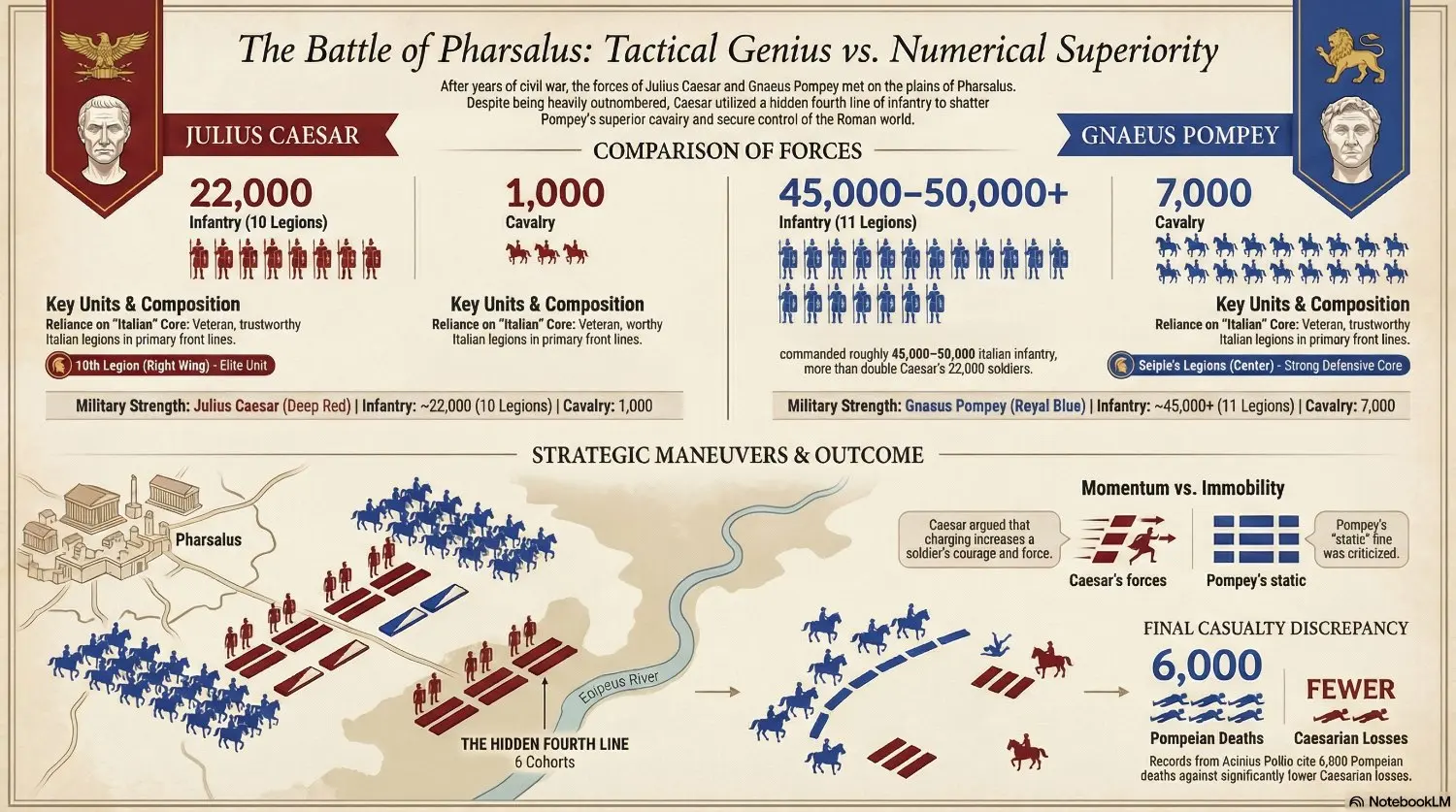
Caesar read the field's asymmetry the evening before and hid his answer behind his right: a fourth line, six cohorts drawn off obliquely, with the instruction that became doctrine — not to throw the pila but to keep and thrust them upward, at the faces, at the eyes, the young cavalry of the nobility, he is reported saying, being unwilling to be ugly; whether the psychology or merely the reach decided it, Labienus's mass, having swept the Caesarian horse exactly as designed, struck the standing hedge of points, recoiled, and disintegrated, and the six cohorts wheeled through the vacated space onto the naked flank of Pompey's infantry as the third Caesarian line went in fresh. Pompey the Great left the field before his army finished dying — back to the camp, the tradition's details of the prepared victory-banquet and the laurelled tents supplied by the victors who ate it — and Caesar, walking the fifteen thousand enemy dead, spoke the sentence Pollio heard and Suetonius kept: They would have it so; I, Gaius Caesar, after such deeds, should have been condemned, had I not sought help from my army. The clemency processed the twenty-four thousand prisoners — among them a bookish thirty-four-year-old named Marcus Junius Brutus, whose pardon Caesar had ordered sought out particularly — and the pursuit followed the fugitive by Lesbos, where Cornelia joined him, toward the client-East that had been his making: to Egypt, where the counselors of the boy-king Ptolemy XIII, weighing the suppliant against the pursuer, produced the eunuch-court's syllogism — the theme is Theodotus the rhetorician's, dead men do not bite — and sent a small boat to the roadstead off Pelusium. In it sat Septimius, a Roman who had been Pompey's own centurion in the pirate war; Pompey, reading the silence in the boat, went over the side with a Sophoclean tag about entering a tyrant's doors, and was stabbed from behind as he studied his landing-speech, his wife and son watching from the ship's rail — killed on the day after his fifty-eighth birthday, beheaded on the sand, the trunk left for his freedman to burn on a fisherman's pyre of wreckage.
Caesar lingered two months more on the river with the queen — the son born that summer was called, by the Alexandrians and the problem itself, Caesarion — then moved with five years' compressed velocity: through Syria and Pontus, where Pharnaces, the parricide of Chapter 6, had used the civil war to retake his father's kingdom and maul a Roman army at Nicopolis, and was extinguished at Zela on the second of August 47 in a five-day campaign and four-hour battle uphill against scythed chariots, reported to Rome in the three words that are the period's most perfect document of self-knowledge — veni, vidi, vici; through an Italy where his unpaid veteran legions, the Tenth at their head, had marched on Rome demanding discharge, and were broken to obedience by a single word of address — Quirites, "citizens," civilians — the master of the client-army demonstrating that its bond ran person-to-person and could be severed by grammar; and into the African campaign of 46 against the re-formed republican center: Scipio, Cato governing Utica, Juba, and Labienus, fourteen legions against his ten. It ended on the sixth of April at Thapsus, where the army — the sources say the veterans forced the signal before Caesar gave it — stormed the double Pompeian position against a backdrop of panicking war-elephants and then, deaf for once to the clemency-trumpet, massacred the surrendering: ten thousand killed asking quarter, the one great stain on the clementia, senators dying under the swords of soldiers who had decided the policy of mercy merely recycled enemies. Cato, holding Utica with the war lost, spent his last evening arguing the Phaedo at dinner, twice reading the dialogue through in the night, and fell on his sword toward dawn; the wound failing — the hand was injured, the thrust went awry — he tore it open against his physician's stitches and died refusing the survival his friends were forcing on him, at forty-eight. Caesar's reported words — Cato, I begrudge you your death, as you begrudged me the sparing of your life — opened instead of closing the account: the pamphlet war of Cato and Anticato that followed fixed the Stoic suicide as the Republic's patron martyr, a defeat administered to the dictator by a corpse. The quadruple triumph of 46 — Gaul, Egypt, Pontus, Africa, the civil victories decently costumed as foreign ones, Vercingetorix strangled at the culminating hour, the soldiers chanting their license-songs at the chariot wheels warning the citizens to lock up their wives; and one year later the last army of the name of Pompey, under the sons Gnaeus and Sextus with the unkillable Labienus, was destroyed at Munda in Spain on the seventeenth of March 45 in the one battle Caesar called a fight for his life rather than for victory — the veteran lines locked shield-to-shield on the hillside until the commander dismounted into the first rank asking his men whether they proposed to hand him to boys; thirty thousand fell including Labienus, Gnaeus was hunted down and beheaded, and Sextus vanished into the hills to become, in the next decade, the sea-king of the age.
Tactical illustrations
Outcome and critical assessment
Result and caution: Caesar secured military supremacy; his assassination followed in 44 BC. The Alexandrian, African and Spanish Wars are transmitted with Caesar's works but are not all authored by Caesar. His own Civil War ends before the full conflict is resolved. Munda's precise battlefield location remains debated.
Historical record: IR-V, chapter 8; Caesar, Civil War and the associated continuations; Appian, Civil Wars 2; Dio, books 41–43.