Wars · IV. The Republic at war with itself
W041 Crassus and the Parthian disaster at Carrhae
Battles and sieges
Carrhae 53 BCCrassus crossed into Parthian territory seeking military success and political stature. His expedition faced the operational demands of open country, uncertain guidance and an opponent able to combine mounted archery with heavily armored cavalry. The defeat near Carrhae in 53 BC and the loss of Roman standards became a lasting political and commemorative disaster.
The destruction of much of the army and Crassus' death did not begin an uninterrupted Roman retreat from all eastern affairs. Rome retained its Syrian base and continued to intervene diplomatically and militarily. Parthian commanders and kings had their own strategic and internal political objectives.
Command, forces and military problem
| Field | Dossier |
|---|---|
| Roman leadership | Crassus, Publius Crassus and surviving subordinate commanders |
| Opposing or rival parties | Surena commanding for the Arsacid monarchy |
| Forces and capabilities | Heavy infantry and supporting cavalry against mounted archers and armored lancers |
| Operational problem | Maintain cohesion, supplies and mutual support under mobile missile and cavalry pressure. |
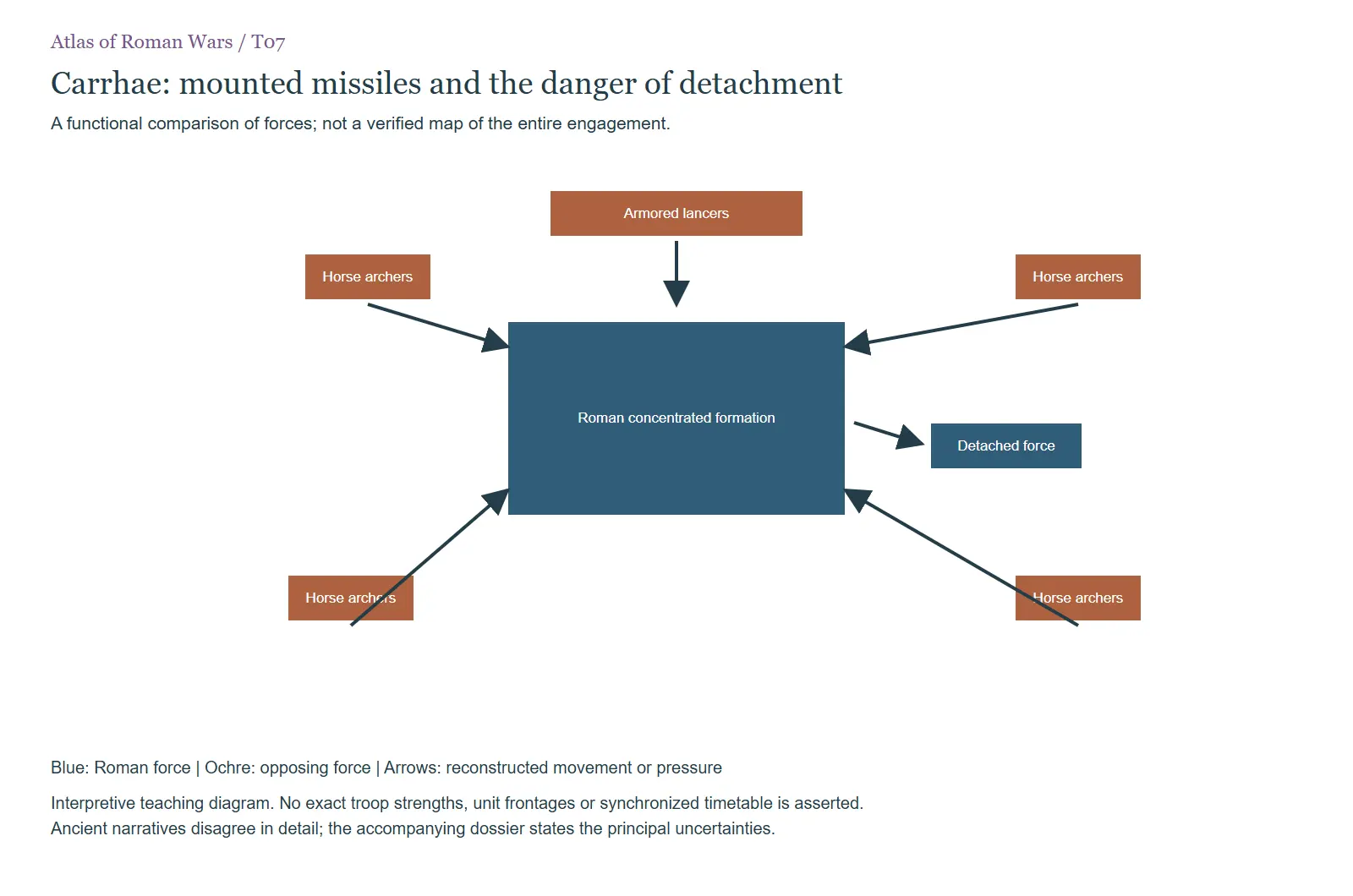
The opposing military systems
Crassus commanded an army whose principal strength lay in heavy infantry, with cavalry and other supporting troops. Surena's Parthian force combined mounted archers and armored lancers. The important contrast is between tactical functions, not an assumption that every Roman was immobile or every Parthian wore identical equipment. Mobile missile troops could keep pressure on an infantry formation while heavy cavalry threatened any disorder or exposed pursuit.
The open Mesopotamian theater made water, guidance and intelligence particularly important. Armenia offered a different potential approach, but selecting a route also involved political relationships and the ability to support an army. The failure should not be explained simply by drawing one "wrong road" on a modern map and assuming all alternatives were equally available.
The destruction of the field army
The engagement conventionally located near Carrhae subjected the Roman force to sustained missile pressure and the danger of mounted attack. Publius Crassus' detached force became a particular focus of the disaster. Attempts to resolve the tactical problem through pursuit could expose troops outside mutual support, while remaining concentrated did not make the army immune to arrows, exhaustion and demoralization.
The later retreat involved separation, loss of cohesion and failed negotiations. Crassus' death removed not only a commander but one of the central figures in Roman power politics. Survivors and detached elements mean that "annihilation" should not be used as a literal claim that no Roman soldier escaped.
Consequences and the problem of memory
The loss of standards became a continuing Roman political grievance. Augustus later represented their diplomatic recovery as a major achievement, demonstrating how the material symbols of an earlier defeat could be reused in a different ruler's program. The defeat also altered the balance among Roman leaders before the civil war.
Plutarch's account arranges the campaign around character, warning and failed judgment; Dio supplies a different retrospective framework. Neither gives a neutral modern analysis of weapon performance. The effectiveness of Parthian archery is clear, but exact assertions about arrow penetration, endless ammunition and the mechanical impossibility of a Roman response require more evidence than a dramatic narrative supplies. The famous accounts of Crassus' corpse and molten gold belong to a separate history of the moral meaning assigned to his death.
Outcome and critical assessment
Result and caution: a severe Roman defeat with major political consequences. Treat tactical descriptions and claims about endless arrow supplies as ancient narrative requiring scrutiny. Carrhae is a securely identified city; the city marker is not the exact boundary of the battlefield. Stories of molten gold belong to the transmitted death tradition, not an established forensic account.
Historical record: Plutarch, Crassus; Dio, book 40; IR-V, late Republican eastern context.