Wars · II. Carthage and the connected Mediterranean
W013 The Mercenary War and Rome's seizure of Sardinia
After the First Punic War, disputes over payments to Carthage's troops and wider resentment of Carthaginian rule developed into a dangerous revolt. Hamilcar Barca helped restore Carthaginian control in Africa. The struggle matters here because it constrained Carthaginian options during the same years that Rome intervened over Sardinia.
Rome's annexation of Sardinia and the additional financial demands imposed on Carthage deepened the postwar imbalance. Carthaginian expansion in Iberia under the Barcids then created a new resource and political base, without making a second war an inevitable prearranged sequel.
Command, forces and military problem
| Field | Dossier |
|---|---|
| Roman leadership | Roman government and commanders involved in Sardinia |
| Opposing or rival parties | Carthaginian government, unpaid troops and African communities in the contextual war |
| Forces and capabilities | Mercenary and regional armies; Roman maritime coercion over the islands |
| Operational problem | Exploit a rival's crisis without confusing that internal war with direct Roman belligerency. |
Extended campaign study
The account below develops the operations and their interpretation. Reported numbers and reconstructed tactical details retain the uncertainties described in the dossier.
The Mercenary War (240–237 BC)
The peace of 241 BC ended hostilities between Rome and Carthage but did not end the violence in the Carthaginian world. The Carthaginian state, exhausted by twenty-three years of war and now burdened with the indemnity payments of the Peace of Lutatius, was financially incapable of paying off the mercenary armies that had served the war in Sicily. The mercenaries — perhaps twenty thousand men, including Libyan, Iberian, Gallic, Greek, and Italian contingents under various national leaders — were brought back to Africa in the months following the peace and were stationed at the town of Sicca Veneria, southwest of Carthage, while the Carthaginian government deliberated over how to pay them.
The deliberation took too long. The mercenaries, sensing that the city intended to negotiate down the back-pay rather than pay it in full, mutinied. Their leaders — principally a Campanian named Spendius (a former slave who had escaped from Roman captivity) and a Libyan named Mathos — organized the army into a coherent fighting force, recruited Libyan auxiliaries from the Carthaginian-subject populations of the African hinterland (who had their own grievances against Carthaginian rule and saw the mutiny as an opportunity for liberation), and turned the mercenary army into an instrument of revolt. By the autumn of 240 BC, what had begun as a pay dispute had escalated into a full-scale civil war that threatened the survival of the Carthaginian state itself.
The conflict that followed — Polybius calls it the Truceless War (polemos aspondos) for its unusual ferocity, and the standard modern historiographical name Mercenary War — was conducted on both sides with a brutality that exceeded even the cruelty conventional in ancient warfare. The mercenaries, fighting for their own survival in a hostile country and against a state that had repeatedly broken faith with them, tortured and killed Carthaginian prisoners with elaborate cruelty; the Carthaginians, fighting against an enemy on their own doorstep and recognizing that defeat meant the destruction of the city, retaliated in kind. The cycle of atrocity was such that the war was conducted in the manner of a war of extermination rather than the regular combat of ancient state warfare.
The Carthaginian field command was given initially to Hanno (the same Hanno who had commanded the unsuccessful relief fleet at the Aegates Islands — his political position was such that he was given the command despite his recent failure), who proved tactically inadequate against the mercenary forces. After eighteen months of inconclusive operations and serious defeats, Hanno was replaced by Hamilcar Barca, returned from his Sicilian command and now charged with the salvage of the situation. Hamilcar's command against the mercenaries was one of the great military performances of the era.
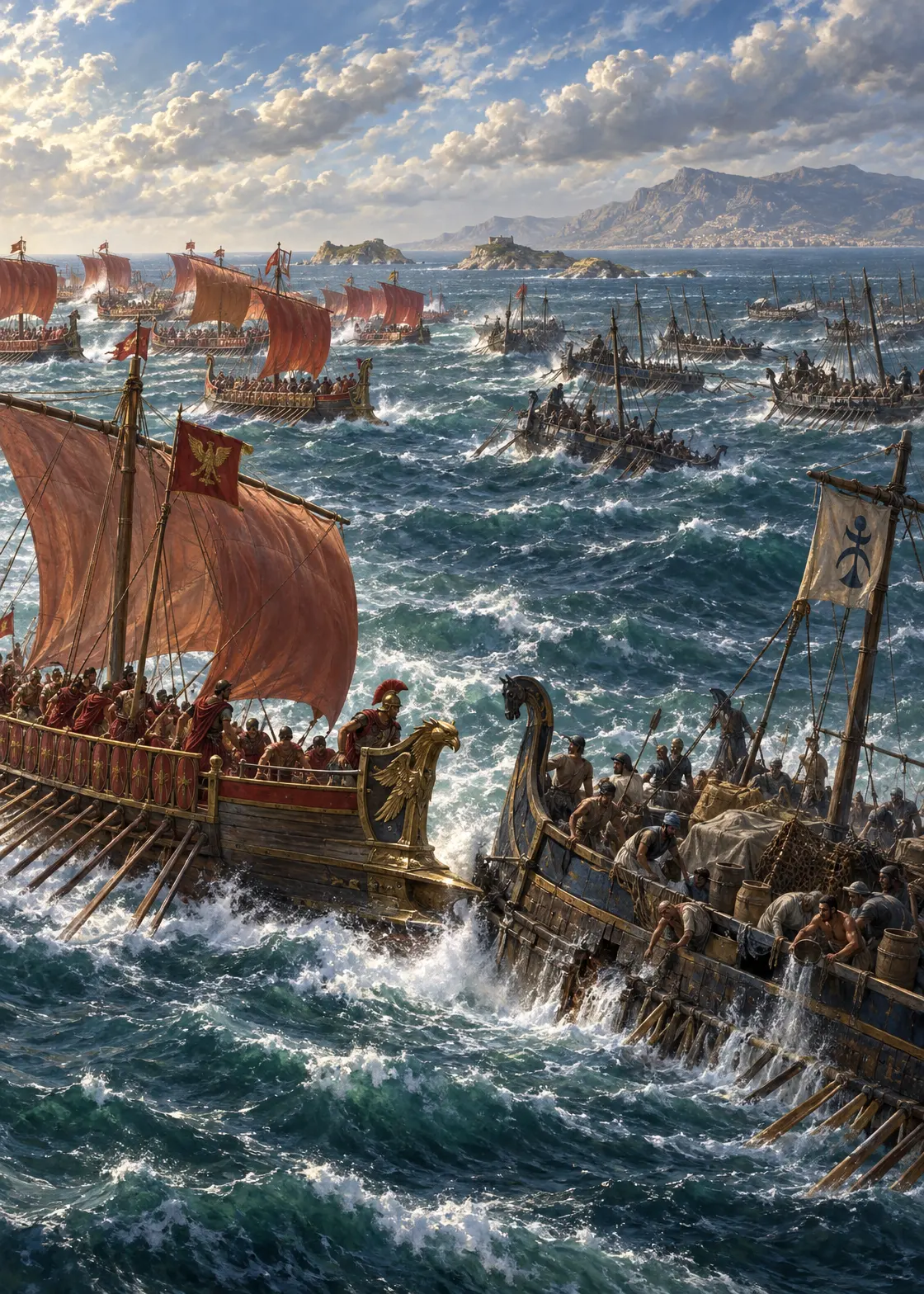
Operating with limited Carthaginian field forces (perhaps ten thousand foot, two thousand cavalry, and a small elephant corps), he conducted a series of operations that progressively isolated the mercenary forces from one another, defeated them in detail, and reduced them to surrender or massacre. The decisive engagement, fought in the autumn of 238 BC at a position called the Saw (so named for the topographical resemblance of the surrounding mountains to the teeth of a saw), trapped Spendius's main force in a position from which escape was impossible; the surrender was followed by the crucifixion of the surrendered leaders.
Mathos's faction held out somewhat longer, retreating to the Libyan city of Tunis and continuing resistance through 237 BC. Mathos himself was eventually captured and was executed in Carthage with elaborate cruelty — paraded through the streets while subjected to systematic torture for several hours before his death — by the Carthaginian populace whose feelings about the war had become unrestrained. The Mercenary War ended in early 237 BC with the suppression of the last mercenary holdouts and the reassertion of Carthaginian control over Africa.
The political consequences of the war were several and durable. The Barcid faction, having saved the city from destruction, emerged as the dominant political force in Carthaginian government. Hamilcar Barca and his sons-in-law (Hasdrubal the Fair preeminent among them) and his sons (Hannibal, Hasdrubal, and Mago) would direct Carthaginian state policy for the next four decades. The Carthaginian governing oligarchy, traumatized by the war and grateful to the Barcids, granted them a degree of strategic autonomy that effectively gave them dictatorial control over the state's foreign policy in particular regions. The Carthaginian populace developed a deep resentment of the mercenary tradition and would, for the rest of the Punic Wars, prefer Carthaginian citizens in the army even at significant strategic cost.
The Roman Seizure of Sardinia and Corsica (238 BC)
The Roman action that followed, in the closing phase of the Mercenary War, was one of the more morally questionable decisions of the entire Republican period and was so understood by some contemporaries. The Carthaginian garrisons in Sardinia, presented with the chaos of the Mercenary War and with the impossibility of receiving reinforcements or pay from the home city, themselves mutinied, killed their officers, and took control of the island. The Sardinian native population, having its own grievances against Carthaginian rule, joined the mutiny against the mercenaries themselves, and the island descended into chaos. The mercenary leaders, recognizing that they could not hold the island against either the Sardinian population or eventual Carthaginian return, appealed to Rome in 238 BC for Roman protection of their position.
The Roman Senate, after debate, accepted the appeal. The legal position was indefensible: the Peace of Lutatius had specifically reserved Sardinia and Corsica to Carthage, and Rome had no claim to either island. The political calculation, however, was that Carthage in her present state could not contest a Roman occupation, and that the strategic gain of acquiring the two major Tyrrhenian islands outweighed the diplomatic cost. The Roman garrisons were dispatched. The Carthaginians, on the partial recovery of their situation by mid-238 BC, protested and threatened war; the Romans, recognizing that Carthage was in no position to wage one, responded by demanding an additional indemnity of 1,200 talents and threatening immediate further hostilities if it were not paid. Carthage, having no real option, paid the indemnity and accepted the loss of the islands.
The episode is the strongest evidence available that Roman foreign policy in the period was driven by opportunistic acquisition rather than by adherence to treaty obligations. Polybius, generally a defender of Roman conduct, treats the Sardinia episode with explicit disapproval and identifies it as the principal cause of Carthaginian resentment that would, in the next generation, contribute to the Hannibalic War. The Barcid family, in particular, took the Sardinian seizure as evidence that Rome could not be trusted in peace and that the only secure path for Carthaginian survival was the development of an independent power-base from which Rome could be confronted on more equal terms. The path led directly to Spain.
Hamilcar Barca in Spain (237–228 BC)
Hamilcar Barca's Spanish enterprise, undertaken in the autumn of 237 BC, was authorized by the Carthaginian Senate with reluctance and would prove the most consequential single decision of the entire interwar period. The strategic conception was Hamilcar's own: that the Carthaginian state could not recover its position in the western Mediterranean by remaining within its existing geographical confines, and that an aggressive program of expansion into Iberia would provide both the manpower (in Iberian mercenary recruits) and the wealth (in the silver mines of southern Spain) necessary to challenge Rome in any future conflict. The Carthaginian Senate accepted the program but extracted no firm commitments from Hamilcar about its strategic limits; he was, in effect, given a free hand to develop a new Carthaginian power-base in Iberia on whatever terms his judgment dictated.
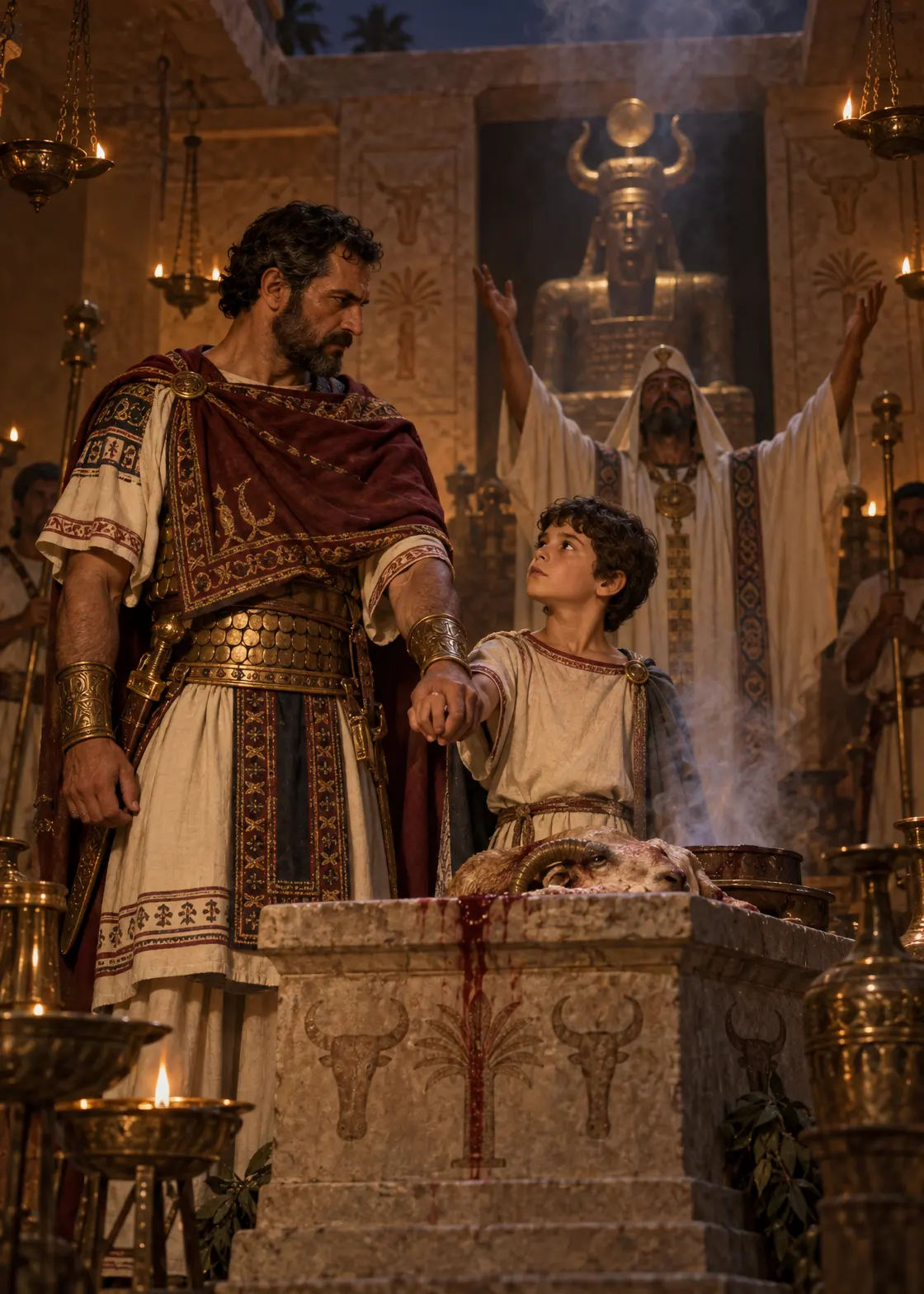
Hamilcar crossed to Spain in late 237 BC with his army and his family, including his nine-year-old son Hannibal. The famous tradition — preserved in Polybius and Livy — that Hamilcar made Hannibal swear, before an altar in Spain, eternal enmity to Rome dates to this moment; Hannibal himself, fifty years later, would tell the story to Antiochus III of Syria, and through that channel it entered the historiographical tradition. The historicity of the oath is generally accepted, though its precise form is uncertain. What is firmly historical is that the Barcid family from this point conducted Spanish affairs as a quasi-royal undertaking, with the territory becoming progressively a Barcid principality only nominally subject to the home government.
Hamilcar's military operations in Spain were conducted with the characteristic mix of force and diplomacy that the Barcid school of warfare would make its trademark. He defeated the Iberian tribes of the south and east in a series of engagements (the precise tactical details are not well preserved), incorporated subdued populations into his army as auxiliaries, recruited mercenaries from the Celtiberian and Iberian tribal nobility, and established Carthaginian-controlled cities at strategic points (notably Acra Leuke, modern Alicante, founded as a base on the southeastern coast). By 230 BC he had brought all of southern Spain under Carthaginian control and was extending operations into the central peninsular plateau. He himself died in 229 BC in an engagement against the Oretani tribe — drowned, by Polybius's account, while attempting to escape across a river after an ambush. His command devolved upon his son-in-law Hasdrubal, called the Fair for his striking appearance and for his diplomatic-political abilities.
Hasdrubal the Fair and Carthago Nova (228–221 BC)
Hasdrubal's command in Spain extended for seven years, from 228 to 221 BC. His policy was distinguished from Hamilcar's by a greater emphasis on diplomacy and political consolidation over direct military conquest. He concluded marriage alliances with the Iberian tribal nobility (his own marriage to a daughter of an Iberian chief is firmly attested; further such alliances among his lieutenants are recorded). He founded the city of Carthago Nova (New Carthage, modern Cartagena), the largest single Carthaginian foundation in Spain and the principal Barcid administrative and military center. Carthago Nova was conceived as a Carthaginian-style city of perhaps twenty thousand inhabitants, with elaborate fortifications, a substantial harbor, an arsenal, and access to the silver mines of southern Spain that were the principal financial base of the entire Barcid enterprise. The city served as the symbolic and administrative capital of what was, by 222 BC, effectively a Carthaginian colonial state in Spain — formally subordinate to the home city but in practice operating as an autonomous polity under Barcid governance.
The concern was strategic: a Carthaginian power-base in Iberia represented, in the longer view, a potential challenge to Roman dominance in the western Mediterranean of a kind that the original Peace of Lutatius had not anticipated. The Roman diplomatic response, conducted in 226 BC, was the negotiation of the Ebro Treaty with Hasdrubal. The treaty, the exact terms of which are debated in modern scholarship because of variations between the Polybian and Livian accounts, established the river Ebro (modern Ebro, in northeastern Spain) as the northern limit of Carthaginian expansion. The Carthaginians agreed not to cross the river under arms; the Romans, by implication and by some readings of the treaty, recognized Carthaginian dominance south of the river. The treaty was understood in Rome as a containment device; it was understood in Carthage as recognition of the Barcid sphere of influence; the ambiguity in interpretation would be a contributing factor to the war of 218.
Hasdrubal was assassinated in 221 BC by an Iberian slave whose master had been executed on Hasdrubal's orders — a personal revenge killing of the kind ancient sources frequently report and the historicity of which is firm. His successor was elected, on the spot in the Spanish army, by the soldiers themselves: Hannibal Barca, the elder son of Hamilcar, now twenty-six years old and with seven years of campaigning experience in Spain as a junior officer under his brother-in-law. The selection of Hannibal was ratified by the Carthaginian Senate after the fact — a political formality that recognized the fait accompli of Barcid family succession in the Spanish command.
Outcome and critical assessment
Result and caution: Carthage survived its internal war but lost further room for maneuver. This record is explicitly contextual: the Mercenary War itself was not a Roman–Carthaginian war. An atlas should preserve its relationship to Roman expansion without misclassifying its belligerents.
Historical record: IR-II, chapter 3; Polybius, 1.65–88 and the opening of book 3.