Wars · II. Carthage and the connected Mediterranean
W014 The first two Illyrian wars
Roman intervention against the Illyrian rulers associated with Queen Teuta brought a Roman military presence into the eastern Adriatic. The ancient account emphasizes maritime attacks and the mistreatment of Roman envoys, but the politics of coastal communities and competing rulers also mattered. Islands, anchorages and links to the Greek mainland shaped the operations.
The settlement established Roman relationships with several coastal communities. Demetrius of Pharos subsequently challenged that arrangement, prompting the campaign of 219 BC. His defeat and flight connected Adriatic affairs more closely to Macedonian politics.
Command, forces and military problem
| Field | Dossier |
|---|---|
| Roman leadership | Roman consuls and expeditionary commanders |
| Opposing or rival parties | Teuta's regime and later Demetrius of Pharos |
| Forces and capabilities | Naval transport, coastal land forces, island positions and local allies |
| Operational problem | Secure Adriatic access and prevent hostile control of ports and island bases. |
Campaign geography and operational plates
The Balkans: Adriatic approaches and interior corridors
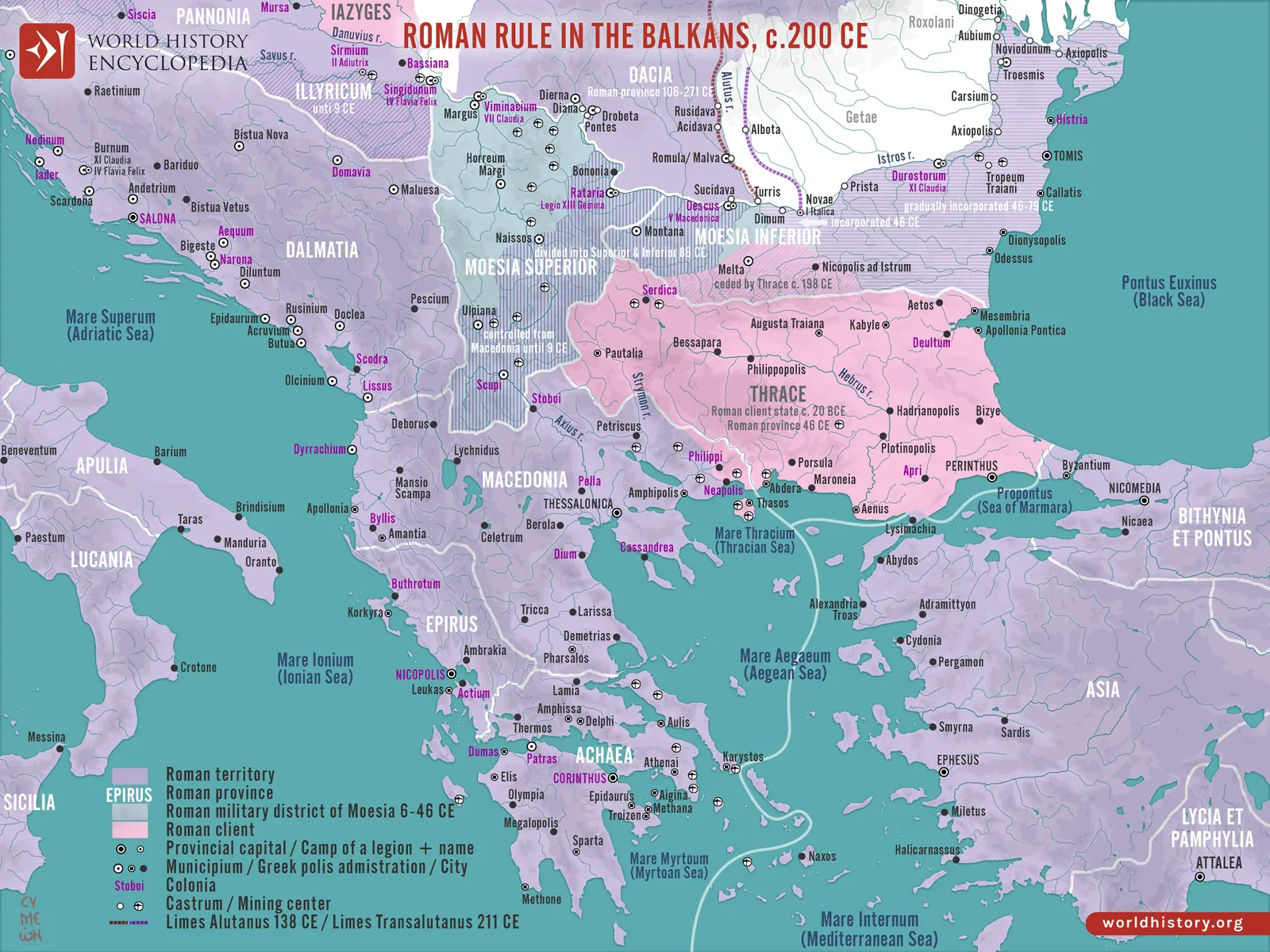
The Adriatic coast, Macedonian approaches and Danubian interior were connected but operationally distinct. Coastal access did not remove the difficulties of reaching defended inland communities. Later roads and military stations help explain the mature imperial network; they should not be read backward as infrastructure available to the first Republican expeditions.
Extended campaign study
The account below develops the operations and their interpretation. Reported numbers and reconstructed tactical details retain the uncertainties described in the dossier.
The Illyrian Wars (229–228 BC, 219 BC)
Parallel to operations in Cisalpine Gaul, the Roman state conducted two short and decisive campaigns in the eastern Adriatic against the Illyrian tribal coalition under the regent-queen Teuta. The First Illyrian War was triggered by Illyrian piracy in the southern Adriatic, which had been disrupting Italian and Greek commerce for several decades and which had become intolerable to the Roman commercial community in 230 BC. A Roman embassy to Teuta, demanding the suppression of the piracy, was treated with the same disrespect that earlier embassies (notably to the Tarentines in 282) had received: the principal ambassador, Lucius Coruncanius, was assassinated on Teuta's orders. The Senate responded with a declaration of war.
The Roman expedition of 229 BC was a combined fleet-and-army operation under the consuls Gnaeus Fulvius Centumalus and Lucius Postumius Albinus. The fleet of approximately two hundred ships and the field army of approximately twenty thousand reduced the Illyrian coastal positions one by one across a single campaigning season. Demetrius of Pharos, a local Illyrian dynast who held the strategic position of Pharos (modern Hvar in the central Adriatic islands), defected to Rome and provided naval and military support. Teuta's principal positions — Corcyra, Dyrrhachium, Apollonia, and the inland city of Skodra — were taken in turn. By the end of 229 the Illyrian state had been broken; Teuta withdrew to a small remnant kingdom in the interior; Demetrius was installed as a Roman client-ruler of substantial coastal territory; the Greek cities of the Adriatic coast (Apollonia, Dyrrhachium, Corcyra) were established as Roman protected allies; and the piracy was, at least temporarily, suppressed.
The First Illyrian War's importance was less in its military character (which was modest) than in its strategic implications. It was the first Roman military operation conducted east of the Adriatic; it brought the Roman state for the first time into formal diplomatic relations with the major Hellenistic powers (Macedonian and Achaean embassies of congratulation arrived at Rome in 228, recognizing the new Roman power in the region); it established the principle that Rome would intervene to suppress eastern Mediterranean piracy threatening Italian commerce; and it brought the Greek cities of the eastern Adriatic into the Roman alliance system, providing a foothold from which subsequent operations in the Balkans and Greece would be undertaken. The eastern Mediterranean was no longer beyond the Roman strategic horizon.
The Second Illyrian War (219 BC) was a brief campaign against Demetrius of Pharos himself, who had used his Roman-supported position to expand his power on his own account, who had violated his treaty obligations by raiding Greek shipping under his control, and who had increasingly allied himself with the Macedonian king Antigonus Doson (in succession to whom Philip V would shortly become Macedonian king). The Roman response was a swift expeditionary campaign under the consul Lucius Aemilius Paullus, who captured Demetrius's Pharos fortress in a single season and drove the Illyrian dynast into exile at Philip's court (where he would shortly contribute to the diplomatic crisis that would produce the First Macedonian War). The campaign was completed in 219 BC just as the diplomatic crisis with Carthage over Saguntum was reaching its breaking point. The Roman Senate had spent the spring and summer of 219 dealing with the eastern Mediterranean question; by the autumn it would be turning to the western one again.
Outcome and critical assessment
Result and caution: Rome gained a strategic foothold rather than instant possession of a fully formed province of Illyricum. The first two wars should be distinguished from the later campaign against Genthius in 168 BC. Roman descriptions of "piracy" express a particular political perspective and do not by themselves explain the entire conflict.
Historical record: IR-II, chapter 3; Polybius, 2.2–12 and 3.16–19.