Wars · IX. The eastern empire and Justinian's wars
W091 The Gothic war for Italy
Battles and sieges
End of the first Gothic siege of Rome 538 ADRavenna 540 ADTaginae / Busta Gallorum 552 ADLactarius mountain 553 ADBelisarius' invasion moved through Sicily and southern Italy to Naples and Rome. The defense of Rome against the army of Witigis in AD 537–538 and the capture of Ravenna in AD 540 were major successes without ending the war. Gothic recovery under Totila reopened the contest and repeatedly changed control of Italian towns.
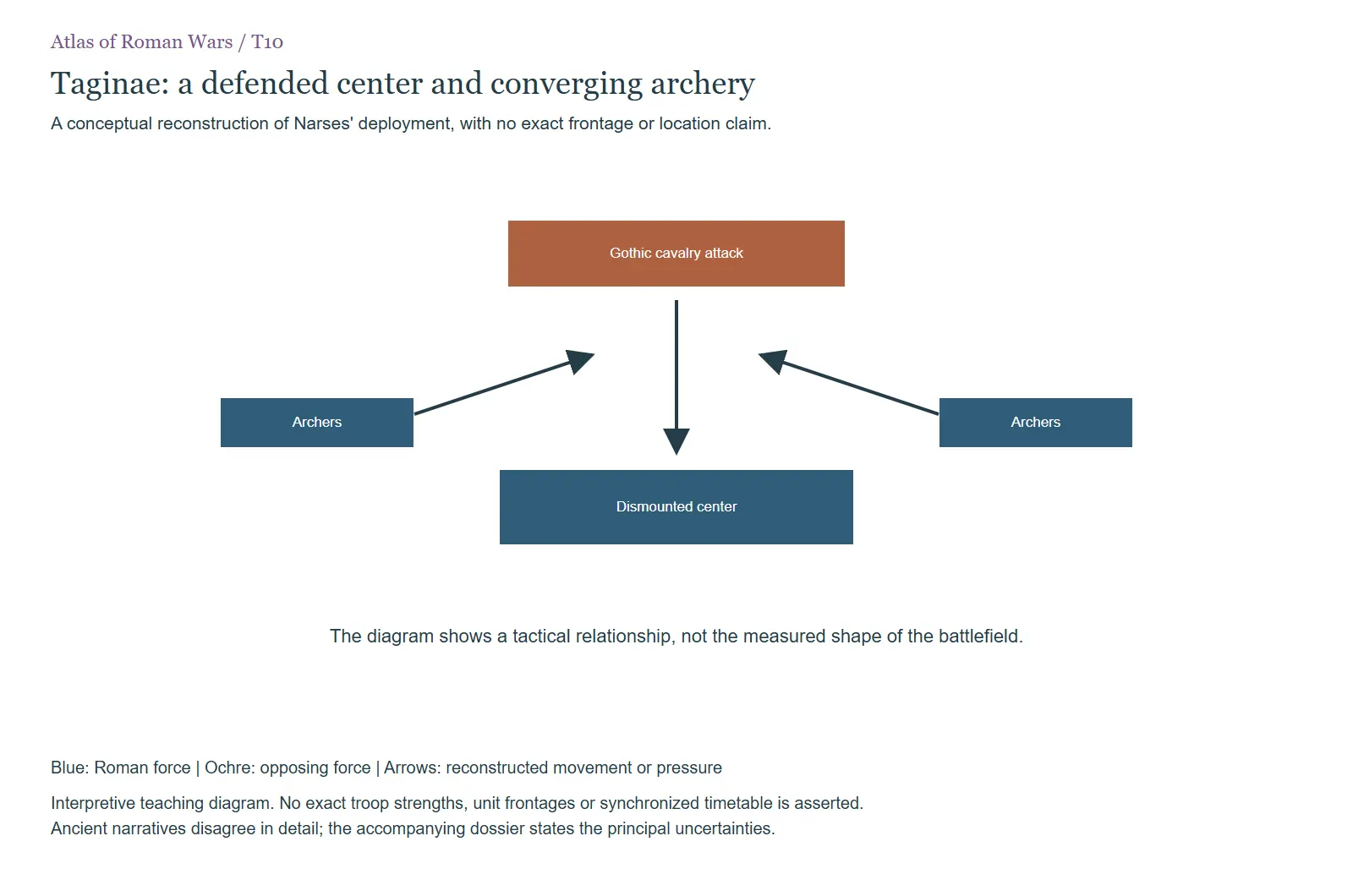
Narses led the later imperial offensive. Totila was defeated and died after the battle conventionally called Taginae or Busta Gallorum in AD 552; Teias' final resistance ended near the Lactarius mountain in AD 552/553. The later fighting and settlement conventionally extend the war's frame to AD 554.
Command, forces and military problem
| Field | Dossier |
|---|---|
| Roman leadership | Belisarius, Narses and other imperial commanders |
| Opposing or rival parties | Theodahad, Witigis, Totila and Teias in successive phases |
| Forces and capabilities | Mixed infantry, mounted archers, allied troops, fleets and defended Italian cities |
| Operational problem | Maintain ports, pay and communications through repeated reversals over a long reconquest. |
Campaign geography and operational plates
Justinian’s reconquests in the Mediterranean
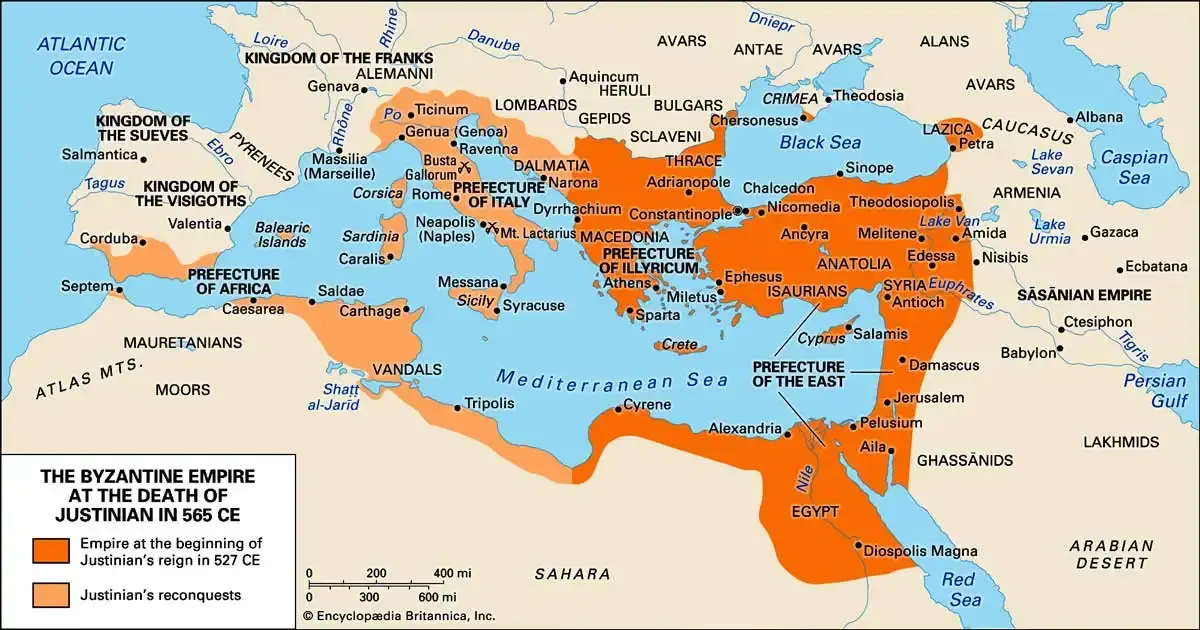
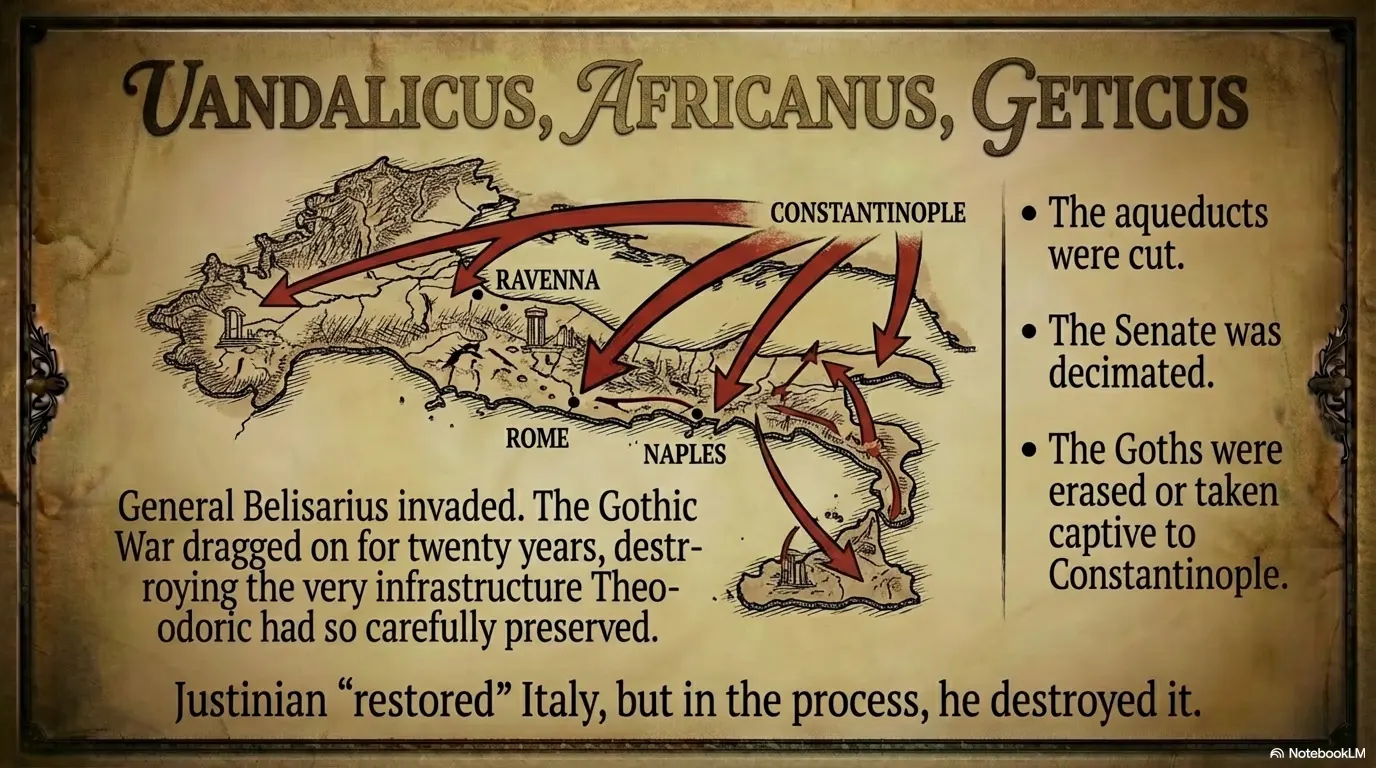
The combined colored territory is an end-of-reign comparison, not the operational position at the moment Belisarius sailed. Africa, Italy and the limited Spanish acquisitions resulted from distinct expeditions and settlements. The map makes their maritime connections visible while the dossiers explain the uneven and contested process by which those areas were acquired.
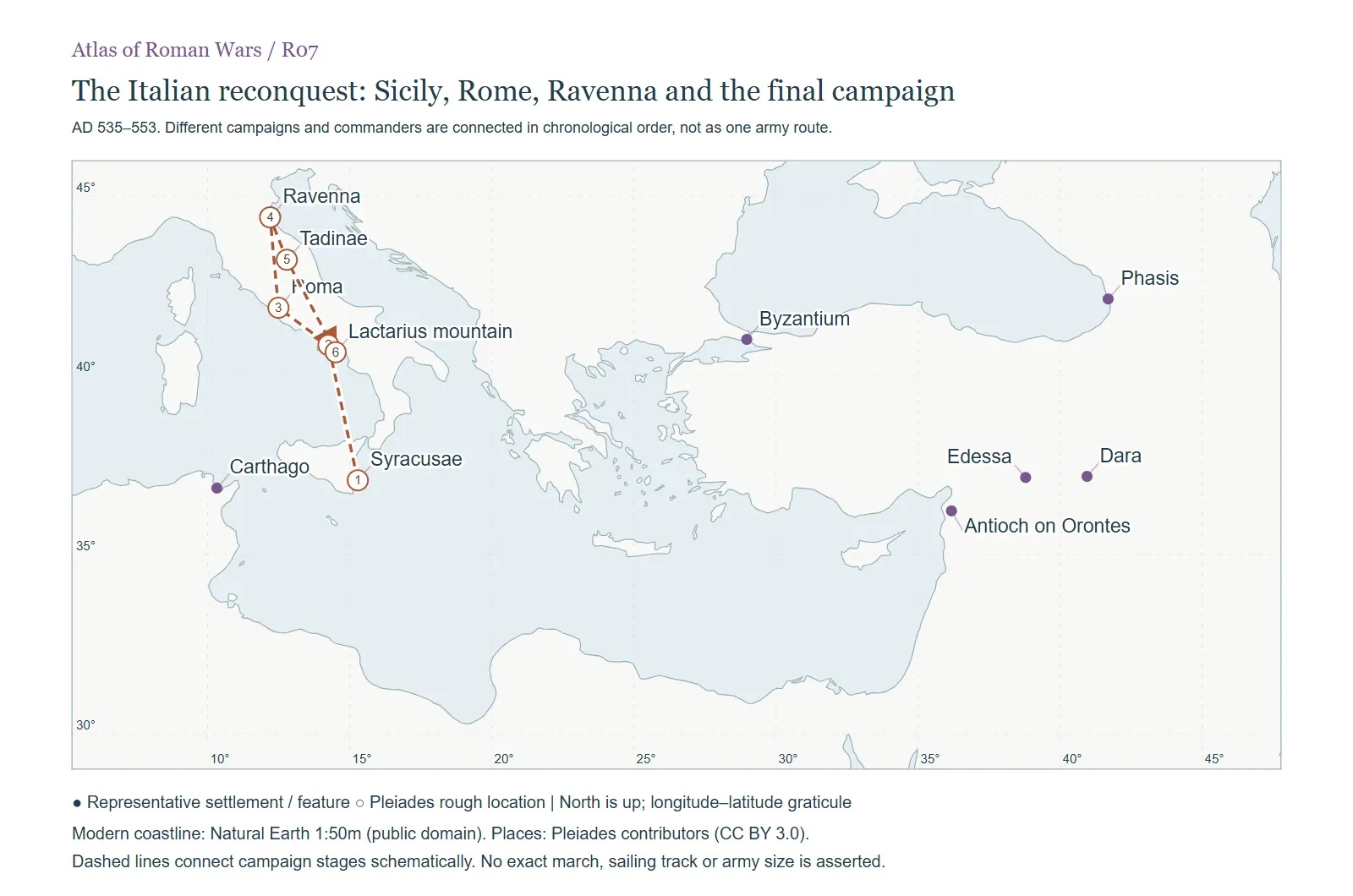
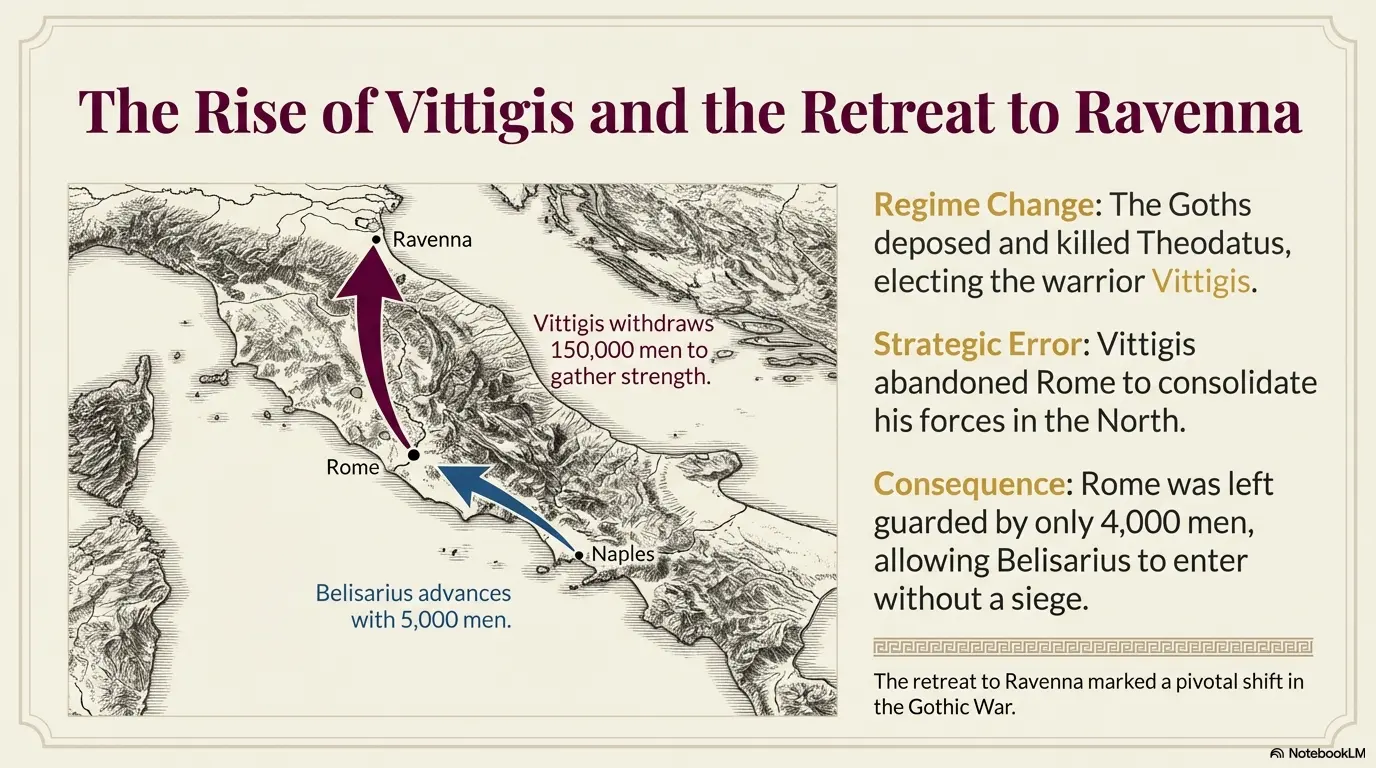
Belisarius’ opening Italian campaigns, AD 535–537
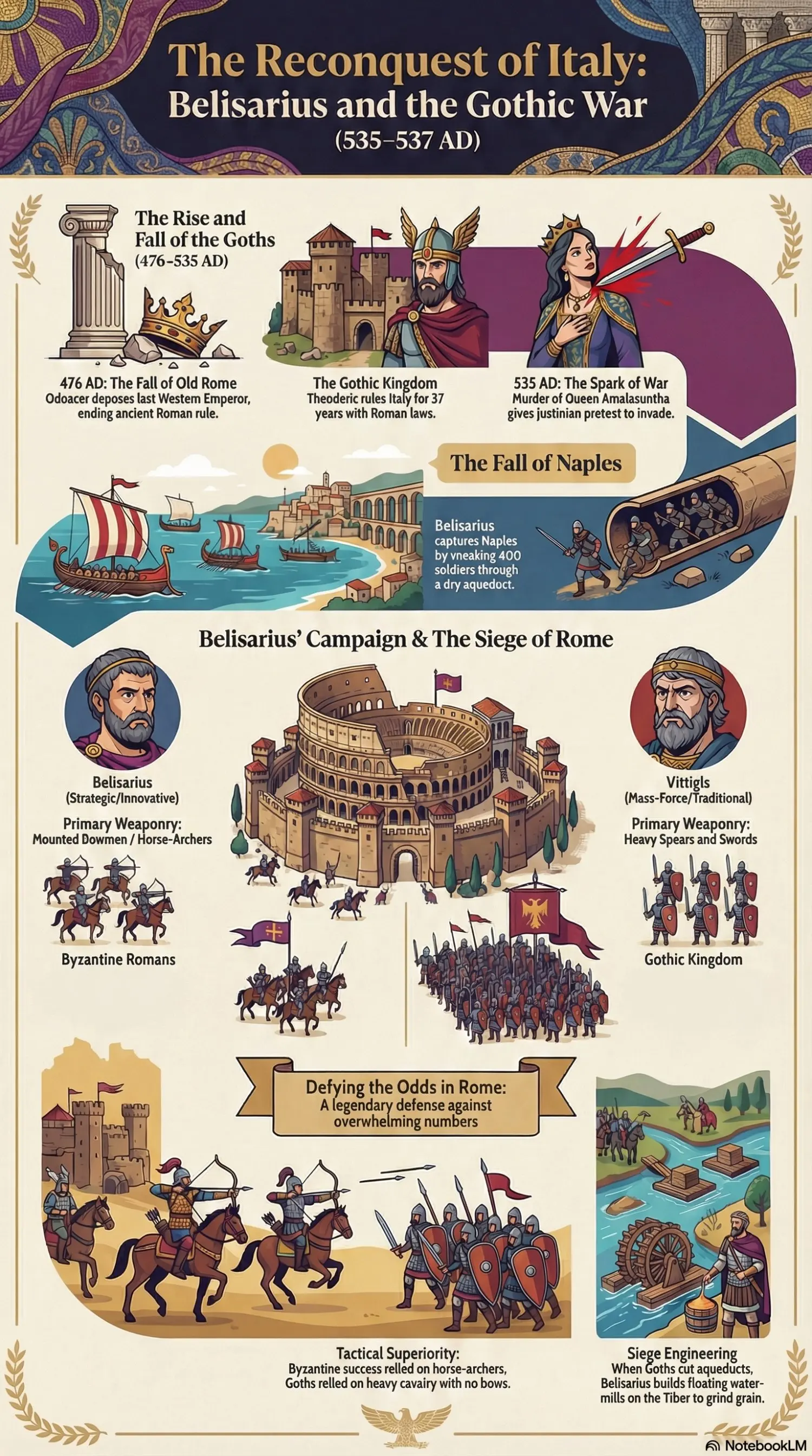
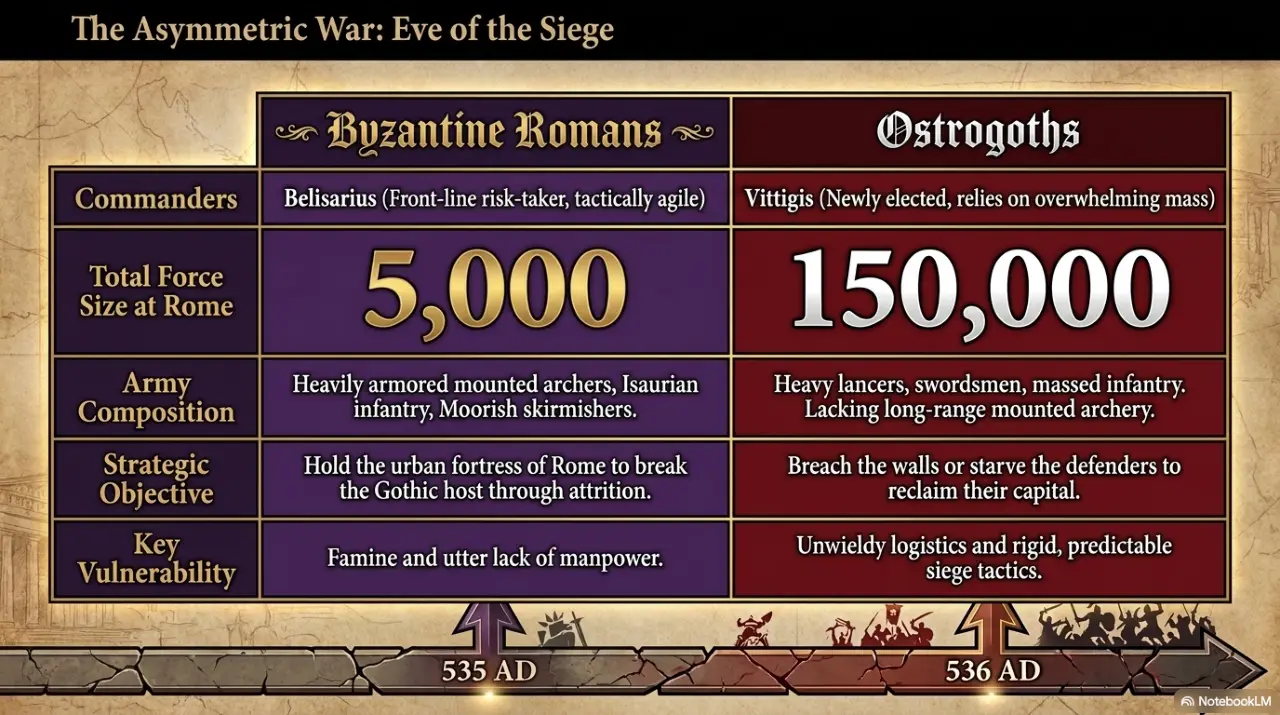
The opening sequence links the Sicilian base, the approach through southern Italy, the capture of Naples and the occupation and defense of Rome. It is an introduction to one phase of a much longer war. The date range in the heading must not be read as the duration of the full Gothic conflict, and its large Gothic host figure remains a transmitted claim.
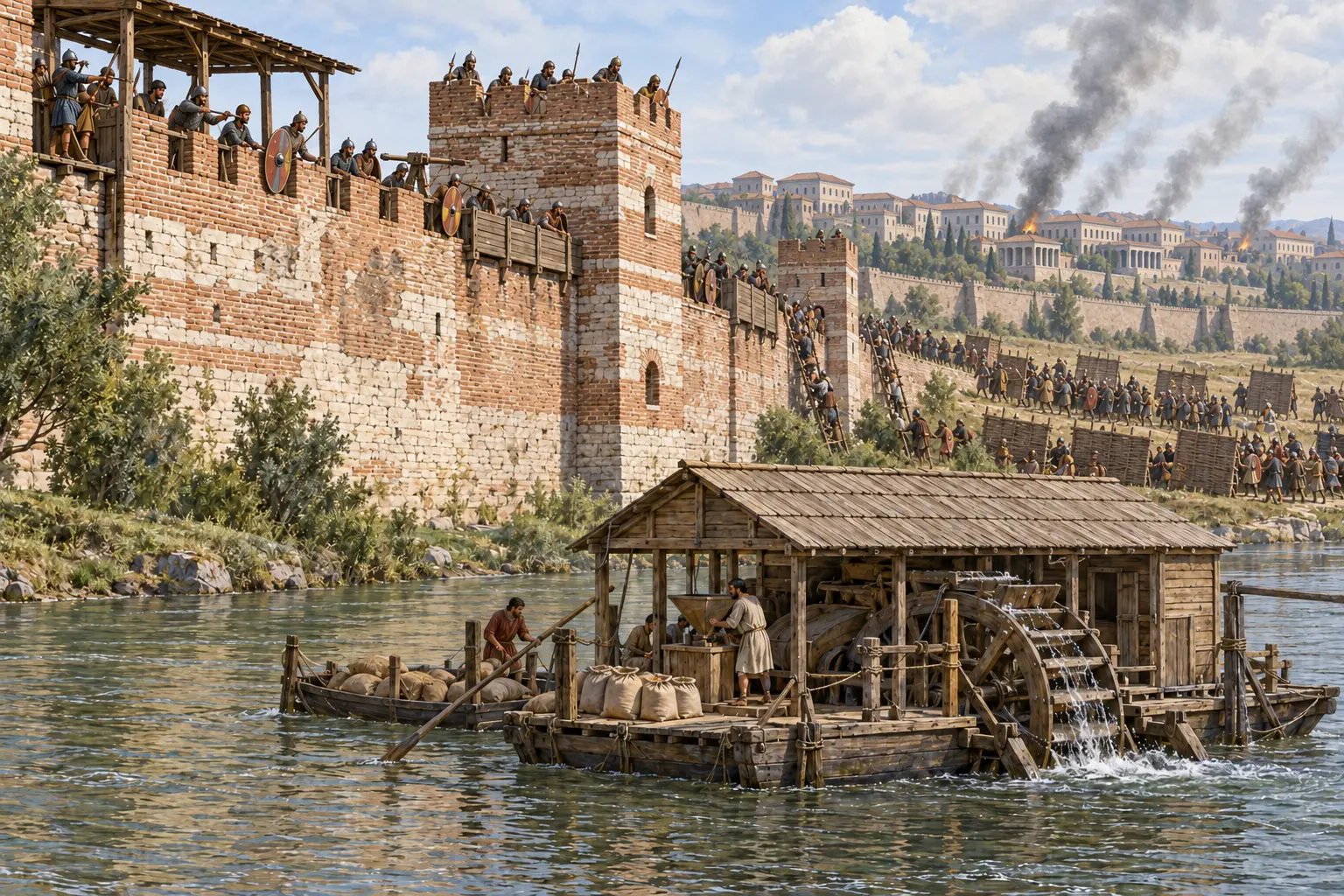
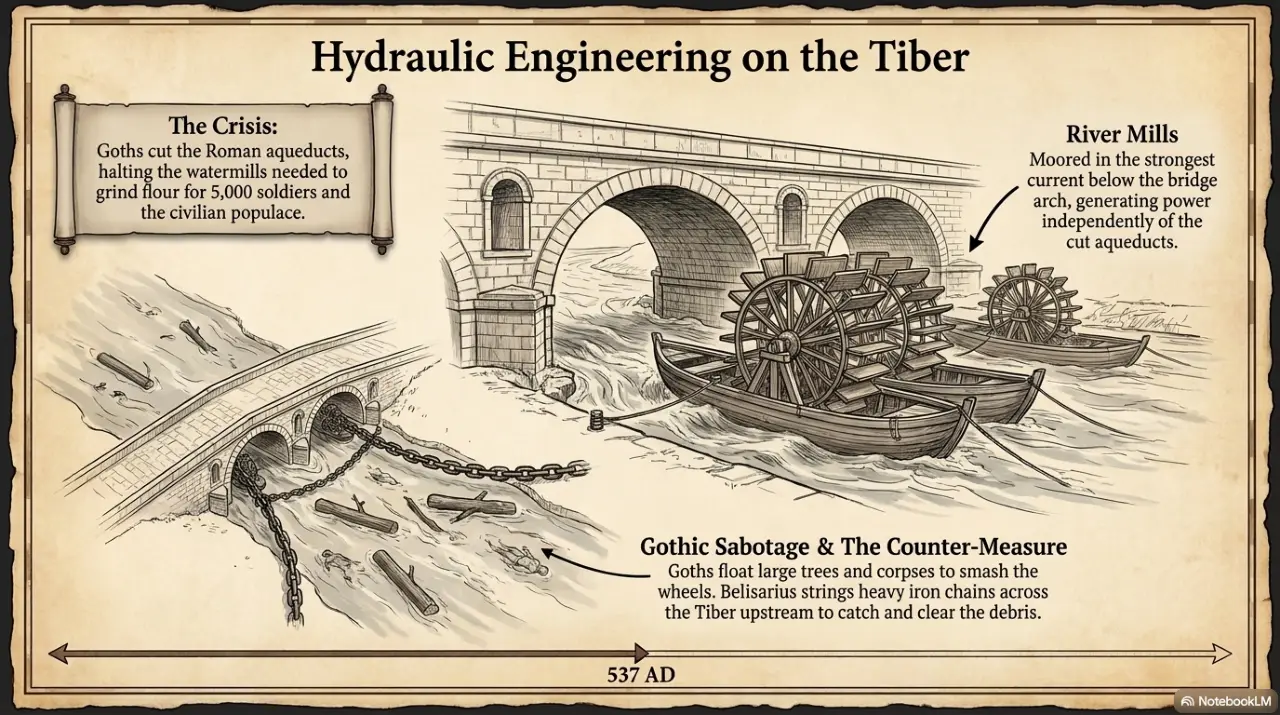
Rome: floating mills and the food supply
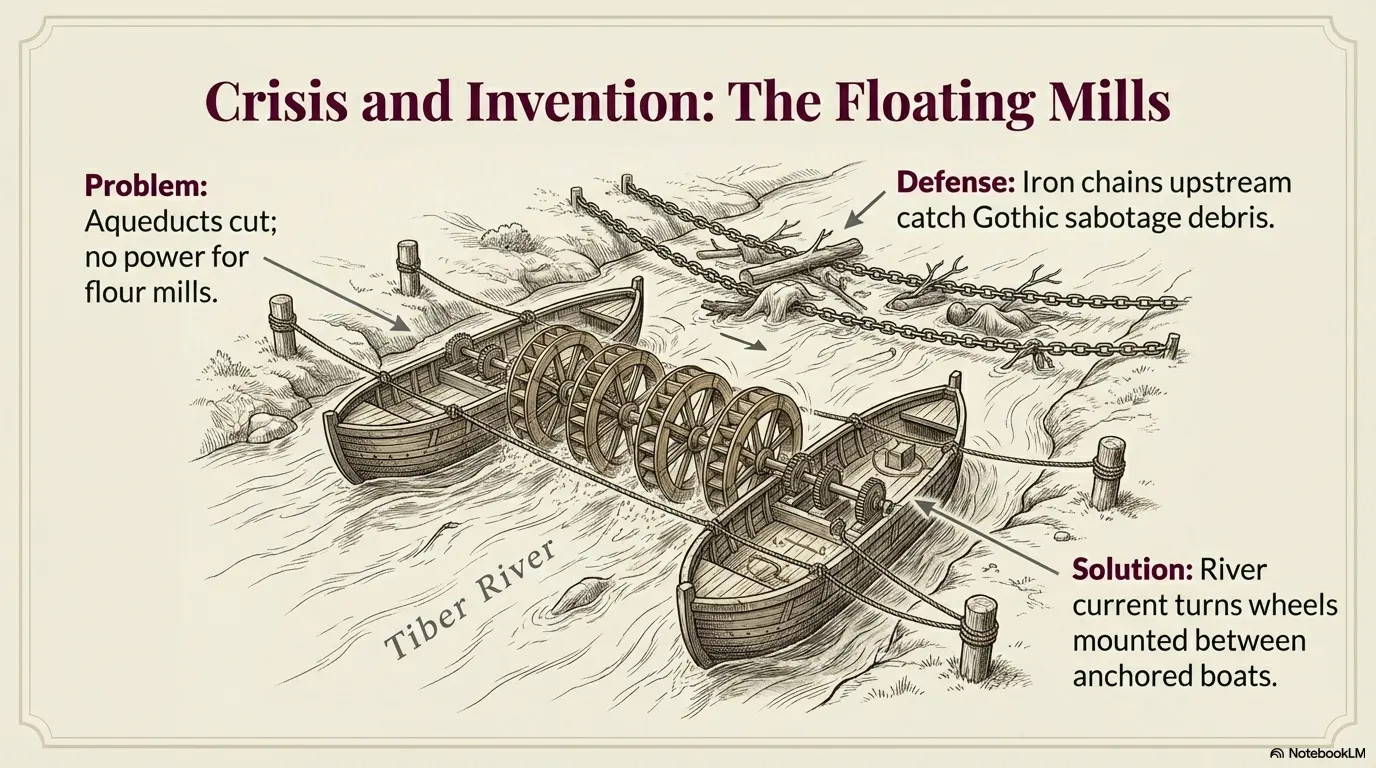
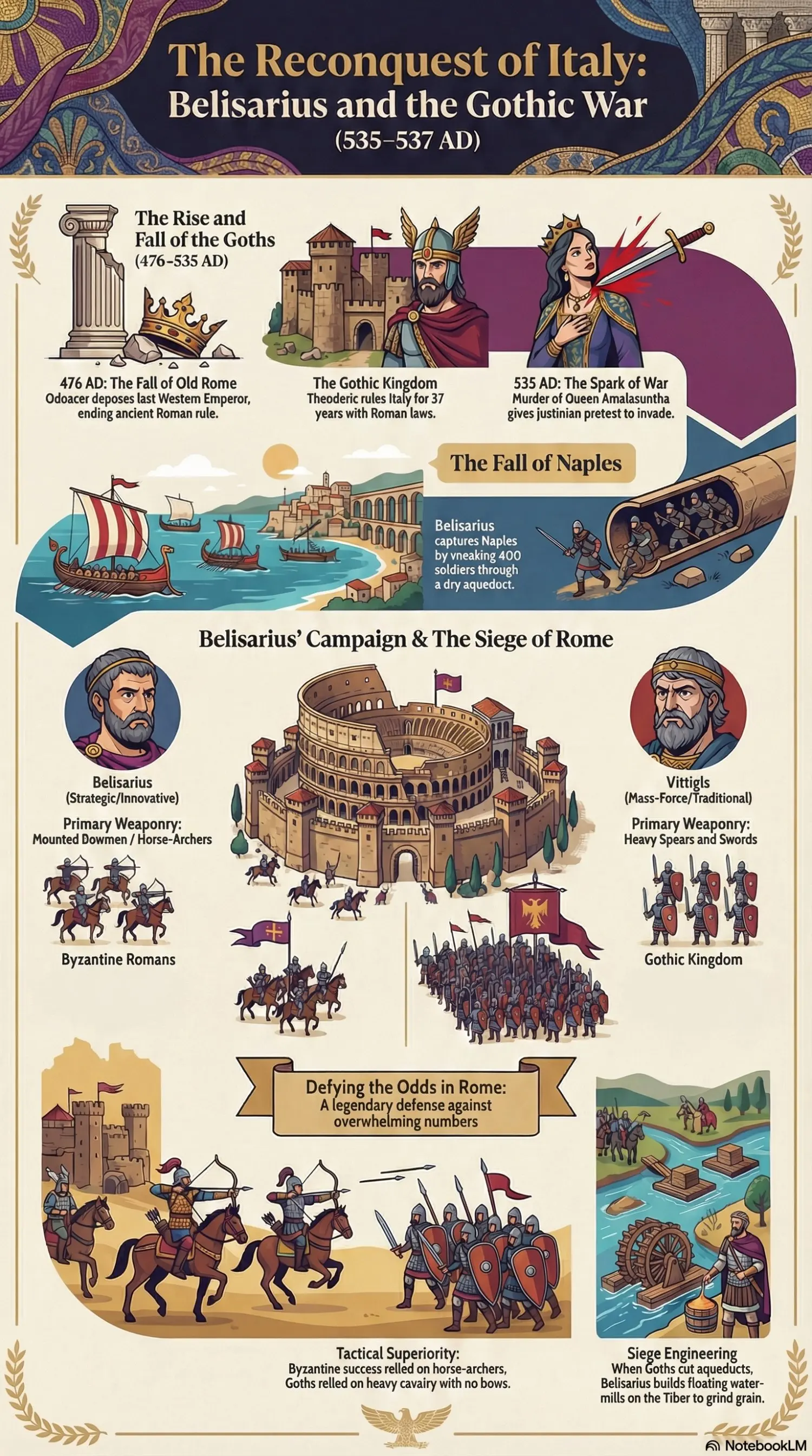
Cutting aqueducts threatened more than drinking water: it interrupted the power used to grind grain. The floating mills illustrate an adaptation that converted river current into work. Their protection also became part of the defense. The figure belongs with food supply and siege endurance, not merely with a catalogue of ingenious machines.
Contemporary campaign chronicle
The following substantial selections incorporate Procopius' account in H. B. Dewing's public-domain translation. Ancient book, chapter and section numbers are retained. Speeches, reported figures, judgments and divine explanations are the ancient author's testimony, not independently established modern conclusions. Editorial event-date overlays have been removed.
The invasion, Sicily and Naples
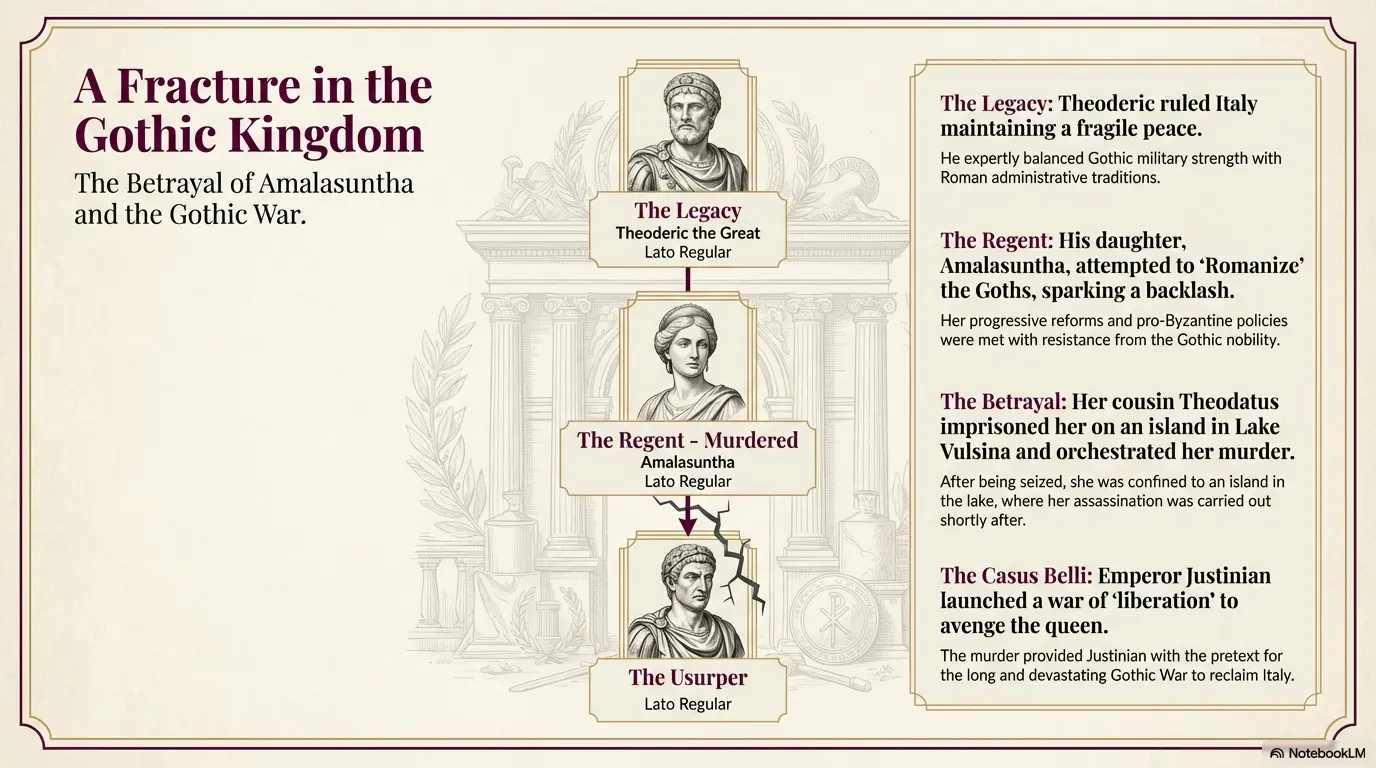
5.5.1. Meanwhile it happened that Belisarius had distinguished himself by the defeat of Gelimer and the Vandals. And the emperor, upon learning what had befallen Amalasuntha, immediately entered upon the war, being in the ninth year of his reign. And he first commanded Mundus, the general of Illyricum, to go to Dalmatia, which was subject to the Goths, and make trial of Salones. Now Mundus was by birth a barbarian, but exceedingly loyal to the cause of the emperor and an able warrior. Then he sent Belisarius by sea with four thousand soldiers from the regular troops and the foederati, and about three thousand of the Isaurians. And the commanders were men of note: Constantinus and Bessas from the land of Thrace, and Peranius from Iberia which is hard by Media, a man who was by birth a member of the royal family of the Iberians, but had before this time come as a deserter to the Romans through enmity toward the Persians; and the levies of cavalry were commanded by Valentinus, Magnus, and Innocentius, and the infantry by Herodian, Paulus, Demetrius, and Ursicinus, while the leader of the Isaurians was Ennes. And there were also two hundred Huns as allies and three hundred Moors.
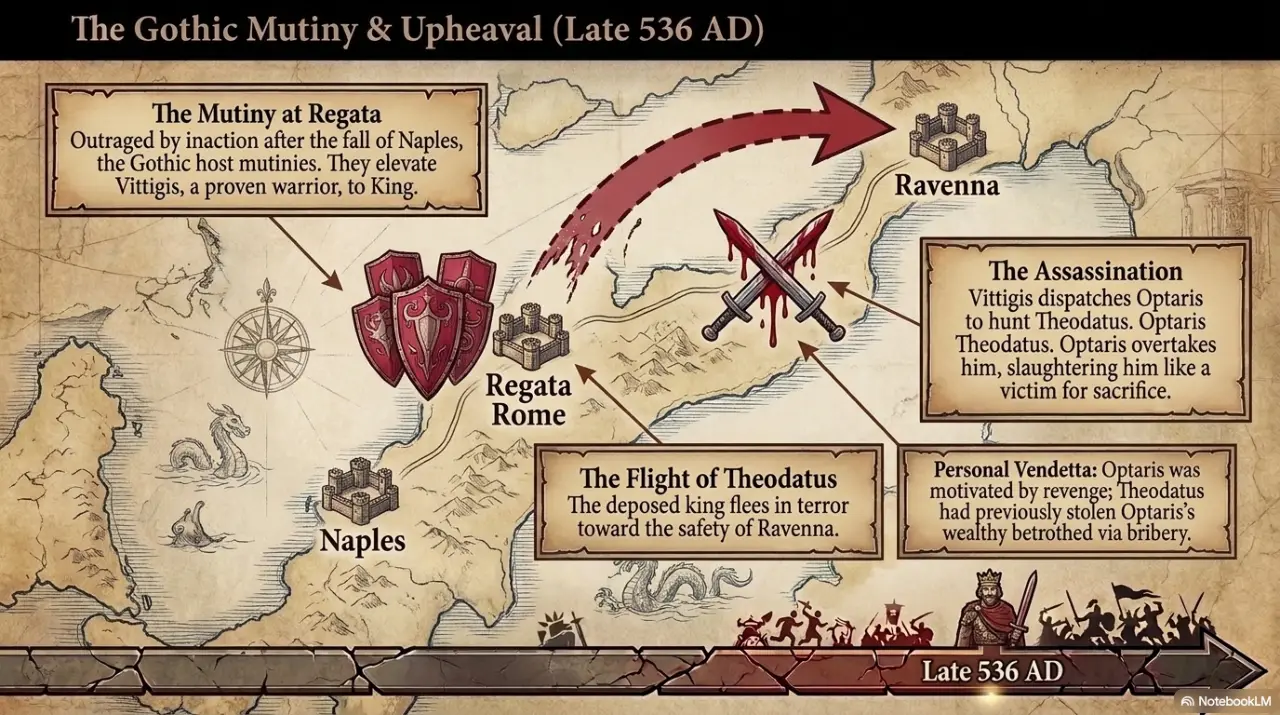
But the general in supreme command over all was Belisarius, and he had with him many notable men as spearmen and guards. And he was accompanied also by Photius, the son of his wife Antonina by a previous marriage; he was still a young man wearing his first beard, but possessed the greatest discretion and shewed a strength of character beyond his years. And the emperor instructed Belisarius to give out that his destination was Carthage, but as soon as they should arrive at Sicily, they were to disembark there as it obliged for some reason to do so, and make trial of the island. And if it should be possible to reduce it to subjection without any trouble, they were to take possession and not let it go again; but if they should meet with any obstacle, they were to sail with all speed to Libya, giving no one an opportunity to perceive what their intention was.
5.5.8. And he also sent a letter to the leaders of the Franks as follows: "The Goths, having seized by violence Italy, which was ours, have not only refused absolutely to give it back, but have committed further acts of injustice against us which are unendurable and pass beyond all bounds. For this reason we have been compelled to take the field against them, and it is proper that you should join with us in waging this war, which is rendered yours as well as ours not only by the orthodox faith, which rejects the opinion of the Arians, but also by the enmity we both feel toward the Goths." Such was the emperor's letter; and making a gift of money to them, he agreed to give more as soon as they should take an active part. And they with all zeal promised to fight in alliance with him.
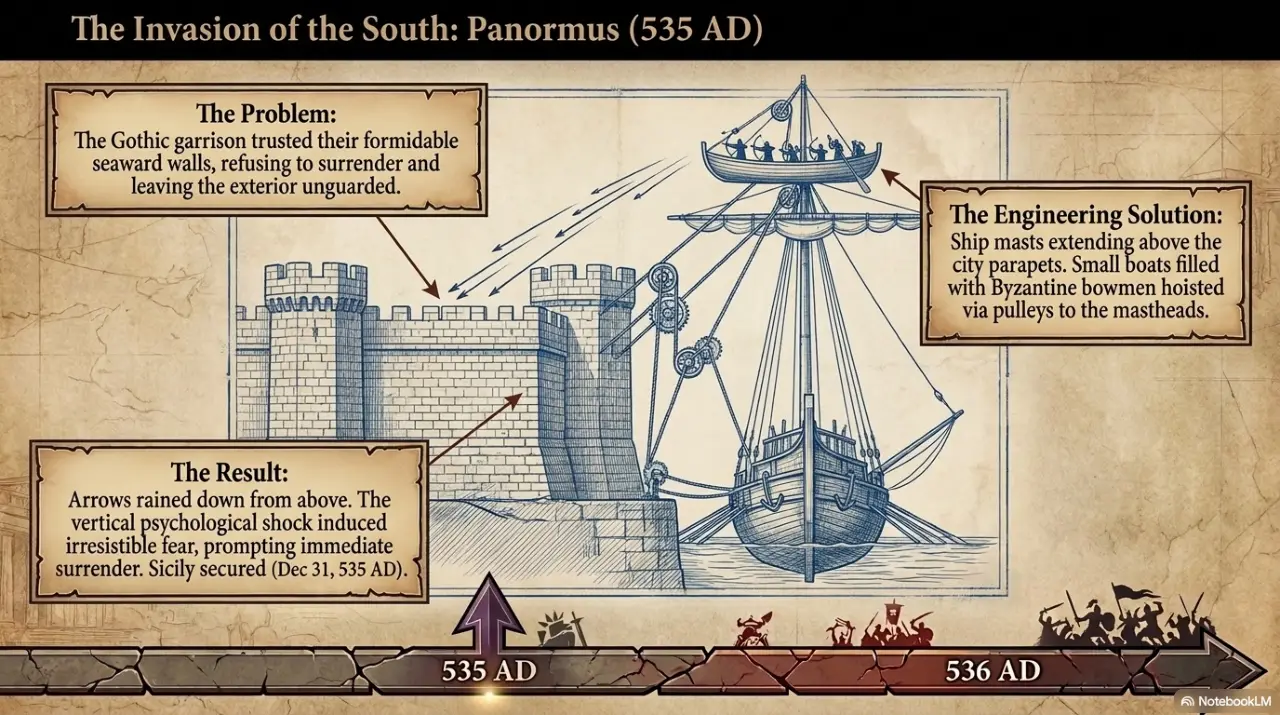
5.5.11. Now Mundus and the army under his command entered Dalmatia, and engaging with the Goths who encountered them there, defeated them in the battle and took possession of Salones. As for Belisarius, he put in at Sicily and took Catana. And making that place his base of operations, he took over Syracuse and the other cities by surrender without any trouble; except, indeed, that the Goths who were keeping guard in Panormus, having confidence in the fortifications of the place, which was a strong one, were quite unwilling to yield to Belisarius and ordered him to lead his army away from there with all speed. But Belisarius, considering that it was impossible to capture the place from the landward side, ordered the fleet to sail into the harbour, which extended right up to the wall. For it was outside the circuit-wall and entirely without defenders. Now when the ships had anchored there, it was seen that the masts were higher than the parapet.
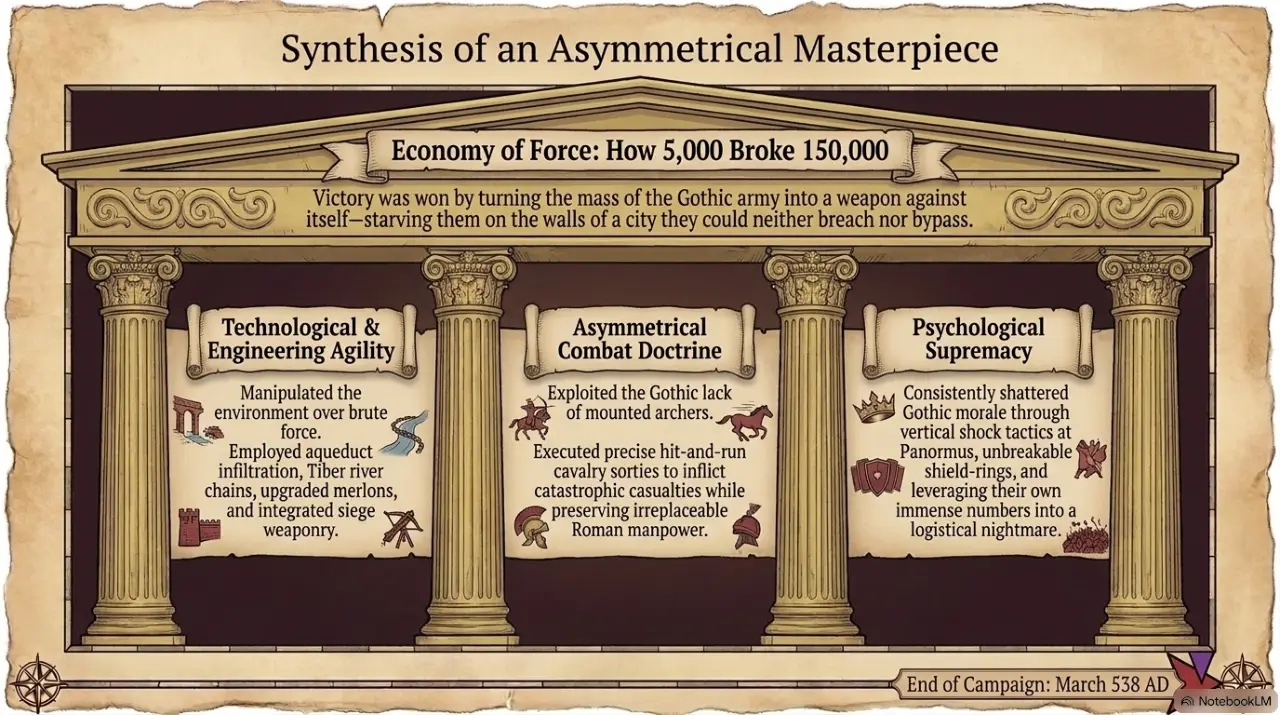
Straightway, therefore, he filled all the small boats of the ships with bowmen and hoisted them to the tops of the masts. And when from these boats the enemy were shot at from above, they fell into such an irresistible fear that they immediately delivered Panormus to Belisarius by surrender.
5.5.17. As a result of this the emperor held all Sicily subject and tributary to himself. And at that time it so happened that there fell to Belisarius a piece of good fortune beyond the power of words to describe. For, having received the dignity of the consulship because of his victory over the Vandals, while he was still holding this honour, and after he had won the whole of Sicily, on the last day of his consulship, [535 A.D.] he marched into Syracuse, loudly applauded by the army and by the Sicilians and throwing golden coins to all. This coincidence, however, was not intentionally arranged by him, but it was a happy chance which befell the man, that after having recovered the whole of the island for the Romans he marched into Syracuse on that particular day; and so it was not in the senate house in Byzantium, as was customary, but there that he laid down the office of the consuls and so became an ex-consul. Thus, then, did good fortune attend Belisarius.
5.6.1. And when Peter learned of the conquest of Sicily, he was still more insistent in his efforts to frighten Theodatus and would not let him go. But he, turning coward and reduced to speechlessness no less than if he himself had become a captive with Gelimer, entered into negotiations with Peter without the knowledge of any others, and between them they formed an agreement, providing that Theodatus should retire from all Sicily in favour of the Emperor Justinian, and should send him also a golden crown every year weighing three hundred litrae, and Gothic warriors to the number of three thousand whenever he should wish; and that Theodatus himself should have no authority to kill any priest or senator, or to confiscate his property for the public treasury except by the decision of the emperor; and that if Theodatus wished to advance any of his subjects to the patrician or some other senatorial rank this honour should not be bestowed by him, but he should ask the emperor to bestow it; and that the Roman populace, in acclaiming their sovereign, should always shout the name of the emperor first, and afterward that of Theodatus, both in the theatres and in the hippodromes and wherever else it should be necessary for such a thing to be done; furthermore, that no statue of bronze nor of any other material should ever be set up to Theodatus alone, but statues must always be made for both, and they must stand thus: on the right that of the emperor, and on the other side that of Theodatus. And after Theodatus had written in confirmation of this agreement he dismissed the ambassador.
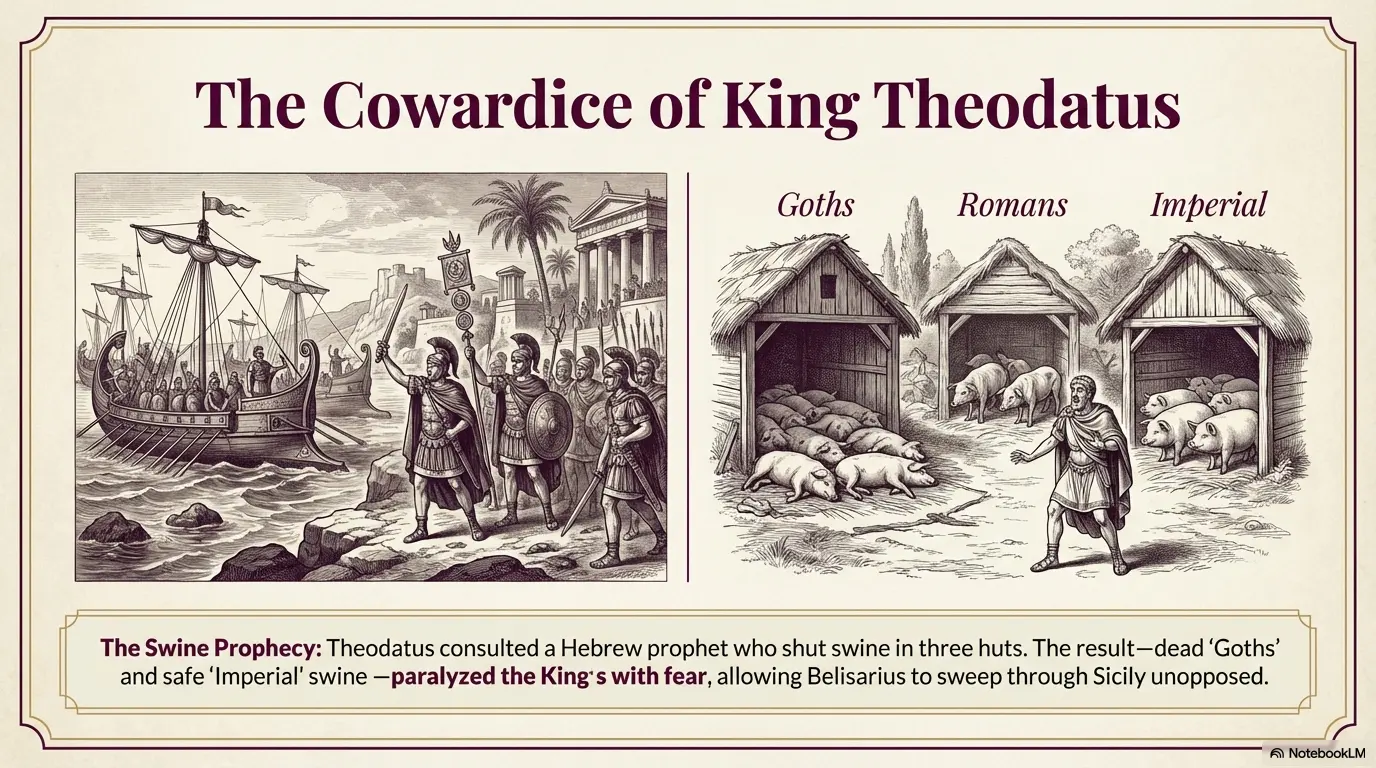
5.6.6. But, a little later, terror laid hold upon the man's soul and brought him into fears which knew no bound and tortured his mind, filling him with dread at the name of war, and reminding him that if the agreement drawn up by Peter and himself did not please the emperor at all, war would straightway come upon him. Once more, therefore, he summoned Peter, who had already reached Albani, for a secret conference, and enquired of the man whether he thought that the agreement would be pleasing to the emperor. And he replied that he supposed it would. "But if," said Theodatus, "these things do not please the man at all, what will happen then?" And Peter replied "After that you will have to wage war, most noble Sir." "But what is this," he said; "is it just, my dear ambassador?" And Peter, immediately taking him up, said "And how is it not just, my good Sir, that the pursuits appropriate to each man's nature should be preserved?" "What, pray, may this mean?" asked Theodatus. "It means," was the reply, "that your great interest is to philosophize, while Justinian's is to be a worthy emperor of the Romans. And there is this difference, that for one who has practised philosophy it would never be seemly to bring about the death of men, especially in such great numbers, and it should be added that this view accords with the teachings of Plato, which you have evidently espoused, and hence it is unholy for you not to be free from all bloodshed; but for him it is not at all inappropriate to seek to acquire a land which has belonged from of old to the realm which is his own." Thereupon Theodatus, being convinced by this advice, agreed to retire from the kingship in favour of the Emperor Justinian, and both he and his wife took an oath to this effect. He then bound Peter by oaths that he would not divulge this agreement until he should see that the emperor would not accept the former convention. And he sent with him Rusticus, a priest who was especially devoted to him and a Roman citizen, to negotiate on the basis of this agreement. And he also entrusted a letter to these men.
5.6.14. So Peter and Rusticus, upon reaching Byzantium, reported the first decision to the emperor, just as Theodatus had directed them to do. But when the emperor was quite unwilling to accept the proposal, they revealed the plan which had been committed to writing afterwards. This was to the following effect: "I am no stranger to royal courts, but it was my fortune to have been born in the house of my uncle while he was king and to have been reared in a manner worthy of my race; and yet I have had little experience of wars and of the turmoils which wars entail. For since from my earliest years I have been passionately addicted to scholarly disputations and have always devoted my time to this sort of thing, I have consequently been up to the present time very far removed from the confusion of battles.
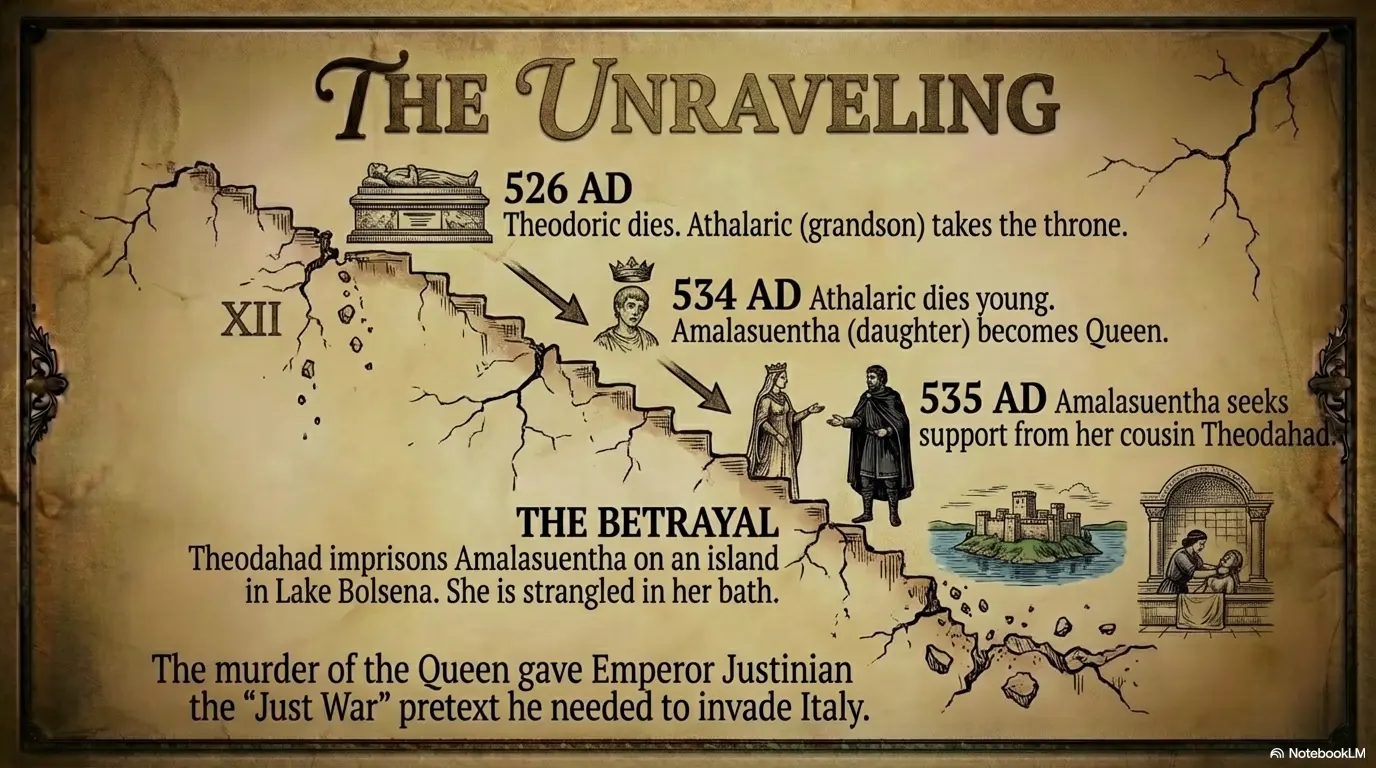
Therefore it is utterly absurd that I should aspire to the honours which royalty confers and thus lead a life fraught with danger, when it is possible for me to avoid them both. For neither one of these is a pleasure to me; the first, because it is liable to satiety, for it is a surfeit of all sweet things, and the second, because lack of familiarity with such a life throws one into confusion. But as for me, if estates should be provided me which yielded an annual income of no less than twelve centenaria, I should regard the kingdom as of less account than them, and I shall hand over to thee forthwith the power of the Goths and Italians. For I should find more pleasure in being a farmer free from all cares than in passing my life amid a king's anxieties, attended as they are by danger after danger. Pray send a man as quickly as possible into whose hands I may fittingly deliver Italy and the affairs of the kingdom."
5.6.22. Such was the purport of the letter of Theodatus. And the emperor, being exceedingly pleased, replied as follows: "From of old have I heard by report that you were a man of discretion, but now, taught by experience, I know it by the decision you have reached not to await the issue of the war. For certain men who in the past have followed such a course have been completely undone. And you will never repent having made us friends instead of enemies. But you will not only have this that you ask at our hands, but you will also have the distinction of being enrolled in the highest honours of the Romans. Now for the present I have sent Athanasius and Peter, so that each party may have surety by some agreement. And almost immediately Belisarius also will visit you to complete all the arrangements which have been agreed upon between us." After writing this the emperor sent Athanasius, the brother of Alexander, who had previously gone on an embassy to Atalaric, as has been said, and for the second time Peter the orator, whom I have mentioned above, enjoining upon them to assign to Theodatus the estates of the royal household, which they call "patrimonium"; and not until after they had drawn up a written document and had secured oaths to fortify the agreement were they to summon Belisarius from Sicily, in order that he might take over the palace and all Italy and hold them under guard. And he wrote to Belisarius that as soon as they should summon him he should go thither with all speed.
5.8.1. And Belisarius, leaving guards in Syracuse and Panormus, crossed with the rest of the army from Messana to Rhegium (where the myths of the poets say Scylla and Charybdis were), and every day the people of that region kept coming over to him. For since their towns had from of old been without walls, they had no means at all of guarding them, and because of their hostility toward the Goths they were, as was natural, greatly dissatisfied with their present government.
And Ebrimous came over to Belisarius as a deserter from the Goths, together with all his followers; this man was the son-in-law of Theodatus, being married to Theodenanthe, his daughter. And he was straightway sent to the emperor and received many gifts of honour and in particular attained the patrician dignity. And the army of Belisarius marched from Rhegium through Bruttium and Lucania, and the fleet of ships accompanied it, sailing close to the mainland. But when they reached Campania, they came upon a city on the sea, Naples by name, which was strong not only because of the nature of its site, but also because it contained a numerous garrison of Goths. And Belisarius commanded the ships to anchor in the harbour, which was beyond the range of missiles, while he himself made his camp near the city. He then first took possession by surrender of the fort which is in the suburb, and afterwards permitted the inhabitants of the city at their own request to send some of their notables into his camp, in order that they might tell what their wish was and, after receiving his reply, report to the populace. Straightway, therefore, the Neapolitans sent Stephanus. And he, upon coming before Belisarius, spoke as follows:
5.8.7. "You are not acting justly, O general, in taking the field against men who are Romans and have done no wrong, who inhabit but a small city and have over us a guard of barbarians as masters, so that it does not even lie in our power, if we desire to do so, to oppose them. But it so happens that even these guards had to leave their wives and children, and their most precious possessions in the hands of Theodatus before they came to keep guard over us. Therefore, if they treat with you at all, they will plainly be betraying, not the city, but themselves. And if one must speak the truth with no concealment, you have not counselled to your advantage, either, in coming against us. For if you capture Rome, Naples will be subject to you without any further trouble, whereas if you are repulsed from there, it is probable that you will not be able to hold even this city securely. Consequently the time you spend on this siege will be spent to no purpose."
5.8.11. So spoke Stephanus. And Belisarius replied as follows: "Whether we have acted wisely or foolishly in coming here is not a question which we propose to submit to the Neapolitans. But we desire that you first weigh carefully such matters as are appropriate to your deliberations and then act solely in accordance with your own interests. Receive into your city, therefore, the emperor's army, which has come to secure your freedom and that of the other Italians, and do not choose the course which will bring upon you the most grievous misfortunes. For those who, in order to rid themselves of slavery or any other shameful thing, go into war, such men, if they fare well in the struggle, have double good fortune, because along with their victory they have also acquired freedom from their troubles, and if defeated they gain some consolation for themselves, in that, they have not of their own free will chosen to follow the worse fortune. But as for those who have the opportunity to be free without fighting, but yet enter into a struggle in order to make their condition of slavery permanent, such men, even if it so happens that they conquer, have failed in the most vital point, and if in the battle they fare less happily than they wished, they will have, along with their general ill-fortune, also the calamity of defeat. As for the Neapolitans, then, let these words suffice. But as for these Goths who are present, we give them the choice, either to array themselves hereafter on our side under the great emperor, or to go to their homes altogether immune from harm. Because, if both you and they, disregarding all these considerations, dare to raise arms against us, it will be necessary for us also, if God so wills, to treat whomever we meet as an enemy. If, however, it is the will of the Neapolitans to choose the cause of the emperor and thus to be rid of so cruel a slavery, I take it upon myself, giving you pledges, to promise that you will receive at our hands those benefits which the Sicilians lately hoped for, and with regard to which they were unable to say that we had sworn falsely."
5.8.19. Such was the message which Belisarius bade Stephanus take back to the people. But privately he promised him large rewards if he should inspire the Neapolitans with good-will toward the emperor. And Stephanus, upon coming into the city, reported the words of Belisarius and expressed his own opinion that it was inexpedient to fight against the emperor. And he was assisted in his efforts by Antiochus, a man of Syria, but long resident in Naples for the purpose of carrying on a shipping business, who had a great reputation there for wisdom and justice. But there were two men, Pastor and Asclepiodotus, trained speakers and very notable men among the Neapolitans, who were exceedingly friendly toward the Goths, and quite unwilling to have any change made in the present state of affairs.
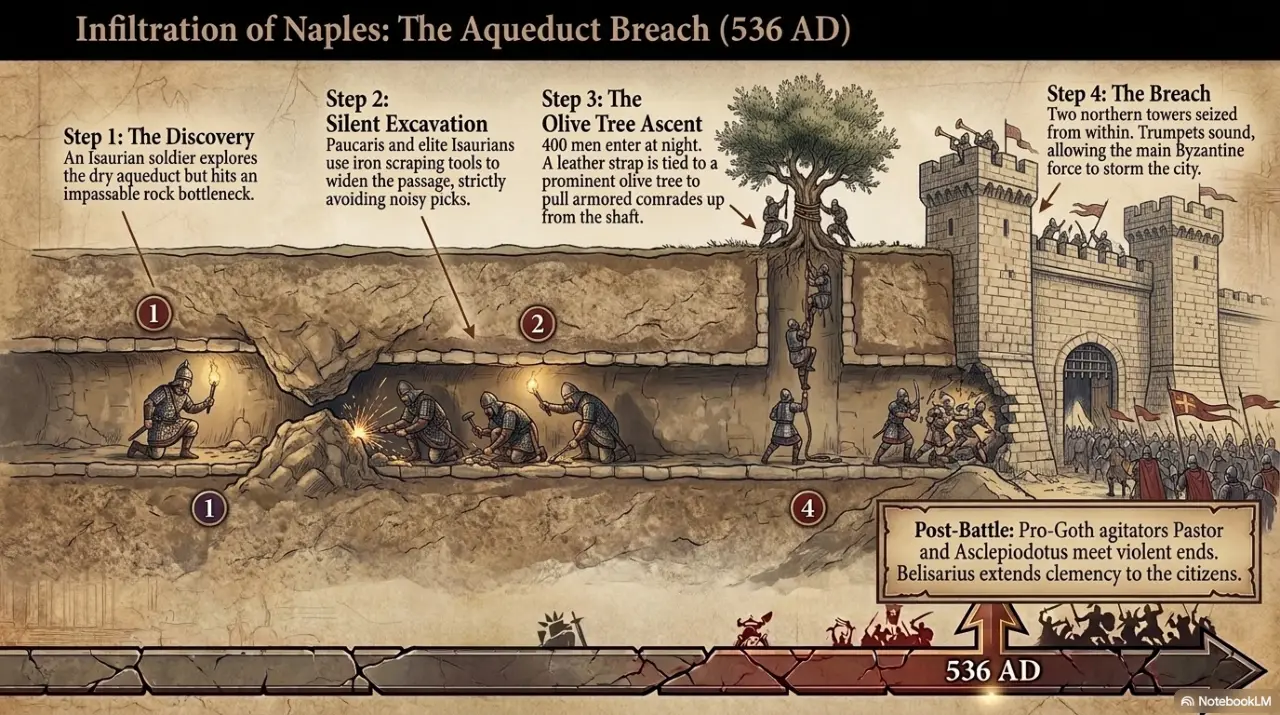
These two men, planning how they might block the negotiations, induced the multitude to demand many serious concessions, and to try to force Belisarius to promise on oath that they should forthwith obtain what they asked for. And after writing down in a document such demands as nobody would have supposed that Belisarius would accept, they gave it to Stephanus. And he, returning to the emperor's army, shewed the writing to the general, and enquired of him whether he was willing to carry out all the proposals which the Neapolitans made and to take an oath concerning them. And Belisarius promised that they should all be fulfilled for them and so sent him back. Now when the Neapolitans heard this, they were in favour of accepting the general's assurances at once and began to urge that the emperor's army be received into the city with all speed. For he declared that nothing unpleasant would befall them, if the case of the Sicilians was sufficient evidence for anyone to judge by, since, as he pointed out, it had only recently been their lot, after they had exchanged their barbarian tyrants for the sovereignty of Justinian, to be, not only free men, but also immune from all difficulties. And swayed by great excitement they were about to go to the gates with the purpose of throwing them open. And though the Goths were not pleased with what they were doing, still, since they were unable to prevent it, they stood out of the way.
The siege and defense of Rome
5.15.1. At that time Pitzas, a Goth, coming from Samnium, also put himself and all the Goths who were living there with him into the hands of Belisarius, as well as the half of that part of Samnium which lies on the sea, as far as the river which flows through the middle of that district. For the Goths who were settled on the other side of the river were neither willing to follow Pitzas nor to be subjects of the emperor. And Belisarius gave him a small number of soldiers to help him guard that territory. And before this the Calabrians and Apulians, since no Goths were present in their land, had willingly submitted themselves to Belisarius, both those on the coast and those who held the interior. Among the interior towns is Beneventus, which in ancient times the Romans had named "Maleventus," but now they call it Beneventus, avoiding the evil omen of the former name, "ventus" having the meaning "wind" in the Latin tongue. For in Dalmatia, which lies across from this city on the opposite mainland, a wind of great violence and exceedingly wild is wont to fall upon the country, and when this begins to blow, it is impossible to find a man there who continues to travel on the road, but all shut themselves up at home and wait. Such, indeed, is the force of the wind that it seizes a man on horseback together with his horse and carries him through the air, and then, after whirling him about in the air to a great distance, it throws him down wherever he may chance to be and kills him. And it so happens that Beneventus, being opposite to Dalmatia, as I have said, and situated on rather high ground, gets some of the disadvantage of this same wind. This city was built of old by Diomedes, the son of Tydeus, when after the capture of Troy he was repulsed from Argos.
And he left to the city as a token the tusks of the Calydonian Boar, which his uncle Meleager had received as a prize of the hunt, and they are there even up to my time, a noteworthy sight and well worth seeing, measuring not less than three spans around and having the form of a crescent. There, too, they say that Diomedes met Aeneas, the son of Anchises, when he was coming from Ilium, and in obedience to the oracle gave him the statue of Athena which he had seized as plunder in company with Odysseus, when the two went into Troy as spies before the city was captured by the Greeks. For they tell the story that when he fell sick at a later time, and made enquiry concerning the disease, the oracle responded that he would never be freed from his malady unless he should give this statue to a man of Troy. And as to where in the world the statue itself is, the Romans say they do not know, but even up to my time they shew a copy of it chiselled on a certain stone in the temple of Fortune, where it lies before the bronze statue of Athena, which is set up under the open sky in the eastern part of the temple. And this copy on the stone represents a female figure in the pose of a warrior and extending her spear as if for combat; but in spite of this she has a chiton reaching to the feet. But the face does not resemble the Greek statues of Athena, but is altogether like the work of the ancient Aegyptians. The Byzantines, however, say that the Emperor Constantine dug up this statue in the forum which bears his name and set it there. So much, then, for this. In this way Belisarius won over the whole of that part of Italy which is south of the Ionian Gulf, as far as Rome and Samnium, and the territory north of the gulf, as far as Liburnia, had been gained by Constantianus, as has been said. But I shall now explain how Italy is divided among the inhabitants of the land. The Adriatic Sea sends out a kind of outlet far into the continent and thus forms the Ionian Gulf, but it does not, as in other places where the sea enters the mainland, form an isthmus at its end. For example, the so-called Crisaean Gulf, ending at Lechaeum, where the city of Corinth is, forms the isthmus of that city, about forty stades in breadth; and the gulf off the Hellespont, which they call the Black Gulf, makes the isthmus at the Chersonese no broader than the Corinthian, but of about the same size. But from the city of Ravenna, where the Ionian Gulf ends, to the Tuscan Sea is not less than eight days' journey for an unencumbered traveller. And the reason is that the arm of the sea, as it advances, always inclines very far to the right. And below this gulf the first town is Dryus, which is now called Hydrus. And on the right of this are the Calabrians, Apulians, and Samnites, and next to them dwell the Piceni, whose territory extends as far as the city of Ravenna. And on the other side are the remainder of the Calabrians, the Bruttii, and the Lucani, beyond whom dwell the Campani as far as the city of Taracina, and their territory is adjoined by that of Rome. These peoples hold the shores of the two seas, and all the interior of that part of Italy. And this is the country called Magna Graecia in former times.
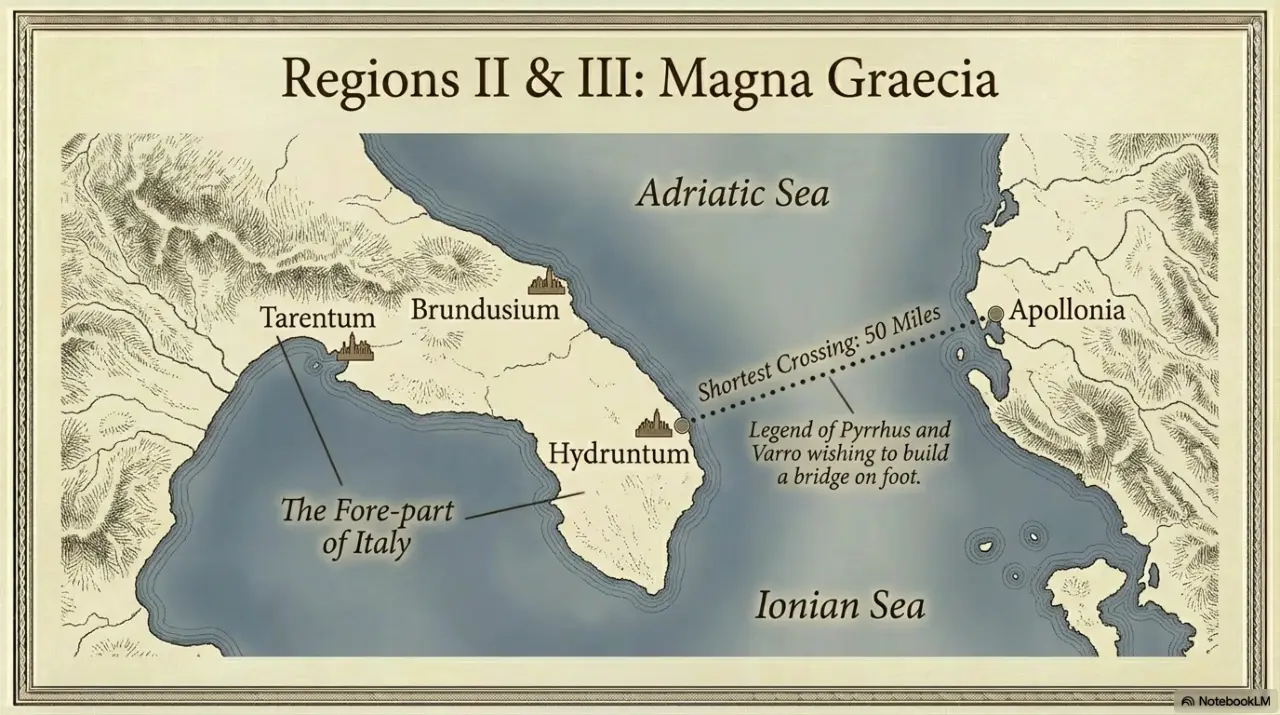
For among the Bruttii are the Epizephyrian Locrians and the inhabitants of Croton and Thurii. But north of the gulf the first inhabitants are Greeks, called Epirotes, as far as the city of Epidamnus, which is situated on the sea. And adjoining this is the land of Precalis, beyond which is the territory called Dalmatia, all of which is counted as part of the western empire. And beyond that point is Liburnia, and Istria, and the land of the Veneti extending to the city of Ravenna. These countries are situated on the sea in that region. But above them are the Siscii and Suevi (not those who are subjects of the Franks, but another group), who inhabit the interior. And beyond these are settled the Carnii and Norici. On the right of these dwell the Dacians and Pannonians, who hold a number of towns, including Singidunum and Sirmium, and extend as far as the Ister River. Now these peoples north of the Ionian Gulf were ruled by the Goths at the beginning of this war, but beyond the city of Ravenna on the left of the river Padus the country was inhabited by the Ligurians. And to the north of them live the Albani in an exceedingly good land called Langovilla, and beyond these are the nations subject to the Franks, while the country to the west is held by the Gauls and after them the Spaniards. On the right of the Padus are Aemilia and the Tuscan peoples, which extend as far as the boundaries of Rome. So much, then, for this.
5.16.1. So Belisarius took possession of all the territory of Rome as far as the river Tiber, and strengthened it. And when all had been settled by him in the best possible manner, he gave to Constantinus a large number of his own guards together with many spearmen, including the Massagetae Zarter, Chorsomanus, and Aeschmanus, and an army besides, commanding him to go into Tuscia, in order to win over the towns of that region. And he gave orders to Bessas to take possession of Narnia, a very strong city in Tuscia.
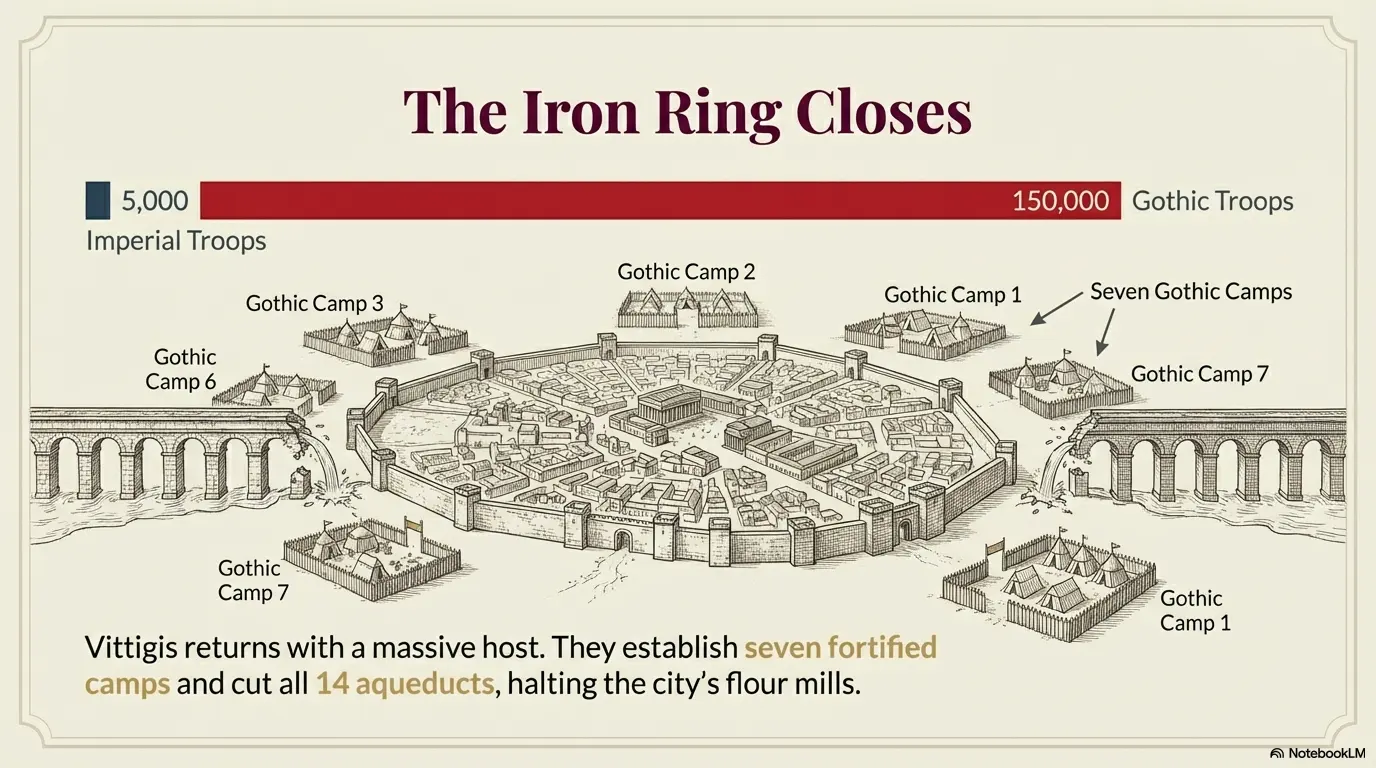
Now this Bessas was a Goth by birth, one of those who had dwelt in Thrace from of old and had not followed Theoderic when he led the Gothic nation thence into Italy, and he was an energetic man and a capable warrior. For he was both a general of the first rank, and a skilful man in action. And Bessas took Narnia not at all against the will of the inhabitants, and Constantinus won over Spolitium and Perusia and certain other towns without any trouble. For the Tuscans received him into their cities willingly. So after establishing a garrison in Spolitium, he himself remained quietly with his army in Perusia, the first city in Tuscia. Now when Vittigis heard this, he sent against them an army with Unilas and Pissas as its commanders. And Constantinus confronted these troops in the outskirts of Perusia and engaged with them. The battle was at first evenly disputed, since the barbarians were superior in numbers, but afterwards the Romans by their valour gained the upper hand and routed the enemy, and while they were fleeing in complete disorder the Romans killed almost all of them; and they captured alive the commanders of the enemy and sent them to Belisarius. Now when Vittigis heard this, he was no longer willing to remain quietly in Ravenna, where he was embarrassed by the absence of Marcias and his men, who had not yet come from Gaul. So he sent to Dalmatia a great army with Asinarius and Uligisalus as its commanders, in order to recover Dalmatia for the Gothic rule. And he directed them to add to their own troops an army from the land of the Suevi, composed of the barbarians there, and then to proceed directly to Dalmatia and Salones. And he also sent with them many ships of war, in order that they might be able to besiege Salones both by land and by sea. But he himself was hastening to go with his whole army against Belisarius and Rome, leading against him horsemen and infantry to the number of not less than one hundred and fifty thousand, and the most of them as well as their horses were clad in armour. So Asinarius, upon reaching the country of the Suevi, began to gather the army of the barbarians, while Uligisalus alone led the Goths into Liburnia. And when the Romans engaged with them at a place called Scardon, they were defeated in the battle and retired to the city of Burnus; and there Uligisalus awaited his colleague. But Constantianus, upon hearing of the preparations of Asinarius, became afraid for Salones, and summoned the soldiers who were holding all the fortresses in that region. He then dug a moat around the whole circuit-wall and made all the other preparations for the siege in the best manner possible. And Asinarius, after gathering an exceedingly large army of barbarians, came to the city of Burnus. There he joined Uligisalus and the Gothic army and proceeded to Salones. And they made a stockade about the circuit-wall, and also, filling their ships with soldiers, kept guard over the side of the fortifications which faced the sea. In this manner they proceeded to besiege Salones both by land and by sea; but the Romans suddenly made an attack upon the ships of the enemy and turned them to flight, and many of them they sunk, men and all, and also captured many without their crews. However, the Goths did not raise the siege, but maintained it vigorously and kept the Romans still more closely confined to the city than before. Such, then, were the fortunes of the Roman and Gothic armies in Dalmatia. But Vittigis, upon hearing from the natives who came from Rome that the army which Belisarius had was very small, began to repent of his withdrawal from Rome, and was no longer able to endure the situation, but was now so carried away by fury that he advanced against them. And on his way thither he fell in with a priest who was coming from Rome. Whereupon they say that Vittigis in great excitement enquired of this man whether Belisarius was still in Rome, shewing that he was afraid he would not be able to catch him, but that Belisarius would forestall him by running away. But the priest, they say, replied that he need not be at all concerned about that; for he, the priest, was able to guarantee that Belisarius would never resort to flight, but was remaining where he was. But Vittigis, they say, kept hastening still more than before, praying that he might see with his own eyes the walls of Rome before Belisarius made his escape from the city.
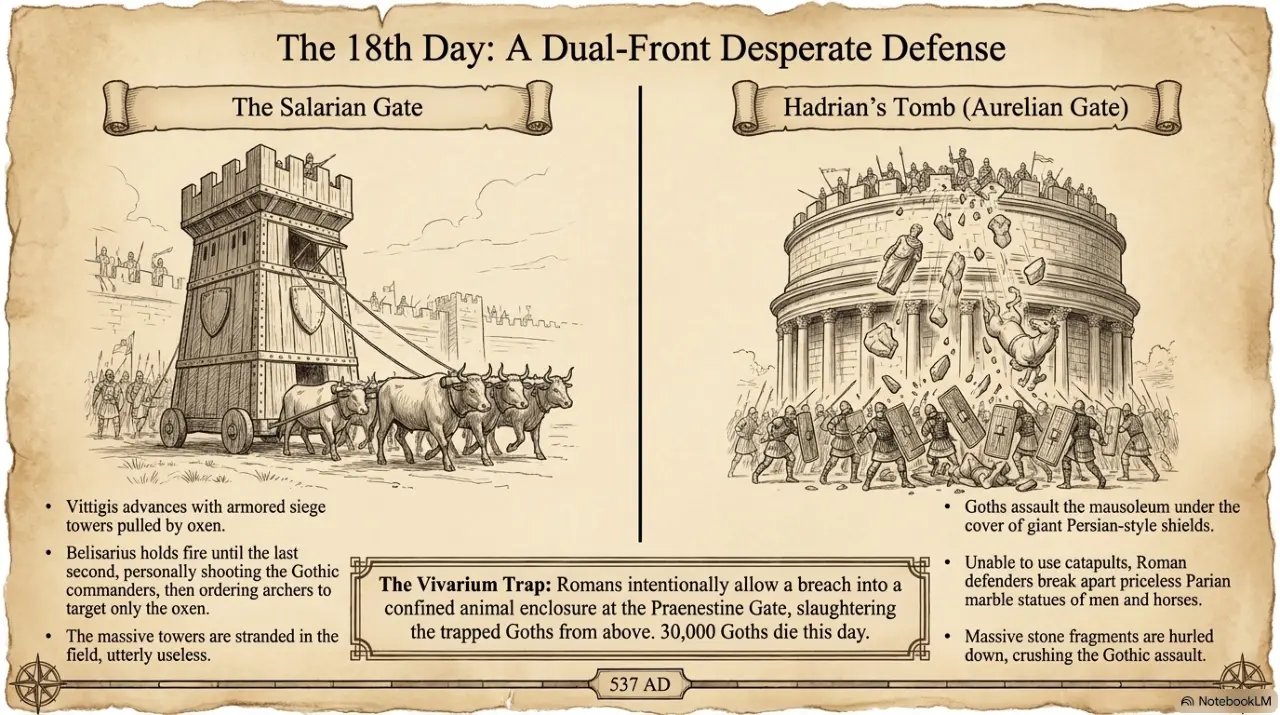
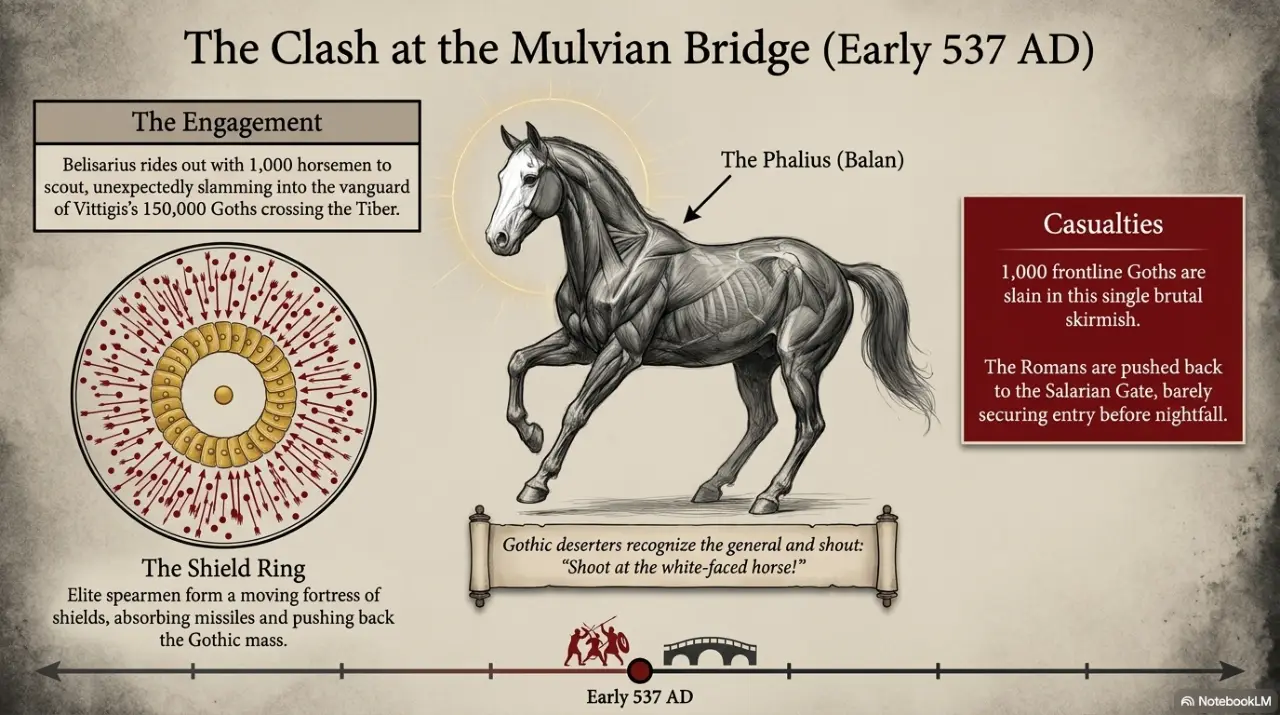
5.18.1. On the following day the Goths destroyed the gates of the tower with no trouble and made the crossing, since no one tried to oppose them. But Belisarius, who had not as yet learned what had happened to the garrison, was bringing up a thousand horsemen to the bridge over the river, in order to look over the ground and decide where it would be best for his forces to make camp. But when they had come rather close, they met the enemy already across the river, and not at all willingly they engaged with some of them. And the battle was carried on by horsemen on both sides. Then Belisarius, though he was safe before, would no longer keep the general's post, but began to fight in the front ranks like a soldier; and consequently the cause of the Romans was thrown into great danger, for the whole decision of the war rested with him. But it happened that the horse he was riding at that time was unusually experienced in warfare and knew well how to save his rider; and his whole body was dark grey, except that his face from the top of his head to the nostrils was the purest white. Such a horse the Greeks call "phalius" and the barbarians "balan." And it so happened that the most of the Goths threw their javelins and other missiles at him and at Belisarius for the following reason. Those deserters who on the previous day had come to the Goths, when they saw Belisarius fighting in the front ranks, knowing well that, if he should fall, the cause of the Romans would be ruined instantly, cried aloud urging them to "shoot at the white-faced horse." Consequently this saying was passed around and reached the whole Gothic army, and they did not question it at all, since they were in a great tumult of fighting, nor did they know clearly that it referred to Belisarius. But conjecturing that it was not by mere accident that the saying had gained such currency as to reach all, the most of them, neglecting all others, began to shoot at Belisarius. And every man among them who laid any claim to valour was immediately possessed with a great eagerness to win honour, and getting as close as possible they kept trying to lay hold of him and in a great fury kept striking with their spears and swords. But Belisarius himself, turning from side to side, kept killing as they came those who encountered him, and he also profited very greatly by the loyalty of his own spearmen and guards in this moment of danger. For they all surrounded him and made a display of valour such, I imagine, as has never been shewn by any man in the world to this day; for, holding out their shields in defence of both the general and his horse, they not only received all the missiles, but also forced back and beat off those who from time to time assailed him. And thus the whole engagement was centred about the body of one man. In this struggle there fell among the Goths no fewer than a thousand, and they were men who fought in the front ranks; and of the household of Belisarius many of the noblest were slain, and Maxentius, the spearman, after making a display of great exploits against the enemy. But by some chance Belisarius was neither wounded nor hit by a missile on that day, although the battle was waged around him alone. Finally by their valour the Romans turned the enemy to flight, and an exceedingly great multitude of barbarians fled until they reached their main army. For there the Gothic infantry, being entirely fresh, withstood their enemy and forced them back without any trouble. And when another body of cavalry in turn reinforced the Goths, the Romans fled at top speed until they reached a certain hill, which they climbed, and there held their position. But the enemy's horsemen were upon them directly, and a second cavalry battle took place. There Valentinus, the groom of Photius, the son of Antonina, made a remarkable exhibition of valour. For by leaping alone into the throng of the enemy he opposed himself to the onrush of the Goths and thus saved his companions. In this way the Romans escaped, and arrived at the fortifications of Rome, and the barbarians in pursuit pressed upon them as far as the wall by the gate which has been named the Salarian Gate. But the people of Rome, fearing lest the enemy should rush in together with the fugitives and thus get inside the fortifications, were quite unwilling to open the gates, although Belisarius urged them again and again and called upon them with threats to do so. For, on the one hand, those who peered out of the tower were unable to recognise the man, for his face and his whole head were covered with gore and dust, and at the same time no one was able to see very clearly, either; for it was late in the day, about sunset.
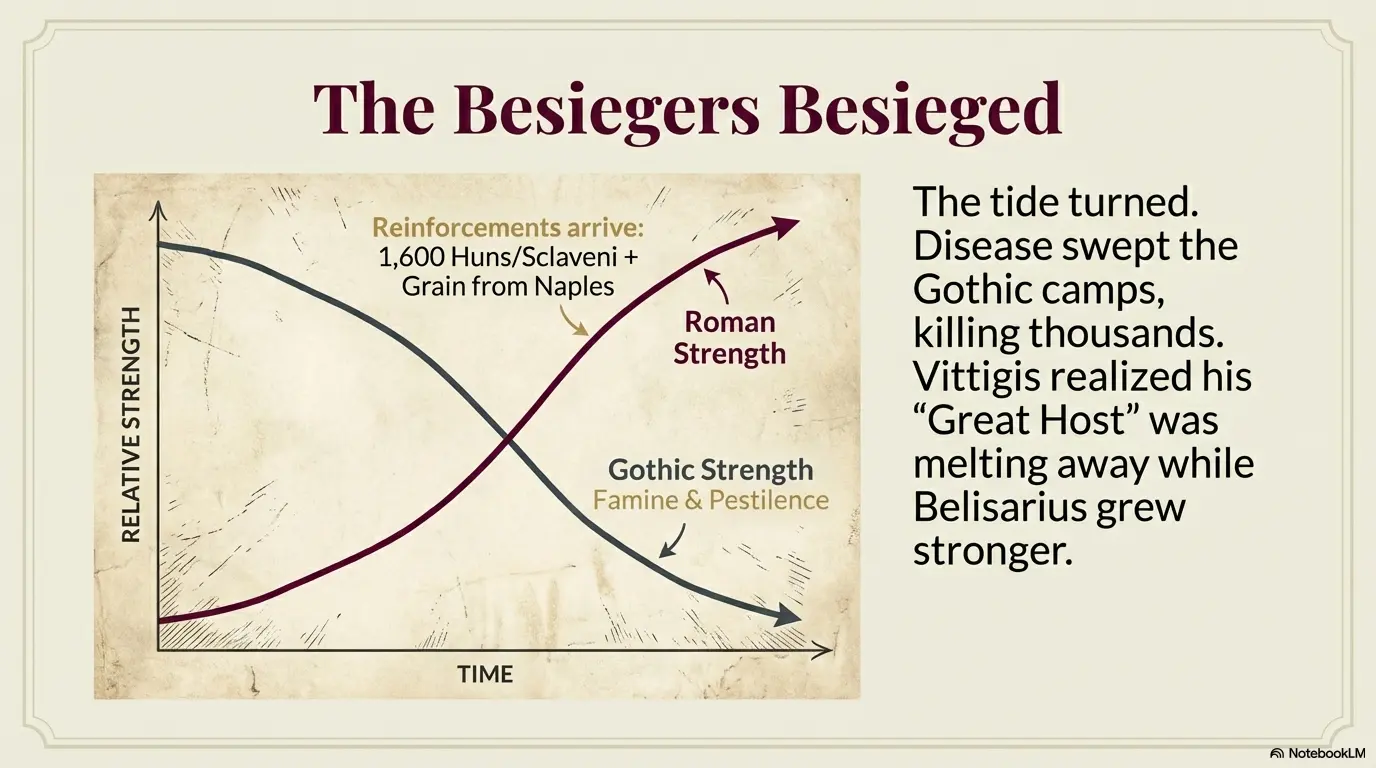
Moreover, the Romans had no reason to suppose that the general survived; for those who had come in flight from the rout which had taken place earlier reported that Belisarius had died fighting bravely in the front ranks. So the throng of the enemy, which had rushed up in strength and possessed with great fury, were purposing to cross the moat straightway and attack the fugitives there; and the Romans, finding themselves massed along the wall, after they had come inside the moat, and so close together that they touched one another, were being crowded into a small space. Those inside the fortifications, however, since they were without a general and altogether unprepared, and being in a panic of fear for themselves and for the city, were quite unable to defend their own men, although these were now in so perilous a situation. Then a daring thought came to Belisarius, which unexpectedly saved the day for the Romans. For urging on all his men he suddenly fell upon the enemy. And they, even before this, had been in great disorder because of the darkness and the fact that they were making a pursuit, and now when, much to their surprise, they saw the fugitives attacking them, they supposed that another army also had come to their assistance from the city, and so were thrown into a great panic and all fled immediately at top speed. But Belisarius by no means rushed out to pursue them, but returned straightway to the wall. And at this the Romans took courage and received him and all his men into the city. So narrowly did Belisarius and the emperor's cause escape peril; and the battle which had begun early in the morning did not end until night. And those who distinguished themselves above all others by their valour in this battle were, among the Romans, Belisarius, and among the Goths, Visandus Vandalarius, who had fallen upon Belisarius at the first when the battle took place about him, and did not desist until he had received thirteen wounds on his body and fell. And since he was supposed to have died immediately, he was not cared for by his companions, although they were victorious, and he lay there with the dead. But on the third day, when the barbarians had made camp hard by the circuit-wall of Rome and had sent some men in order to bury their dead and to perform the customary rites of burial, those who were searching out the bodies of the fallen found Visandus Vandalarius with life still in him, and one of his companions entreated him to speak some word to him. But he could not do even this, for the inside of his body was on fire because of the lack of food and the thirst caused by his suffering, and so he nodded to him to put water into his mouth. Then when he had drunk and become himself again, they lifted and carried him to the camp. And Visandus Vandalarius won a great name for this deed among the Goths, and he lived on a very considerable time, enjoying the greatest renown. This, then, took place on the third day after the battle. But at that time Belisarius, after reaching safety with his followers, gathered the soldiers and almost the whole Roman populace to the wall, and commanded them to burn many fires and keep watch throughout the whole night. And going about the circuit of the fortifications, he set everything in order and put one of his commanders in charge of each gate. But Bessas, who took command of the guard at the gate called the Praenestine, sent a messenger to Belisarius with orders to say that the city was held by the enemy, who had broken in through another gate which is across the Tiber River and bears the name of Pancratius, a holy man. And all those who were in the company of Belisarius, upon hearing this, urged him to save himself as quickly as possible through some other gate. He, however, neither became panic-stricken, nor did he hesitate to declare that the report was false. And he also sent some of his horsemen across the Tiber with all speed, and they, after looking over the ground there, brought back word that no hostile attack had been made on the city in that quarter. He therefore sent immediately to each gate and instructed the commanders everywhere that, whenever they heard that the enemy had broken in at any other part of the fortifications, they should not try to assist in the defence nor abandon their post, but should remain quiet; for he himself would take care of such matters. And he did this in order that they might not be thrown into disorder a second time by a rumour which was not true. But Vittigis, while the Romans were still in great confusion, sent to the Salarian Gate one of his commanders, Vacis by name, a man of no mean station.
And when he had arrived there, he began to reproach the Romans for their faithlessness to the Goths and upbraided them for the treason which he said they had committed against both their fatherland and themselves, for they had exchanged the power of the Goths for Greeks who were not able to defend them, although they had never before seen any men of the Greek race come to Italy except actors of tragedy and mimes and thieving sailors. Such words and many like them were spoken by Vacis, but since no one replied to him, he returned to the Goths and Vittigis. As for Belisarius, he brought upon himself much ridicule on the part of the Romans, for though he had barely escaped from the enemy, he bade them take courage thenceforth and look with contempt upon the barbarians; for he knew well, he said, that he would conquer them decisively. Now the manner in which he had come to know this with certainty will be told in the following narrative. At length, when it was well on in the night, Belisarius, who had been fasting up to this time, was with difficulty compelled by his wife and those of his friends who were present to taste a very little bread. Thus, then, the two armies passed this night.
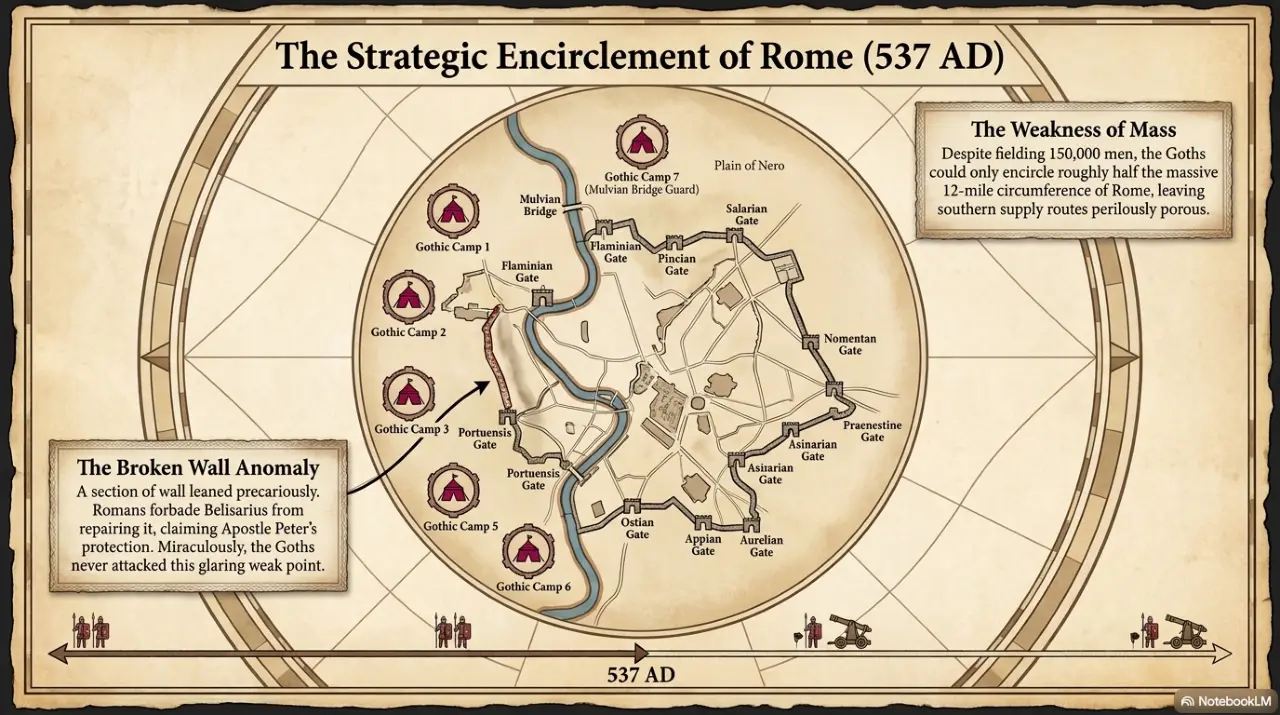
5.19.1. But on the following day they arrayed themselves for the struggle, the Goths thinking to capture Rome by siege without any trouble on account of the great size of the city, and the Romans defending it. Now the wall of the city has fourteen large gates and several smaller ones. And the Goths, being unable with their entire army to envelop the wall on every side, made six fortified camps from which they harassed the portion of the wall containing five gates, from the Flaminian as far as the one called the Praenestine Gate; and all these camps were made by them on the left bank of the Tiber River.
Wherefore the barbarians feared lest their enemy, by destroying the bridge which bears the name of Mulvius, should render inaccessible to them all the land on the right bank of the river as far as the sea, and in this way have not the slightest experience of the evils of a siege, and so they fixed a seventh camp across the Tiber in the Plain of Nero, in order that the bridge might be between their two armies. So in this way two other gates came to be exposed to the attacks of the enemy, the Aurelian (which is now named after Peter, the chief of the Apostles of Christ, since he lies not far from there) and the Transtiburtine Gate. Thus the Goths surrounded only about one-half of the wall with their army, but since they were in no direction wholly shut off from the wall by the river, they made attacks upon it throughout its whole extent whenever they wished. Now the way the Romans came to build the city-wall on both sides of the river I shall now proceed to tell. In ancient times the Tiber used to flow alongside the circuit-wall for a considerable distance, even at the place where it is now enclosed. But this ground, on which the wall rises along the stream of the river, is flat and very accessible. And opposite this flat ground, across the Tiber, it happens that there is a great hill where all the mills of the city have been built from of old, because much water is brought by an aqueduct to the crest of the hill, and rushes thence down the incline with great force. For this reason the ancient Romans determined to surround the hill and the river bank near it with a wall, so that it might never be possible for an enemy to destroy the mills, and crossing the river, to carry on operations with ease against the circuit-wall of the city. So they decided to span the river at this point with a bridge, and to attach it to the wall; and by building many houses in the district across the river they caused the stream of the Tiber to be in the middle of the city. So much then for this. And the Goths dug deep trenches about all their camps, and heaped up the earth, which they took out from them, on the inner side of the trenches, making this bank exceedingly high, and they planted great numbers of sharp stakes on the top, thus making all their camps in no way inferior to fortified strongholds. And the camp in the Plain of Nero was commanded by Marcias (for he had by now arrived from Gaul with his followers, with whom he was encamped there), and the rest of the camps were commanded by Vittigis with five others; for there was one commander for each camp. So the Goths, having taken their positions in this way, tore open all the aqueducts, so that no water at all might enter the city from them. Now the aqueducts of Rome are fourteen in number, and were made of baked brick by the men of old, being of such breadth and height that it is possible for a man on horseback to ride in them. And Belisarius arranged for the defence of the city in the following manner. He himself held the small Pincian Gate and the gate next to this on the right, which is named the Salarian. For at these gates the circuit-wall was assailable, and at the same time it was possible for the Romans to go out from them against the enemy. The Praenestine Gate he gave to Bessas. And at the Flaminian, which is on the other side of the Pincian, he put Constantinus in command, having previously closed the gates and blocked them up most securely by building a wall of great stones on the inside, so that it might be impossible for anyone to open them.
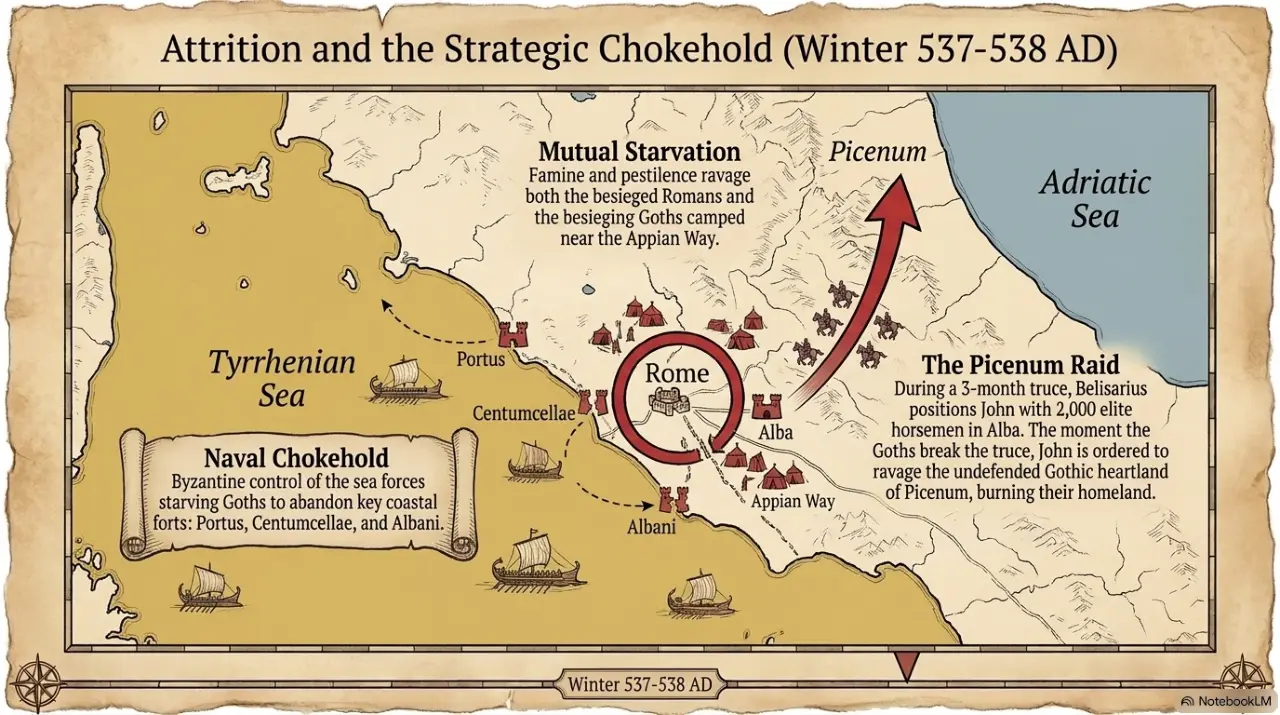
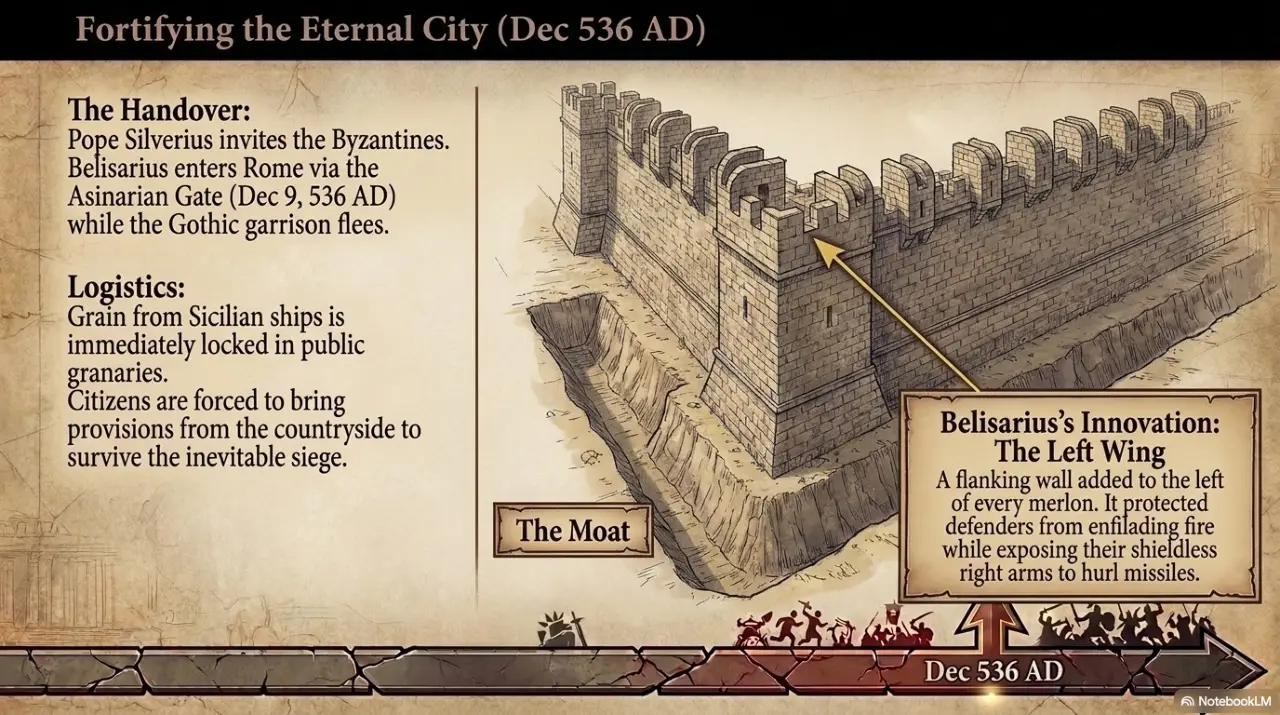
For since one of the camps was very near, he feared least some secret plot against the city should be made there by the enemy. And the remaining gates he ordered the commanders of the infantry forces to keep under guard. And he closed each of the aqueducts as securely as possible by filling their channels with masonry for a considerable distance, to prevent anyone from entering through them from the outside to do mischief. But after the aqueducts had been broken open, as I have stated, the water no longer worked the mills, and the Romans were quite unable to operate them with any kind of animals owing to the scarcity of all food in time of siege; indeed they were scarcely able to provide for the horses which were indispensable to them. And so Belisarius hit upon the following device. Just below the bridge which I lately mentioned as being connected with the circuit-wall, he fastened ropes from the two banks of the river and stretched them as tight as he could, and then attached to them two boats side by side and two feet apart, where the flow of the water comes down from the arch of the bridge with the greatest force, and placing two mills on either boat, he hung between them the mechanism by which mills are customarily turned. And below these he fastened other boats, each attached to the one next behind in order, and he set the water-wheels between them in the same manner for a great distance. So by the force of the flowing water all the wheels, one after the other, were made to revolve independently, and thus they worked the mills with which they were connected and ground sufficient flour for the city. Now when the enemy learned this from the deserters, they destroyed the wheels in the following manner. They gathered large trees and bodies of Romans newly slain and kept throwing them into the river; and the most of these were carried with the current between the boats and broke off the mill-wheels. But Belisarius, observing what was being done, contrived the following device against it. He fastened above the bridge long iron chains, which reached completely across the Tiber. All the objects which the river brought down struck upon these chains, and gathered there and went no farther. And those to whom this work was assigned kept pulling out these objects as they came and bore them to the land. And Belisarius did this, not so much on account of the mills, as because he began to think with alarm that the enemy might get inside the bridge at this point with many boats and be in the middle of the city before their presence became known. Thus the barbarians abandoned the attempt, since they met with no success in it. And thereafter the Romans continued to use these mills; but they were entirely excluded from the baths because of the scarcity of water. However, they had sufficient water to drink, since even for those who lived very far from the river it was possible to draw water from wells. But as for the sewers, which carry out from the city whatever is unclean, Belisarius was not forced to devise any plan of safety, for they all discharge into the Tiber River, and therefore it was impossible for any plot to be made against the city by the enemy in connection with them.
Ravenna and the unsettled conquest
6.29.1. It was in these circumstances that envoys arrived from the emperor, Domnicus and Maximinus, both members of the senate, in order to make peace on the following terms. Vittigis was to receive one-half of the royal treasure, and to rule over the territory which is north of the river Padus; but the other half of the money was to fall to the emperor, and he was to make subject and tributary to himself all that lay south of the Padus. So the envoys, having shewn the emperor's letter to Belisarius, betook themselves to Ravenna. And when the Goths and Vittigis had learned the purpose of their coming, they gladly agreed to make the treaty on these terms. But Belisarius, upon hearing this, was moved with vexation, counting it a great calamity that anyone should prevent him from winning the decisive victory of the whole war, when it was possible to do so with no trouble, and from leading Vittigis a captive to Byzantium. So when the envoys returned to him from Ravenna, he refused absolutely to ratify the agreement by his own signature.
And when the Goths became aware of this, they began to feel that the Romans were offering them peace with treacherous intent, and became very suspicious of them; and they forthwith declared flatly that without both the signature and the oath of Belisarius they would never make a compact with the Romans.
6.29.7. And Belisarius, upon hearing that some of the commanders were criticizing him bitterly, on the ground that he was plainly plotting against the emperor's cause, and for this reason was quite unwilling to bring the war to an end, called them all together, and, in the presence of Domnicus and Maximinus, spoke as follows. "I am not alone in knowing that the fortune of war is by no means fixed and firm, but 1 think that each one of you shares this same view with me regarding it. For many men have been deceived by the hope of victory when it seemed certain that it would come to them, while men who, to all appearances, have met with disaster, have many a time had the fortune to triumph unexpectedly over their adversaries. Consequently 1 say that men deliberating with regard to peace should not put before them only the expectation of success, but reflecting that the result will be either way, they should make their choice of policy on this basis. In view of this, it has seemed best to me, at any rate, to bring to a conference you, my colleagues, and these envoys of the emperor, to the end that the present occasion may afford an opportunity to choose at our leisure whatever course may seem destined to be of advantage to the emperor, that after the event you may never bring any reproach against me. For it would be a thing most monstrous, first to be silent as long as it is possible to choose the better course, and later upon surveying the outcome decreed by fortune, to bring accusations. Now as to the emperor's decision with a view to the conclusion of the war, and as to the wishes of Vittigis, you are of course well informed. And if you, too, think this course advantageous, let each man come forward and speak. If, however, you think that you are able to recover the whole of Italy for the Romans and to gain the mastery over the enemy, nothing will prevent you from speaking with complete frankness." When Belisarius had thus spoken, all expressed the opinion with certainty that the emperor's decision was best, and that they would be unable to do the enemy any further harm. And Belisarius was pleased with the expression of the commanders' opinion, and asked them to set it down in writing, in order that they might never deny it. They accordingly wrote a document stating that they were unable to achieve superiority over their opponents in the war.
6.29.17. These deliberations, then, were being carried forward in the Roman camp. But the Goths, hard pressed by the famine and no longer able to endure their suffering, were in a state of suspense; for while they were hostile to the rule of Vittigis, seeing that he had been unfortunate in the extreme, still they were reluctant to yield to the emperor fearing only this, that upon becoming slaves of the emperor they would be compelled to remove from Italy and go to Byzantium and settle there. So after deliberating among themselves, all the best of the Goths decided to declare Belisarius Emperor of the West. And sending to him secretly, they begged him to assume the royal power; for upon this condition, they declared, they would follow him gladly. But Belisarius was quite unwilling to assume the ruling power against the will of the emperor; for he had an extraordinary loathing for the name of tyrant, and furthermore he had, in fact, been bound by the emperor previously by most solemn oaths never during his lifetime to organize a revolution; still, in order to turn the situation before him to the best advantage, he let it appear that he received the proposals of the barbarians gladly. And Vittigis, perceiving this, became fearful, and saying that the deliberations of the Goths had arrived at the best possible result, he too secretly urged Belisarius to enter upon the royal power; for no one, he said, would stand in his way. Then indeed Belisarius again called together the envoys of the emperor and all the commanders and asked them whether it seemed to them a matter of great importance to make all the Goths with Vittigis captives, and to secure as plunder all their wealth, and recover the whole of Italy for the Romans. And they said that this would be for the Romans a great and overwhelming piece of good fortune, and they begged him to bring it about as quickly as possible, by whatever means he could.
6.29.22. Accordingly Belisarius at once sent to Vittigis and the notables of the Goths some of his intimates, bidding them carry out what they had promised. And indeed the famine would not permit them to put off the matter to any other time, but, by its increasing pressure, was driving them to this decision. Consequently they again sent envoys to the camp of the Romans, with instructions to make some vague statement openly, but in secret to receive pledges from Belisarius, both that he would do no harm to anyone of the Goths, and that thenceforth he himself would be king of the Goths and Italians; this accomplished, they were to come with him and the Roman army into Ravenna. As for Belisarius, he swore to everything else, just as the envoys required of him, but concerning the kingship he said that he would swear to Vittigis himself and the rulers of the Goths.
And the envoys, thinking that he would never reject the kingship, but that he would strive for it above all other things, made not the least hesitation in urging him to come with them into Ravenna. Then Belisarius ordered Bessas and John and Narses and Aratius to go with their several commands to different places (for these were the men whom he suspected of being exceedingly hostile to him), and to provide provisions for themselves; for he alleged that it was no longer possible for him, in the place where he was, to bring in provisions for the whole army. So these officers, as well as Athanasius, the pretorian prefect, who had recently come from Byzantium, proceeded to carry out the instructions given them, but he himself with the remainder of the army marched into Ravenna with the envoys of the Goths. And loading a fleet of ships with grain and other provisions, he gave orders that they should sail with all speed into the harbour of Classis; for thus the Romans call the suburb of Ravenna where the harbour is.
6.29.32. And while I watched the entry of the Roman army into Ravenna at that time, an idea came to me, to the effect that it is not at all by the wisdom of men or by any other sort of excellence on their part that events are brought to fulfilment, but that there is some divine power which is ever warping their purposes and shifting them in such a way that there will be nothing to hinder that which is being brought to pass. For although the Goths were greatly superior to their opponents in number and in power, and had neither fought a decisive battle since they had entered Ravenna nor been humbled in spirit by any other disaster, still they were being made captives by the weaker army and were regarding the name of slavery as no insult. But when the women, as they sat at the gate, had seen the whole army (for they had heard from their husbands that the enemy were men of great size and too numerous to be counted), they all spat upon the faces of their husbands, and pointing with their hands to the victors, reviled them for their cowardice.
6.29.35. As for Belisarius, he held Vittigis under guard, but not in disgrace, and urged those of the barbarians who lived south of the river Padus to go to their own lands and care for them unmolested. This he did because he felt that he would have no hostile force to deal with in that quarter, and that the Goths of that region would never unite, because he had, as it happened, previously established a large number of Roman troops in the towns there. So these Goths gladly made haste to return. And thus the Romans were now making their position secure, for in Ravenna at least they were no longer outnumbered by the Goths. He next took possession of the money in the palace, which he intended to convey to the emperor.
But as for the private property of the Goths, neither did he take plunder from any individual, nor would he permit any other Roman to take such plunder, but each one of them preserved his property according to the terms of the agreement. Now when those of the barbarians who were keeping guard in the strongest of the towns heard that both Ravenna and Vittigis were held by the Romans, they began to send envoys to Belisarius, craving permission to submit themselves by surrender and the places they guarded. And he most willingly furnished pledges to them all, and thus took over Tarbesium and such other strongholds as there were in Venetia. For Caesena was the only one remaining in Aemilia, and this he had previously taken over along with Ravenna. And the Goths who commanded these towns, as soon as they received the pledges, came to Belisarius and remained with him — all except Ildibadus, a man of note, who commanded the garrison in Verona; for though he too sent envoys to Belisarius on the same mission as the others, especially because Belisarius had found his children in Ravenna and taken possession of them, still he did not either come to Ravenna or submit himself to Belisarius. For fortune brought him to a situation which I shall now describe.
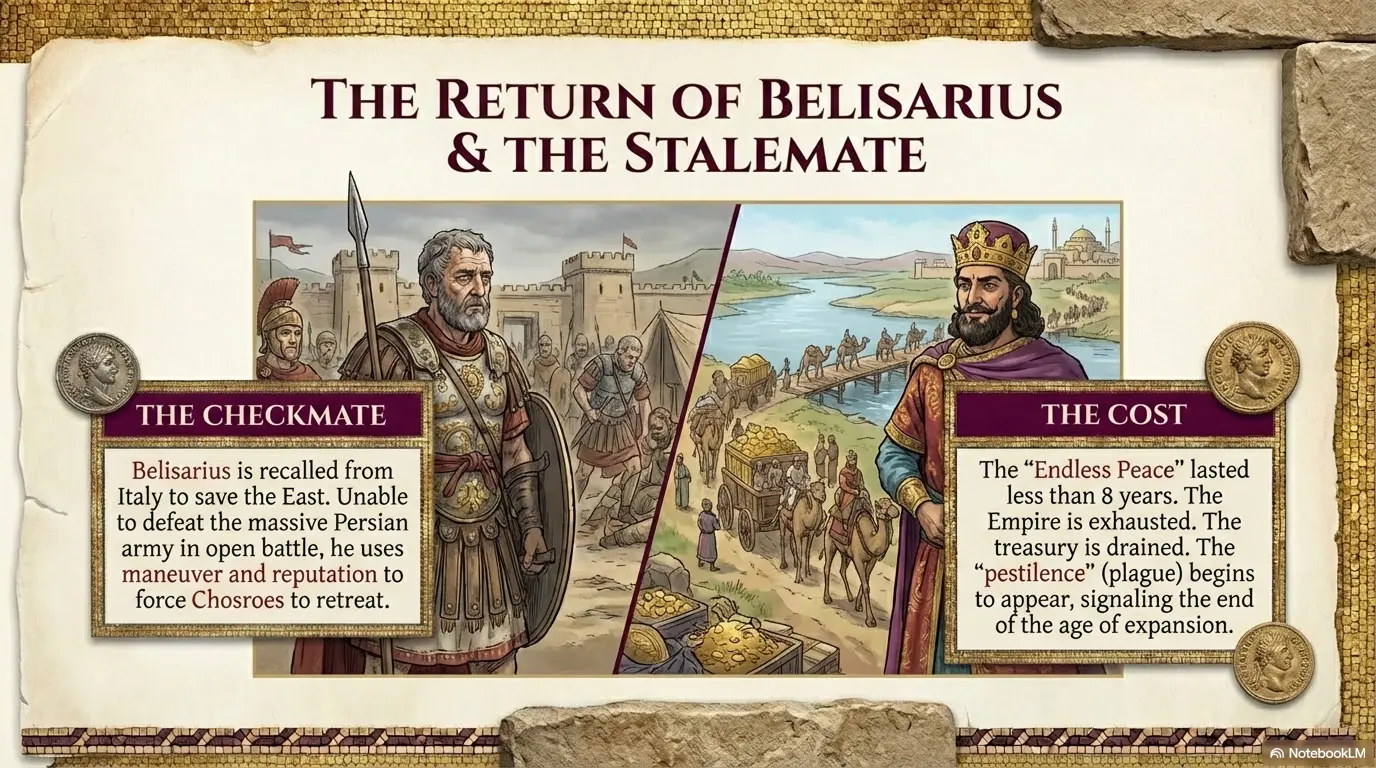
6.30.1. Certain officers of the Roman army, out of malice toward Belisarius, began to slander him to the emperor, advancing against him a charge of usurpation for which there were no grounds whatever in his case. And the emperor, not so much because he was persuaded by these slanders as because the Medic war was already pressing upon him, summoned Belisarius to come as quickly as possible, in order to take the field against the Persians; meanwhile he commanded Bessas and John with the others to take charge of Italy, and directed Constantianus to go to Ravenna from Dalmatia. Now the Goths who inhabited the country to the north of the Padus and of Ravenna, upon hearing that the emperor was summoning Belisarius, at first, indeed, paid no heed to the matter, thinking that Belisarius would never regard the kingdom of Italy as of less account than loyalty to Justinian. But when they learned that he was making preparations for his departure in real earnest, all the loyal Goths of that region who were still left formed a common purpose and went to Uraias, the nephew of Vittigis, at Ticinum; and after first lamenting long with him, they spoke as follows: "The man who has proved to be chiefly responsible for the present misfortunes of the nation of the Goths is no other than you. For we, on our part, should have long ago removed that uncle of yours from the kingship, seeing that he has led us in such a cowardly manner and with such ill fortune, just as we removed Theodatus, the nephew of Theoderic, unless, out of respect for the natural vigour which you seemed to display, we had decided to concede to Vittigis merely the title of king, but in fact to entrust to you alone the rule of the Goths. What, however, seemed then consideration, now stands out clearly as folly and the cause of these misfortunes of ours.
For very many of the Goths, as you know, dear Uraias, and our noblest, have perished in the war, and such nobles as are left among the survivors Belisarius will lead away along with Vittigis and all our wealth. And no one could deny that we too shall suffer this same fate a little later, seeing that we are reduced to a small and pitiable band. Since, therefore, such a dire fate has encompassed us, it will be preferable for us to die with glory rather than to see our wives and children led by the enemy to the extremities of the earth. And we shall, in all probability, accomplish something worthy of valorous men, if only we have you as leader of our struggles." Thus spoke the Goths.
The Gothic recovery under Totila
7.1.1. Thus Belisarius departed, though the situation was still unsettled, and he arrived at Byzantium in company with Vittigis and the notables of the Goths and the children of Ildibadus, bringing with him all the treasure; and he was escorted by Ildiger, Valerian, Martinus, and Herodian only. Now the Emperor Justinian did indeed take pleasure in seeing Vittigis and his wife, and marvelled at both the beauty and the great stature of the barbarian throng.
But upon receiving the wealth of Theoderic, a notable sight in itself, he merely set it forth for the members of the senate to view privately in the palace, being jealous because of the magnitude and splendour of the achievement; and neither did he bring it out before the people, nor did he accord to Belisarius the customary triumph, as he had done when he returned from his victory over Gelimer and the Vandals. However, the name of Belisarius was on the lips of all: to him were ascribed two victories, such as had never before fallen to the lot of any one man to achieve; he had brought two kings captive to Byzantium, and unexpectedly had made both the race and the possessions of Gizeric and of Theoderic Roman spoil — two kings than whom none, among barbarians at least, has ever been more illustrious; and he had brought back their wealth from the enemy and restored it once more to the state, and recovered for the empire in a short space of time almost one half of its territory on land and sea. And the Byzantines took delight in watching Belisarius as he came forth from his house each day and proceeded toward the market-place or as he returned to his house, and none of them could get enough of this sight. For his progress resembled a crowded festival procession, since he was always escorted by a large number of Vandals, as well as Goths and Moors. Furthermore, he had a fine figure and was tall and remarkably handsome. But his conduct was so meek and his attitude toward those who met him so affable that he seemed like a very poor man and one of no repute. As a commander the love ever felt for him both by soldiers and peasants was irresistible, seeing that, in his treatment of his soldiers on the one hand, he was surpassed by none in generosity; (for when any had met with misfortune in battle, he used to console them by large presents of money for the wounds they had received, and to those who had distinguished themselves he presented bracelets and necklaces to wear as prizes, and when a soldier had lost in battle horse or bow or anything else whatsoever, another was straightway provided in its place by Belisarius); and in his treatment of the peasants, on the other hand, he won their affection because he shewed so much restraint and such consideration for them that it never fell to their lot to suffer any violence when Belisarius was general — nay, rather, all those whose land was visited by a large body of troops under his command unexpectedly found that they were enriched; for they always set their own price upon everything sold to the soldiers. And whenever the crops were ripe, Belisarius used to watch closely that the cavalry in passing should not damage any man's grain. Also, when the fruit was ripe on the trees, not a single man was permitted to touch it. Furthermore, he possessed the virtue of self-restraint in a marvellous degree; and hence it was that he never would touch any woman other than his wedded wife. And so, although he took captive such great numbers of women from both the Vandals and the Goths, and such beautiful women as no man in the world, I suppose, has ever seen, he refused to allow any of them to come into his presence or meet him in any other way. In addition to all his other qualities, he was also remarkably shrewd, and in difficult situations he was able with unerring judgment to decide upon the best course of action. Furthermore, in the dangers of war he was both courageous without incurring unnecessary risks and daring to a degree without losing his cool judgment, either striking quickly or holding back his attack upon the enemy according to the requirements of the situation. Nay more, in desperate situations, on the one hand he shewed a spirit which was both full of confidence and unruffled by excitement, and in the fulness of success, on the other hand, he neither gave way to vanity nor rushed into indulgence; at any rate no man ever saw Belisarius intoxicated. Now as long as he was in command of the Roman army both in Libya and in Italy, he was continually victorious and always acquired whatever lay before him.
But when he had been brought back to Byzantium by imperial summons, his ability was recognized still more fully than in previous times and received most generous appreciation. For since by his own outstanding merit in every field he was prominent above all his fellows, and surpassed the generals of all time in the vastness of his wealth and the number of his bodyguards and spearmen, he was naturally looked upon by all officers and soldiers alike as a formidable person. For no one, I am sure, had the hardihood to resist his commands, and his men never refused to carry out whatever orders he gave, both respecting as they did his ability and fearing his power. For he used to equip seven thousand horsemen from his own household, and not one of these was an inferior man, but each of them could claim to stand first in the line of battle and to challenge the best of the enemy. Indeed, when Rome was beleaguered by the Goths, and the Roman elders were watching the progress of the struggle through the various engagements, they marvelled greatly and cried out that one man's household was destroying the power of Theoderic. So Belisarius, having become, as was noted above, a man of power, both because of the respect accorded him and because of his sound judgment, continued to advise such measures as would prove in the interest of the emperor's cause and to carry out with independent judgment the decisions reached. But the other commanders, being, unlike him, on an equality with one another, and having no single thought in mind except to make sure of their own personal gain, had already begun both to plunder the Romans and to put the civil population at the mercy of the soldiers, and neither were they themselves any longer giving heed to the requirements of the situation, nor could they secure obedience to their commands on the part of the soldiers. Consequently, many blunders were committed by them, and the entire fabric of the Roman power was utterly destroyed in a short space of time. And I shall now proceed to recount the story of these events as best I can. When Ildibadus learned that Belisarius had departed from Ravenna and was on his way, he began to gather about him all the barbarians and as many of the Roman soldiers as were inclined to favour a revolution. And he sought by every means to strengthen his rule, and laboured diligently to recover for the Gothic nation the sovereignty of Italy. Now at the first not more than a thousand men followed him and they held only one city, Ticinum, but little by little all the inhabitants of Liguria and Venetia came over to his side. Now there was a certain Alexander in Byzantium who held the office of comptroller of the state treasury; this official the Romans call "logothete," using a Greek name. This man was always making charges against the soldiers for the losses they caused to the treasury of the state. And by subjecting them to trial for offences of this sort, he on his part quickly rose from obscurity to fame and from poverty to immense wealth, and not only this, but he also succeeded in collecting great sums of money for the emperor, surpassing all predecessors in this; but it was he, more than any other man, who was chiefly responsible for the deterioration of the army, in that the soldiers were both few and poor and reluctant to face the perils of war. The Byzantines indeed went so far as to call him by the name "Snips," because it was an easy feat for him to cut off the edge all around a golden coin, and while thus making it as much smaller as he wished, still to preserve the circular shape it originally had. For they call the tool with which such work is done "snips." This Alexander, then, it was whom the emperor sent to Italy after summoning Belisarius to return. And directly upon his arrival at Ravenna, he published an altogether unreasonable financial reckoning. For though the Italians had neither laid hands upon the emperor's money nor committed any offence against the state, he summoned them, first of all, to face an investigation, laying to their charge the wrongs they had done Theoderic and the other Gothic rulers, and compelling them to pay whatever gains they had made, as he alleged, by deceiving the Goths.
In the second place, he disappointed the soldiers by the niggardliness of the reckoning with which he repaid them for their wounds and dangers. Hence not only did the Italians become disaftected from the Emperor Justinian, but not one of the soldiers was willing any longer to undergo the dangers of war, and by wilfully refusing to fight, they caused the strength of the enemy to grow continually greater. While the other commanders were remaining quiet on account of this situation, Vitalius alone (for he happened to have in Venetia a numerous army comprising with others a great throng of barbarian Eruli) had the courage to do battle with Ildibadus, fearing, as actually happened, that at a later time when his power had grown greatly they would be no longer able to check him. But in the fierce battle which took place near the city of Tarbesium, Vitalius was badly defeated and fled, saving some few men, but losing the most of them there. In this battle many Eruli fell and among them Visandus, the leader of the Eruli, was killed. And Theudimund, the son of Mauricius and grandson of Mundus, a mere lad at the time, came indeed into danger of death, but succeeded in making his escape in company with Vitalius. As a result of this achievement the name of Ildibadus reached the emperor and spread over the whole world. But after a time it so fell out that enmity sprang up between Uraias and Ildibadus for the following reason.
Uraias had a wife who in wealth and personal beauty was adjudged first among all the women of these barbarians. This woman once went down to the bath clad in great magnificence of ornament and taking with her a very notable company of attendants. And seeing the wife of Ildibadus there in plain garments, she not only did her no obeisance as the consort of the king but otherwise too ignored and did her insult. For Ildibadus was still in poverty, having by no means come into royal wealth. And the wife of Ildibadus, being very much offended by the uncalled-for insult, came to her husband in tears and demanded that he avenge her for the outrageous treatment she had received from the wife of Uraias. Accordingly Ildibadus first slandered Uraias to the barbarians, imputing to him that he was intending to desert to the enemy, but a little later he put him to death by treachery, and thereby incurred the enmity of the Goths. For it was by no means in accordance with their wish that Uraias should be thus unceremoniously removed from the world. And forthwith a large number of them formed a party and began to denounce Ildibadus vehemently as having committed an unholy deed. However, no one was willing to exact vengeance from him for this murder. But there was one among them, Velas by name, who, though a Gepid by birth, had attained the dignity of serving among the king's guards. This man had wooed a woman fair to look upon, and he loved her with an extraordinary love; but while he was off on an expedition against the enemy, in order to make some attack upon them in company with certain others, Ildibadus, meantime, either through ignorance or prompted by some other motive, married his intended bride to someone else among the barbarians. And when Velas, returning from the army, heard this, being passionate by nature, he could not bear the insult thus done him, but decided immediately to kill Ildibadus, thinking that he would thereby render a welcome service to all the Goths. And so, when the king on a certain occasion was entertaining the noblest of the Goths at a banquet, he watched for an opportunity and put his plot into execution. For while the king is dining, it is customary for many persons to stand about him and among them his bodyguards. So when he had stretched out his hand to the food as he lay reclining upon the couch, Velas suddenly smote his neck with his sword. And so, while the food was still grasped in the man's fingers, his head was severed and fell upon the tablew and filled all those present with great consternation and amazement. Such, then, was the vengeance which overtook Ildibadus for the murder of Uraias. And the winter drew to a close and the sixth year ended in this war, the history of [541 a.d.] which Procopius has written.
7.5.1. Not long after this Totila sent an army against Justinus and Florentia, putting in command of the force the most warlike of the Goths, Vledas, Roderic, and Uliaris. And when they came to Florentia, they established themselves in camp about the wall and entered upon a siege. Thereupon Justinus, in great agitation because, as it happened, he had brought no provisions at all into the city, sent to Ravenna to the commanders of the Roman army, begging them to come to his assistance with all speed. And the messenger slipped unobserved through the enemy's lines by night, and upon reaching Ravenna reported the situation which confronted the garrison. As a result of this intelligence a considerable Roman army immediately started on the way to Florentia, under command of Bessas, Cyprian and John the nephew of Vitalian. When the Goths learned of this army through their scouts, they broke up the siege and withdrew to a place called Mucellis, one day's journey distant from Florentia. And when the Roman army had joined forces with Justinus, the commanders left there a few of his men to guard the city, but took the rest along with them and proceeded against the enemy.
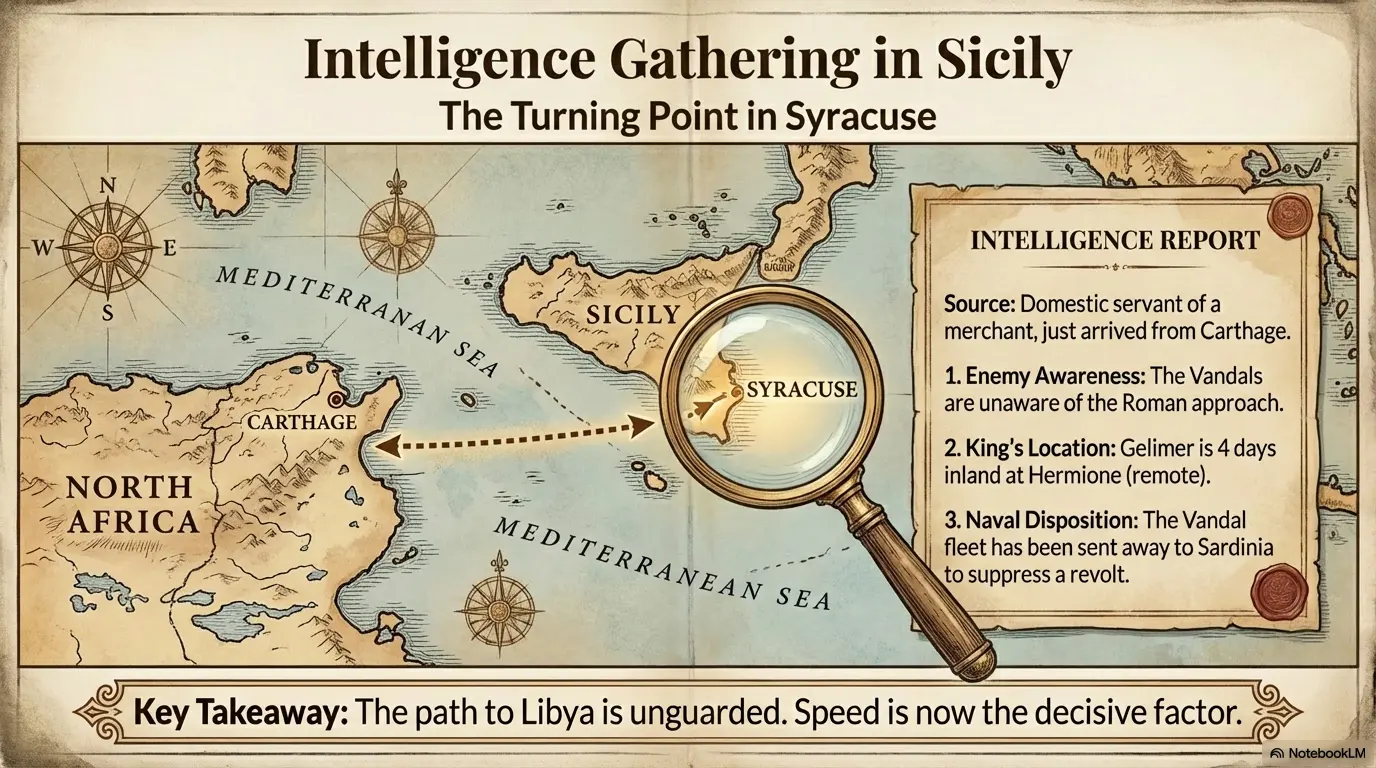
And as they proceeded on their way it was decided that the most advantageous plan was for one of the commanders to choose out the most famous fighters in the whole army and with them go in advance of the others, and make a sudden and unexpected attack upon the enemy, while the rest of the army should proceed without quickening its pace and come upon the scene later. So they cast lots with this plan in view and awaited the decision of fortune in the matter. Now the lot fell out for John, but the commanders were no longer willing to carry out the agreement. Thus it was that John was compelled with his own troops alone to go in advance of the others and make an attack upon the enemy. But the barbarians, learning that their opponents were advancing upon them and being greatly terrified, decided to abandon the plain where they had established their camp, and in confusion ran to the top of a high hill which rises near by. And when the force of John arrived there, they too ran up against the enemy and opened the attack. But since the barbarians defended themselves vigorously, a violent struggle took place and many men on both sides, while making a remarkable display of heroism, were beginning to fall. Now though John had led a charge with loud shouting and tumult against the enemy opposite him, it so happened that one of his bodyguards was hit by a javelin thrown by one of the enemy and fell , as a result of this the Romans, now repulsed, began to retire to the rear. By this time the remainder of the Roman army also had reached the plain, where they formed a phalanx and stood waiting. And if they had stood fast to give support to John's troops, which were now in full flight, they could have advanced all together upon the enemy, and not only would they have defeated them in the battle, but they would have been able also to capture practically the whole force. But by some chance it so fell out that an untrue report was circulated through the Roman army to the effect that John had perished at the hand of one of his own bodyguards during the action then in progress. And when the report came to the commanders, they were no longer willing to hold their position, but they one and all began to retire in a disgraceful sort of retreat. For neither did they keep their troops in order, nor did they move off in any kind of groups, but each man for himself, just as he could, rushed off in headlong flight. And many indeed perished in this flight, and as for the rest, all such as were saved continued their flight for many days although they were not pursued at all. And some time afterwards they entered such strongholds as each one happened upon, and the report they carried to those they chanced to meet was only this, that John was dead. And consequently they were no longer in contact with each other, nor had they any purpose of uniting thereafter against the enemy, but each remained inside the circuit-wall of his own fort and began to prepare for a siege, fearing that the barbarians would come against him. Totila, meanwhile, was shewing great kindness to his prisoners, and thereby succeeded in winning their allegiance, and henceforth the most of them voluntarily served under him against the Romans. And the winter drew to its close, and the seventh year ended in this war, the history of which Procopius has written. [542 ad]
Rome changes hands again
7.20.1. Meanwhile Bessas continued to grow more wealthy than ever by retailing his grain, since his prices were fixed by the necessity of those who wanted it. And since he was entirely wrapped up in his concern for this traffic, he neither paid heed to the defence of the walls nor concerned himself with any other measures for security whatsoever, but any of the soldiers who so wished were allowed to neglect their duties; and meanwhile there was only an insignificant garrison on the walls, and even this received very little attention.
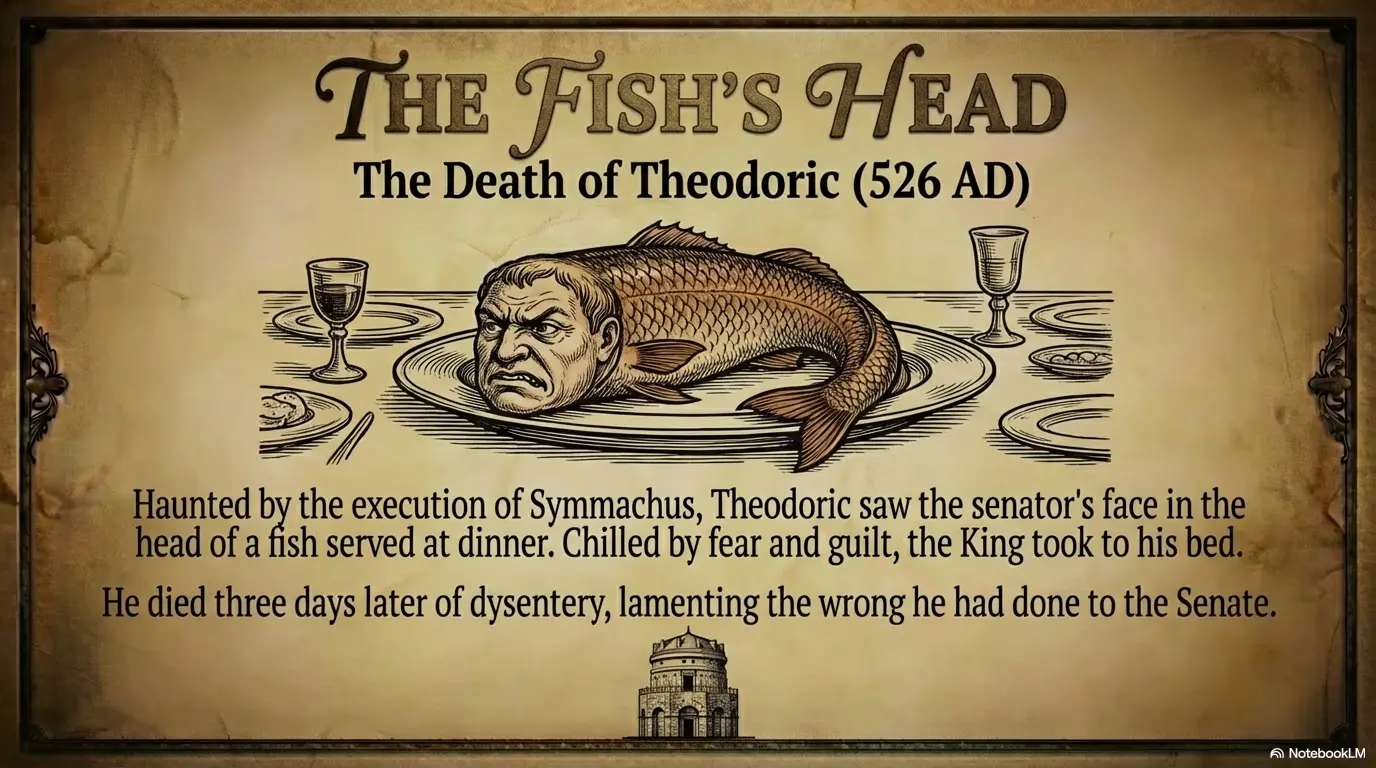
For those who chanced from day to day to be assigned to guard duty were freely permitted to sleep, since no one was put in command of them who might possibly take some notice of such an act; nor did any officers consent to go the rounds of the fortifications, as had been customary, and inspect the guards to see what they were doing, and furthermore not one of the citizens was able to assist them in keeping guard: for an exceedingly small number, as I have said, were left in the city and these were wasted to the last degree by the famine. Thus it came about that four Isaurians who were keeping guard by the Asinarian Gate did as follows: having waited carefully for that part of the night during which it always fell to the lot of the soldiers next them to sleep while the guarding of that portion of the wall devolved upon them, they fastened ropes to the battlement long enough to reach down to the ground, and laying hold of these with both hands got outside the fortifications; then they went before Totila and agreed to receive him and the Gothic army into the city; for, as they declared, they were able to do this without any trouble. And Totila promised that he would be exceedingly grateful to them if they made good these promises and that he would put them in possession of great sums of money; he then sent with them two of his men to look over the place from which these men claimed that the Goths could effect an entrance into the city. So this party came up beside the wall and, laying hold of the ropes, ascended to the battlement, where not a man uttered a sound or observed what was going on. So when they reached the top, the Isaurians shewed the barbarians everything, namely that those who wished to ascend would meet with no obstacle, and that after they had come up they would have complete freedom of action, meeting as they would with not the least resistance; then, after bidding them carry this report to Totila, they sent them away. Now when Totila heard this report, he was, in a way, pleased at the intelligence, but, notwithstanding this, he felt a suspicion as regards the Isaurians and was not inclined to place very much confidence in them. Not many days later these men came to him again, urging him to undertake the enterprise. Totila thereupon sent two other men with them, with instructions that they too should make a thorough investigation of the whole situation and bring back a report. And these men, upon returning to him, made a report in all respects like that of those previously sent. But during this time a large force of Roman soldiers, who were out on a reconnoitering expedition, charged upon ten Goths walking along a road not far from the city, and they took them prisoners and straightway brought them before Bessas. And he enquired of these barbarians what Totila's purpose really was; and the Goths said that he was in hopes that some of the Isaurians would deliver the city to him: for the story had already become known to many of the barbarians. But even when Bessas and Conon heard this, they treated the matter with great unconcern and took no heed of the report. And a third time the Isaurians came into the presence of Totila and tried to induce the man to do the deed. So he sent with them a number of men and among them one related to him by blood, and they, upon returning to him, reported the whole situation and encouraged him to proceed. Totila, then, as soon as night came on, put his whole force under arms in silence and led them up near the Asinarian Gate. And he commanded four men who were conspicuous among the Goths for their bravery and strength to climb up the ropes with the Isaurians to the battlements, during that part of the night, of course, in which the guarding of that portion of the wall fell to the Isaurians while the others were taking their turn at sleeping.

And when these men got inside the fortifications, they descended to the Asinarian Gate without meeting any opposition; there they shattered with axes both the wooden beam with which the Romans customarily made the gates fast by fitting it into recesses in the wall on either side, and also all the ironwork into which the guards always inserted their keys to shut the gates or open them according to the need of the moment. Then they swung the gates open, just as they wished to do, and without any trouble received Totila and the Gothic army into the city. But Totila collected his men there in one place and would not allow them to scatter at all, for he feared that they would fall into some ambush set by the enemy. And tumult and confusion, as was natural, fell upon the city, and the most of the Roman soldiers were fleeing with their commanders through another gate, each one taking whatever course he found easy to follow, while only a few with the rest of the Romans were taking refuge in the sanctuaries. Among the patricians Uecius and Basil ius, in company with a few others (for horses happened to be at hand for them) succeeded in escaping with Bessas. But Maximus, Olybrius, Orestes, and some others fled to the church of the Apostle Peter. Among the common people, however, it so fell out that only five hundred men had been left throughout the whole city, and these with difficulty found refuge in the sanctuaries. For all the rest of the population were gone, some having departed to other lands and some having been carried off by the famine, as I have stated above. Now many persons during that night kept reporting to Totila that both Bessas and the enemy were fleeing. But he, saying the report they had given was a pleasing one, would not permit a pursuit. "For what could be sweeter for a man," he said, "than a fleeing enemy." When it was already day and there was now no suspicion left of any ambush, Totila, for his part, went to the church of the Apostle Peter to pray, but the Goths began to slay those who fell in their way. And in this manner there perished among the soldiers twenty-six, and among the people sixty. And when Totila had come to the sanctuary, Pelagius came before him carrying the Christian scriptures in his hand, and, making supplication in every manner possible, said " Spare thine own, O Master." And Totila, mocking him with a haughty air of indifference, said "Now at last, Pelagius, you have come to make yourself a suppliant before me." "Yes" replied Pelagius, "at a time when God has made me your slave. Nay, spare your slaves, O Master, from now on." And Totila received this supplication with favour and forbade the Goths thereafter to kill any Roman at all, but he permitted them, while setting aside for him the most valuable of the property, to have unrestricted authority to plunder all the rest for themselves. Now he found much of value in the houses of patricians, but most of all in the house where Bessas had lodged. For that ill-starred wretch had been only collecting for Totila the outrageous sums which, as set forth above, he had charged for the grain. And thus the Romans in general, and particularly the members of the senate, found themselves reduced to such straits that they clothed themselves in the garments of slaves and rustics, and lived by begging bread or any other food from their enemies; a very notable example of this change of fortune being that of Rusticiana, the daughter of Symmachus, who had been wife of Boetius, a woman who was always lavishing her wealth upon the needy. Indeed these wretches went about to all the houses and kept knocking at the doors and begging that they give them food, feeling no shame in doing so. Now the Goths, on their part, were eager to put Rusticiana to death, bringing against her the charge that after bribing the commanders of the Roman army, she had destroyed the statues of Theoderic, her motive in so doing having been to avenge the murder not only of her father Symmachus, but also of her husband Boethius.
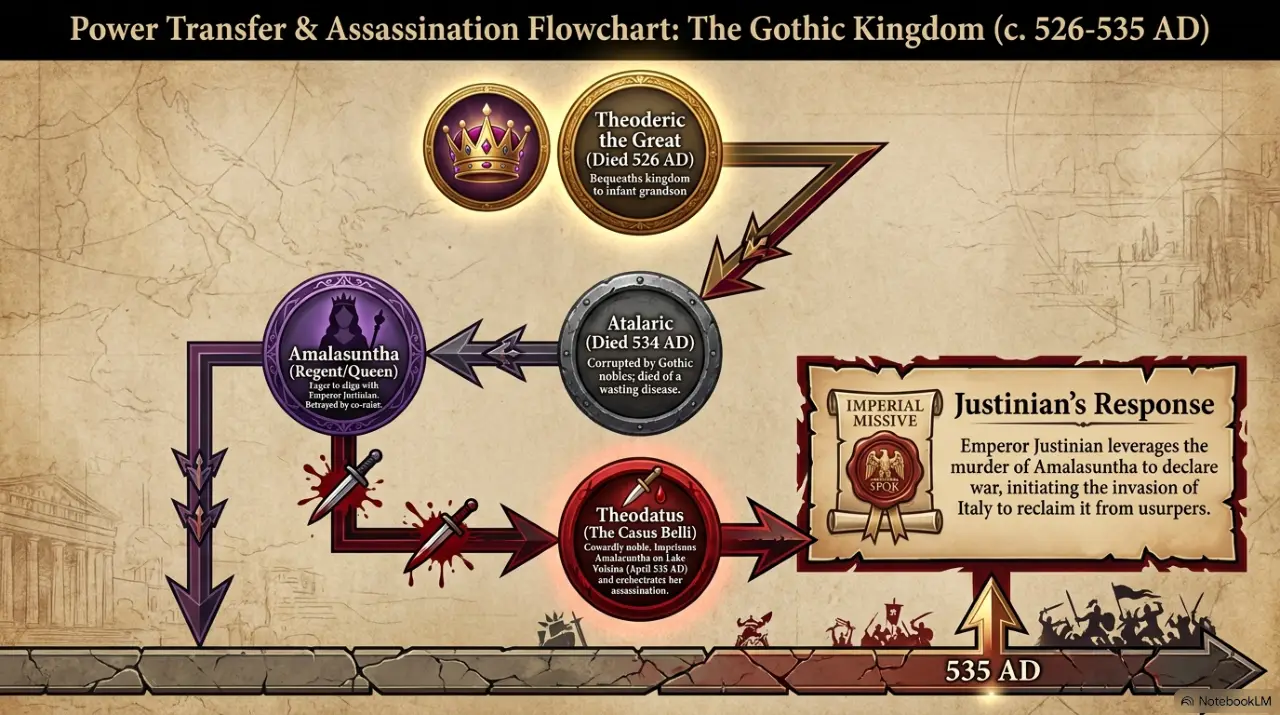
But Totila would not permit her to suffer any harm, but he guarded both her and all the other women safe from insult, although the Goths were extremely eager to have intercourse with them. Consequently not one of them had the ill fortune to suffer personal insult, whether married, unwed, or widow, and Totila won great renown for moderation from this course.
7.21.1. On the day following the capture Totila gathered all the Goths together and spoke as follows: "Fellow-soldiers, it is not with the purpose of making to you any new or unknown exhortation that I have brought you together in this place, but in order to say those very things which I have often said to you, and which you for your part have heeded with the result that the greatest of blessings have fallen to your lot. Do not, therefore, on this account regard this present exhortation as of little moment. For when words lead to good fortune, men ought not to feel surfeit of them, even though the speaker seem to wear out his hearers with much speaking; for they cannot reasonably reject the benefit gained from such words. Now what I would say is this: only yesterday, as it were, we assembled a host of two hundred thousand most warlike soldiers, we had at our disposal enormous wealth, and could display a lavish abundance of both horses and arms, we had a numerous company of mature men of the greatest discretion — a circumstance considered most advantageous for those entering upon a war — and yet, with all this in our favour, we were vanquished by five thousand Greeklings,p and for no good reason were stripped of our power and everything else that was ours. But now it has been our fortune, though reduced to a small number, destitute of arms and in pitiable plight and without any experience at all, to gain the mastery over an enemy more than twenty thousand strong. Our experience, then, to put it in a word, has been such as I have described. But the causes of this outcome, though you know them full well, I must now state to you. The Goths in earlier times paid less heed to justice than to any other thing, and treated each other and their Roman subjects as well in an unholy manner; wherefore God was then moved to take the field against them on the side of their enemies. And so, although we were far superior to our opponents in number and in valour and in the general equipment for war, we were defeated by a power which was invisible and quite uncomprehended. It will therefore rest with you to guard your blessings — manifestly by continuing to observe justice. For if you change your course, God too will instantly change His favour and become hostile to you. For it is not His wont to fight with a race of men or a particular nation, but with such as shew the greater honour to justice. And for Him it is no labour to transfer his blessings from one people to the other. For whereas only to refrain from wrong-doing inheres in the will of man, God by His very nature has all things in His power. I say, therefore, that you must observe justice strictly both in your dealings with each other and with your subjects; for it would amount to the same thing to tell you to preserve your good fortune for ever." After Totila had made this speech before the Goths, he likewise called together the members of the Roman senate, and reproached and abused them at length, saying that, although they had received many benefits from both Theoderic and Atalaric, in that they themselves had always been appointed to the chief offices throughout the kingdom and had thus administered the government, and had, furthermore, amassed vast wealth, still they had acted with such ingratitude toward the Goths, their benefactors, that, regardless of their obligations, they had planned a revolt to their own harm, and brought in the Greeks to attack their fatherland, thus turning traitors to themselves on the impulse of the moment.
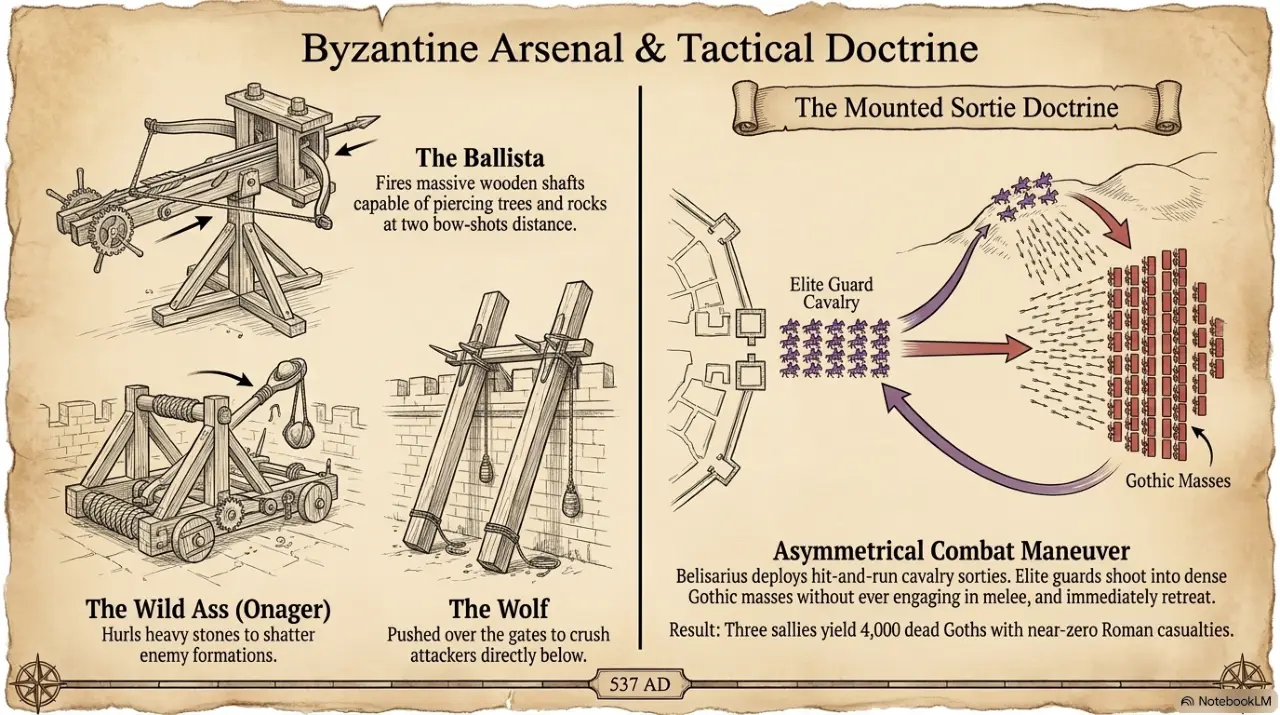
Then, after enquiring whether they had ever suffered any personal harm at the hands of the Goths, he compelled them to state whether any good thing came to them from the Emperor Justinian, reviewing all that had happened in order: first, they had, he said, been stripped of practically all the offices; second, they had been maltreated by the logothetes,p as they were called, in that they had been compelled to settle accounts for their treatment of the Goths during their official careers; and, third, although they were in dire straits on account of the war, they were paying the Greeks not a whit less in public taxes than in times of peace. And he included many other things too in his speech, such things as an angry master might be expected to say in upbraiding men who have become his slaves. Then he set before them Herodian and the Isaurians who had handed over the city to him, and said: "You, who have been reared together with the Goths, have not up to the present day seen fit to surrender to us even one empty town, but these men have received us into Rome itself and Spolitium. By this action you have been reduced to the rank of household slaves, while these men, seeing that they have really proved themselves friends and kinsmen of the Goths, will hold your offices hereafter." Now when the patricians heard this, they sat in silence. But Pelagius began to plead with Totila for them as men who had suffered reverse and misfortune, and would not let him go until he made them a promise of kind treatment and thus sent them away. After this he sent Pelagius and one of the Roman orators, Theodorus by name, as envoys to the Emperor Justinian, having bound them by most solemn oaths that they would remain loyal to him and would make every effort to return to Italy as quickly as possible. And he instructed them to exert themselves to the utmost to secure peace for him from the emperor, in order, as he said, that he, for his part, might not be compelled to raze Rome entirely to the ground, to destroy the members of the senate, and to carry the war into Illyricum. And he also wrote a letter to the Emperor Justinian. Now the emperor had already heard of what had taken place in Italy. But when later on the envoys came before him, they delivered the message which Totila had instructed them to bring and put the letter into his hands. Now the contents of the letter were as follows: "As to what has transpired in the city of Rome, since I suppose thou hast learned everything, I have decided to remain silent. But as to the purpose for which I have sent these envoys, thou shalt straightway be informed. We demand that thou, for thy part, take to thyself the advantages which flow from peace and also grant them to us. These advantages are recalled and exemplified most admirably in the lives of Anastasius and Theoderic, who ruled as kings not long ago, and filled their whole reigns with peace and prosperity. And if this same condition should perchance please thee, thou wouldst properly be called my father, and thou wilt also have us hereafter as allies against whomsoever thou mayest wish to use us." When the Emperor Justinian saw this letter thus brought to him, and heard all the words of the envoys, he dismissed them instantly, giving them only this reply and writing it to Totila, that he had made Belisarius supreme commander in the war, and that he, consequently, had full power to make such settlement with Totila as he wished.
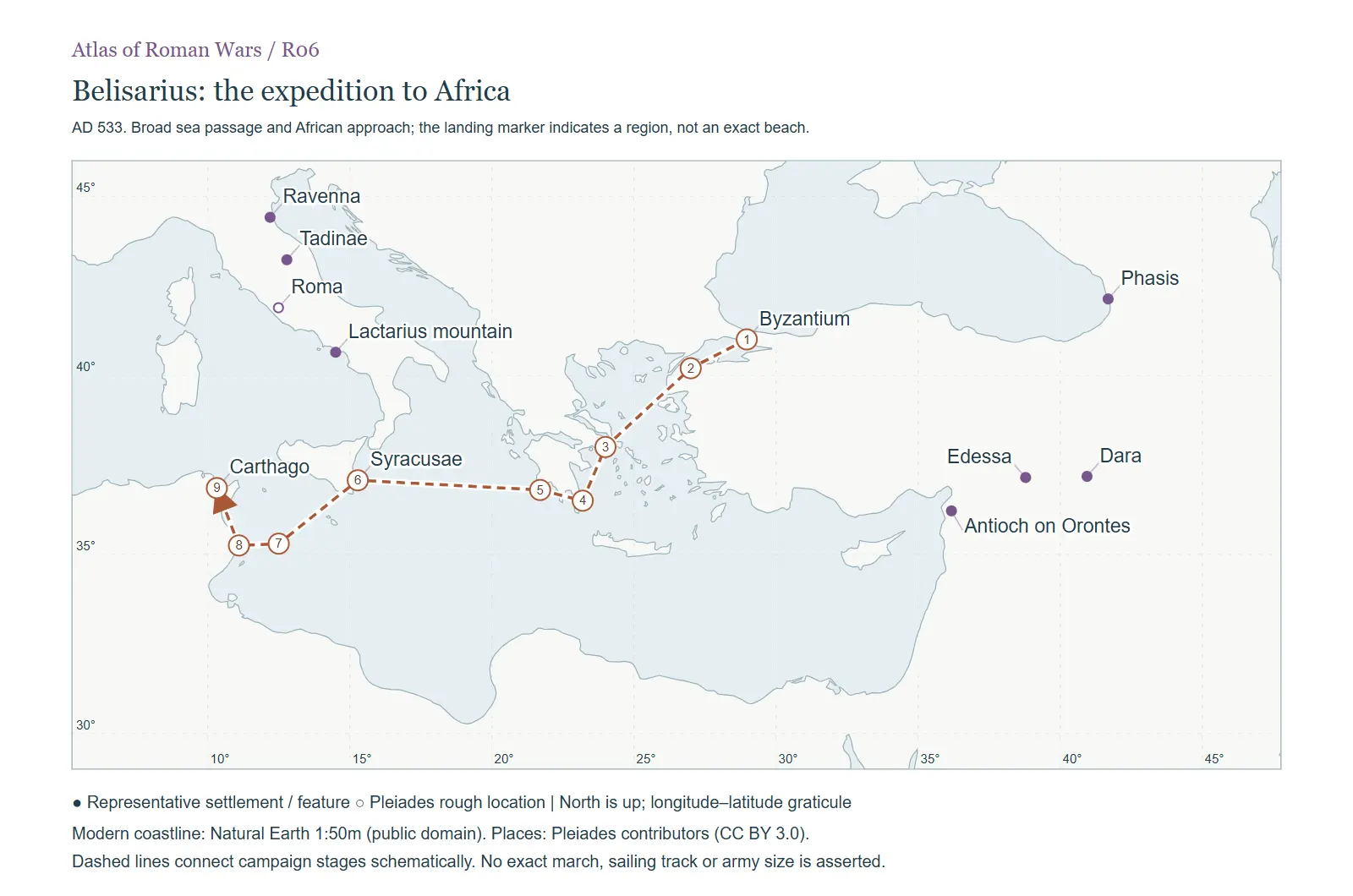
Narses, Taginae and the last Gothic field army
8.29.1. Such were the events of the march of the Roman army. Now Totila, having already learned what had taken place in Venetia, at first remained quiet in the vicinity of Rome awaiting Teias and his army. But when they had come and only two thousand horsemen were still missing, Totila, without awaiting these, started on the march with all the rest of the army in order to encounter the enemy in a suitable place. But he learned on this march both what had befallen Usdrilas and also that his enemy had passed by Ariminum, whereupon he crossed the whole of Tuscia, and upon reaching the mountains called the Apennines established his camp there and remained close to a village which the inhabitants call Taginae. And the Roman army led by Narses also made camp on the Apennines not long afterward and remained in that position, about one hundred stades distant from the camp of their opponents, in a place which is level but surrounded by many hills close by, the very place where once, they say, Camillus as general of the Romans defeated in battle and destroyed the host of the Gauls. And the place even to my day bears witness to this deed in its name and preserves the memory of the disaster which befell the Gauls, being called Busta Gallorum. For the Latins call the remains of the funeral pyre "busta." And there are great numbers of mounded tombs of their bodies in this place.
8.29.6. Now Narses immediately sent from there some of his associates, bidding them exhort Totila to lay aside warfare and at last make plans for peace, for he must realize that as ruler of only a small number of men recently banded together by no law, he would not be able to contend for very long with the whole Roman empire. But he told them this also, that, if they saw that Totila was determined to fight, they should immediately urge him to appoint a definite day for the battle. These envoys accordingly came before Totila and carried out their instructions. And he in a spirit of bravado began to boast that by all means they must fight, but the envoys rejoined quickly, "Very well, good Sir, appoint some definite time for the engagement." Whereupon he immediately said, "At the end of eight days let us match our strength." So the envoys returned to Narses and reported their agreement, whereupon he, suspecting that Totila was planning treachery, made preparations to fight on the following day. And in fact he was right in his judgment of the purpose of his enemy. For on the succeeding day Totila was at hand self-announced with his whole army. And immediately the two armies took up positions opposite one another, not more than two bowshots apart.
8.29.11. Now there was a small hill there which both were eager to occupy, thinking that it was favourably situated for their purposes, both in order to shoot at their opponents from a high point of vantage, and also because the ground being hilly thereabout, as I have previously stated, it was impossible for anyone to encircle the Roman camp on that side and get behind it except by following a single path which happened to skirt the hill. Consequently both of them were bound to consider it of particular importance; the Goths, in order that they might surround their enemy during the engagement and so place them between two forces, and the Romans, in order that they might not have this thing happen to them. But Narses had anticipated the Goths by choosing fifty infantrymen from a cohort and sending them late at night to occupy and hold the hill. And they, finding none of the enemy in the way, went there and remained quiet. Now there is a certain water-course in front of the hill, running along the path which I have just mentioned and opposite the spot where the Goths had made their camp, and it was at this point that the fifty took up their position, standing shoulder to shoulder and arrayed in the form of a phalanx as well as the limited space permitted.
8.29.16. After day came, Totila saw what had happened and was eager to dislodge them. So he immediately sent a troop of horsemen against them with orders to drive them out from there as quickly as possible. The horsemen accordingly charged upon them with great hubbub and shouting, intending to capture them at the first cry, but the Romans drew up together into a small space and, making a barrier with their shields and thrusting forward their spears, held their ground. Then the Goths came on, charging in haste and thus getting themselves into disorder, while the fifty, pushing with their shields and thrusting very rapidly with their spears, which were nowhere allowed to interfere one with the other, defended themselves most vigorously against their assailants; and they purposely made a din with their shields, terrifying the horses, on the one hand, by this means, aud the men, on the other, with the points of their spears. And the horses became excited, because they were greatly troubled both by the rough ground and by the din of the shields, and also because they could not get through anywhere, while the men at the same time were gradually worn out, fighting as they were with men packed so closely together and not giving an inch of ground, and trying to manage horses that did not in the least obey their urging. So they were repulsed in the first attack and rode back. And a second time they made the attempt and retired with the same experience. Then, after faring thus many times, they no longer continued the attack, but Totila substituted another troop for this work. And when they fared as their predecessors had, still others undertook the task. So after Totila had in this way sent in many troops and had accomplished nothing with all of them, he finally gave up.
8.29.22. Thus the fifty won great renown for valour, but two of them distinguished themselves particularly in this action, Paulus and Ansilas, who had leaped out from the phalanx and made a display of valour surpassing all others. For they drew their swords and laid them on the ground, and then stretched their bows and kept shooting with a most telling aim at the enemy. And they destroyed many men and many horses as well, as long as their quivers still held arrows. At length, when their missiles had now entirely failed them, seizing their swords and holding their shields before them, all by themselves they warded off the assailants. And whenever any of their opponents on horseback came at them with their spears, they immediately broke off the heads of the spears with a blow of their swords. But after they had in this manner checked the onrushes of the enemy many times, it came about that the sword of one of them (this was Paulus) was bent double by the frequent cutting of the wooden shafts and so was utterly useless. This then he immediately threw on the ground, and seizing the spears with both hands he would wrench them from his assailants. And by wrenching four spears from the enemy in this way in the sight of all he made himself the chief cause of their abandoning their attempt. Wherefore, in consequence of the exploit, Narses made him a personal guard of his own from that time on.
8.30.1. Such was the progress of these events. Both armies now prepared for action. And Narses gathered his army in a small space and exhorted them as follows. " When an army is entering the combat with its strength evenly matched with that of the enemy, a long speech of exhortation and encouragement would perhaps be necessary of the sort which would inspire the men with ardour, in order that, being superior to the enemy in this respect they might find the issue of the combat wholly what they wish.
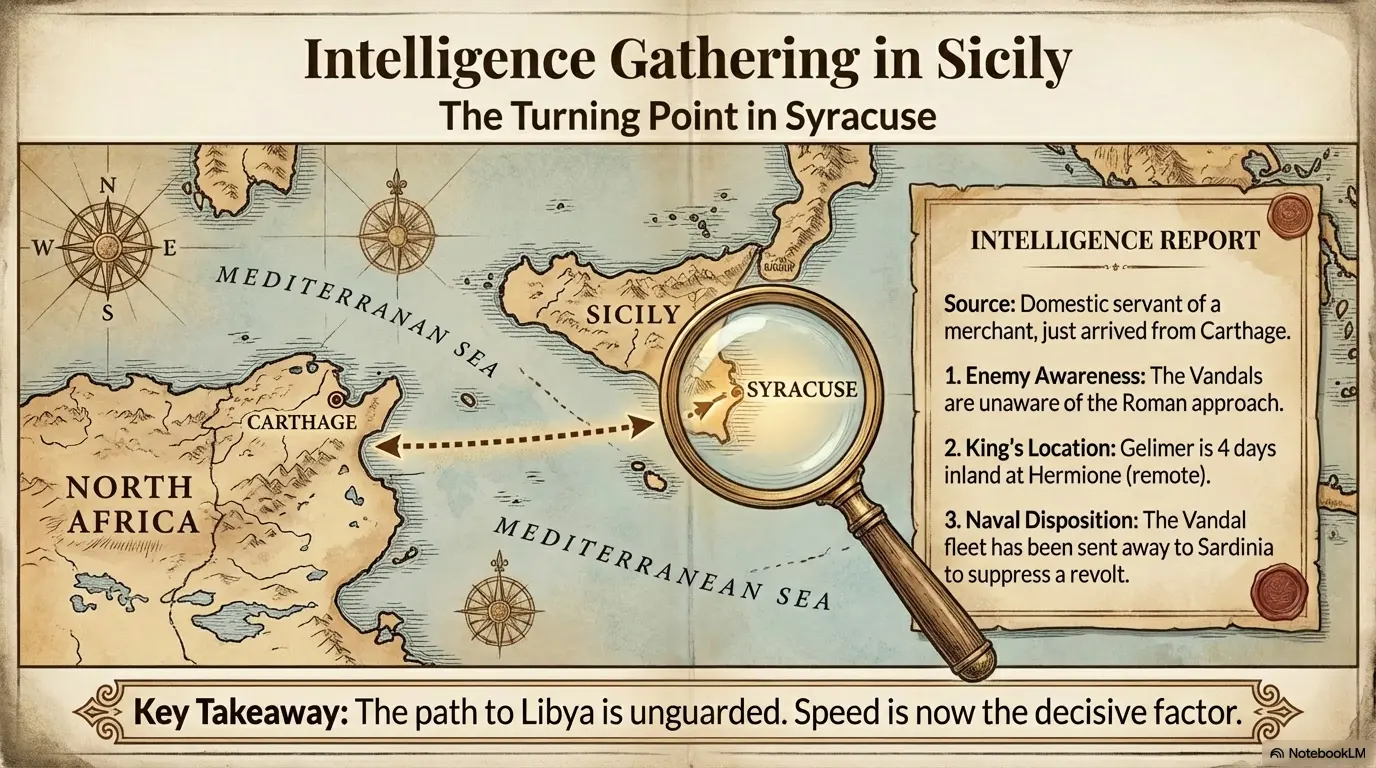
But in your case, my men, you who have to fight against an army vastly inferior to you in valour, in numbers, and in every sort of equipment besides, I think nothing further is necessary than that we enter this engagement with God propitious to us. Do you, then, invoke His alliance with unceasing prayer, and so fare forth with great contempt to achieve the overthrow of these robbers, who, being originally slaves of the great emperor and then turning fugitives and setting a tyrant over themselves who was a worthless fellow from the common rabble, have been able for a certain season to work havoc in the Roman empire by their thievish actions. And yet one would have supposed that these men would not even have arrayed themselves against us now, if they had considered the probabilities. Yet they are playing a desperate game with an irrational sort of boldness and displaying the rashness of frenzy, and in this spirit they dare to embrace a death which obviously awaits them, not shielding themselves by a reasonable hope, nor even looking forward to see what will fall to their lot through a strange and unexpected turn of events, but being indisputably led on by God to the punishment earned by their administration of the state. For such men as have been condemned to suffer by the powers above move on to their punishment unaided. But aside from this, while you for your part are entering this combat in defence of a lawful government, they are in revolt against the laws and fighting a battle of desperation, not expecting to transmit anything they hold to any successors, but well assured that it will all perish with them and that the hope on which they live is ephemeral. Consequently they deserve thoroughly to be despised. For those who are not organized under law and good government are bereft of all virtue, and the victory, naturally, is already decided; for victory is not accustomed to range itself against the virtues." Such was the exhortation which Narses made.
8.30.7. And Totila likewise, seeing his men in abject terror of the Roman army, called them all together and spoke as follows: "Fellow-soldiers, I have brought you together here with the purpose of making a final exhortation. For no other admonition will, I believe, be necessary after this battle, but the result will certainly be that the war will be decided on one day. For so thoroughly have both we and the Emperor Justinian become exhausted and stripped of all power through being subjected to toils and battles and hardships for an exceedingly long time, and so completely have we found ourselves unable to meet the demands of the war, that, if we shall overcome our opponents in this present engagement, they will be utterly unable to come back in the future, while if we meet with any reverse in this battle, no hope will be left the Goths of renewing the fight, but either side will have in defeat a thoroughly sufficient excuse for inaction.
8.30.10. or when men once give up the fight against overwhelming obstacles, they no longer have the courage to return to them, but even when they are perhaps strongly impelled to do so by actual need, their hearts rebel, for the memory of their failure makes their spirit quail. Having heard this, my men, play the brave part with all your might, without holding any fighting power in reserve for some other occasion, and put your whole strength into the struggle without trying to save your bodies for another danger. And let there be on your part no sparing of arms or of horses, for they will never again be useful to you. For fortune, having demolished everything else, has preserved only the ultimate hope for this day. Tune your hearts, then, to a high courage, and make ready for deeds of noble daring. For when hope hangs by a thread, as it now does with you, the only safe course will be not to lose courage for the briefest moment of time. For after the point of the crisis has passed, zeal becomes for ever worthless, even though it be of an altogether immoderate sort, since the nature of things has no place for valour after the event, for once the need has passed, everything which follows must necessarily be too late. I believe, then, that you should enter the struggle making the best use of every opportunity which presents itself in action, so that you may be enabled also to enjoy the benefits to come from it. And you understand well that in the present situation he who flees thoroughly deserves his own destruction. For men abandon their post and flee for no other reason than that they may live; but if flight can be seen to involve the death of the fugitive, he who faces the danger will be in much greater safety than the man who flees. But the vast number of the enemy is worthy only to be despised, seeing that they present a collection of men from the greatest possible number of nations. For an alliance which is patched together from many sources gives no firm assurance of either loyalty or power, but being split up in nationality it is naturally divided likewise in purpose.
8.30.18. And do not think that Huns and Lombards and Enili, hired by them with I know not how much money, will ever endanger themselves for them to the point of death. For life with them is not so cheap as to take second place to silver in their estimation, but I well know that after making an appearance of fighting they will desert with all speed, either because they have received their pay, or as carrying out the orders of their own commanders. For even things that seem most delightful, — to say nothing of what happens in war — if they do not turn out in accordance with men's wishes, but if they are forced or hired or subject to any other compulsion, then such things will come no longer to be accounted pleasant, but by reason of the compulsion appear detestable. Remembering these things let us with all enthusiasm engage with the enemy."
8.31.1. This then spoke Totila. And the armies drew together for battle and arrayed themselves as follows. All the forces in each army took their stand facing the enemy, making the phalanx as deep as possible and the front very long. And the Roman left wing was held by Narses and John near the hill, and with them was the flower of the Roman army; for each of them had, apart from the other soldiers, a great following of spearmen and guards and barbarian Huns, all chosen for their valour; and on the right were arrayed Valerian and John the Glutton along with Dagisthaeus and all the rest of the Romans. Furthermore, they placed on both wings about eight thousand unmounted bowmen from the regular troops. But at the centre of the phalanx Narses had placed the Lombards and the nation of the Eruli and all the other barbarians, causing them to dismount from their horses and making them infantry, in order that, if it should chance that they turned cowards in the engagement or deserted, they might not be too eager to fly.
8.31.6. Now Narses had set the extreme left wing of the Roman front at an angle, placing fifteen hundred cavalry there. And the instructions previously given provided that the five hundred, on the one hand, should rush to the rescue the moment that any of the Romans chanced to be driven back, while the thousand, at the moment when the enemy's infantry began action, were to get behind them immediately and thus place them between two forces. And Totila arrayed his army in the same way opposite his enemy. Then going along his own battle-line he kept encouraging his soldiers with voice and expression and urging them to boldness. Narses likewise did the same thing, holding in the air bracelets and necklaces and golden bridles on poles and displaying certain other incentives to bravery in the coming struggle. For some time, however, neither army began battle, but both remained quiet awaiting the assault of their opponents.
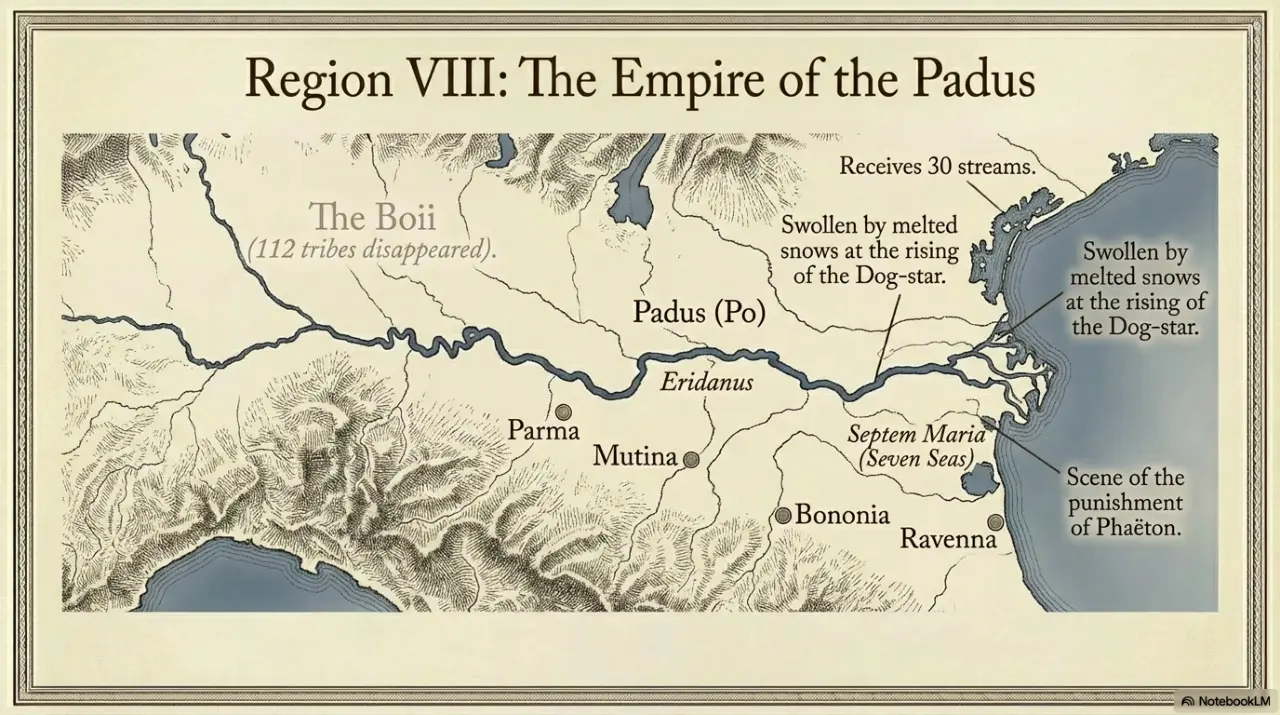
8.31.11. But later on one man of the Gothic army named Coccas, who had a great reputation as an active fighter, rode his horse out and came close to the Roman army and uttered a challenge, if anyone was willing to come forth against him in single combat. Now this Coccas happened to be one of the Roman soldiers who had previously deserted to Totila. And immediately one of the spearmen of Narses stood forth against him, a man of Armenian birth named Anzalas, who was likewise mounted on a horse. Coccas then made the first rush and charged his foe in order to smite him with his spear, aiming the weapon at his belly. But Anzalas, by suddenly turning his horse aside, caused the charge of his enemy to be futile. By this manoeuvre he was placed on his enemy's flank and he now thrust his spear into his left side. And Coccas fell from his horse to the ground and lay there a dead man. Whereupon a tremendous shout arose from the Roman army, but even then neither side began any fighting.
8.31.17. But Totila now went alone into the space between the armies, not in order to engage in single combat, but in order to prevent his opponents from using the present opportunity. For he had learned that the two thousand Goths who had been missing were now drawing near, and so he sought to put off the engagement until their arrival by doing as follows. First of all, he was not at all reluctant to make an exhibition to the enemy of what manner of man he was. For the armour in which he was clad was abundantly plated with gold and the ample adornments which hung from his cheek-plates as well as from his helmet and spear were not only of purple but in other respects befitting a king, marvellous in their abundance. And he himself, sitting upon a very large horse, began to perform the dance under arms skilfully between the armies. For he wheeled his horse round in a circle and then turned him again to the other side and so made him run round and round. And as he rode he hurled his javelin into the air and caught it again as it quivered above him, then passed it rapidly from hand to hand, shifting it with consummate skill, and he gloried in his practice in such matters, falling back on his shoulders, spreading his legs and leaning from side to side, like one who has been instructed with precision in the art of dancing from childhood. By these tactics he wore away the whole early part of the day. And wishing to prolong indefinitely the postponement of the battle, he sent to the Roman army saying that he wished to confer with them. But Narses declared that he must be trifling, seeing that he had been set on fighting at the time when there was opportunity to make proposals, but now, upon reaching the battle-field, he came forward to parley.
8.32.1. Meanwhile the two thousand Goths arrived; and when Totila had learned that they had reached the stockade, seeing that it was time for the morning meal, he himself went off to his own tent and the Goths began to break up their formation and retire. And when Totila reached his quarters, he found the two thousand already present. He then commanded all to take their meal, and changing his entire equipment he armed himself with all care with the private soldier's equipment and led the army out straightway against his enemy, thinking that he would fall upon them unexpectedly and thus overwhelm them. But even so he did not find the Romans unprepared. For Narses had feared, as actually happened, that the enemy would fall upon them when they were not expecting it, and so he had given orders that not a single man should either sit down to lunch or go off to sleep or even remove his cuirass, nor yet take his bridle off his horse. However, he did not allow them to be altogether without food, but commanded them to eat a small meal in ranks and with their equipment on, meanwhile maintaining a sharp look-out constantly and expecting the attack of the enemy. However, they were no longer arrayed in the same formation as before, for the Roman wings, in each of which four thousand unmounted horsemen had taken their stand, were moved forward at Narses' command so as to form a crescent, out the Gothic infantry were all placed in a body in the rear of the cavalry, in order that, if the horsemen should be routed, the fugitives might fall back upon them and be saved, and all could then advance immediately together.
8.32.6. Now orders had been given to the entire Gothic army that they should use neither bow nor any other weapon in this battle except their spears. Consequently it came about that Totila was outgeneralled by his own folly; for in entering this battle he was led, by what I do not know, to throw against his opponents his own army with inadequate equipment and outflanked and in no respect a match for their antagonists. For the Romans, on the one hand, made use of each weapon in the fighting according to the particular need of the moment, shooting with bows or thrusting with spears or wielding swords, or using any other weapon which was convenient and suitable at a given point, some of them mounted on horses and others entering the combat on foot, their numbers proportioned to the needs of the situation, so that at one point they could carry out an encircling movement around the enemy, and at another receive a charge and with their shields stop short the attack. The cavalry of the Goths, on the other hand, leaving their infantry behind, and trusting only to their spears, made their charge with reckless impetuosity; and once in the midst of the fray they suffered for their own folly. For in making their charge against their enemy's centre they had, before they realized it, placed themselves in between the eight thousand infantry, and being raked by their bowshots from either side they gave up immediately, since the bowmen kept gradually turning both the wings of their front so as to form the crescent which I have mentioned above. Consequently the Goths lost many men as well as many horses in this phase of the encounter before they had ever engaged with their opponents, and only after they had experienced very heavy losses did they with difficulty finally reach the ranks of their enemy.
8.32.11. At this point I cannot admire any of the Romans or of their barbarian allies more than the others. For they all shewed a common enthusiasm and displayed the same valour and energy in action, for each of them received the enemy's attack with the utmost vigour and repulsed the assault. And it was now toward evening when each of the two armies suddenly began to move, the Goths in retreat and the Romans in pursuit. For the Goths could no longer hold out against the onslaught of their enemy, but began to give ground before their attacks, and finally turned precipitately, terrified by their great numbers and their perfect order. And they gave not a thought to resistance, being as filled with terror as if some apparitions of the air had fallen upon them or as if Heaven were warring against them. But when shortly they reached their own infantry, their misfortune was doubled and trebled. For they did not come to them in an orderly retreat, as with the purpose of recovering their breath and renewing the fight with their assistance, as is customary; indeed they had no intention either of throwing back their pursuers by a massed attack or of undertaking a counter pursuit or any other military manoeuvre, but they arrived in such disorder that some of the men were actually destroyed by the onrushing cavalry. Consequently the infantry did not open intervals to receive them nor stand fast to rescue them, but they all began to flee precipitately with the cavalry, and in the rout they kept killing each other just as in a battle at night.
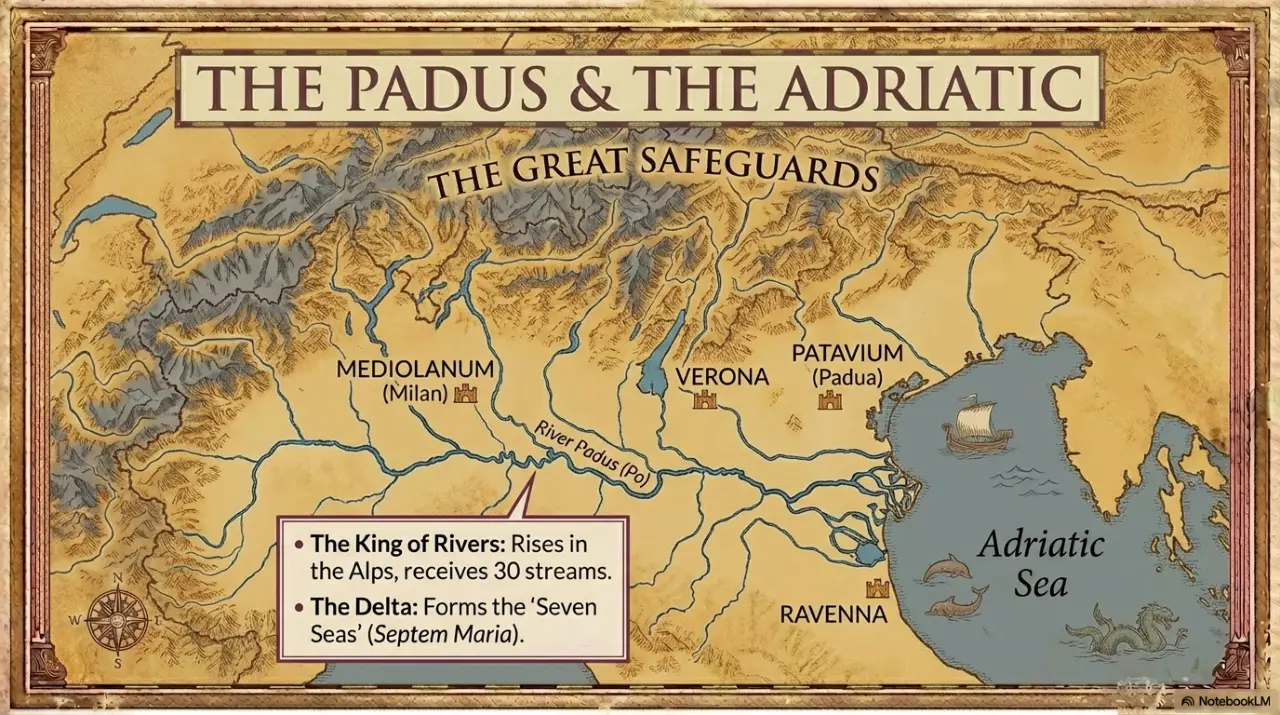
Meanwhile the Roman army, profiting by their panic, continued to kill without mercy all who fell in their way, while their victims offered no defence nor dared look them in the face, but gave themselves up to their enemy to treat as they wished; so thoroughly had terror settled upon them and panic possessed them.
8.32.20. Six thousand of the Goths perished in this battle, while great numbers put themselves into the hands of their opponents. These the Romans for the moment made prisoners, but a little later they slew them. And not Goths alone were destroyed, but also great numbers of the old Roman soldiers who had earlier detached themselves from the Roman army and deserted, as I have told in the previous narrative, to Totila and the Goths. But all the soldiers of the Gothic army who had the fortune neither to perish nor to come under the hand of their enemy were able to hide or to flee, according as each could avail himself of horse or foot or good luck so as to find opportunity for the one or a place for the other.
8.32.22. Such was the conclusion of this battle, and complete darkness was already settling down. But Totila was in flight through the night accompanied by not more than five men, one of whom chanced to be Scipuar, pursued by some of the Romans who did not know that he was Totila; among these was Asbadus of the Gepaedes. This man had drawn close to Totila and was charging him with the purpose of thrusting his spear into his back. But a Gothic youth of the household of Totila, who was following his fleeing master, outraged at what was taking place, cried aloud, "What is this, you dog? Are you rushing to smite your own master?" Then Asbadus thrust his spear with all his strength at Totila, but he himself was wounded in the foot by Scipuar and remained there. And Scipuar was wounded in turn by one of the pursuers and stopped, whereupon those who had been making the pursuit with Asbadus, four in number, gave up the chase in order to save him, and turned back with him. But the escort of Totila, thinking that the enemy were still pursuing them, rode forward without pausing, taking him along with great determination, though mortally wounded and fainting, for necessity compelled them to that headlong flight. So after covering eighty-four stades they came to a place called Caprae. Here they rested from travel and endeavoured to treat the wound of Totila, who not long afterwards completed the term of his life. And there his followers buried him in the earth and departed.
8.32.28. Such was the conclusion of the reign and the life of Totila, who had ruled the Goths eleven years. But the end which came to him was not worthy of his past achievements, for everything had gone well with the man before that, and his end was not commensurate with his deeds. But here again Fortune was obviously disporting herself and tearing human affairs to shreds by way of making a display of her own perverse nature and unaccountable will; for she had endowed Totila of her own free will with prosperity for no particular reason for a long time, and then after this fashion smote the man with cowardice and destruction at the present time for no fitting cause. But these things, I believe, have never been comprehensible to man, nor will they ever become so at any future time. And yet there is always much talk on this matter and opinions are being for ever bandied about according to each man's taste, as he seeks comfort for his ignorance in an explanation which seems reasonable. But I shall return to the previous narrative.
8.32.31. The Romans, indeed, did not know that Totila had been thus taken from the world, until a certain woman of the Gothic race told them and pointed out the grave. But when they heard it they did not think the story sound, and so they came to the spot and with no hesitation dug out the grave and brought up from it the corpse of Totila; then, they say, after recognizing him and satisfying their curiosity with this sight, they again buried him in the earth and immediately reported the whole matter to Narses.
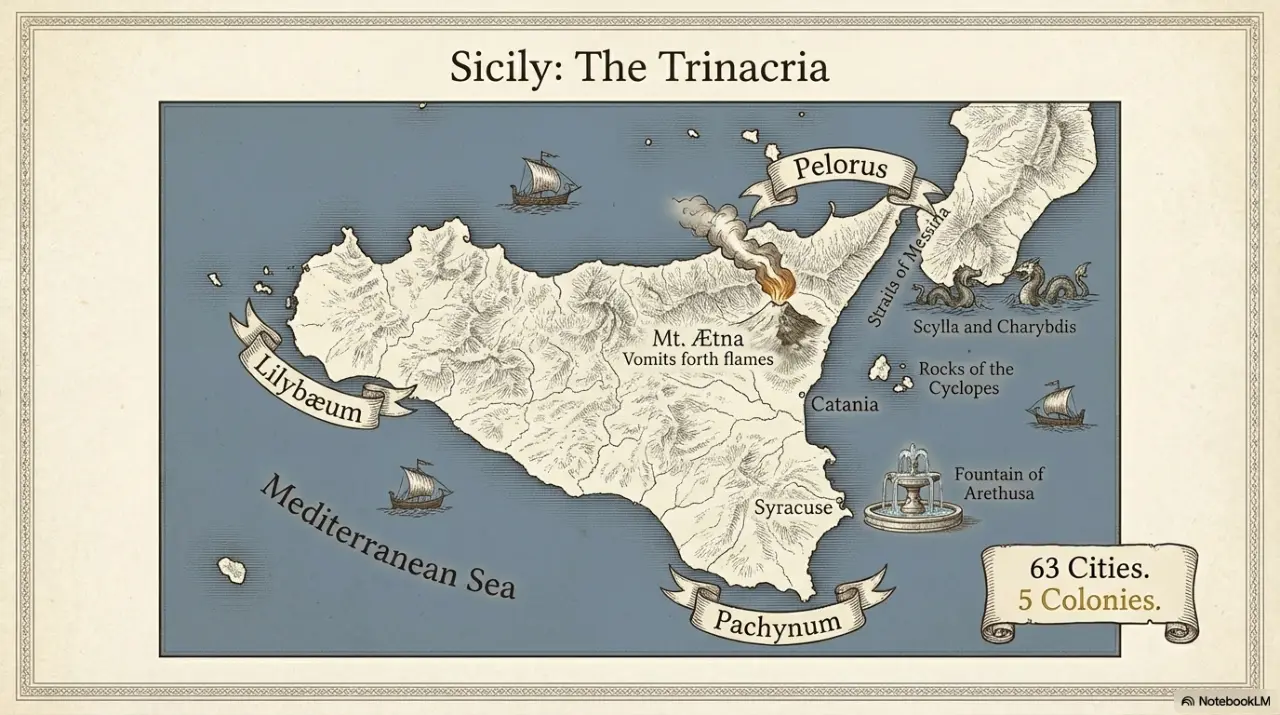
8.32.33. But some say that Totila's death and this battle happened otherwise than I have told it; and it has seemed to me not improper to record this version. For these say that the retreat of the Gothic army did not take place in any strange and unaccountable manner, but while some of the Romans were shooting from a distance, a missile from a bow suddenly struck Totila, but not by the purpose of the man who had sent it, for Totila was armed in the fashion of a simple soldier and the place in the phalanx where he stood had been chosen at random; for he did not wish to be manifest to his enemy, nor would he, of course, expose himself to attack; but some chance prepared this fate for him and directed the shaft to the man's body. Then he, having suffered a mortal wound and being tortured with intense pain, withdrew from the phalanx with a few men and moved slowly away. And as far as Caprae he endured the suffering and continued to ride his horse, but there he fainted and after that remained there to care for his wound, and not long afterwards the final day of his life came upon him. Meanwhile the Gothic army, not being in any case a match for their opponents, upon seeing also that their commander had been unexpectedly rendered unfit for battle, became thunderstruck to think that Totila alone among them had been mortally wounded with no design on the part of the enemy, and consequently they became alarmed and discouraged and were plunged into terror which had no bounds and began to retreat in that disgraceful manner. But concerning these matters let each man speak according to his knowledge.
8.34.1. At that time it was shewn to the world with the greatest clearness that in the case of all men who have been doomed to suffer ill, even those things which seem to be blessings turn out for their destruction, and even when they have fared as they wish they are, it may be, destroyed together with this same prosperity. For this victory turned out to be for the Roman senate and people a cause of far greater destruction, in the following manner. The Goths, on the one hand, as by their flight they abandoned the dominion of Italy, made it an incident of their progress to destroy" without mercy the Romans who fell in their way. And the barbarians of the Roman army, on the other hand, treated as enemies all whom they chanced upon as they entered the city. Furthermore, this too befell them. Many of the members of the senate, by decision of Totila, had been remaining previously in the towns of Campania. And some of them, upon learning that Rome was held by the emperor's army, departed from Campania and went thither. But' when this was learned by the Goths who happened to be in the fortresses there, they searched that whole country and killed all the patricians. Among these was Maximus, whom I have mentioned in the preceding narrative. It happened also that Totila, when he went from there to encounter Narses, had gathered the children of the notable Romans from each city and selected about three hundred of them whom he considered particularly fine in appearance, telling their parents that they were to live with him, though in reality they were to be hostages to him. And at that time Totila merely commanded that they should be north of the Padus River, but now Teias found and killed them all.
Outcome and critical assessment
Result and caution: imperial government was restored over much of Italy, at enormous human and material cost. Ravenna's fall in AD 540 was not the final Roman victory. Procopius' main account ends before every episode of consolidation; Agathias is necessary for a fuller continuation. The mapped Tadinae and Lactarius feature are locators, not certifications of every reconstructed battle line.
Historical record: Procopius, Wars 5–8, especially 8.29–35 for the final Gothic battles; Bury for continuation and settlement; campaign tables.