Wars · IX. The eastern empire and Justinian's wars
W092 Africa after the conquest: mutiny and the wars with the Mauri
Battles and sieges
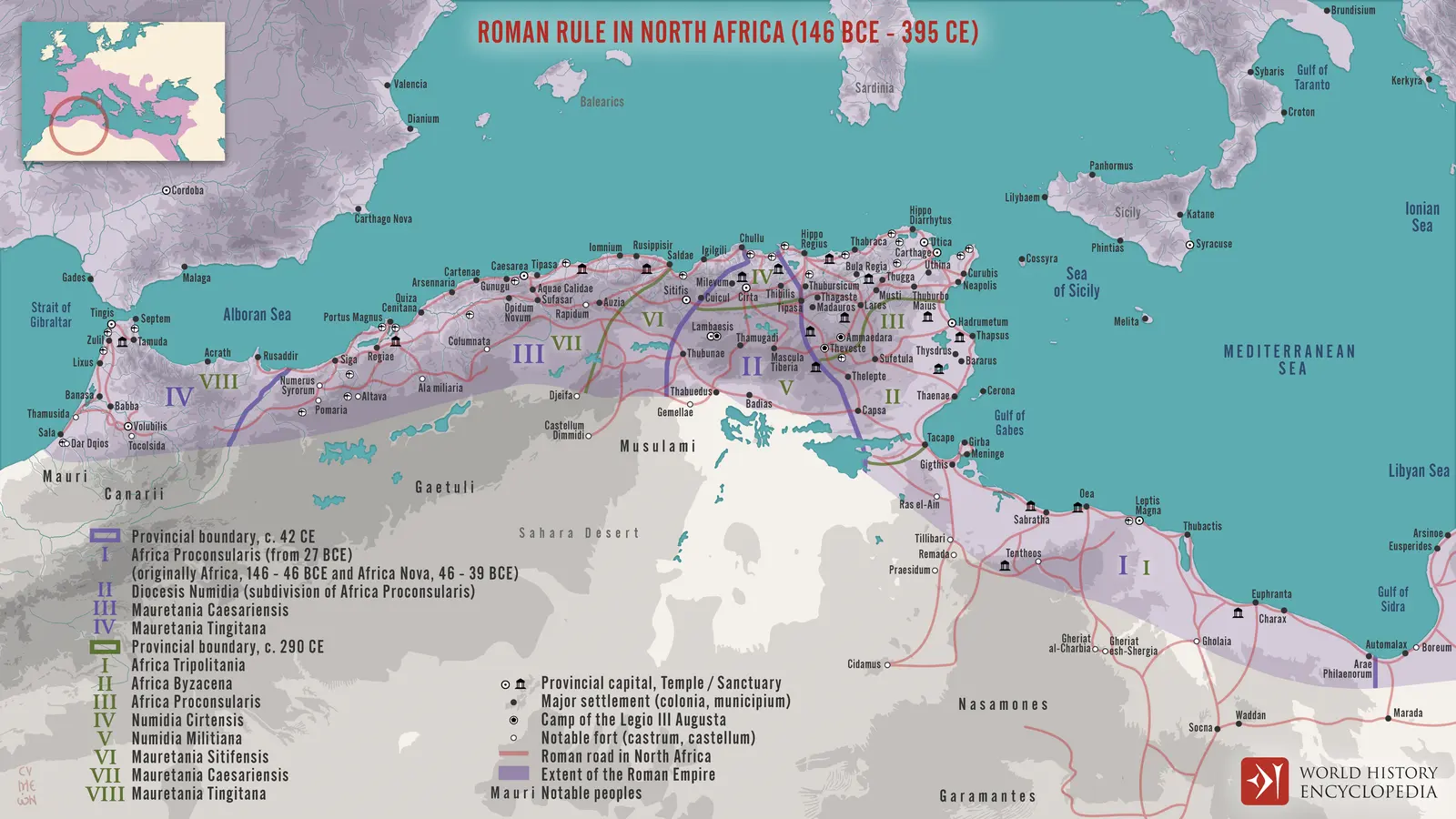
Cillium 544 ADThe end of the Vandal monarchy left difficult questions of military pay, land, authority and regional alliances. Mutiny within the Roman army and resistance by groups called Mauri created a prolonged emergency. Leaders and coalitions changed; these were not merely the last Vandal soldiers continuing the same war.
Solomon's campaigns produced successes before his death in defeat at Cillium in AD 544. Later operations under John Troglita helped restore the imperial position, with a decisive victory conventionally dated to AD 548. Local allies were essential to Roman campaigning and to the politics of the resulting order.
Command, forces and military problem
| Field | Dossier |
|---|---|
| Roman leadership | Solomon, Germanus, John Troglita and other commanders |
| Opposing or rival parties | Different Mauri rulers and coalitions; mutinous imperial troops |
| Forces and capabilities | Imperial and local allied forces, regional armies and defended provincial bases |
| Operational problem | Make the conquest governable by resolving mutiny and building workable regional alliances. |
Contemporary campaign chronicle
The following substantial selections incorporate Procopius' account in H. B. Dewing's public-domain translation. Ancient book, chapter and section numbers are retained. Speeches, reported figures, judgments and divine explanations are the ancient author's testimony, not independently established modern conclusions. Editorial event-date overlays have been removed.
Solomon and the first campaigns inland
4.11.1. Now when Solomon heard what had befallen Rufinus and Aïgan, he made ready for war and wrote as follows to the commanders of the Moors: "Other men than you have even before this had the ill fortune to lose their senses and to be destroyed, men who had no means of judging beforehand how their folly would turn out. But as for you, who have the example near at hand in your neighbours, the Vandals, what in the world has happened to you that you have decided to raise your hands against the great emperor and throw away your own security, and that too when you have given the most dread oaths in writing and have handed over your children as pledges to the agreement? Is it that you have determined to make a kind of display of the fact that you have no consideration either for God or for good faith or for kinship itself or for safety or for any other thing at all? And yet, if such is your practice in matters which concern the divine, in what ally do you put your trust in marching against the emperor of the Romans? And if you are taking the field to the destruction of your children, what in the world is it in behalf of which you have decided to endanger yourselves? But if any repentance has by now entered your hearts for what has already taken place, write to us, that we may satisfactorily arrange with you touching what has already been done; but if your madness has not yet abated, expect a Roman war, which will come upon you together with the oaths which you have violated and the wrong which you are doing to your own children."
4.11.9. Such was the letter which Solomon wrote. And the Moors replied as follows: "Belisarius deluded us with great promises and by this means persuaded us to become subjects of the Emperor Justinian; but the Romans, while giving us no share in any good thing, expected to have us, though pinched with hunger, as their friends and allies. Therefore it is more fitting that you should be called faithless than that the Moors should be. For the men who break treaties are not those who, when manifestly wronged, bring accusation against their neighbours and turn away from them, but those who expect to keep others in faithful alliance with them and then do them violence. And men make God their enemy, not when they march against others in order to recover their own possessions, but when they get themselves into danger of war by encroaching upon the possessions of others. And as for children, that will be your concern, who are not permitted to marry more than one wife; but with us, who have, it may be, fifty wives living with each of us, offspring of children can never fail."
4.11.14. When Solomon had read this letter, he decided to lead his whole army against the Moors. So after arranging matters in Carthage, he proceeded with all his troops to Byzacium. And when he reached the place which is called Mammes, where the four Moorish commanders, whom I have mentioned a little before, were encamped, he made a stockade for himself. Now there are lofty mountains there, and a level space near the foothills of the mountains, where the barbarians had made preparations for the battle and arranged their fighting order as follows. They formed a circle of their camels, just as, in the previous narrative, I have said Cabaon did, making the front about twelve deep. And they placed the women with the children within the circle; (for among the Moors it is customary to take also a few women, with their children, to battle, and these make the stockades and huts for them and tend the horses skilfully, and have charge of the camels and the food; they also sharpen the iron weapons and take upon themselves many of the tasks in connection with the preparation for battle); and the men themselves took their stand on foot in between the legs of the camels, having shields and swords and small spears which they are accustomed to hurl like javelins. And some of them with their horses remained quietly among the mountains. But Solomon disregarded one half of the circle of the Moors, which was towards the mountain, placing no one there. For he feared lest the enemy on the mountain should come down and those in the circle should turn about and thus make the men drawn up there exposed to attack on both sides in the battle. But against the remainder of the circle he drew up his whole army, and since he saw the most of them frightened and without courage, on account of what had befallen Aïgan and Rufinus, and wishing to admonish them to be of good cheer, he spoke as follows: "Men who have campaigned with Belisarius, let no fear of these men enter your minds, and, if Moors gathered to the number of fifty thousand have already defeated five hundred Romans, let not this stand for you as an example. But call to mind your own valour, and consider that while the Vandals defeated the Moors, you have become masters of the Vandals in war without any effort, and that it is not right that those who have conquered the greater should be terrified before those who are inferior. And indeed of all men the Moorish nation seems to be the most poorly equipped for war's struggle. For the most of them have no armour at all, and those who have shields to hold before themselves have only small ones which are not well made and are not able to turn aside what strikes against them. And after they have thrown those two small spears, if they do not accomplish anything, they turn of their own accord to flight. So that it is possible for you, after guarding against the first attack of the barbarians, to win the victory with no trouble at all. But as to your equipment of arms, you see, of course, how great is the difference between it and that of your opponents. And apart from this, both valour of heart and strength of body and experience in war and confidence because you have already conquered all your enemies, — all these advantages you have; but the Moors, being deprived of all these things, put their trust only in their own great throng. And it is easier for a few who are most excellently prepared to conquer a multitude of men not good at warfare than it is for the multitude to defeat them. For while the good soldier has his confidence in himself, the cowardly man generally finds that the very number of those arrayed with him produces a want of room that is full of peril. Furthermore, you are warranted in despising these camels, which cannot fight for the enemy, and when struck by our missiles will, in all probability, become the cause of considerable confusion and disorder among them. And the eagerness for battle which the enemy have acquired on account of their former success will be your ally in the fight. For daring, when it is kept commensurate with one's power, will perhaps be of some benefit even to those who make use of it, but when it exceeds one's power it lends into danger. Bearing these things in mind and despising the enemy, observe silence and order; for by taking thought for these things we shall win the victory over the disorder of the barbarians more easily and with less labour." Thus spoke Solomon.
4.11.37. And the commanders of the Moors also, seeing the barbarians terrified at the orderly array of the Romans, and wishing to recall their host to confidence again, exhorted them in this wise: "That the Romans have human bodies, the kind that yield when struck with iron, we have been taught, O fellow-soldiers, by those of them whom we have recently met, the best of them all, some of whom we have overwhelmed with our spears and killed, and the others we have seized and made our prisoners of war. And not only is this so, but it is now possible to see also that we boast great superiority over them in numbers. And, furthermore, the struggle for us involves the very greatest things, either to be masters of all Libya or to be slaves to these braggarts. It is therefore necessary for us to be in the highest degree brave men at the present time. For it is not expedient that those whose all is at stake should be other than exceedingly courageous. And it behoves us to despise the equipment of arms which the enemy have. For if they come on foot against us, they will not be able to move rapidly, but will be worsted by the agility of the Moors, and their cavalry will be terrified both by the sight of the camels, and by the noise they make, which, rising above the general tumult of battle, will, in all likelihood, throw them into disorder. And if anyone by taking into consideration the victory of the Romans over the Vandals thinks them not to be withstood, he is mistaken in his judgment. For the scales of war are, in the nature of the case, turned by the valour of the commander or by fortune; and Belisarius, who was responsible for their gaining the mastery over the Vandals, has now, thanks to Heaven, been removed out of our way.
And, besides, we too have many times conquered the Vandals and stripped them of their power, and have thus made the victory over them a more feasible and an easier task for the Romans. And now we have reason to hope to conquer this enemy also if you shew yourselves brave men in the struggle."
4.11.47. After the officers of the Moors had delivered this exhortation, they began the engagement. And at first there arose great disorder in the Roman army. For their horses were offended by the noise made by the camels and by the sight of them, and reared up and threw off their riders and the most of them fled in complete disorder. And in the meantime the Moors were making sallies and hurling all the small spears which they had in their hands, thus causing the Roman army to be filled with tumult, and they were hitting them with their missiles while they were unable either to defend themselves or to remain in position. But after this, Solomon, observing what was happening, leaped down from his horse himself first and caused all the others to do the same. And when they had dismounted, he commanded the others to stand still, and, holding their shields before them and receiving the missiles sent by the enemy, to remain in their position; but he himself, leading forward not less than five hundred men, made an attack upon the other portion of the circle. These men he commanded to draw their swords and kill the camels which stood at that point. Then the Moors who were stationed there beat a hasty retreat, and the men under Solomon killed about two hundred camels, and straightway, when the camels fell, the circle became accessible to the Romans. And they advanced on the run into the middle of the circle where the women of the Moors were sitting; meanwhile the barbarians in consternation withdrew to the mountain which was close by, and as they fled in complete disorder the Romans followed behind and killed them. And it is said that ten thousand of the Moors perished in this encounter, while all the women together with the children were made slaves. And the soldiers secured as booty all the camels which they had not killed. Thus the Romans with all their plunder went to Carthage to celebrate the festival of triumph.
4.12.1. But the barbarians, being moved with anger, once more took the field in a body against the Romans, leaving behind not one of their number, and they began to overrun the country in Byzacium, sparing none of any age of those who fell in their way. And when Solomon had just marched into Carthage it was reported that the barbarians with a great host had come into Byzacium and were plundering everything there. He therefore departed quickly with his whole army and marched against them. And when he reached Bourgaon, where the enemy were encamped, he remained some days in camp over against them, in order that, as soon as the Moors should get on level ground, he might begin the battle. But since they remained on the mountain, he marshalled his army and arrayed it for battle; the Moors, however, had no intention of ever again engaging in battle with the Romans in level country (for already an irresistible fear had come over them), but on the mountain they hoped to overcome them more easily. Now Mt. Bourgaon is for the most part precipitous and on the side toward the east extremely difficult to ascend, but on the west it is easily accessible and rises in an even slope. And there are two lofty peaks which rise up, forming between them a sort of vale, very narrow, but of incredible depth. Now the barbarians left the peak of the mountain unoccupied, thinking that on this side no hostile movement would be made against them; and they left equally unprotected the space about the foot of the mountain where Bourgaon was easy of access. But at the middle of the ascent they made their camp and remained there, in order that, if the enemy should ascend and begin battle with them, they might at the outset, being on higher ground, shoot down upon their heads. They also had on the mountain many horses, prepared either for flight or for the pursuit, if they should win the battle. Now when Solomon saw that the Moors were unwilling to fight another battle on the level ground, and also that the Roman army was opposed to making a siege in a desert place, he was eager to come to an encounter with the enemy on Bourgaon. But inasmuch as he saw that the soldiers were stricken with terror because of the multitude of their opponents, which was many times greater than it had been in the previous battle, he called together the army and spoke as follows: "The fear which the enemy feel toward you needs no other arraignment, but voluntarily pleads guilty, bringing forward, as it does, the testimony of its own witnesses. For you see, surely, our opponents gathered in so many tens and tens of thousands, but not daring to come down to the plain and engage with us, unable to feel confidence even in their own selves, but taking refuge in the difficulty of this place. It is therefore not even necessary to address any exhortation to you, at the present time at least.
For those to whom both the circumstances and the weakness of the enemy give courage, need not, I think, the additional assistance of words. But of this one thing it will be needful to remind you, that if we fight out this engagement also with brave hearts, it will remain for us, having defeated the Vandals and reduced the Moors to the same fortune, to enjoy all the good things of Libya, having no thought whatever of an enemy in our minds. But as to preventing the enemy from shooting down upon our heads, and providing that no harm come to us from the nature of the place, I myself shall make provision." After making this exhortation Solomon commanded Theodorus, who led the "excubitores [40]" (for thus the Romans call their guards), to take with him a thousand infantrymen toward the end of the afternoon and with some of the standards to go up secretly on the east side of Bourgaon, where the mountain is most difficult of ascent and, one might say, impracticable, commanding him that, when they arrived near the crest of the mountain, they should remain quietly there and pass the rest of the night, and that at sunrise they should appear above the enemy and displaying the standards commence to shoot. And Theodoras did as directed. And when it was well on in the night, they climbed up the precipitous slope and reached a point near the peak without being noticed either by the Moors or even by any of the Romans; for they were being sent out, it was said, as an advance guard, to prevent anyone from coming to the camp from the outside to do mischief. And at early dawn Solomon with the whole army went up against the enemy to the outskirts of Bourgaon. And when morning had come and the enemy were seen near at hand, the soldiers were completely at a loss, seeing the summit of the mountain no longer unoccupied, as formerly, but covered with men who were displaying Roman standards; for already some daylight was beginning to shew. But when those on the peak began their attack, the Romans perceived that the army was their own and the barbarians that they had been placed between their enemy's forces, and being shot at from both sides and having no opportunity to ward off the enemy, they thought no more of resistance but turned, all of them, to a hasty flight. And since they could neither run up to the top of Bourgaon, which was held by the enemy, nor go to the plain anywhere over the lower slopes of the mountain, since their opponents were pressing upon them from that side, they went with a great rush to the vale and the unoccupied peak, some even with their horses, others on foot.
But since they were a numerous throng fleeing in great fear and confusion, they kept killing each other, and as they rushed into the vale, which was exceedingly deep, those who were first were being killed constantly, but their plight could not be perceived by those who were coming up behind. And when the vale became full of dead horses and men, and the bodies made a passage from Bourgaon to the other mountain, then the remainder were saved by making the crossing over the bodies. And there perished in this struggle, among the Moors fifty thousand, as was declared by those of them who survived, but among the Romans no one at all, nor indeed did anyone receive even a wound, either at the hand of the enemy or by any accident happening to him, but they all enjoyed this victory unscathed. All of the leaders of the barbarians also made their escape, except Esdilasas, who received pledges and surrendered himself to the Romans. So great, however, was the multitude of women and children whom the Romans seized as booty, that they would sell a Moorish boy for the price of a sheep to any who wished to buy. And then the remainder of the Moors recalled the saying of their women, to the effect that their nation would be destroyed by a beardless man. So the Roman army, together with its booty and with Esdilasas, marched into Carthage; and those of the barbarians who had not perished decided that it was impossible to settle in Byzacium, lest they, being few, should be treated with violence by the Libyans who were their neighbours, and with their leaders they went into Numidia and made themselves suppliants of Iaudas, who ruled the Moors in Aurasium. And the only Moors who remained in Byzacium were those led by Antalas, who during this time had kept faith with the Romans and together with his subjects had remained unharmed.
Mutiny and divided allegiance
4.14.1. And in Italy during these same times the following events took place. Belisarius was sent against Theodatus and the Gothic nation by the Emperor Justinian, and sailing to Sicily he secured this island with no trouble. And the manner in which this was done will be told in the following pages, when the history leads me to the narration of the events in Italy. For it has not seemed to me out of order first to record all the events which happened in Libya and after that to turn to the portion of the history touching Italy and the Goths.
4.14.4. During this winter Belisarius remained in Syracuse and Solomon in Carthage. And it came about during this year that a most dread portent took place. For the sun gave forth its light without brightness, like the moon, during this whole year, and it seemed exceedingly like the sun in eclipse, for the beams it shed were not clear nor such as it is accustomed to shed. And from the time when this thing happened men were free neither from war nor pestilence nor any other thing leading to death. And it was the time when Justinian was in the tenth year of his reign. [536-537 A.D.] [536 A.D.] At the opening of spring, when the Christians were celebrating the feast which they call Easter, there arose a mutiny among the soldiers in Libya. I shall now tell how it arose and to what end it came.
4.14.8. After the Vandals had been defeated in the battle, as I have told previously, the Roman soldiers took their daughters and wives and made them their own by lawful marriage. And each one of these women kept urging her husband to lay claim to the possession of the lands which she had owned previously, saying that it was not right or fitting if, while living with the Vandals, they had enjoyed these lands, but after entering into marriage with the conquerors of the Vandals they were then to be deprived of their possessions. And having these things in mind, the soldiers did not think that they were bound to yield the lands of the Vandals to Solomon, who wished to register them as belonging to the commonwealth and to the emperor's house and said that while it was not unreasonable that the slaves and all other things of value should go as booty to the soldiers, the land itself belonged to the emperor and the empire of the Romans, which had nourished them and caused them to be called soldiers and to be such, not in order to win for themselves such land as they should wrest from the barbarians who were trespassing on the Roman empire, but that this land might come to the commonwealth, from which both they and all others secured their maintenance. This was one cause of the mutiny. And there was a second, concurrent, cause also, which was no less, perhaps even more, effective in throwing all Libya into confusion. It was as follows: In the Roman army there were, as it happened, not less than one thousand soldiers of the Arian faith; and the most of these were barbarians, some of these being of the Erulian nation. Now these men were urged on to the mutiny by the priests of the Vandals with the greatest zeal. For it was not possible for them to worship God in their accustomed way, but they were excluded both from all sacraments and from all sacred rites. For the Emperor Justinian did not allow any Christian who did not espouse the orthodox faith to receive baptism or any other sacrament. But most of all they were agitated by the feast of Easter, during which they found themselves unable to baptize their own children with the sacred water, or do anything else pertaining to this feast. And as if these things were not sufficient for Heaven, in its eagerness to ruin the fortunes of the Romans, it so fell out that still another thing provided an occasion for those who were planning the mutiny. For the Vandals whom Belisarius took to Byzantium were placed by the emperor in five cavalry squadrons, in order that they might be settled permanently in the cities of the East; he also called them the "Vandals of Justinian," and ordered them to betake themselves in ships to the East. Now the majority of these Vandal soldiers reached the East, and, filling up the squadrons to which they had been assigned, they have been fighting against the Persians up to the present time; but the remainder, about four hundred in number, after reaching Lesbos, waiting until the sails were bellied with the wind, forced the sailors to submission and sailed on till they reached the Peloponnesus. And setting sail from there, they came to land in Libya at a desert place, where they abandoned the ships, and, after equipping themselves, went up to Mt. Aurasium and Mauretania. Elated by their accession, the soldiers who were planning the mutiny formed a still closer conspiracy among themselves. And there was much talk about this in the camp and oaths were already being taken. And when the rest were about to celebrate the Easter festival, the Arians, being vexed by their exclusion from the sacred rites, purposed to attack them vigorously.
4.14.22. And it seemed best to their leading men to kill Solomon in the sanctuary on the first day of the feast, which they call the great day. [March 23, 536 A.D.] And they were fortunate enough not to be found out, since no one disclosed this plan. For though there were many who shared in the horrible plot, no word of it was divulged to any hostile person as the orders were passed around, and thus they succeeded completely in escaping detection, for even the spearmen and guards of Solomon for the most part and the majority of his domestics had become associated with this mutiny because of their desire for the lands. And when the appointed day had now come, Solomon was sitting in the sanctuary, utterly ignorant of his own misfortune. And those who had decided to kill the man went in, and, urging one another with nods, they put their hands to their swords, but they did nothing nevertheless, either because they were filled with awe of the rites then being performed in the sanctuary, or because the fame of the general caused them to be ashamed, or perhaps also some divine power prevented them. And when the rites on that day had been completely performed and all were betaking themselves homeward, the conspirators began to blame one another with having turned soft-hearted at no fitting time, and they postponed the plot for a second attempt on the following day. And on the next day they acted in the same manner and departed from the sanctuary without doing anything, and entering the market place, they reviled each other openly, and every single man of them called the next one soft-hearted and a demoralizer of the band, not hesitating to censure strongly the respect felt for Solomon. For this reason, indeed, they thought that they could no longer without danger remain in Carthage, inasmuch as they had disclosed their plot to the whole city.
The most of them, accordingly, went out of the city quickly and began to plunder the lands and to treat as enemies all the Libyans whom they met; but the rest remained in the city, giving no indication of what their own intentions were but pretending ignorance of the plot which had been formed.
4.14.30. But Solomon, upon hearing what was being done by the soldiers in the country, became greatly disturbed, and ceased not exhorting those in the city and urging them to loyalty toward the emperor. And they at first seemed to receive his words with favour, but on the fifth day, when they heard that those who had gone out were secure in their power, they gathered in the hippodrome and insulted Solomon and the other commanders without restraint. And Theodorus, the Cappadocian, being sent there by Solomon, attempted to dissuade them and win them by kind words, but they listened to nothing of what was said. Now this Theodorus had a certain hostility against Solomon and was suspected of plotting against him. For this reason the mutineers straightway elected him general over them by acclamation, and with him they went with all speed to the palace carrying weapons and raising a great tumult. There they killed another Theodorus, who was commander of the guards, a man of the greatest excellence in every respect and an especially capable warrior. And when they had tasted this blood, they began immediately to kill everyone they met, whether Libyan or Roman, if he were known to Solomon or had money in his hands; and then they turned to plundering, going up into the houses which had no soldiers to defend them and seizing all the most valuable things, until the coming of night, and drunkenness following their toil, made them cease.
4.14.37. And Solomon succeeded in escaping unnoticed into the great sanctuary which is in the palace, and Martinus joined him there in the late afternoon. And when all the mutineers were sleeping, they went out from the sanctuary and entered the house of Theodorus, the Cappadocian, who compelled them to dine although they had no desire to do so, and conveyed them to the harbour and put them on the skiff of a certain ship, which happened to have been made ready there by Martinus. And Procopius also, who wrote this history, was with them, and about five men of the house of Solomon. And after accomplishing three hundred stades they reached Misuas, the naval station of Carthage, and, since they had reached safety, Solomon straightway commanded Martinus to go into Numidia to Valerian and the others who shared his command, and endeavour to bring it about that each one of them, if it were in any way possible, should appeal to some of the soldiers known to him, either with money or by other means, and bring them back to loyalty toward the emperor. And he sent a letter to Theodorus, charging him to take care of Carthage and to handle the other matters as should seem possible to him, and he himself with Procopius went to Belisarius at Syracuse. And after reporting everything to him which had taken place in Libya, he begged him to come with all speed to Carthage and defend the emperor, who was suffering unholy treatment at the hands of his own soldiers, Solomon, then, was thus engaged.
4.15.1. But the mutineers, after plundering everything in Carthage, gathered in the plain of Boulla, and chose Stotzas, one of the guards of Martinus, and a passionate and energetic man, as tyrant over them, with the purpose of driving the emperor's commanders out of all Libya and thus gaining control over it. And he armed the whole force, amounting to about eight thousand men, and led them on to Carthage, thinking to win over the city instantly with no trouble. He sent also to the Vandals who had run away from Byzantium with the ships and those who had not gone there with Belisarius in the beginning, either because they had escaped notice, or because those who were taking off the Vandals at that time took no account of them. Now they were not fewer than a thousand, and after no great time they joined Stotzas and the army with enthusiasm. And a great throng of slaves also came to him. And when they drew near Carthage, Stotzas sent orders that the people should surrender the city to him as quickly as possible, on condition of their remaining free from harm. But those in Carthage and Theodorus, in reply to this, refused flatly to obey, and announced that they were guarding Carthage for the emperor. And they sent to Stotzas Joseph, the secretary of the emperor's guards, a man of no humble birth and one of the household of Belisarius, who had recently been sent to Carthage on some mission to them, and they demanded that Stotzas should go no further in his violence. But Stotzas, upon hearing this, straightway killed Joseph and commenced a siege. And those in the city, becoming terrified at the danger, were purposing to surrender themselves and Carthage to Stotzas under an agreement. Such was the course of events in the army in Libya.
4.15.9. But Belisarius selected one hundred men from his own spearmen and guards, and taking Solomon with him, sailed into Carthage with one ship at about dusk, at the time when the besiegers were expecting that the city would be surrendered to them on the following day. And since they were expecting this, they bivouacked that night. But when day had come and they learned that Belisarius was present, they broke up camp as quickly as possible and disgracefully and in complete disorder beat a hasty retreat And Belisarius gathered about two thousand of the army and, after urging them with words to be loyal to the emperor and encouraging them with large gifts of money, he began the pursuit of the fugitives. And he overtook them at the city of Membresa, three hundred and fifty stades distant from Carthage. There both armies made camp and prepared themselves for battle, the forces of Belisarius making their entrenchment at the River Bagradas, and the others in a high and difficult position. For neither of them saw fit to enter the city, since it was without walls. And on the day following they joined battle, the mutineers trusting in their numbers, and the troops of Belisarius despising their enemy as both without sense and without generals. And Belisarius, wishing that these thoughts should be firmly lodged in the minds of his soldiers, called them all together and spoke as follows: —
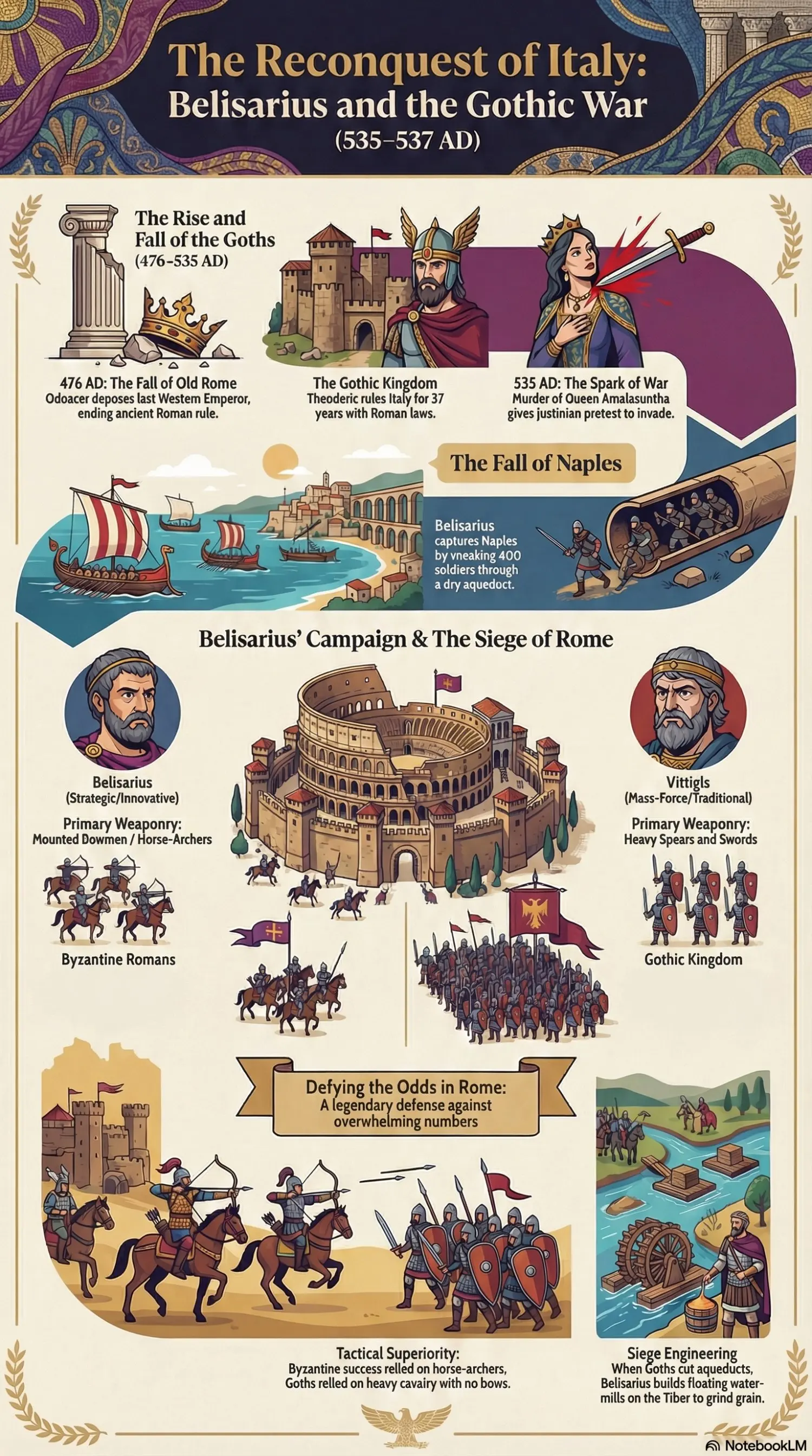
4.15.16. "The situation, fellow-soldiers, both for the emperor and for the Romans, falls far short of our hopes and of our prayers. For we have now come to a combat in which even the winning of the victory will not be without tears for us, since we are fighting against kinsmen and men who have been reared with us. But we have this comfort in our misfortune, that we are not ourselves beginning the battle, but have been brought into the conflict in our own defence. For he who has framed the plot against his dearest friends and by his own act has dissolved the ties of kinship, dies not, if he perishes, by the hands of his friends, but having become an enemy is but making atonement to those who have suffered wrong. And that our opponents are public enemies and barbarians and whatever worse name one might call them, is shewn not alone by Libya, which has become plunder under their hands, nor by the inhabitants of this land, who have been wrongfully slain, but also by the multitude of Roman soldiers whom these enemies have dared to kill, though they have had but one fault to charge them with — loyalty to their government. And it is to avenge these their victims that we have now come against them, having with good reason become enemies to those who were once most dear. For nature has made no men in the world either friends or opponents to one another, but it is the actions of men in every case which, either by the similarity of the motives which actuate them unite them in alliance, or by the difference set them in hostility to each other, making them friends or enemies as the case may be. That, therefore, we are fighting against men who are outlaws and enemies of the state, you must now be convinced; and now I shall make it plain that they deserve to be despised by us. For a throng of men united by no law, but brought together by motives of injustice, is utterly unable by nature to play the part of brave men, since valour is unable to dwell with lawlessness, but always shuns those who are unholy. Nor, indeed, will they preserve discipline or give heed to the commands given by Stotzas. For when a tyranny is newly organized and has not yet won that authority which self-confidence gives, it is, of necessity, looked upon by its subjects with contempt. Nor is it honoured through any sentiment of loyalty, for a tyranny is, in the nature of the case, hated; nor does it lead its subjects by fear, for timidity deprives it of the power to speak out openly. And when the enemy is handicapped in point of valour and of discipline, their defeat is ready at hand. With great contempt, therefore, as I said, we should go against this enemy of ours. For it is not by the numbers of the combatants, but by their orderly array and their bravery, that prowess in war is wont to be measured."
Renewed war and the defeat at Cillium
4.19.1. [539-540 A.D.] And the emperor summoned Germanus together with Symmachus and Domnicus and again entrusted all Libya to Solomon, in the thirteenth year of his reign; and he provided him with an army and officers, among whom were Rufinus and Leontius, the sons of Zaunas the son of Pharesmanas, and John, the son of Sisiniolus. For Martinus and Valerianus had already before this gone under summons to Byzantium. And Solomon sailed to Carthage, and having rid himself of the sedition of Stotzas, he ruled with moderation and guarded Libya securely, setting the army in order, and sending to Byzantium and to Belisarius whatever suspicious elements he found in it, and enrolling new soldiers to equal their number, and removing those of the Vandals who were left and especially all their women from the whole of Libya. And he surrounded each city with a wall, and guarding the laws with great strictness, he restored the government completely. And Libya became under his rule powerful as to its revenues and prosperous in other respects. And when everything had been arranged by him in the best way possible, he again made an expedition against Iaudas and the Moors on Aurasium. And first he sent forward Gontharis, one of his own body-guards and an able warrior, with an army. Now Gontharis came to the Abigas River and made camp near Bagaïs, a deserted city. And there he engaged with the enemy, but was defeated in battle, and retiring to his stockade was already being hard pressed by the siege of the Moors. But afterwards Solomon himself arrived with his whole army, and when he was sixty stades away from the camp which Gontharis was commanding, he made a stockade and remained there; and hearing all that had befallen the force of Gontharis, he sent them a part of his army and bade them keep up the fight against the enemy with courage. But the Moors, having gained the upper hand in the engagement, as I have said, did as follows. The Abigas River flows from Aurasium, and descending into a plain, waters the land just as the men there desire. For the natives conduct this stream to whatever place they think it will best serve them at the moment, for in this plain there are many channels, into which the Abigas is divided, and entering all of them, it passes underground, and reappears again above the ground and gathers its stream together. This takes place over the greatest part of the plain and makes it possible for the inhabitants of the region, by stopping up the waterways with earth, or by again opening them, to make use of the waters of this river as they wish. So at that time the Moors shut off all the channels there and thus allowed the whole stream to flow about the camp of the Romans. As a result of this, a deep, muddy marsh formed there through which it was impossible to go; this terrified them exceedingly and reduced them to a state of helplessness. When this was heard by Solomon, he came quickly. But the barbarians, becoming afraid, withdrew to the foot of Aurasium. And in a place which they call Babosis they made camp and remained there. So Solomon moved with his whole army and came to that place. And upon engaging with the enemy, he defeated them decisively and turned them to flight. Now after this the Moors did not think it advisable for them to fight a pitched battle with the Romans; for they did not hope to overcome them in this kind of contest; but they did have hope, based on the difficult character of the country around Aurasium, that the Romans would in a short time give up by reason of the sufferings they would have to endure and would withdraw from there, just as they formerly had done. The most of them, therefore, went off to Mauretania and the barbarians to the south of Aurasium, but Iaudas with twenty thousand of the Moors remained there. And it happened that he had built a fortress on Aurasium, Zerboule by name. Into this he entered with all the Moors and remained quiet. But Solomon was by no means willing that time should be wasted in the siege, and learning that the plains about the city of Tamougade were full of grain just becoming ripe, he led his army into them, and settling himself there, began to plunder the land. Then, after firing everything, he returned again to the fortress of Zerboule. But during this time, while the Romans were plundering the land, Iaudas, leaving behind some of the Moors, about as many as he thought would be sufficient for the defence of the fortress, himself ascended to the summit of Aurasium with the rest of the army, not wishing to stand siege in the fort and have provisions fail his forces. And finding a high place with cliff's on all sides of it and concealed by perpendicular rocks, Toumar by name, he remained quietly there. And the Romans besieged the fortress of Zerboule for three days. And using their bows, since the wall was not high, they hit many of the barbarians upon the parapets. And by some chance it happened that all the leaders of the Moors were hit by these missiles and died.
And when the three days' time had passed and night came on, the Romans, having learned nothing of the death of the leaders among the Moors, were planning to break up the siege. For it seemed better to Solomon to go against Iaudas and the multitude of the Moors, thinking that, if he should be able to capture that force by siege, the barbarians in Zerboule would with less trouble and difficulty yield to the Romans. But the barbarians, thinking that they could no longer hold out against the siege, since all their leaders had now been destroyed, decided to flee with all speed and abandon the fortress. Accordingly they fled immediately in silence and without allowing the enemy in any way to perceive it, and the Romans also at daybreak began to prepare for departure. And since no one appeared on the wall, although the besieging army was withdrawing, they began to wonder and fell into the greatest perplexity among themselves. And in this state of uncertainty they went around the fortress and found the gate open from which the Moors had departed in flight. And entering the fortress they treated everything as plunder, but they had no thought of pursuing the enemy, for they had set out with light equipment and were familiar with the country round about. And when they had plundered everything, they set guards over the fortress, and all moved forward on foot.
4.20.1. And coming to the place Toumar, where the enemy had shut themselves in and were remaining quiet, they encamped near by in a bad position, where there would be no supply of water, except a little, nor any other necessary thing. And after much time had been spent and the barbarians did not come out against them at all, they themselves, no less than the enemy, if not even more, were hard pressed by the siege and began to be impatient. And more than anything else, they were distressed by the lack of water; this Solomon himself guarded, giving each day no more than a single cupful to each man. And since he saw that they were openly discontented and no longer able to bear their present hardships, he planned to make trial of the place, although it was difficult of access, and called all together and exhorted them as follows: "Since God has granted to the Romans to besiege the Moors on Aurasium, a thing which hitherto has been beyond hope and now, to such as do not see what is actually being done, is altogether incredible, it is necessary that we too should lend our aid to the help that has come from above, and not prove false to this favour, but undergoing the danger with enthusiasm, should reach after the good fortune which is to come from success. For in every case the turning of the scales of human affairs depends upon the moment of opportunity; but if a man, by wilful cowardice, is traitor to his fortune, he cannot justly blame it, having by his own action brought the guilt upon himself. Now as for the Moors, you see their weakness surely and the place in which they have shut themselves up and are keeping guard, deprived of all the necessities of life. And as for you, one of two things is necessary, either without feeling any vexation at the siege to await the surrender of the enemy, or, if you shrink from this, to accept the victory which goes with the danger. And fighting against these barbarians will be the more free from danger for us, inasmuch as they are already fighting with hunger and I think they will never even come to an engagement with us. Having these things in mind at the present time, it behooves you to execute all your orders with eagerness." After Solomon had made this exhortation, he looked about to see from what point it would be best for his men to make an attempt on the place, and for a long time he seemed to be in perplexity. For the difficult nature of the ground seemed to him quite too much to contend with. But while Solomon was considering this, chance provided a way for the enterprise as follows. There was a certain Gezon in the army, a foot-soldier, "optio" of the detachment to which Solomon belonged; for thus the Romans call the paymaster. This Gezon, either in play or in anger, or perhaps even moved by some divine impulse, began to make the ascent alone, apparently going against the enemy, and not far from him went some of his fellow-soldiers, marvelling greatly at what he was doing. And three of the Moors, who had been stationed to guard the approach, suspecting that the man was coming against them, went on the run to confront him. But since they were in a narrow way, they did not proceed in orderly array, but each one went separately. And Gezon struck the first one who came upon him and killed him, and in this way he despatched each of the others. And when those in the rear perceived this, they advanced with much shouting and tumult against the enemy. And when the whole Roman army both heard and saw what was being done, without waiting either for the general to lead the way for them or for the trumpets to give the signal for battle, as was customary, nor indeed even keeping their order, but making a great uproar and urging one another on, they ran against the enemy's camp. There Rufinus and Leontius, the sons of Zaunas the son of Pharesmanes, made a splendid display of valorous deeds against the enemy. And by this the Moors were terror-stricken, and when they learned that their guards also had been destroyed, they straightway turned to flight where each one could, and the most of them were overtaken in the difficult ground and killed. And Iaudas himself, though struck by a javelin in the thigh, still made his escape and withdrew to Mauretania. But the Romans, after plundering the enemy's camp, decided not to abandon Aurasium again, but to guard fortresses which Solomon was to build there, so that this mountain might not be again accessible to the Moors. Now there is on Aurasium a perpendicular rock which rises in the midst of precipices; the natives call it the Rock of Geminianus; there the men of ancient times had built a tower, making it very small as a place of refuge, strong and unassailable, since the nature of the position assisted them. Here, as it happened, Iaudas had a few days previously deposited his money and his women, setting one old Moor in charge as guardian of the money. For he could never have suspected that the enemy would either reach this place, or that they could in all time capture the tower by force. But the Romans at that time, searching through the rough country of Aurasium, came there, and one of them, with a laugh, attempted to climb up to the tower; but the women began to taunt him, ridiculing him as attempting the impossible; and the old man, peering out from the tower, did the same thing. But when the Roman soldier, climbing with both hands and feet, had come near them, he drew his sword quietly and leaped forward as quickly as he could, and struck the old man a fair blow on the neck, and succeeded in cutting it through. And the head fell down to the ground, and the soldiers, now emboldened and holding to one another, ascended to the tower, and took out from there both the women and the money, of which there was an exceedingly great quantity. And by means of it Solomon surrounded many of the cities in Libya with walls. And after the Moors had retired from Numidia, defeated in the manner described, the land of Zabe, which is beyond Mt. Aurasium and is called "First Mauretania," whose metropolis is Sitiphis, was added to the Roman empire by Solomon as a tributary province; for of the other Mauretania Caesarea is the first city, where was settled Mastigas with his Moors, having the whole country there subject and tributary to him, except, indeed, the city of Caesarea. For this city Belisarius had previously recovered for the Romans, as has been set forth in the previous narrative; and the Romans always journey to this city in ships, but they are not able to go by land, since Moors dwell in that country.
And as a result of this all the Libyans who were subjects of the Romans, coming to enjoy secure peace and finding the rule of Solomon wise and very moderate, and having no longer any thought of hostility in their minds, seemed the most fortunate of all men.
4.21.1. But in the fourth year after this it came about that all their blessings were turned to the opposite. [543-544 A.D.] For in the seventeenth year of the reign of the Emperor Justinian, Cyrus and Sergius, the sons of Bacchus, Solomon's brother, were assigned by the emperor to rule over the cities in Libya, Cyrus, the elder, to have Pentapolis, and Sergius Tripolis. And the Moors who are called Leuathae came to Sergius with a great army at the city of Leptimagna, spreading the report that the reason they had come was this, that Sergius might give them the gifts and insignia of office which were customary and so make the peace secure. But Sergius, persuaded by Pudentius, a man of Tripolis, of whom I made mention in the preceding narrative as having served the Emperor Justinian against the Vandals at the beginning of the Vandalic War, received eighty of the barbarians, their most notable men, into the city, promising to fulfil all their demands; but he commanded the rest to remain in the suburb. Then after giving these eighty men pledges concerning the peace, he invited them to a banquet. But they say that these barbarians had come into the city with treacherous intent, that they might lay a trap for Sergius and kill him. And when they came into conference with him, they called up many charges against the Romans, and in particular said that their crops had been plundered wrongfully. And Sergius, paying no heed to these things, rose from the seat on which he was sitting, with intent to go away. And one of the barbarians, laying hold upon his shoulder, attempted to prevent him from going. Then the others began to shout in confusion, and were already rushing together about him. But one of the body-guards of Sergius, drawing his sword, despatched that Moor. And as a result of this a great tumult, as was natural, arose in the room, and the guards of Sergius killed all the barbarians. But one of them, upon seeing the others being slain, rushed out of the house where these things were taking place, unnoticed by anyone, and coming to his tribemates, revealed what had befallen their fellows. And when they heard this, they betook themselves on the run to their own camp and together with all the others arrayed themselves in arms against the Romans. Now when they came near the city of Leptimagna, Sergius and Pudentius confronted them with their whole army. And the battle becoming a hand-to-hand fight, at first the Romans were victorious and slew many of the enemy, and, plundering their camp, secured their goods and enslaved an exceedingly great number of women and children. But afterwards Pudentius, being possessed by a spirit of reckless daring, was killed; and Sergius with the Roman army, since it was already growing dark, marched into Leptimagna. At a later time the barbarians took the field against the Romans with a greater array. And Sergius went to join his uncle Solomon, in order that he too might go to meet the enemy with a larger army; and he found there his brother Cyrus also. And the barbarians, coming into Byzacium, made raids and plundered a great part of the country there; and Antalas (whom I mentioned in the preceding narrative as having remained faithful to the Romans and as being for this reason sole ruler of the Moors in Byzacium) had by now, as it happened, become hostile to Solomon, because Solomon had deprived him of the maintenance with which the emperor had honoured him and had killed his brother, charging him with responsibility for an uprising against the people of Byzacium. So at that time Antalas was pleased to see these barbarians, and making an offensive and defensive alliance with them, led them against Solomon and Carthage. And Solomon, as soon as he heard about this, put his whole army in motion and marched against them, and coming upon them at the city of Tebesta, distant six days' journey from Carthage, he established his camp in company with the sons of his brother Bacchus, Cyrus and Sergius and Solomon the younger. And fearing the multitude of the barbarians, he sent to the leaders of the Leuathae, reproaching them because, while at peace with the Romans, they had taken up arms and come against them, and demanding that they should confirm the peace existing between the two peoples, and he promised to swear the most dread oaths, that he would hold no remembrance of what they had done. But the barbarians, mocking his words, said that he would of course swear by the sacred writings of the Christians, which they are accustomed to call Gospels. Now since Sergius had once taken these oaths and then had slain those who trusted in them, it was their desire to go into battle and make a test of these same sacred writings, to see what sort of power they had against the perjurers, in order that they might first have absolute confidence in them before they finally entered into the agreement. When Solomon heard this, he made his preparations for the combat. And on the following day he engaged with a portion of the enemy as they were bringing in a very large booty, conquered them in battle, seized all their booty and kept it under guard. And when the soldiers were dissatisfied and counted it an outrage that he did not give them the plunder, he said that he was awaiting the outcome of the war, in order that they might distribute everything then, according to the share that should seem to suit the merit of each. But when the barbarians advanced a second time, with their whole army, to give battle, this time some of the Romans stayed behind and the others entered the encounter with no enthusiasm. At first, then, the battle was evenly contested, but later, since the Moors were vastly superior by reason of their great numbers, the most of the Romans fled, and though Solomon and a few men about him held out for a time against the missiles of the barbarians, afterwards they were overpowered by the enemy, and fleeing in haste, reached a ravine made by a brook which flowed in that region. And there Solomon's horse stumbled and threw him to the ground, and his body-guards lifted him quickly in their arms and set him upon his horse. But overcome by great pain and unable to hold the reins longer, he was overtaken and killed by the barbarians, and many of his guards besides. Such was the end of Solomon's life.
The later African emergency
4.23.1. But Antalas and the army of the Moors were gathering again in Byzacium and Stotzas was with them, having some few soldiers and Vandals. And John, the son of Sisiniolus, being earnestly entreated by the Libyans, gathered an army and marched against them. Now Himerius, the Thracian, was commander of the troops in Byzacium, and at that time he was ordered by John to bring with him all the troops there, together with the commanders of each detachment, and come to a place called Menephesse, which is in Byzacium, and join his force there. But later, upon hearing that the enemy were encamped there, John wrote to Himerius telling what had happened and directing him to unite with his forces at another place, that they might not go separately, but all together, to encounter the enemy. But by some chance those who had this letter, making use of another road, were quite unable to find Himerius, and he together with his army, coming upon the camp of the enemy, fell into their hands. Now there was in this Roman army a certain youth, Severianus, son of Asiaticus, a Phoenician and a native of Emesa, commanding a detachment of horse. This man alone, together with the soldiers under him, fifty in number, engaged with the enemy. And for some time they held out, but later, being overpowered by the great multitude, they ran to the top of a hill in the neighbourhood on which there was also a fort, but one which offered no security. For this reason they surrendered themselves to their opponents when they ascended the hill to attack them. And the Moors killed neither him nor any of the soldiers, but they made prisoners of the whole force; and Himerius they kept under guard, and handed over his soldiers to Stotzas, since they agreed with great readiness to march with the rebels against the Romans; Himerius, however, they threatened with death, if he should not carry out their commands. And they commanded him to put into their hands by some device the city of Hadrumetum on the sea. And since he declared that he was willing, they went with him against Hadrumetum. And upon coming near the city, they sent Himerius a little in advance with some of the soldiers of Stotzas, dragging along, as it seemed, some Moors in chains, and they themselves followed behind. And they directed Himerius to say to those in command of the gates of the city that the emperor's army had won a decisive victory, and that John would come very soon, bringing an innumerable multitude of Moorish captives; and when in this manner the gates had been opened to them, he was to get inside the fortifications together with those who went with him. And he carried out these instructions. And the citizens of Hadrumetum, being deceived in this way (for they could not distrust the commander of all the troops in Byzacium), opened wide the gates and received the enemy. Then, indeed, those who had entered with Himerius drew their swords and would not allow the guards there to shut the gates again, but straightway received the whole army of the Moors into the city. And the barbarians, after plundering it and establishing there some few guards, departed. And of the Romans who had been captured some few escaped and came to Carthage, among whom were Severianus and Himerius.
For it was not difficult for those who wished it to make their escape from Moors. And many also, not at all unwillingly, remained with Stotzas. Not long after this one of the priests, Paulus by name, who had been appointed to take charge of the sick, in conferring with some of the nobles, said: "I myself shall journey to Carthage and I am hopeful that I shall return quickly with an army, and it will be your care to receive the emperor's forces into the city." So they attached some ropes to him and let him down by night from the fortifications, and he, coming to the sea-shore and happening upon a fishing- vessel which was thereabouts, won over the masters of this boat by great sums of money and sailed off to Carthage. And when he had landed there and come into the presence of Sergius, he told the whole story and asked him to give him a considerable army in order to recover Hadrumetum. And since this by no means pleased Sergius, inasmuch as the army in Carthage was not great, the priest begged him to give him some few soldiers, and receiving not more than eighty men, he formed the following plan. He collected a large number of boats and skiffs and embarked on them many sailors and Libyans also, clad in the garments which the Roman soldiers are accustomed to wear. And setting off with the whole fleet, he sailed at full speed straight for Hadrumetum. And when he had come close to it, he sent some men stealthily and declared to the notables of the city that Germanus, the emperor's nephew, had recently come to Carthage, and had sent a very considerable army to the citizens of Hadrumetum. And he bade them take courage at this and open for them one small gate that night. And they carried out his orders. Thus Paulus with his followers got inside the fortifications, and he slew all the enemy and recovered Hadrumetum for the emperor; and the rumour about Germanus, beginning there, went even to Carthage. And the Moors, as well as Stotzas and his followers, upon hearing this, at first became terrified and went off in flight to the extremities of Libya, but later, upon learning the truth, they counted it a terrible thing that they, after sparing all the citizens of Hadrumetum, had suffered such things at their hands. For this reason they made raids everywhere and wrought unholy deeds upon the Libyans, sparing no one whatever his age, and the land became at that time for the most part depopulated. For of the Libyans who had been left some fled into the cities and some to Sicily and the other islands. But almost all the notables came to Byzantium, among whom was Paulus also, who had recovered Hadrumetum for the emperor. And the Moors with still less fear, since no one came out against them, were plundering everything, and with them Stotzas, who was now powerful. For many Roman soldiers were following him, some who had come as deserters, and others who had been in the beginning captives but now remained with him of their own free will. And John, who was indeed a man of some reputation among the Moors, was remaining quiet because of the extreme hostility he had conceived against Sergius.
4.24.1. At this time the emperor sent to Libya, with some few soldiers, another general, Areobindus, a man of the senate and of good birth, but not at all skilled in matters of warfare. And he sent with him Athanasius, a prefect, who had come recently from Italy, and some few Armenians led by Artabanes and John, sons of John, of the line of the Arsacidae, who had recently left the Persian army and as deserters had come back to the Romans, together with the other Armenians. And with Areobindus was his sister and Prejecta, his wife, who was the daughter of Vigilantia, the sister of the Emperor Justinian. The emperor, however, did not recall Sergius, but commanded both him and Areobindus to be generals of Libya, dividing the country and the detachments of soldiers between them. And he enjoined upon Sergius to carry on the war against the barbarians in Numidia, and upon Areobindus to direct his operations constantly against the Moors in Byzacium. And when this expedition lauded at Carthage, Sergius departed forthwith for Numidia with his own army, and Areobindus, upon learning that Antalas and Stotzas were encamped near the city of Siccaveneria, which is three days' journey distant from Carthage, commanded John, the son of Sisiniolus, to go against them, choosing out whatever was best of the army; and he wrote to Sergius to unite with the forces of John, in order that they might all with one common force engage with the enemy. Now Sergius decided to pay no heed to the message and have nothing to do with this affair, and John with a small army was compelled to engage with an innumerable host of the enemy. And there had always been great enmity between him and Stotzas, and each one used to pray that he might become the slayer of the other before departing from the world. At that time, accordingly, as soon as the fighting was about to come to close quarters, both rode out from their armies and came against each other. And John drew his bow, and, as Stotzas was still advancing, made a successful shot and hit him in the right groin, and Stotzas, mortally wounded, fell there, not yet dead, but destined to survive this wound only a little time. And all came up immediately, both the Moorish army and those who followed Stotzas, and placing Stotzas with little life in him against a tree, they advanced upon their enemy with great fury; and since they were far superior in numbers, they routed John and all the Romans with no difficulty. Then, indeed, they say, John remarked that death had now a certain sweetness for him, since his prayer regarding Stotzas had reached fulfilment. And there was a steep place near by, where his horse stumbled and threw him off. And as he was trying to leap upon the horse again, the enemy caught and killed him, a man who had shown himself great both in reputation and in valour. And Stotzas learned this and then died, remarking only that now it was most sweet to die. In this battle John, the Armenian, brother of Artabanes, also died, after making a display of valorous deeds against the enemy. And the emperor, upon hearing this, was very deeply grieved because of the valour of John; and thinking it inexpedient for the two generals to administer the province, he immediately recalled Sergius and sent him to Italy with an army, and gave over the whole power of Libya to Areobindus.
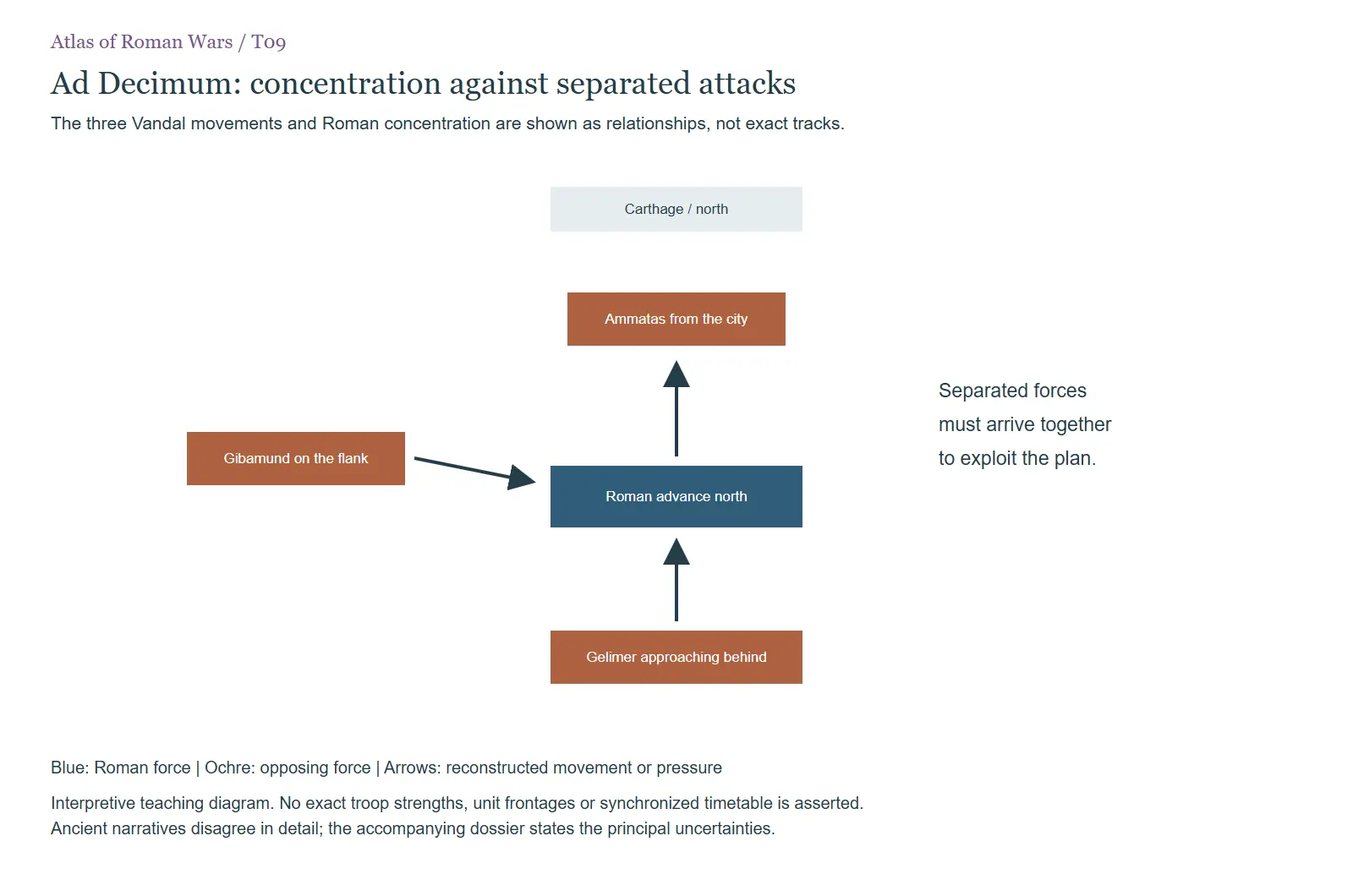
4.25.1. And two months after Sergius had departed from there, Gontharis essayed to set up a tyranny in the following manner. He himself, as it happened, was commanding the troops in Numidia and spending his time there for that reason, but he was secretly treating with the Moors that they might march against Carthage. Forthwith, therefore, an army of the enemy, having been gathered into one place from Numidia and Byzacium, went with great zeal against Carthage. And the Numidians were commanded by Coutzinas and Iaudas, and the men of Byzacium by Antalas. And with him was also John, the tyrant, and his followers; for the mutineers, after the death of Stotzas, had set him up as ruler over themselves. And when Areobindus learned of their attack, he summoned to Carthage a number of the officers with their men, and among them Gontharis. And he was joined also by Artabanes and the Armenians. Areobindus, accordingly, bade Gontharis lead the whole army against the enemy. And Gontharis, though he had promised to serve him zealously in the war, proceeded to act as follows. One of his servants, a Moor by birth and a cook by trade, he commanded to go to the enemy's camp, and to make it appear to all others that he had run away from his master, but to tell Antalas secretly that Gontharis wished to share with him the rule of Libya. So the cook carried out these directions, and Antalas heard the word gladly, but made no further reply than to say that worthy enterprises are not properly brought to pass among men by cooks. When this was heard by Gontharis, he immediately sent to Antalas one of his body- guards, Ulitheus by name, whom he had found especially trustworthy in his service, inviting him to come as close as possible to Carthage. For, if this were done, he promised him to put Areobindus out of the way. So Ulitheus without the knowledge of the rest of the barbarians made an agreement with Antalas that he, Antalas, should rule Byzacium, having half the possessions of Areobindus and taking with him fifteen hundred Roman soldiers, while Gontharis should assume the dignity of king, holding the power over Carthage and the rest of Libya. And after settling these matters he returned to the Roman camp, which they had made entirely in front of the circuit-wall, distributing among themselves the guarding of each gate. And the barbarians not long afterwards proceeded straight for Carthage in great haste, and they made camp and remained in the place called Decimum.
And departing from there on the following day, they were moving forward. But some of the Roman army encountered them, and engaging with them unexpectedly, slew a small number of the Moors. But these were straightway called back by Gontharis, who rebuked them for acting with reckless daring and for being willing to give the Romans foreknowledge of the danger into which they were thrown. But in the meantime Areobindus sent to Coutzinas secretly and began to treat with him with regard to turning traitor. And Coutzinas promised him that, as soon as they should begin the action, he would turn against Antalas and the Moors of Byzacium. For the Moors keep faith neither with any other men nor with each other. This Areobindus reported to Gontharis. And he, wishing to frustrate the enterprise by having it postponed, advised Areobindus by no means to have faith in Coutzinas, unless he should receive from him his children as hostages. So Areobindus and Coutzinas, constantly sending secret messages to each other, were busying themselves with the plot against Antalas. And Gontharis sent Ulitheus once more and made known to Antalas what was being done. And he decided not to make any charges against Coutzinas nor did he allow him to know that he had discovered the plot, nor indeed did he disclose anything of what had been agreed upon by himself and Gontharis. But though enemies and hostile at heart to one another, they were arrayed together with treacherous intent, and each of them was marching with the other against his own particular friend. With such purposes Coutzinas and Antalas were leading the Moorish army against Carthage. And Gontharis was intending to kill Areobindus, but, in order to avoid the appearance of aiming at sole power, he wished to do this secretly in battle, in order that it might seem that the plot had been made by others against the general, and that he had been compelled by the Roman army to assume command over Libya. Accordingly he circumvented Areobindus by deceit, and persuaded him to go out against the enemy and engage with them, now that they had already come close to Carthage. He decided, therefore, that on the following day he would lead the whole army against the enemy at sunrise. But Areobindus, being very inexperienced in this matter and reluctant besides, kept holding back for no good reason. For while considering how he should put on his equipment of arms and armour, and making the other preparations for the sally, he wasted the greatest part of the day. He accordingly put off the engagement to the following day and remained quiet. But Gontharis, suspecting that he had hesitated purposely, as being aware of what was being done, decided openly to accomplish the murder of the general and make his attempt at the tyranny.
4.26.1. And on the succeeding day he proceeded to act as follows. Opening wide the gates where he himself kept guard, he placed huge rocks under them, that no one might be able easily to shut them, and he placed armoured men with bows in their hands about the parapet in great numbers, and he himself, having put on his breastplate, took his stand between the gates. And his purpose in doing this was not that he might receive the Moors into the city; for the Moors, being altogether fickle, are suspicious of all men. And it is not unnatural that they are so; for whoever is by nature treacherous toward his neighbours is himself unable to trust anyone at all, but he is compelled to be suspicious of all men, since he estimates the character of his neighbour by his own mind. For this reason, then, Gontharis did not hope that even the Moors would trust him and come inside the circuit-wall, but he made this move in order that Areobindus, falling into great fear, might straightway rush off in flight, and, abandoning Carthage as quickly as he could, might betake himself to Byzantium. And he would have been right in his expectation had not winter come on just then and frustrated his plan. [544-545 A.D.] And Areobindus, learning what was being done, summoned Athanasius and some of the notables. And Artabanes also came to him from the camp with two others and he urged Areobindus neither to lose heart nor to give way to the daring of Gontharis, but to go against him instantly with all his men and engage him in battle, before any further trouble arose. At first, then, Areobindus sent to Gontharis one of his friends, Phredas by name, and commanded him to test the other's purpose. And when Phredas returned and reported that Gontharis by no means denied his intention of seizing the supreme power, he purposed immediately to go against him arrayed for battle. But in the meantime Gontharis slandered Areobindus to the soldiers, saying that he was a coward and not only possessed with fear of the enemy, but at the same time quite unwilling to give them, his soldiers, their pay, and that he was planning to run away with Anastasius and that they were about to sail very soon from Mandracium [68], in order that the soldiers, fighting both with hunger and with the Moors, might be destroyed; and he enquired whether it was their wish to arrest both and keep them under guard. For thus he hoped either that Areobindus, perceiving the tumult, would turn to flight, or that he would be captured by the soldiers and ruthlessly put to death. Moreover he promised that he himself would advance to the soldiers money of his own, as much as the government owed them. And they were approving his words and were possessed with great wrath against Areobindus, but while this was going on Areobindus together with Artabanes and his followers came there. And a battle took place on the parapet and below about the gate where Gontharis had taken his stand, and neither side was worsted. And all were about to gather from the camps, as many as were well disposed to the emperor, and capture the mutineers by force. For Gontharis had not as yet deceived all, but the majority remained still uncorrupted in mind. But Areobindus, seeing then for the first time the killing of men (for he had not yet, as it happened, become acquainted with this sight), was terror-stricken and, turning coward, fled, unable to endure what he saw. Now there is a temple inside the fortifications of Carthage hard by the sea-shore, the abode of men who are very exact in their practice of religion, whom we have always been accustomed to call "monks"; this temple had been built by Solomon not long before, and he had surrounded it with a wall and rendered it a very strong fortress. And Areobindus, fleeing for refuge, rushed into the monastery, where he had already sent his wife and sister. Then Artabanes too ran away, and all the rest withdrew from Carthage as each one could. And Gontharis, having taken the city by assault, with the mutineers took possession of the palace, and was already guarding both the gates and the harbour most carefully. First, then, he summoned Athanasius, who came to him without delay, and by using much flattery Athanasius made it appear that what had been done pleased him exceedingly. And after this Gontharis sent the priest of the city and commanded Areobindus, after receiving pledges, to come to the palace, threatening that he would besiege him if he disobeyed and would not again give him pledges of safety, but would use every means to capture and put him to death. So the priest, Reparatus, stoutly declared to Areobindus that in accordance with the decision of Gontharis he would swear that no harm would come to him from Gontharis, telling also what he had threatened in case he did not obey. But Areobindus became afraid and agreed that he would follow the priest immediately, if the priest, after performing the rite of the sacred bath in the usual manner, should swear to him by that rite and then give him pledges for his safety. So the priest did according to this. And Areobindus without delay followed him, clad in a garment which was suitable neither for a general nor for any one else in military service, but altogether appropriate to a slave or one of private station; this garment the Romans call "casula" in the Latin tongue. And when they came near the palace, he took in his hands the holy scriptures from the priest, and so went before Gontharis. And falling prone he lay there a long time, holding out to him the suppliant olive-branch and the holy scriptures, and with him was the child which had been counted worthy of the sacred bath by which the priest had given him the pledge, as has been told. And when, with difficulty, Gontharis had raised him to his feet, he enquired of Gontharis in the name of all things holy whether his safety was secure. And Gontharis now bade him most positively to be of good cheer, for he would suffer no harm at his hands, but on the following day would be gone from Carthage with his wife and his possessions. Then he dismissed the priest Reparatus, and bade Areobindus and Athanasius dine with him in the palace. And during the dinner he honoured Areobindus, inviting him to take his place first on the couch; but after the dinner he did not let him go, but compelled him to sleep in a chamber alone; and he sent there Ulitheus with certain others to assail him. And while he was wailing and crying aloud again and again and speaking many entreating words to them to move them to pity, they slew him. Athanasius, however, they spared, passing him by, I suppose, on account of his advanced age.
Outcome and critical assessment
Result and caution: imperial Africa stabilized substantially, without making every inland community uniformly obedient. Procopius and the later poetic tradition of Corippus offer different kinds of testimony. Corippus is a necessary further reading witness, not a separately verified local text claimed by this edition. The quick conquest of AD 533–534 should never stand in for this longer history.
Historical record: Procopius, Wars 4; Bury for later African campaigns and context. The absence of a separately identified local Corippus edition limits a complete primary-source reconstruction of the final phase.