Wars · IX. The eastern empire and Justinian's wars
W090 The Vandalic war
The deposition of Hilderic by Gelimer formed part of the political justification for Justinian's intervention. Belisarius' expedition crossed the Mediterranean and landed in Africa. Roman success at Ad Decimum opened the way to Carthage; the later victory at Tricamarum and Gelimer's surrender ended the Vandal monarchy.
Shipping, landing arrangements, discipline, intelligence and the separate deployment of Vandal forces affected the campaign. Procopius accompanied the expedition and offers particularly valuable detail, but his narrative also organizes success around the choices and fortunes of commanders.
Command, forces and military problem
| Field | Dossier |
|---|---|
| Roman leadership | Belisarius, John the Armenian and other expeditionary commanders |
| Opposing or rival parties | Gelimer, Ammatas, Gibamund and Tzazon |
| Forces and capabilities | Roman expeditionary infantry and cavalry against dispersed Vandal forces |
| Operational problem | Land, concentrate and defeat separated enemy forces before the expedition's supply position deteriorates. |
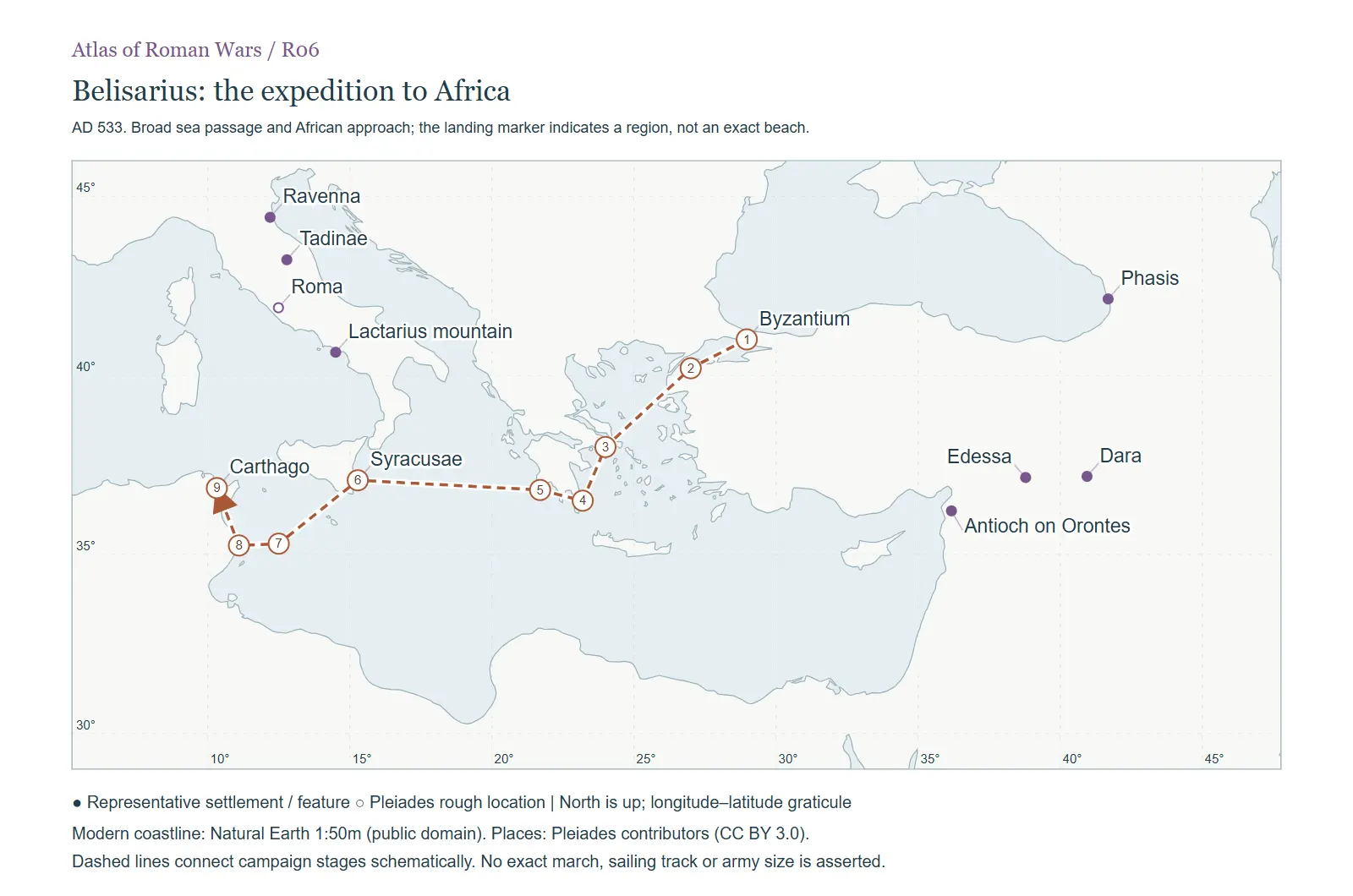
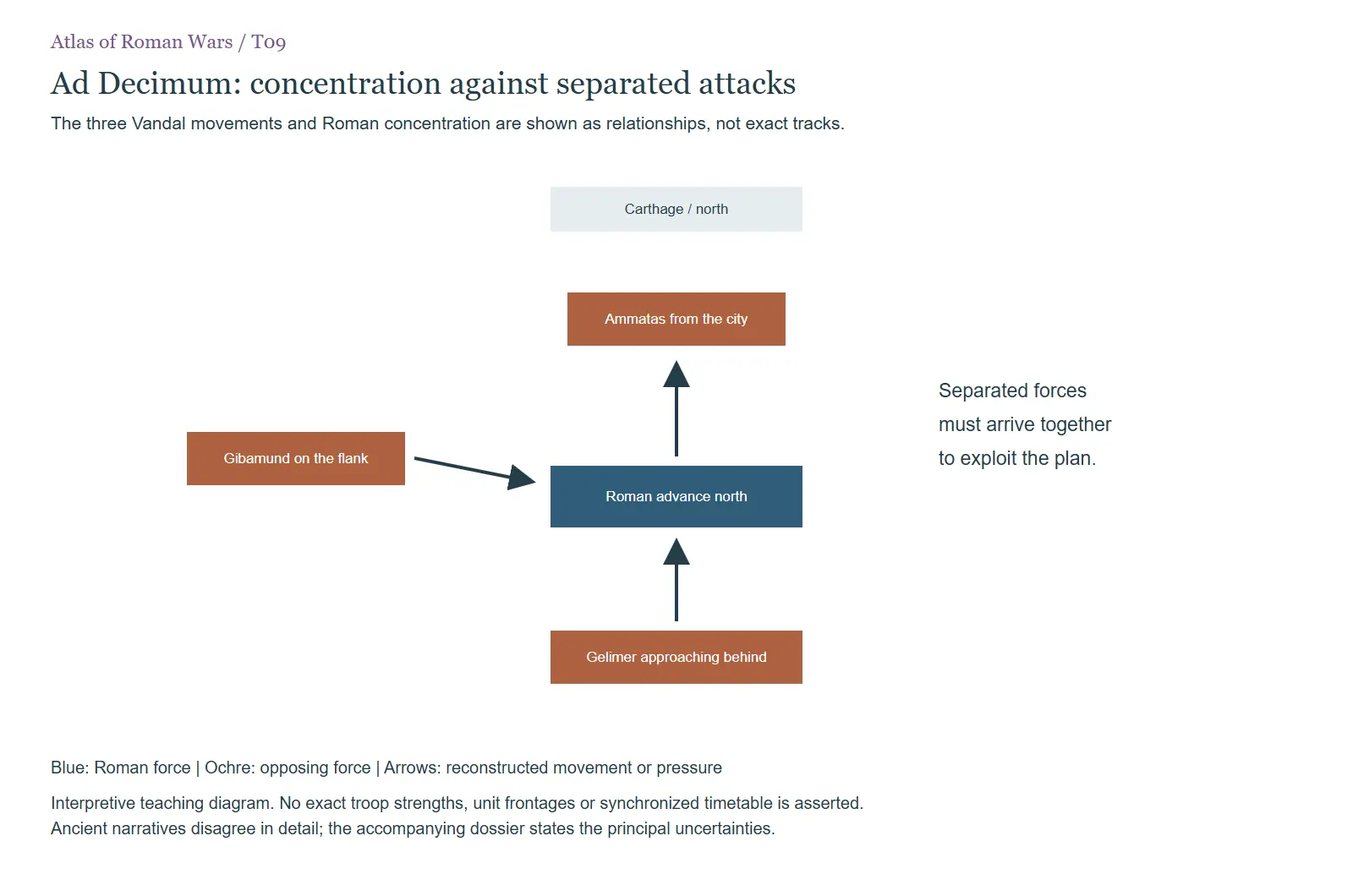
Campaign geography and operational plates
Justinian’s reconquests in the Mediterranean
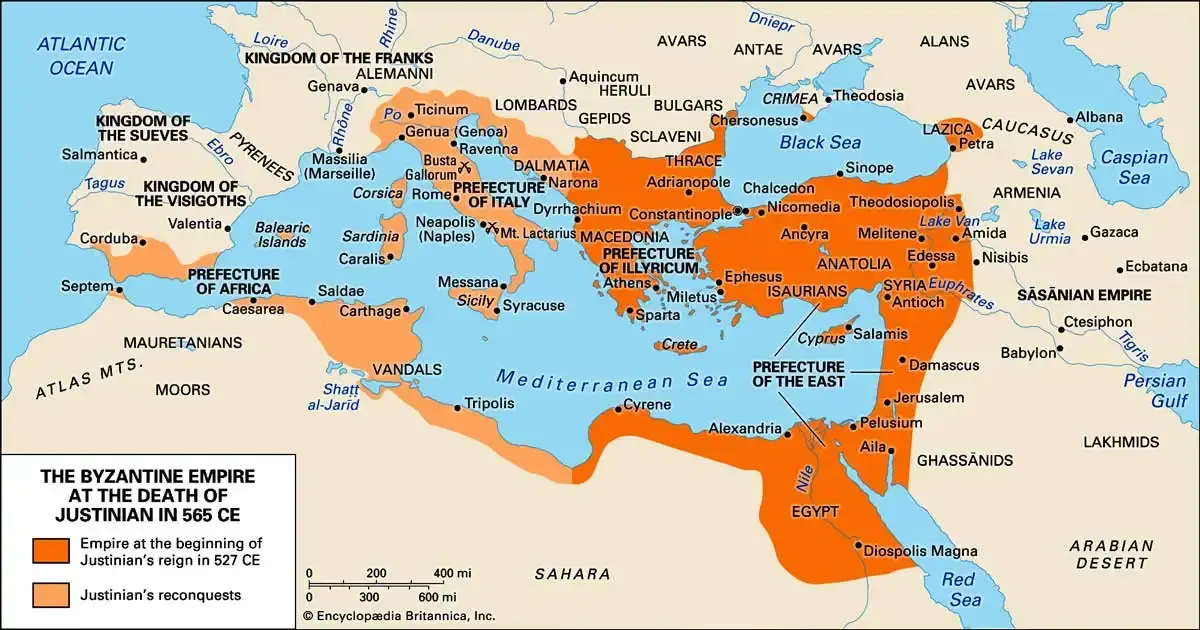
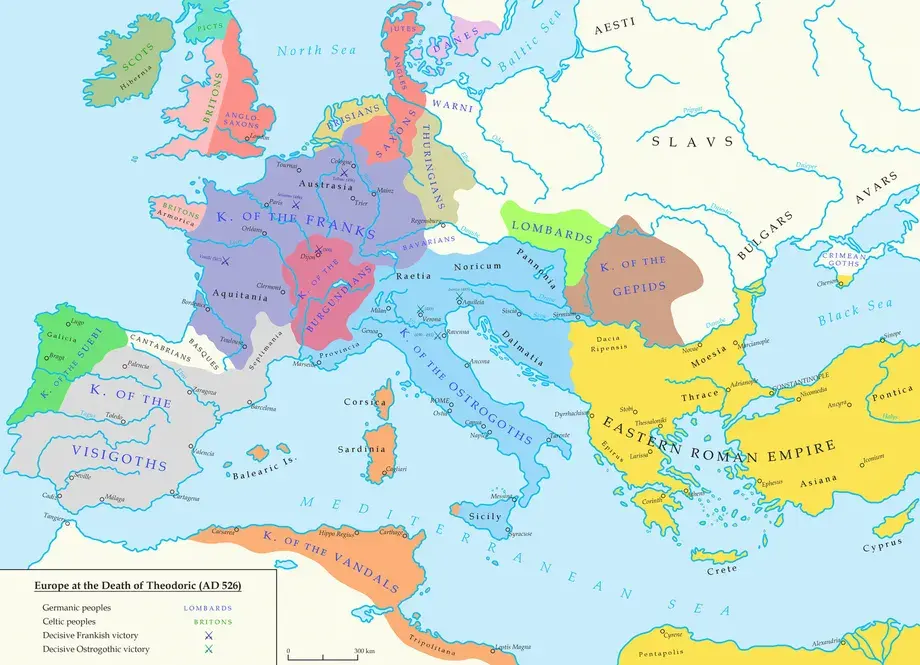
The combined colored territory is an end-of-reign comparison, not the operational position at the moment Belisarius sailed. Africa, Italy and the limited Spanish acquisitions resulted from distinct expeditions and settlements. The map makes their maritime connections visible while the dossiers explain the uneven and contested process by which those areas were acquired.
The Vandal kingdom before the Roman invasion
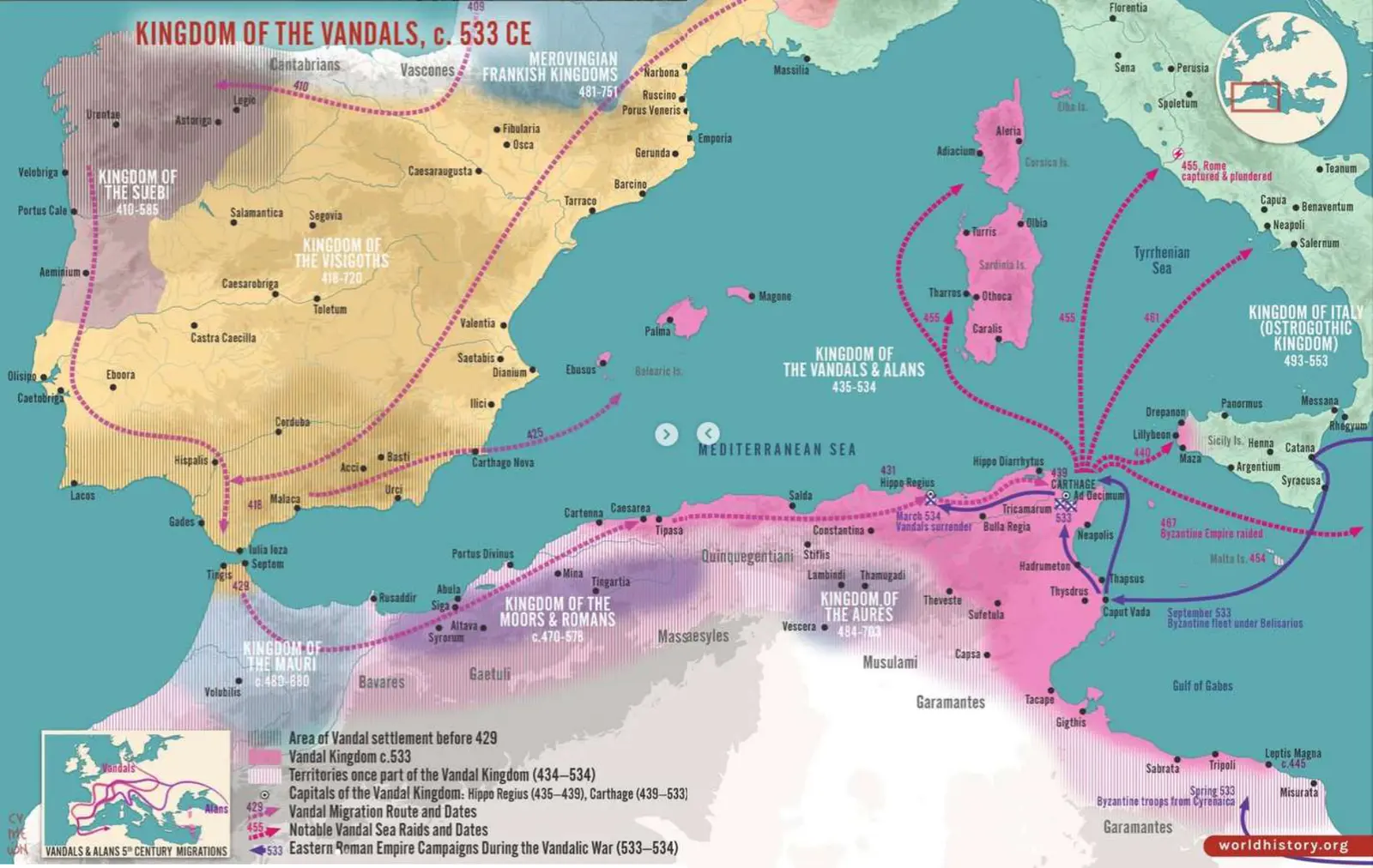
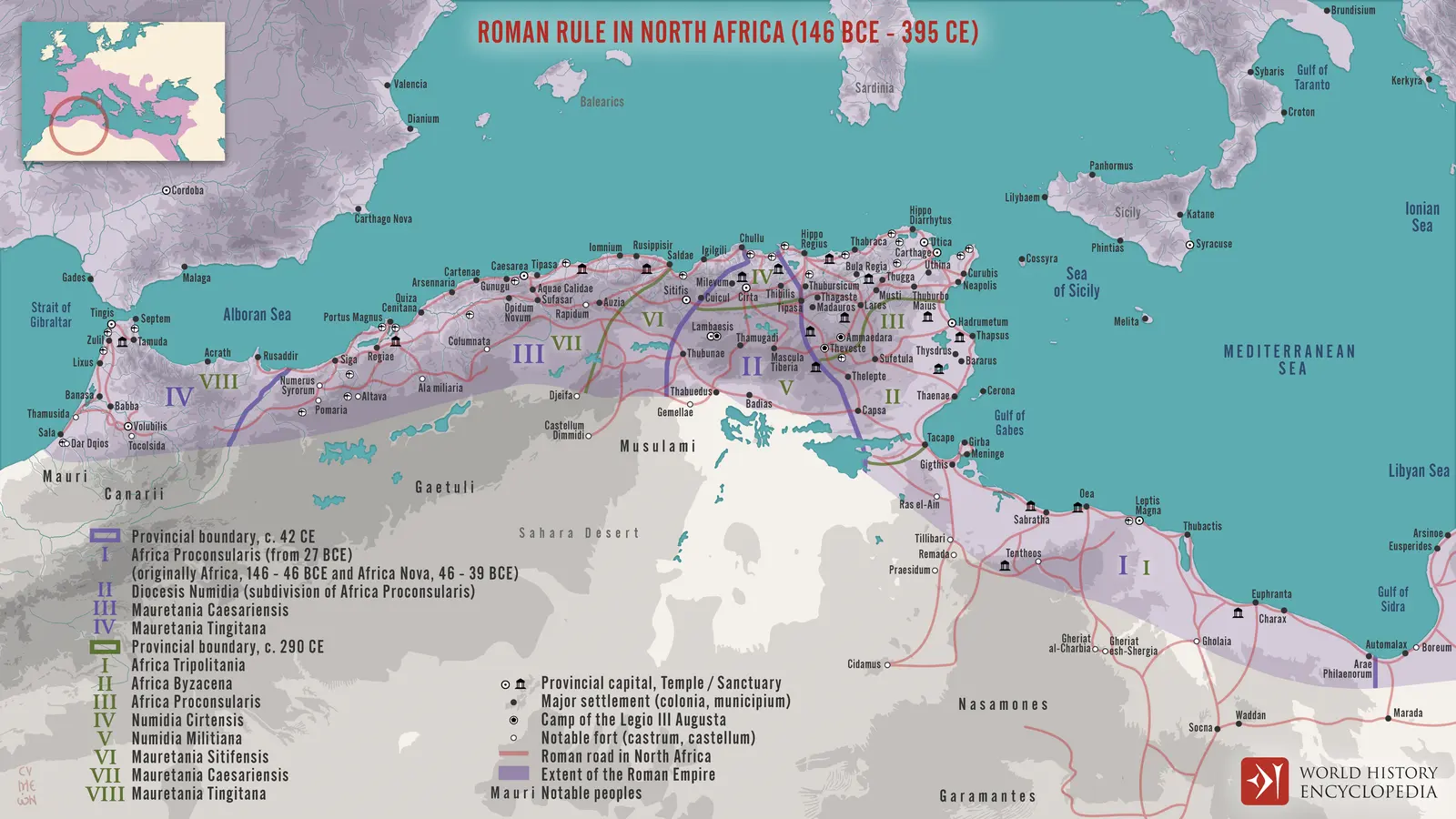
The African kingdom was a coastal and maritime power as well as a land army. Its positions in the western Mediterranean help explain why naval access and intelligence about dispersed forces mattered to the expedition. Belisarius' campaign should be followed from landing to field battles rather than inferred directly from the kingdom's colored outline.
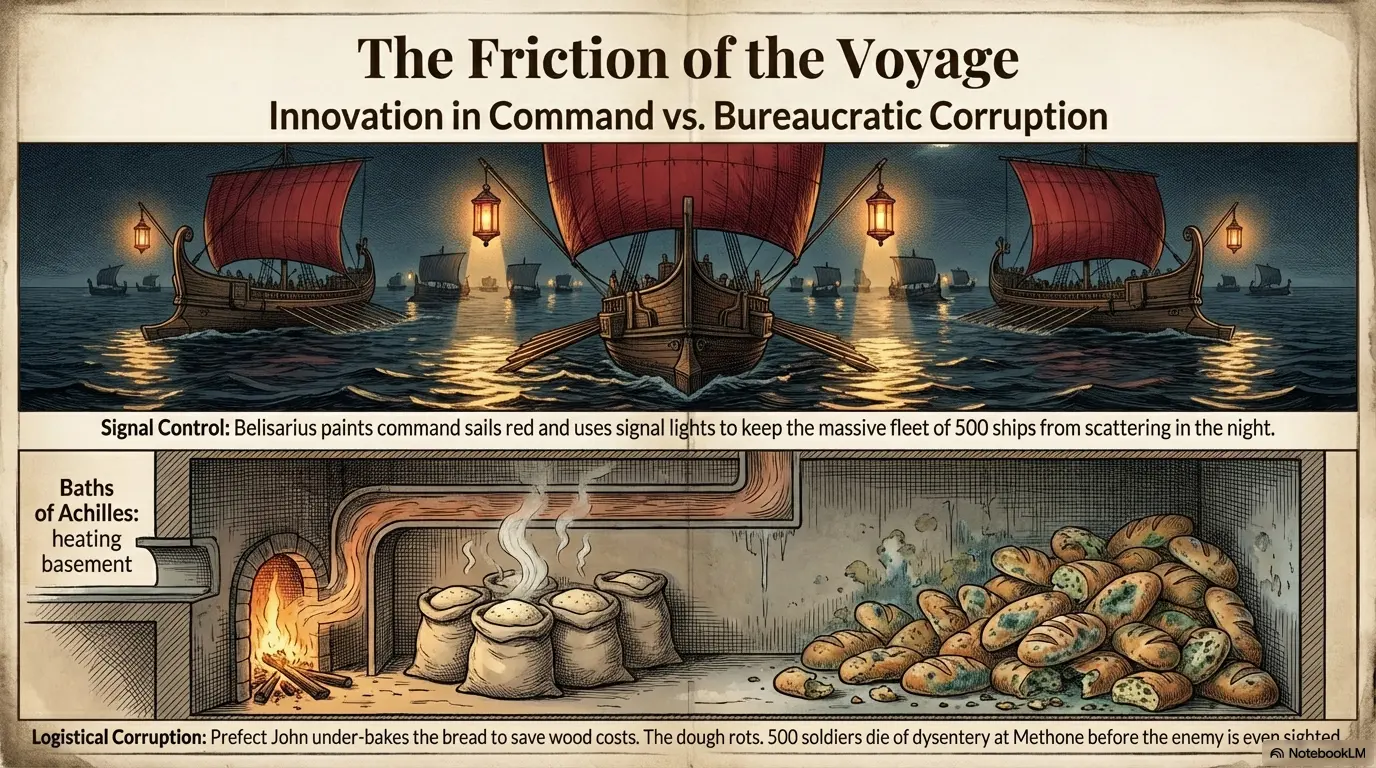
The African expedition: fleet cohesion and spoiled provisions
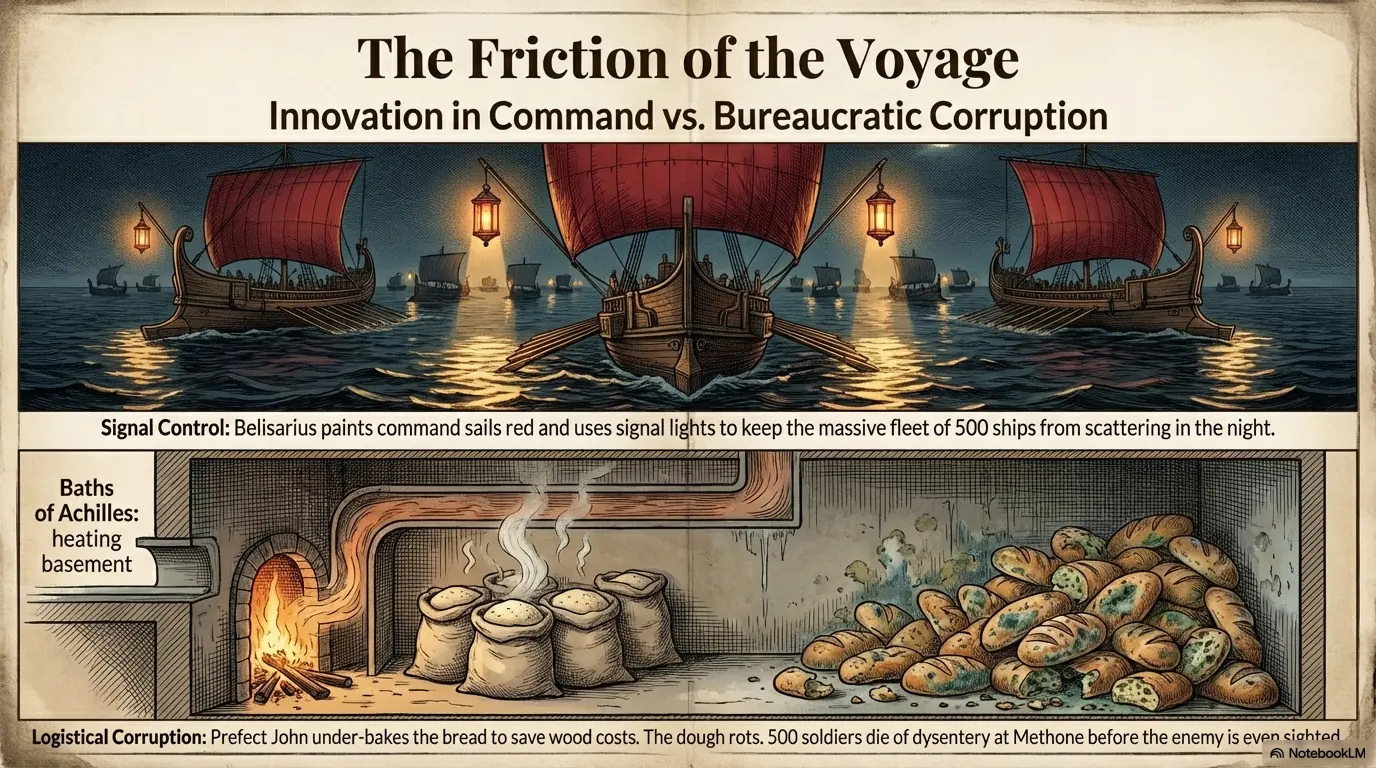
A transport fleet had to remain sufficiently coherent to deliver its army while managing sickness and food. Signals and the quality of provisions therefore belonged to operational effectiveness. The two panels connect command at sea with the bodily condition of the men who would eventually disembark, without supplying a complete fleet inventory.
Keeping water usable at sea
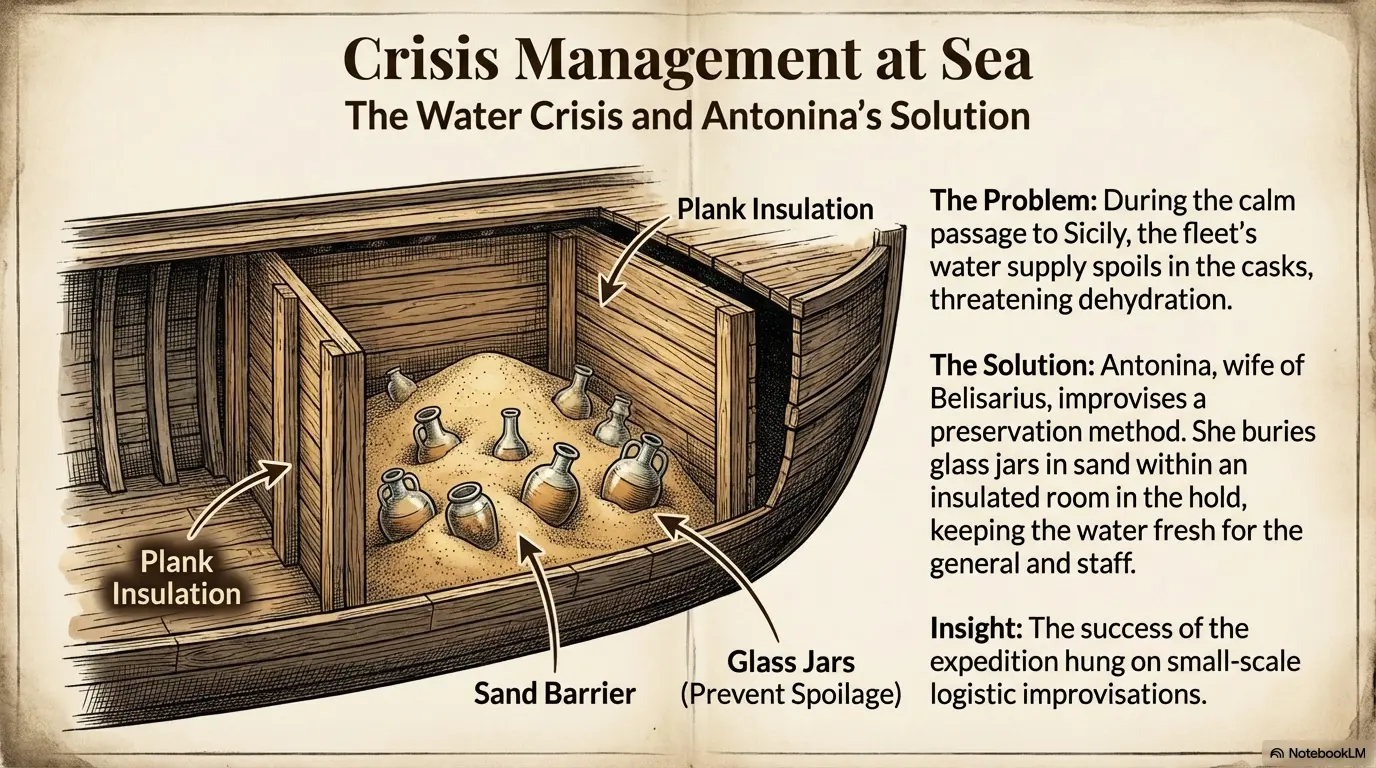
The illustration translates a narrative detail into a supply problem: water could deteriorate before the fleet reached a reliable replenishment point. It explains the reported arrangement through containers and insulation. It should not be used to infer exact water temperatures, quantities carried or the design of every transport vessel.
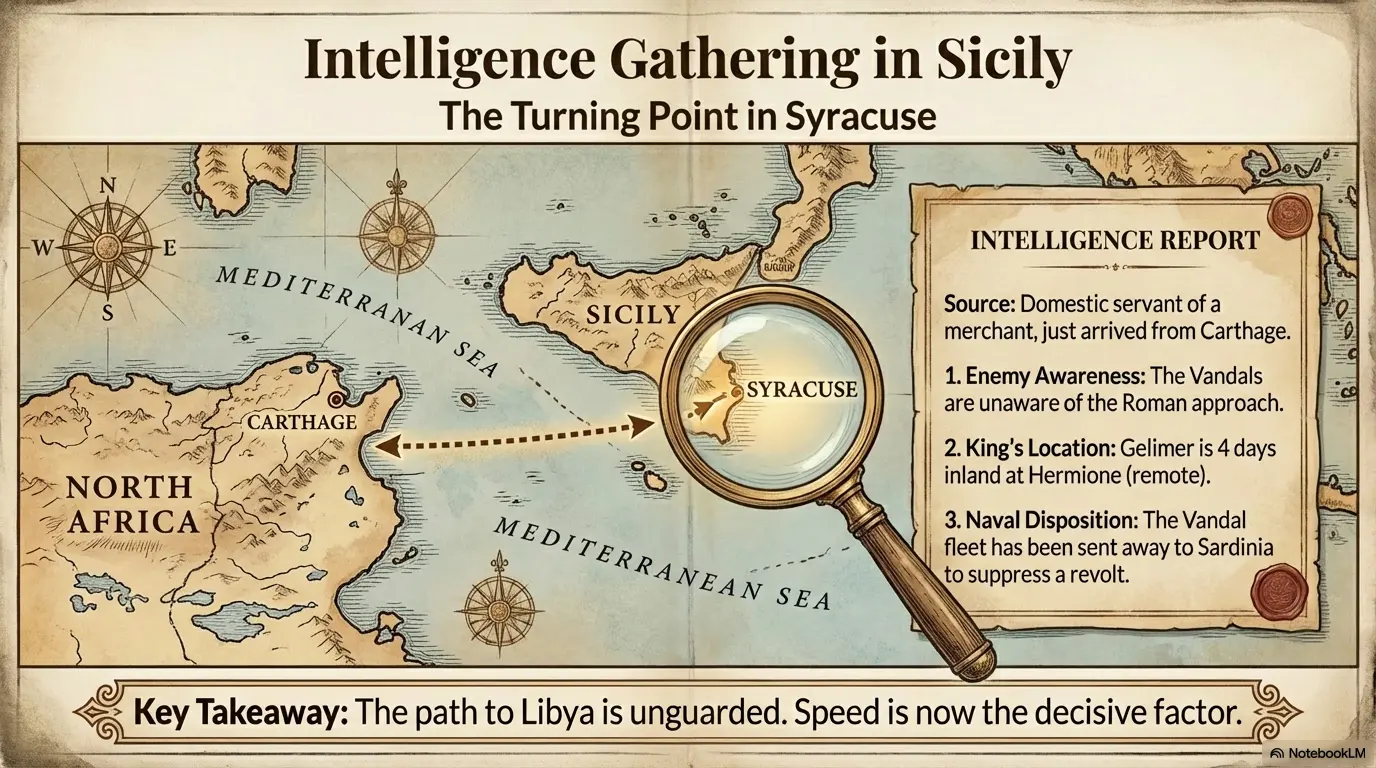
Sicily as an intelligence stop
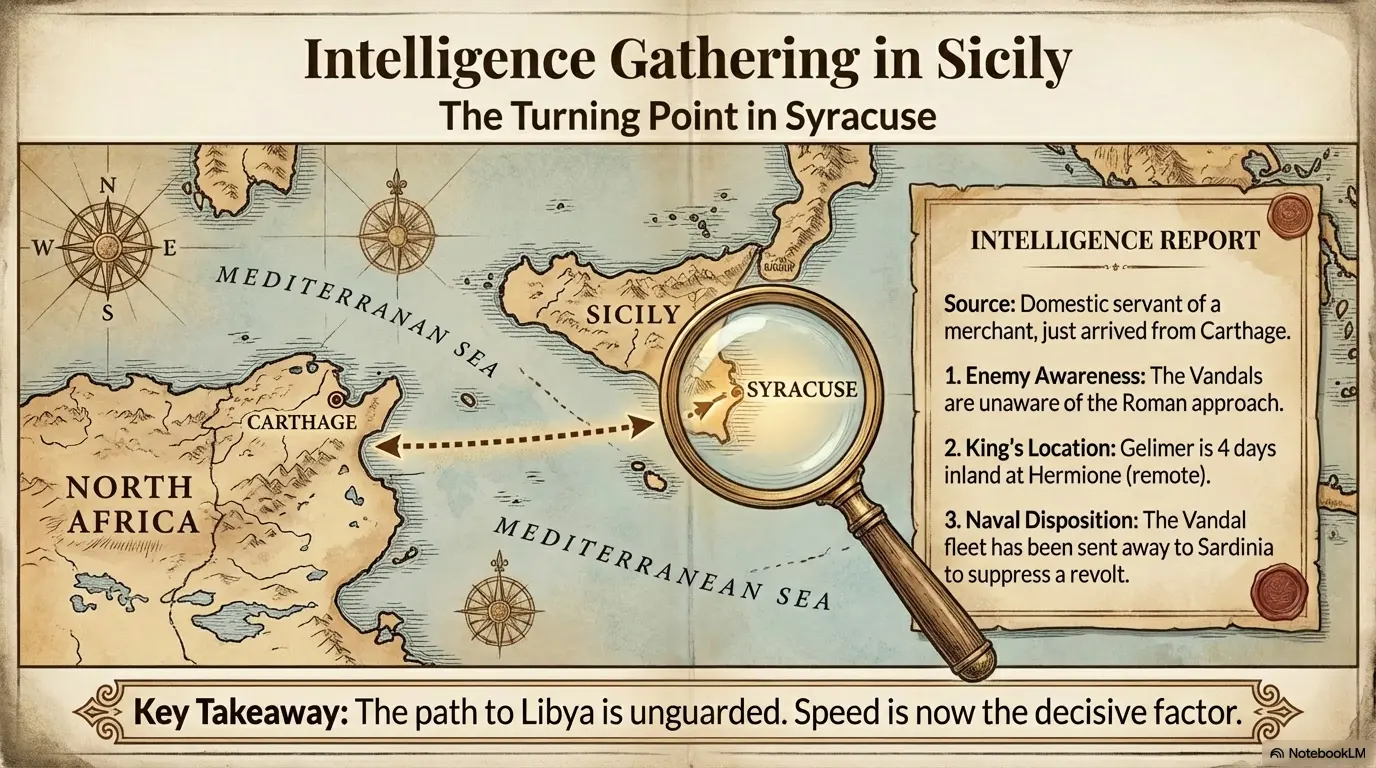
Reports about enemy awareness, royal location and the absence of naval forces could change the perceived risk of an expedition. Sicily was therefore more than a point on the sailing route. The figure helps distinguish what the commander believed he knew from the later outcome, while leaving the reliability and timing of individual reports to the narrative.
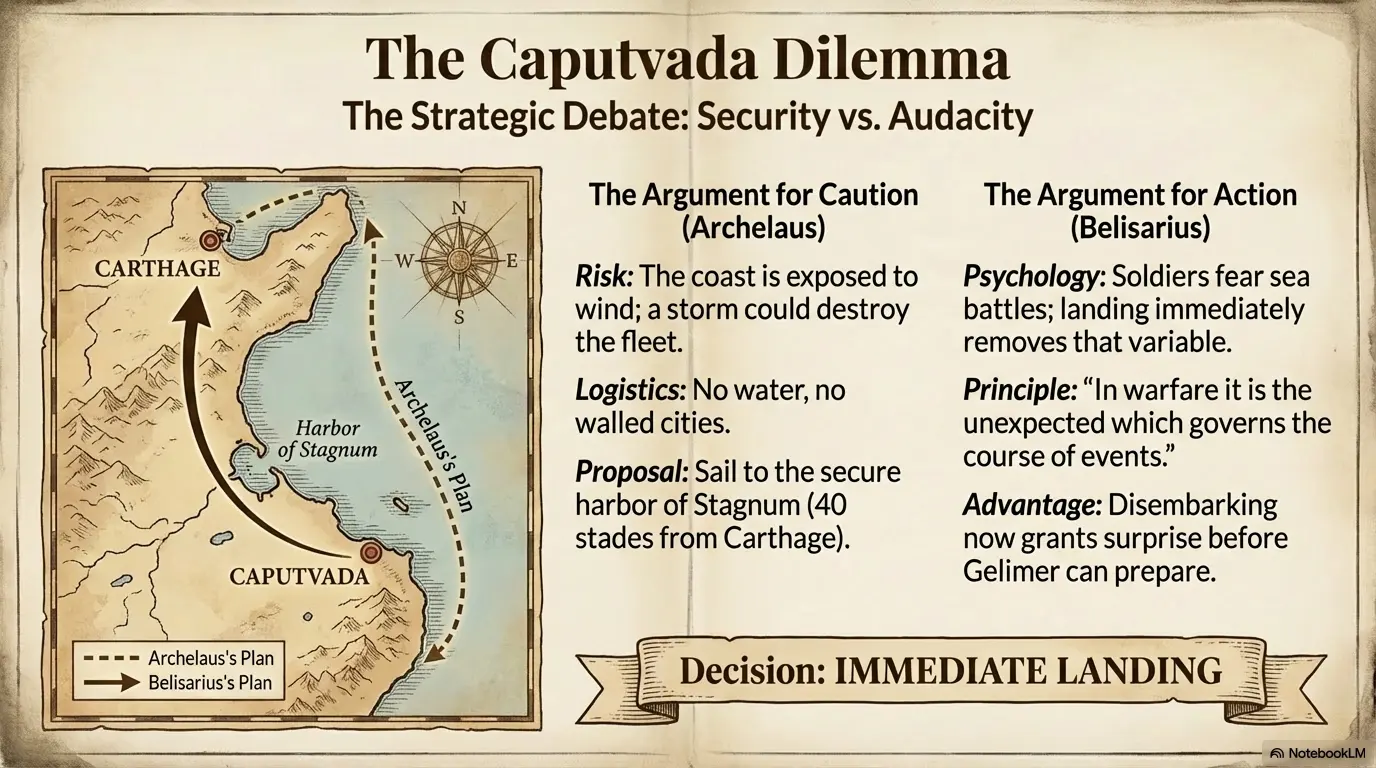
Caputvada: the choice between immediate landing and a safer harbor
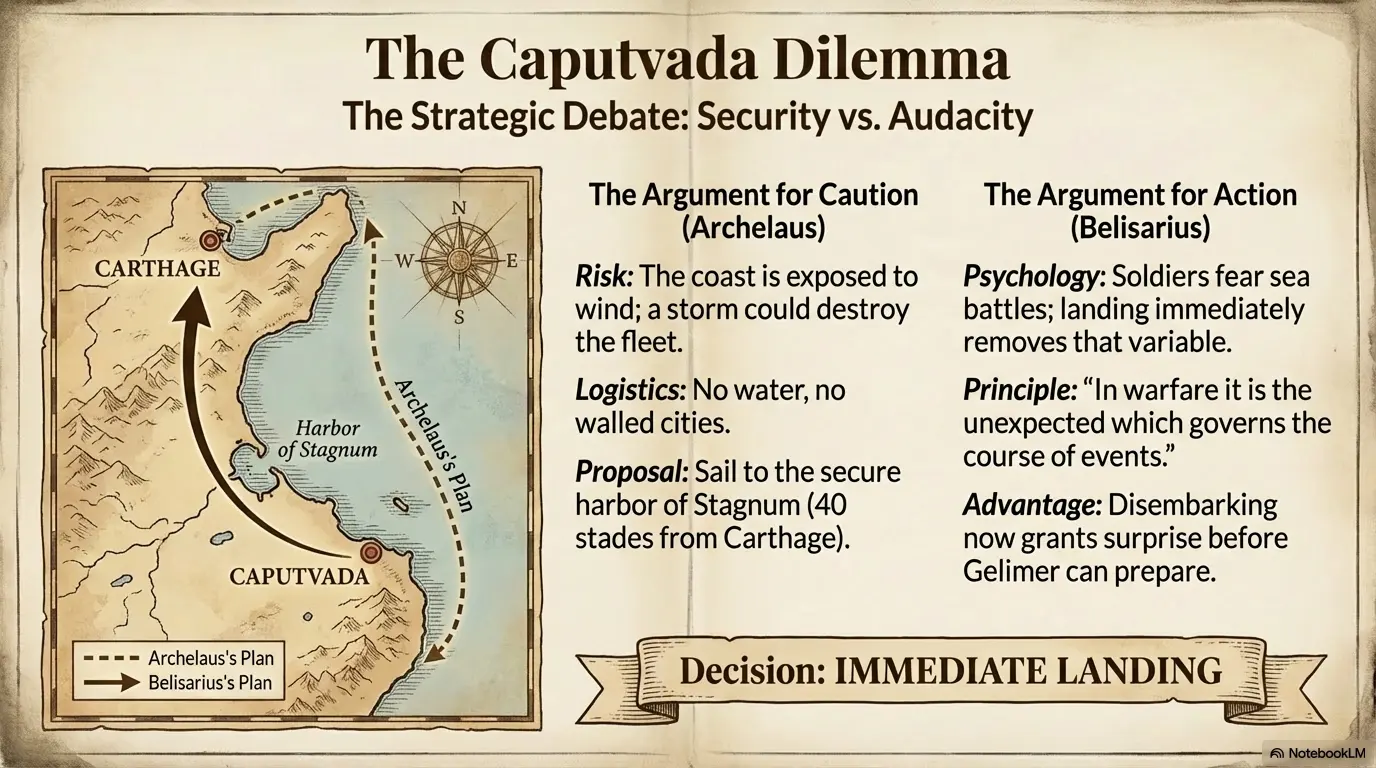
The choice involved several risks at once: water, weather, enemy proximity and the morale of troops remaining aboard ship. The graphic usefully places those considerations beside one another. A decision can be understandable without being inevitable, and the success of the landing does not prove that every rejected option was irrational.
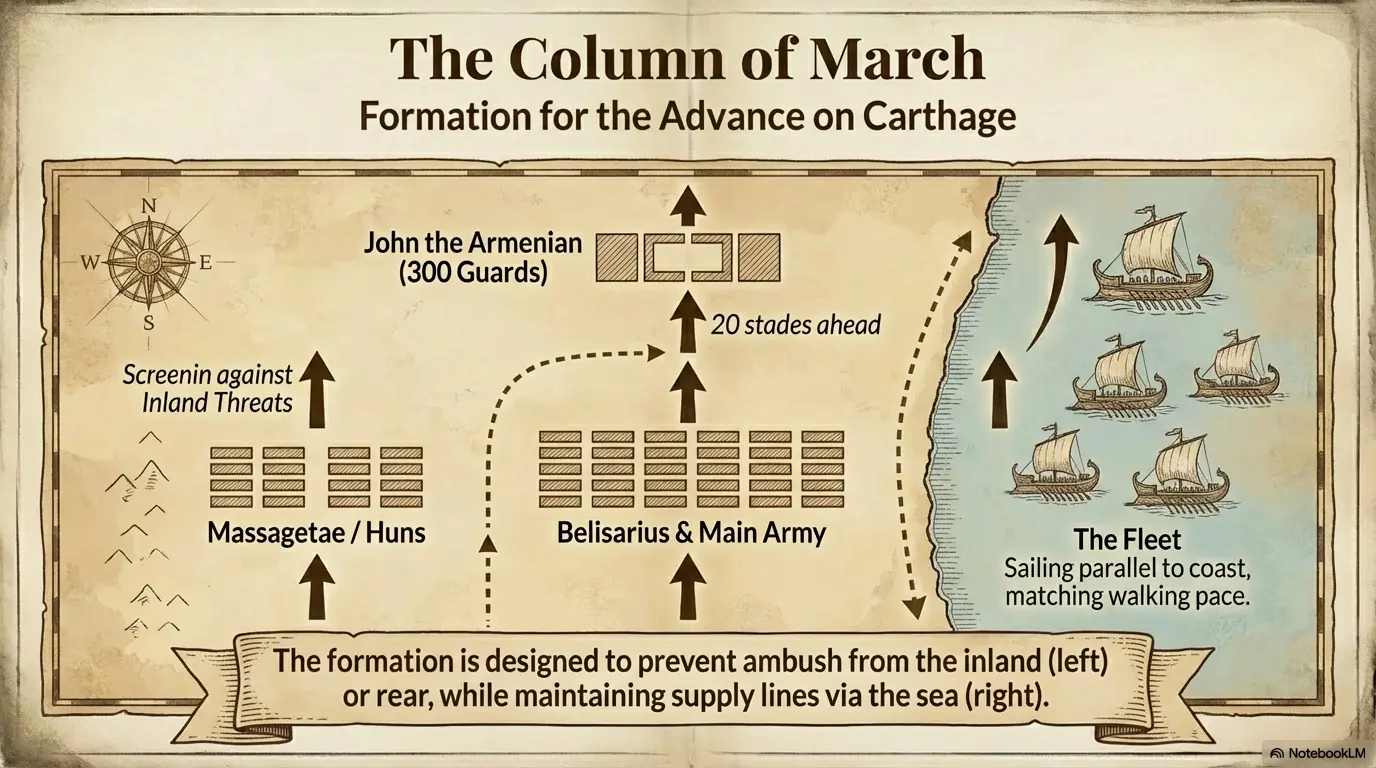
The advance on Carthage: protecting a column in motion
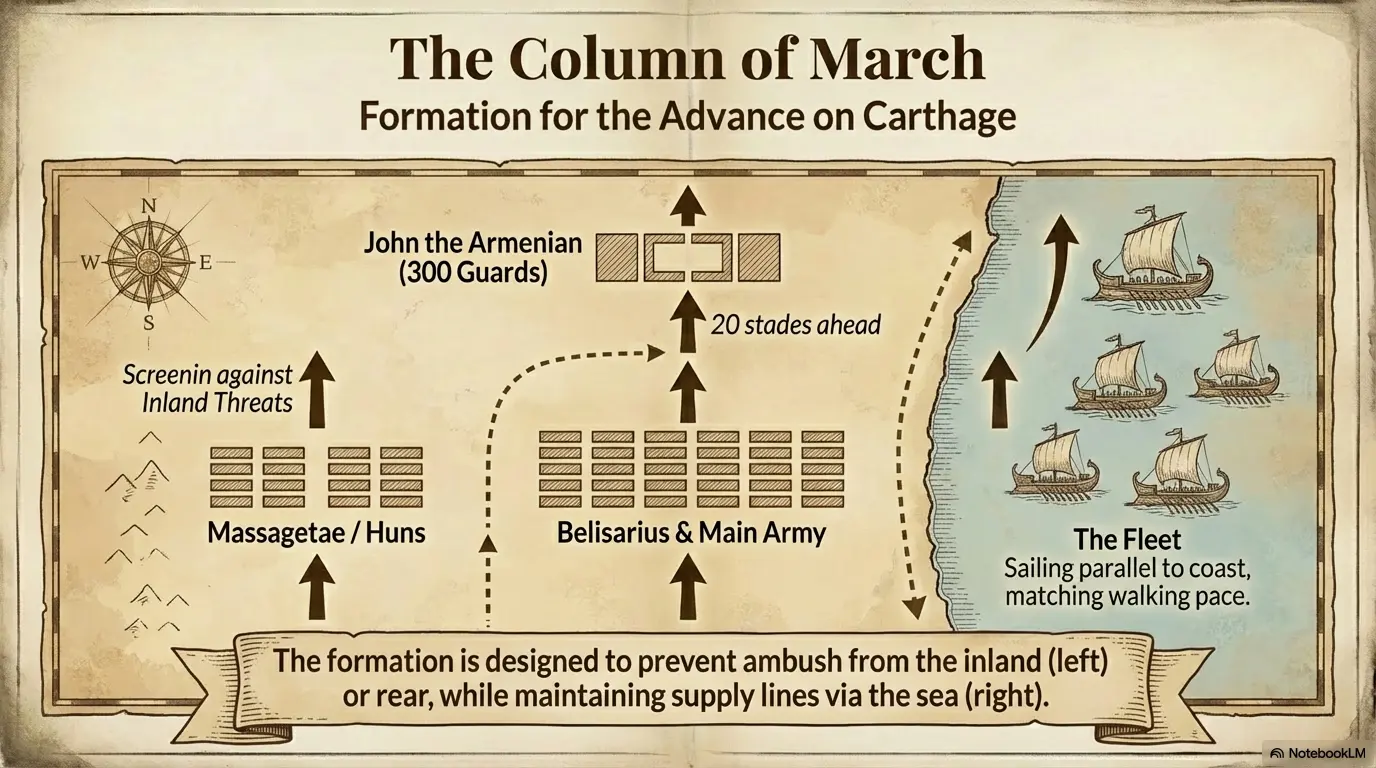
The relationship among the road column, a detached screen and ships along the coast explains how the army sought warning and access to supplies. Those elements did not occupy permanently fixed distances from one another. The neatly aligned boxes illustrate functions; contact, terrain and uncertainty could disrupt the arrangement.
Contemporary campaign chronicle
The following substantial selections incorporate Procopius' account in H. B. Dewing's public-domain translation. Ancient book, chapter and section numbers are retained. Speeches, reported figures, judgments and divine explanations are the ancient author's testimony, not independently established modern conclusions. Editorial event-date overlays have been removed.
The expedition and the African landing
3.10.1. And when the Emperor Justinian considered that the situation was as favourable as possible, both as to domestic affairs and as to his relations with Persia, he took under consideration the situation in Libya. But when he disclosed to the magistrates that he was gathering an army against the Vandals and Gelimer, the most of them began immediately to show hostility to the plan, and they lamented it as a misfortune, recalling the expedition of the Emperor Leon and the disaster of Basiliscus, and reciting how many soldiers had perished and how much money the state had lost. But the men who were the most sorrowful of all, and who, by reason of their anxiety, felt the keenest regret, were the pretorian prefect, whom the Romans call "praetor," and the administrator of the treasury, and all to whom had been assigned the collection of either public or imperial taxes, for they reasoned that while it would be necessary for them to produce countless sums for the needs of the war, they would be granted neither pardon in case of failure nor extension of time in which to raise these sums. And every one of the generals, supposing that he himself would command the army, was in terror and dread at the greatness of the danger, if it should be necessary for him, if he were preserved from the perils of the sea, to encamp in the enemy's land, and, using his ships as a base, to engage in a struggle against a kingdom both large and formidable. The soldiers, also, having recently returned from a long, hard war, and having not yet tasted to the full the blessings of home, were in despair, both because they were being led into sea-fighting, — a thing which they had not learned even from tradition before then, — and because they were sent from the eastern frontier to the West, in order to risk their lives against Vandals and Moors. But all the rest, as usually happens in a great throng, wished to be spectators of new adventures while others faced the dangers. But as for saying anything to the emperor to prevent the expedition, no one dared to do this except John the Cappadocian, the pretorian prefect, a man of the greatest daring and the cleverest of all men of his time. For this John, while all the others were bewailing in silence the fortune which was upon them, came before the emperor and spoke as follows: "O Emperor, the good faith which thou dost shew in dealing with thy subjects enables us to speak frankly regarding anything which will be of advantage to thy government, even though what is said and done may not be agreeable to thee. For thus does thy wisdom temper thy authority with justice, in that thou dost not consider that man only as loyal to thy cause who serves thee under any and all conditions, nor art thou angry with the man who speaks against thee, but by weighing all things by pure reason alone, thou hast often shewn that it involves us in no danger to oppose thy purposes.
Led by these considerations, O Emperor, I have come to offer this advice, knowing that, though I shall give perhaps offence at the moment, if it so chance, yet in the future the loyalty which I bear you will be made clear, and that for this I shall be able to shew thee as a witness. For if, through not hearkening to my words, thou shalt carry out the war against the Vandals, it will come about, if the struggle is prolonged for thee, that my advice will win renown. For if thou hast confidence that thou wilt conquer the enemy, it is not at all unreasonable that thou shouldst sacrifice the lives of men and expend a vast amount of treasure, and undergo the difficulties of the struggle; for victory, coming at the end, covers up all the calamities of war. But if in reality these things lie on the knees of God, and if it behoves us, taking example from what has happened in the past, to fear the outcome of war, on what grounds is it not better to love a state of quiet rather than the dangers of mortal strife? Thou art purposing to make an expedition against Carthage, to which, if one goes by land, the journey is one of a hundred and forty days, and if one goes by water, he is forced to cross the whole open sea and go to its very end. So that he who brings thee news of what will happen in the camp must needs reach thee a year after the event. And one might add that if thou art victorious over thy enemy, thou couldst not take possession of Libya while Sicily and Italy lie in the hands of others; and at the same time, if any reverse befall thee, O Emperor, the treaty having already been broken by thee, thou wilt bring the danger upon our own land. In fact, putting all in a word, it will not be possible for thee to reap the fruits of victory, and at the same time any reversal of fortune will bring harm to what is well established. It is before an enterprise that wise planning is useful. For when men have failed, repentance is of no avail, but before disaster comes there is no danger in altering plans. Therefore it will be of advantage above all else to make fitting use of the decisive moment." Thus spoke John; and the Emperor Justinian, hearkening to his words, checked his eager desire for the war. But one of the priests whom they call bishops, who had come from the East, said that he wished to have a word with the emperor. And when he met Justinian, he said that God had visited him in a dream, and bidden him go to the emperor and rebuke him, because, after undertaking the task of protecting the Christians in Libya from tyrants, he had for no good reason become afraid. "And yet," He had said, "I will Myself join with him in waging war and make him lord of Libya." When the emperor heard this, he was no longer able to restrain his purpose, and he began to collect the army and the ships, and to make ready supplies of weapons and of food, and he announced to Belisarius that he should be in readiness, because he was very soon to act as general in Libya.
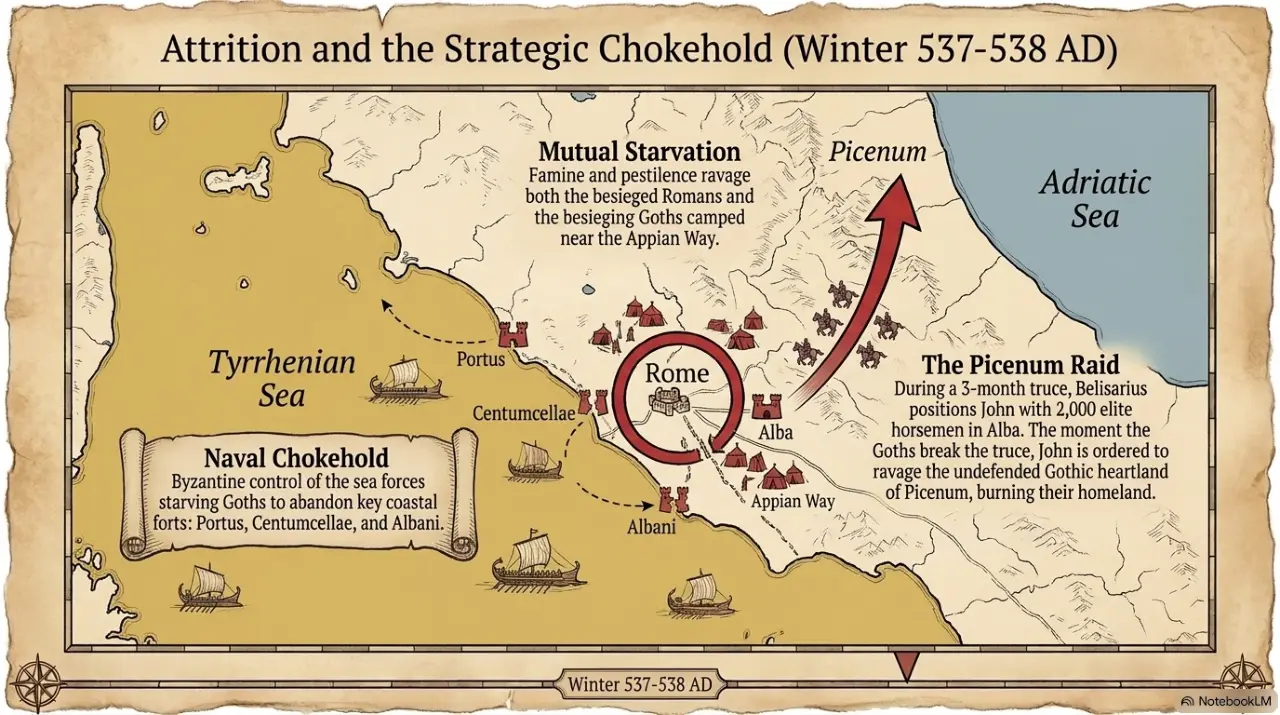
Meanwhile Pudentius, one of the natives of Tripolis in Libya, caused this district to revolt from the Vandals, and sending to the emperor he begged that he should despatch an army to him; for, he said, he would with no trouble win the land for the emperor. And Justinian sent him Tattimuth and an army of no very great size. This force Pudentius joined with his own troops and, the Vandals being absent, he gained possession of the land and made it subject to the emperor. And Gelimer, though wishing to inflict punishment upon Pudentius, found the following obstacle in his way. There was a certain Godas among the slaves of Gelimer, a Goth by birth, a passionate and energetic fellow possessed of great bodily strength, but appearing to be well-disposed to the cause of his master. To this Godas Gelimer entrusted the island of Sardinia, in order both to guard the island and to pay over the annual tribute. But he neither could digest the prosperity brought by fortune nor had he the spirit to endure it, and so he undertook to establish a tyranny, and he refused to continue the payment of the tribute, and actually detached the island from the Vandals and held it himself. And when he perceived that the Emperor Justinian was eager to make war against Libya and Gelimer, he wrote to him as follows: "It was neither because I yielded to folly nor because I had suffered anything unpleasant at my master's hands that I turned my thoughts towards rebellion, but seeing the extreme cruelty of the man both toward his kinsmen and toward his subjects, I could not, willingly at least, be reputed to have a share in his inhumanity. For it is better to serve a just king than a tyrant whose commands are unlawful. But do thou join with me to assist in this my effort and send soldiers so that I may be able to ward off my assailants." And the emperor, on receiving this letter, was pleased, and he sent Eulogius as envoy and wrote a letter praising Godas for his wisdom and his zeal for justice, and he promised an alliance and soldiers and a general, who would be able to guard the island with him and to assist him in every other way, so that no trouble should come to him from the Vandals. But Eulogius, upon coming to Sardinia, found that Godas was assuming the name and wearing the dress of a king and that he had attached a body-guard to his person. And when Godas read the emperor's letter, he said that it was his wish to have soldiers, indeed, come to fight along with him, but as for a commander, he had absolutely no desire for one. And having written to the emperor in this sense, he dismissed Eulogius.
3.11.1. The emperor, meanwhile, not having yet ascertained these things, was preparing four hundred soldiers with Cyril as commander, who were to assist Godas in guarding the island. And with them he also had in readiness the expedition against Carthage, ten thousand foot-soldiers, and five thousand horsemen, gathered from the regular troops and from the "foederati." Now at an earlier time only barbarians were enlisted among the foederati, those, namely, who had come into the Roman political system, not in the condition of slaves, since they had not been conquered by the Romans, but on the basis of complete equality. For the Romans call treaties with their enemies "foedera." But at the present time there is nothing to prevent anyone from assuming this name, since time will by no means consent to keep names attached to the things to which they were formerly applied, but conditions are ever changing about according to the desire of men who control them, and men pay little heed to the meaning which they originally attached to a name. And the commanders of the foederati were Dorotheus, the general of the troops in Armenia, and Solomon, who was acting as manager for the general Belisarius; (such a person the Romans call "domesticus." Now this Solomon was a eunuch, but it was not by the devising of man that he had suffered mutilation, but some accident which befell him while in swaddling clothes had imposed this lot upon him); and there were also Cyprian, Valerian, Martinus, Althias, John, Marcellus, and the Cyril whom I have mentioned above; and the commanders of the regular cavalry were Rufinus and Aïgan, who were of the house of Belisarius, and Barbatus and Pappus, while the regular infantry was commanded by Theodorus, who was surnamed Cteanus, and Terentius, Zaïdus, Marcian, and Sarapis. And a certain John, a native of Epidamnus, which is now called Dyrrachium, held supreme command over all the leaders of infantry. Among all these commanders Solomon was from a place in the East, at the very extremity of the Roman domain, where the city called Daras now stands, and Aïgan was by birth of the Massagetae whom they now call Huns; and the rest were almost all inhabitants of the land of Thrace. And there followed with them also four hundred Eruli, whom Pharas led, and about six hundred barbarian allies from the nation of the Massagetae, all mounted bowmen; these were led by Sinnion and Balas, men endowed with bravery and endurance in the highest degree.
And for the whole force five hundred ships were required, no one of which was able to carry more than fifty thousand medimni, nor any one less than three thousand. And in all the vessels together there were thirty thousand sailors, Egyptians and Ionians for the most part, and Cilicians, and one commander was appointed over all the ships, Calonymus of Alexandria. And they had also ships of war prepared as for sea-fighting, to the number of ninety-two, and they were single-banked ships covered by decks, in order that the men rowing them might if possible not be exposed to the bolts of the enemy. Such boats are called "dromones" by those of the present time; for they are able to attain a great speed. In these sailed two thousand men of Byzantium, who were all rowers as well as fighting men; for there was not a single superfluous man among them. And Archelaus was also sent, a man of patrician standing who had already been pretorian prefect both in Byzantium and in Illyricum, but he then held the position of prefect of the army; for thus the officer charged with the maintenance of the army is designated. But as general with supreme authority over all the emperor sent Belisarius, who was in command of the troops of the East for the second time. And he was followed by many spearmen and many guards as well, men who were capable warriors and thoroughly experienced in the dangers of fighting. And the emperor gave him written instructions, bidding him do everything as seemed best to him, and stating that his acts would be final, as if the emperor himself had done them. The writing, in fact, gave him the power of a king. Now Belisarius was a native of Germania, which lies between Thrace and Illyricum. These things, then, took place in this way. Gelimer, however, being deprived of Tripolis by Pudentius and of Sardinia by Godas, scarcely hoped to regain Tripolis, since it was situated at a great distance and the rebels were already being assisted by the Romans, against whom just at that moment it seemed to him best not to take the field; but he was eager to get to the island before any army sent by the emperor to fight for his enemies should arrive there. He accordingly selected five thousand of the Vandals and one hundred and twenty ships of the fastest kind, and appointing as general his brother Tzazon, he sent them off. And so they were sailing with great enthusiasm and eagerness against Godas and Sardinia. In the meantime the Emperor Justinian was sending off Valerian and Martinus in advance of the others in order to await the rest of the army in the Peloponnesus. And when these two had embarked upon their ships, it came to the emperor's mind that there was something which he wished to enjoin upon them, — a thing which he had wished to say previously, but he had been so busied with the other matters of which he had to speak that his mind had been occupied with them and this subject had been driven out. He summoned them, accordingly, intending to say what he wished, but upon considering the matter, he saw that it would not be propitious for them to interrupt their journey. He therefore sent men to forbid them either to return to him or to disembark from their ships. And these men, upon coming near the ships, commanded them with much shouting and loud cries by no means to turn back, and it seemed to those present that the thing which had happened was no good omen and that never would one of the men in those ships return from Libya to Byzantium. For besides the omen they suspected that a curse also had come to the men from the emperor, not at all by his own will, so that they would not return. Now if anyone should so interpret the incident with regard to these two commanders, Valerian and Martinus, he will find the original opinion untrue. But there was a certain man among the body-guards of Martinus, Stotzas by name, who was destined to be an enemy of the emperor, to make an attempt to set up a tyranny, and by no means to return to Byzantium, and one might suppose that curse to have been turned upon him by Heaven. But whether this matter stands thus or otherwise, I leave to each one to reason out as he wishes. But I shall proceed to tell how the general Belisarius and the army departed.
Ad Decimum: dispersed forces and the approach to Carthage
3.17.1. And Belisarius, having arrayed his army as for battle in the following manner, began the march to Carthage. He chose out three hundred of his guards, men who were able warriors, and handed them over to John, who was in charge of the expenditures of the general's household; such a person the Romans call "optio." And he was an Armenian by birth, a man gifted with discretion and courage in the highest degree.
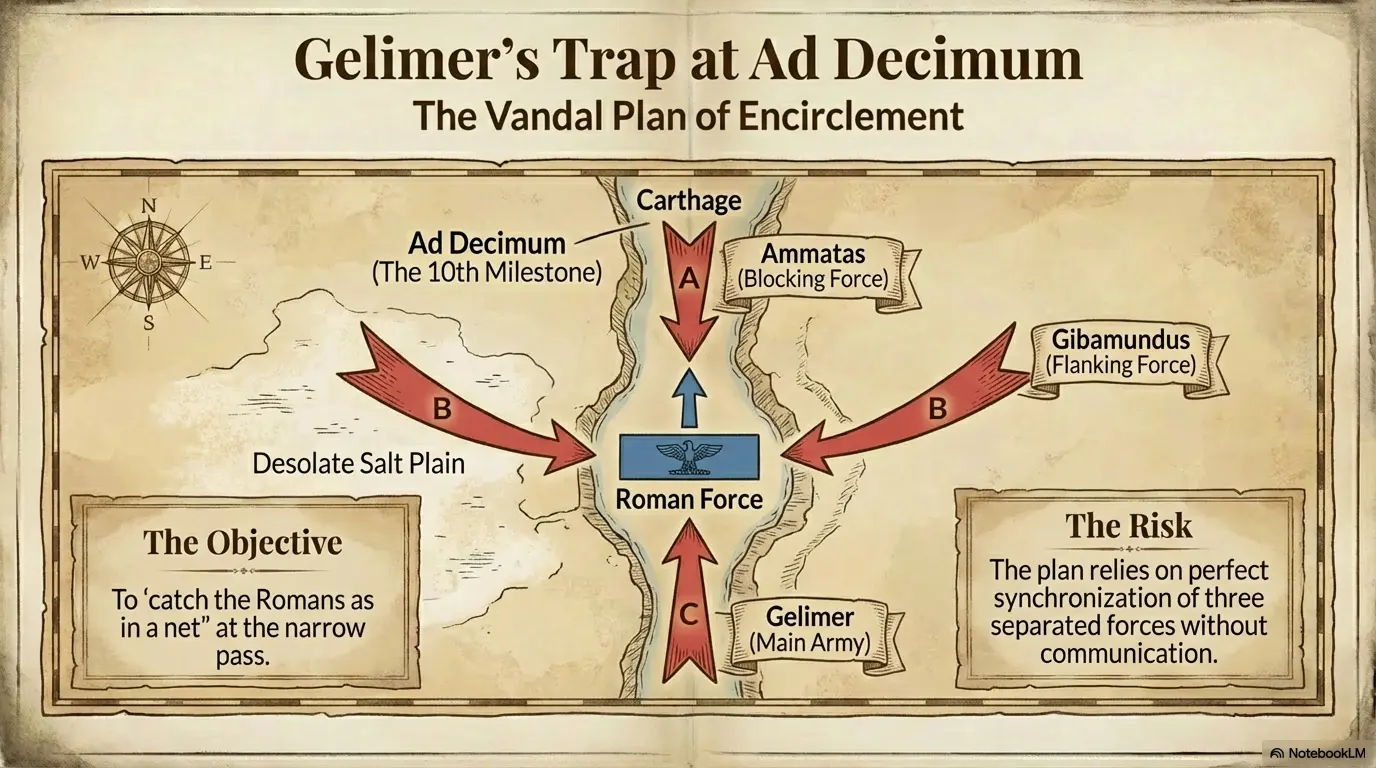
This John, then, he commanded to go ahead of the army, at a distance of not less than twenty stades, and if he should see anything of the enemy, to report it with all speed, so that they might not be compelled to enter into battle unprepared. And the allied Massagetae he commanded to travel constantly on the left of the army, keeping as many stades away or more; and he himself marched in the rear with the best troops. For he suspected that it would not be long before Gelimer, following them from Hermione, would make an attack upon them. And these precautions were sufficient, for on the right side there was no fear, since they were travelling not far from the coast. And he commanded the sailors to follow along with them always and not to separate themselves far from the army, but when the wind was favouring to lower the great sails, and follow with the small sails, which they call "dolones," and when the wind dropped altogether to keep the ships under way as well as they could by rowing. And when Belisarius reached Syllectus, the soldiers behaved with moderation, and they neither began any unjust brawls nor did anything out of the way, and he himself, by displaying great gentleness and kindness, won the Libyans to his side so completely that thereafter he made the journey as if in his own land; for neither did the inhabitants of the land withdraw nor did they wish to conceal anything, but they both furnished a market and served the soldiers in whatever else they wished. And accomplishing eighty stades each day, we completed the whole journey to Carthage, passing the night either in a city, should it so happen, or in a camp made as thoroughly secure as the circumstances permitted. Thus we passed through the city of Leptis and Hadrumetum and reached the place called Grasse, three hundred and fifty stades distant from Carthage. In that place was a palace of the ruler of the Vandals and a park the most beautiful of all we know. For it is excellently watered by springs and has a great wealth of woods. And all the trees are full of fruit; so that each one of the soldiers pitched his tent among fruit-trees, and though all of them ate their fill of the fruit, which was then ripe, there was practically no diminution to be seen in the fruit. But Gelimer, as soon as he heard in Hermione that the enemy were at hand, wrote to his brother Ammatas in Carthage to kill Ilderic and all the others, connected with him either by birth or otherwise, whom he was keeping under guard, and commanded him to make ready the Vandals and all others in the city serviceable for war, in order that, when the enemy got inside the narrow passage at the suburb of the city which they call Decimum, they might come together from both sides and surround them and, catching them as in a net, destroy them. And Ammatas carried this out, and killed Ilderic, who was a relative of his, and Euagees, and all the Libyans who were intimate with them. For Hoamer had already departed from the world. And arming the Vandals, he made them ready, intending to make his attack at the opportune moment. But Gelimer was following behind, without letting it be known to us, except, indeed, that, on that night when we bivouacked in Grasse, scouts coming from both armies met each other, and after an exchange of blows they each retired to their own camp, and in this way it became evident to us that the enemy were not far away. As we proceeded from there it was impossible to discern the ships. For high rocks extending well into the sea cause mariners to make a great circuit, and there is a projecting headland, inside of which lies the town of Hermes. Belisarius therefore commanded Archelaus, the prefect, and Calonymus, the admiral, not to put in at Carthage, but to remain about two hundred stades away until he himself should summon them. And departing from Grasse we came on the fourth day to Decimum, seventy stades distant from Carthage.
3.18.1. And on that day Gelimer commanded his nephew Gibamundus with two thousand of the Vandals to go ahead of the rest of the army on the left side, in order that Ammatas coming from Carthage, Gelimer himself from the rear, and Gibamundus from the country to the left, might unite and accomplish the task of encircling the enemy with less difficulty and exertion.
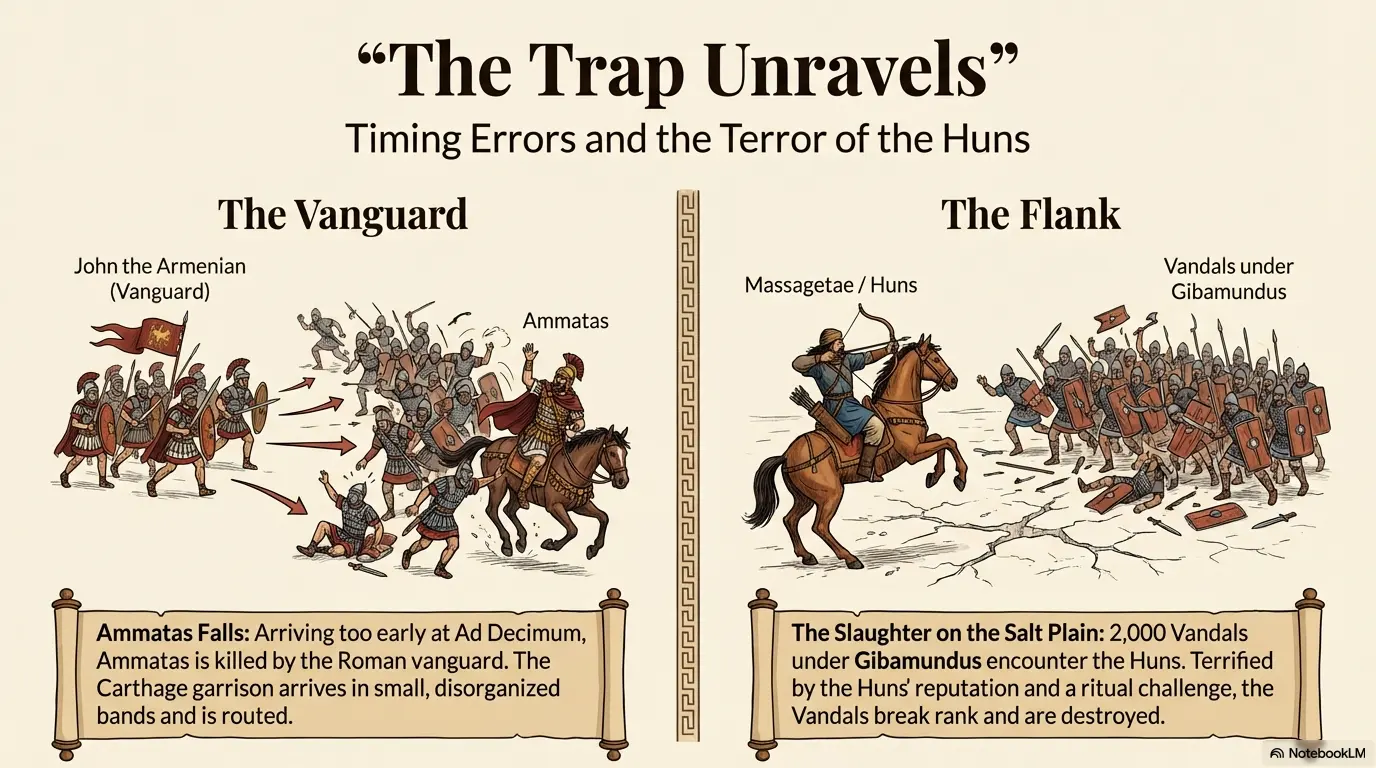
But as for me, during this struggle I was moved to wonder at the ways of Heaven and of men, noting how God, who sees from afar what will come to pass, traces out the manner in which it seems best to him that things should come to pass, while men, whether they are deceived or counsel aright, know not that they have failed, should that be the issue, or that they have succeeded, God's purpose being that a path shall be made for Fortune, who presses on inevitably toward that which has been foreordained. For if Belisarius had not thus arranged his forces, commanding the men under John to take the lead, and the Massagetae to march on the left of the army, we should never have been able to escape the Vandals. And even with this planned so by Belisarius, if Ammatas had observed the opportune time, and had not anticipated this by about the fourth part of a day, never would the cause of the Vandals have fallen as it did; but as it was, Ammatas came to Decimum about midday, in advance of the time, while both we and the Vandal army were far away, erring not only in that he did not arrive at the fitting time, but also in leaving at Carthage the host of the Vandals, commanding them to come to Decimum as quickly as possible, while he with a few men and not even the pick of the army came into conflict with John's men. And he killed twelve of the best men who were fighting in the front rank, and he himself fell, having shewn himself a brave man in this engagement. And the rout, after Ammatas fell, became complete, and the Vandals, fleeing at top speed, swept back all those who were coming from Carthage to Decimum. For they were advancing in no order and not drawn up as for battle, but in companies, and small ones at that; for they were coming in bands of twenty or thirty. And seeing the Vandals under Ammatas fleeing, and thinking their pursuers were a great multitude, they turned and joined in the flight. And John and his men, killing all whom they came upon, advanced as far as the gates of Carthage. And there was so great a slaughter of Vandals in the course of the seventy stades that those who beheld it would have supposed that it was the work of an enemy twenty thousand strong. At the same time Gibamundus and his two thousand came to Pedion Halon, which is forty stades distant from Decimum on the left as one goes to Carthage, and is destitute of human habitation or trees or anything else, since the salt in the water permits nothing except salt to be produced there; in that place they encountered the Huns and were all destroyed. Now there was a certain man among the Massagetae, well gifted with courage and strength of body, the leader of a few men; this man had the privilege handed down from his fathers and ancestors to be the first in all the Hunnic armies to attack the enemy. For it was not lawful for a man of the Massagetae to strike first in battle and capture one of the enemy until, indeed, someone from this house began the struggle with the enemy. So when the two armies had come not far from each other, this man rode out and stopped alone close to the army of the Vandals. And the Vandals, either because they were dumbfounded at the courageous spirit of the man or perhaps because they suspected that the enemy were contriving something against them, decided neither to move nor to shoot at the man. And I think that, since they had never had experience of battle with the Massagetae, but heard that the nation was very warlike, they were for this reason terrified at the danger. And the man, returning to his compatriots, said that God had sent them these strangers as a ready feast. Then at length they made their onset and the Vandals did not withstand them, but breaking their ranks and never thinking of resistance, they were all disgracefully destroyed.
3.19.1. But we, having learned nothing at all of what had happened, were going on to Decimum. And Belisarius, seeing a place well adapted for a camp, thirty-five stades distant from Decimum, surrounded it with a stockade which was very well made, and placing all the infantry there and calling together the whole army, he spoke as follows: "Fellow-soldiers, the decisive moment of the struggle is already at hand; for I perceive that the enemy are advancing upon us; and the ships have been taken far away from us by the nature of the place; and it has come round to this that our hope of safety lies in the strength of our hands.
For there is not a friendly city, no, nor any other stronghold, in which we may put our trust and have confidence concerning ourselves. But if we should show ourselves brave men, it is probable that we shall still overcome the enemy in the war; but if we should weaken at all, it will remain for us to fall under the hand of the Vandals and to be destroyed disgracefully. And yet there are many advantages on our side to help us on toward victory; for we have with us both justice, with which we have come against our enemy (for we are here in order to recover what is our own), and the hatred of the Vandals toward their own tyrant. For the alliance of God follows naturally those who put justice forward, and a soldier who is ill-disposed toward his ruler knows not how to play the part of a brave man. And apart from this, we have been engaged with Persians and Scythians all the time, but the Vandals, since the time they conquered Libya, have seen not a single enemy except naked Moors. And who does not know that in every work practice leads to skill, while idleness leads to inefficiency? Now the stockade, from which we shall have to carry on the war, has been made by us in the best possible manner. And we are able to deposit here our weapons and everything else which we are not able to carry when we go forth; and when we return here again, no kind of provisions can fail us. And I pray that each one of you, calling to mind his own valour and those whom he has left at home, may so march with contempt against the enemy." After speaking these words and uttering a prayer after them, Belisarius left his wife and the barricaded camp to the infantry, and himself set forth with all the horsemen. For it did not seem to him advantageous for the present to risk an engagement with the whole army, but it seemed wise to skirmish first with the horsemen and make trial of the enemy's strength, and finally to fight a decisive battle with the whole army. Sending forward, therefore, the commanders of the foederati, he himself followed with the rest of the force and his own spearmen and guards. And when the foederati and their leaders reached Decimum, they saw the corpses of the fallen — twelve comrades from the forces of John and near them Ammatas and some of the Vandals. And hearing from the inhabitants of the place the whole story of the fight, they were vexed, being at a loss as to where they ought to go. But while they were still at a loss and from the hills were looking around over the whole country thereabouts, a dust appeared from the south and a little later a very large force of Vandal horsemen. And they sent to Belisarius urging him to come as quickly as possible, since the enemy were bearing down upon them. And the opinions of the commanders were divided. For some thought that they ought to close with their assailants, but the others said that their force was not sufficient for this. And while they were debating thus among themselves, the barbarians drew near under the leadership of Gelimer, who was following a road between the one which Belisarius was travelling and the one by which the Massagetae who had encountered Gibamundus had come. But since the land was hilly on both sides, it did not allow him to see either the disaster of Gibamundus or Belisarius' stockade, nor even the road along which Belisarius' men were advancing.
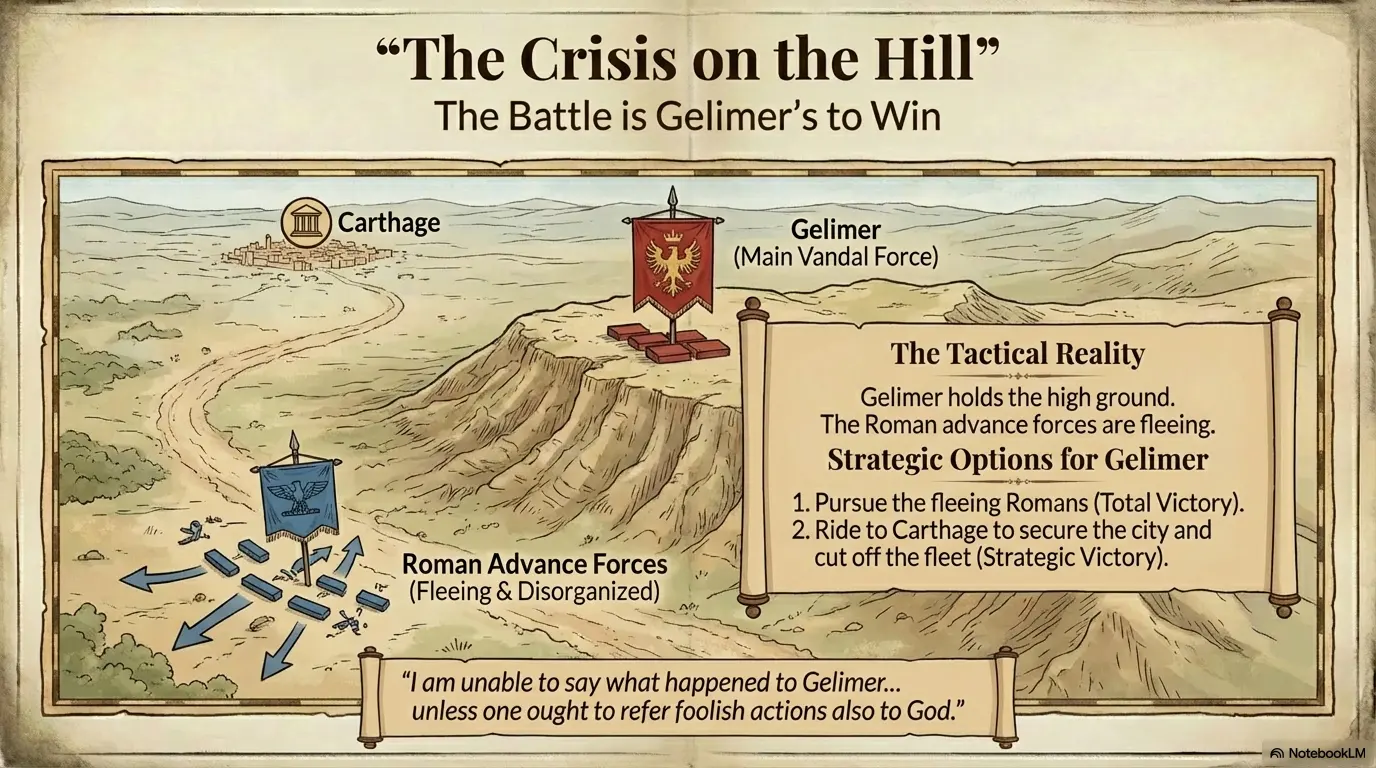
But when they came near each other, a contest arose between the two armies as to which should capture the highest of all the hills there. For it seemed a suitable one to encamp upon, and both sides preferred to engage with the enemy from there. And the Vandals, coming first, took possession of the hill by crowding off their assailants and routed the enemy, having already become an object of terror to them. And the Romans in flight came to a place seven stades distant from Decimum, where, as it happened, Uliaris, the personal guard of Belisarius, was, with eight hundred guardsmen. And all supposed that Uliaris would receive them and hold his position, and together with them would go against the Vandals; but when they came together, these troops all unexpectedly fled at top speed and went on the run to Belisarius. From then on I am unable to say what happened to Gelimer that, having the victory in his hands, he willingly gave it up to the enemy, unless one ought to refer foolish actions also to God, who, whenever He purposes that some adversity shall befall a man, touches first his reason and does not permit that which will be to his advantage to come to his consideration. For if, on the one hand, he had made the pursuit immediately, I do not think that even Belisarius would have withstood him, but our cause would have been utterly and completely lost, so numerous appeared the force of the Vandals and so great the fear they inspired in the Romans; or if, on the other hand, he had even ridden straight for Carthage, he would easily have killed all John's men, who, heedless of everything else, were wandering about the plain one by one or by twos and stripping the dead. And he would have preserved the city with its treasures, and captured our ships, which had come rather near, and he would have withdrawn from us all hope both of sailing away and of victory. But in fact he did neither of these things. Instead he descended from the hill at a walk, and when he reached the level ground and saw the corpse of his brother, he turned to lamentations, and, in caring for his burial, he blunted the edge of his opportunity — an opportunity which he was not able to grasp again. Meantime Belisarius, meeting the fugitives, bade them stop, and arrayed them all in order and rebuked them at length; then, after hearing of the death of Ammatas and the pursuit of John, and learning what he wished concerning the place and the enemy, he proceeded at full speed against Gelimer and the Vandals. But the barbarians, having already fallen into disorder and being now unprepared, did not withstand the onset of the Romans, but fled with all their might, losing many there, and the battle ended at night.

Now the Vandals were in flight, not to Carthage nor to Byzacium, whence they had come, but to the plain of Boulla and the road leading into Numidia. So the men with John and the Massagetae returned to us about dusk, and after learning all that had happened and reporting what they had done, they passed the night with us in Decimum.
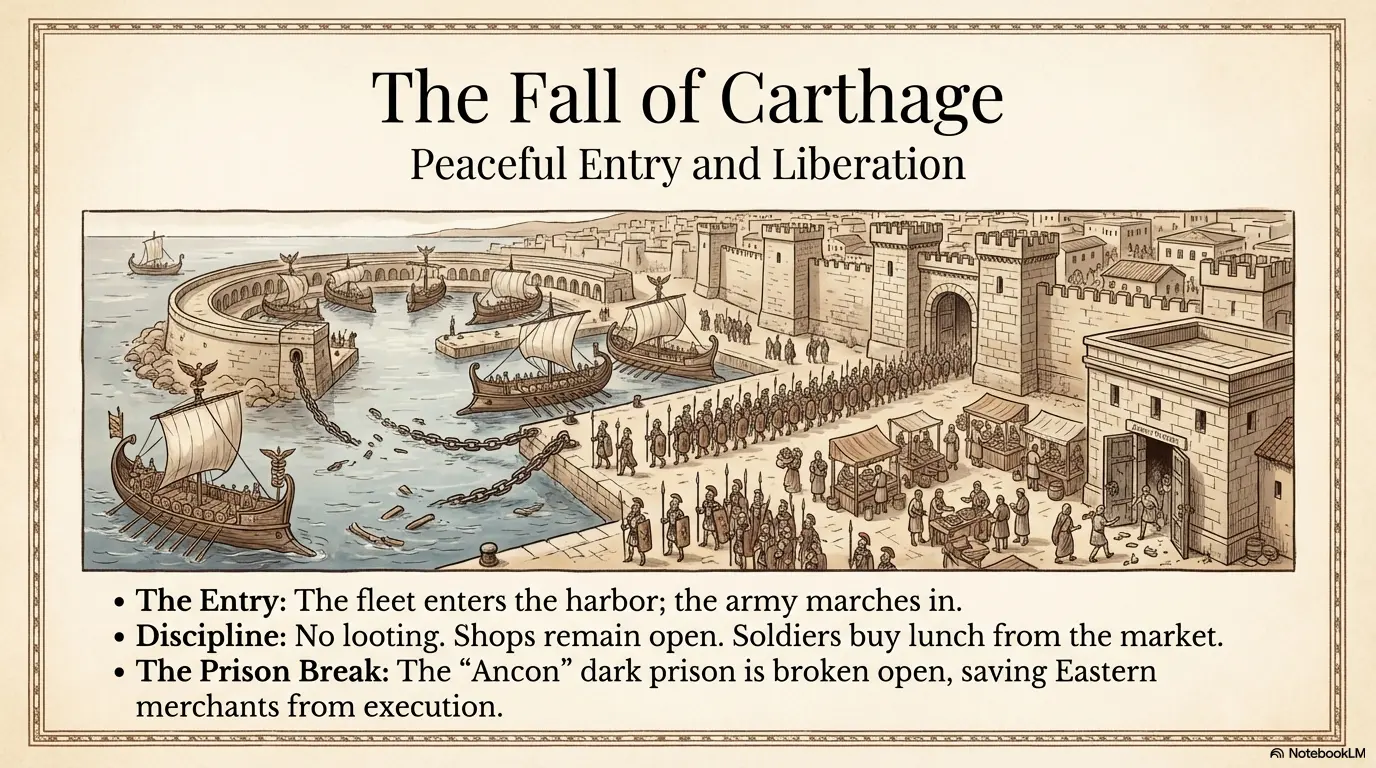
3.20.1. But on the following day the infantry with the wife of Belisarius came up and we all proceeded together on the road toward Carthage, which we reached in the late evening; and we passed the night in the open, although no one hindered us from marching into the city at once. For the Carthaginians opened the gates and burned lights everywhere and the city was brilliant with the illumination that whole night, and those of the Vandals who had been left behind were sitting as suppliants in the sanctuaries. But Belisarius prevented the entrance in order to guard against any ambuscade being set for his men by the enemy, and also to prevent the soldiers from having freedom to turn to plundering, as they might under the concealment of night. On that day, since an east wind arose for them, the ships reached the headland, and the Carthaginians, for they already sighted them, removed the iron chains of the harbour which they call Mandracium, and made it possible for the fleet to enter.
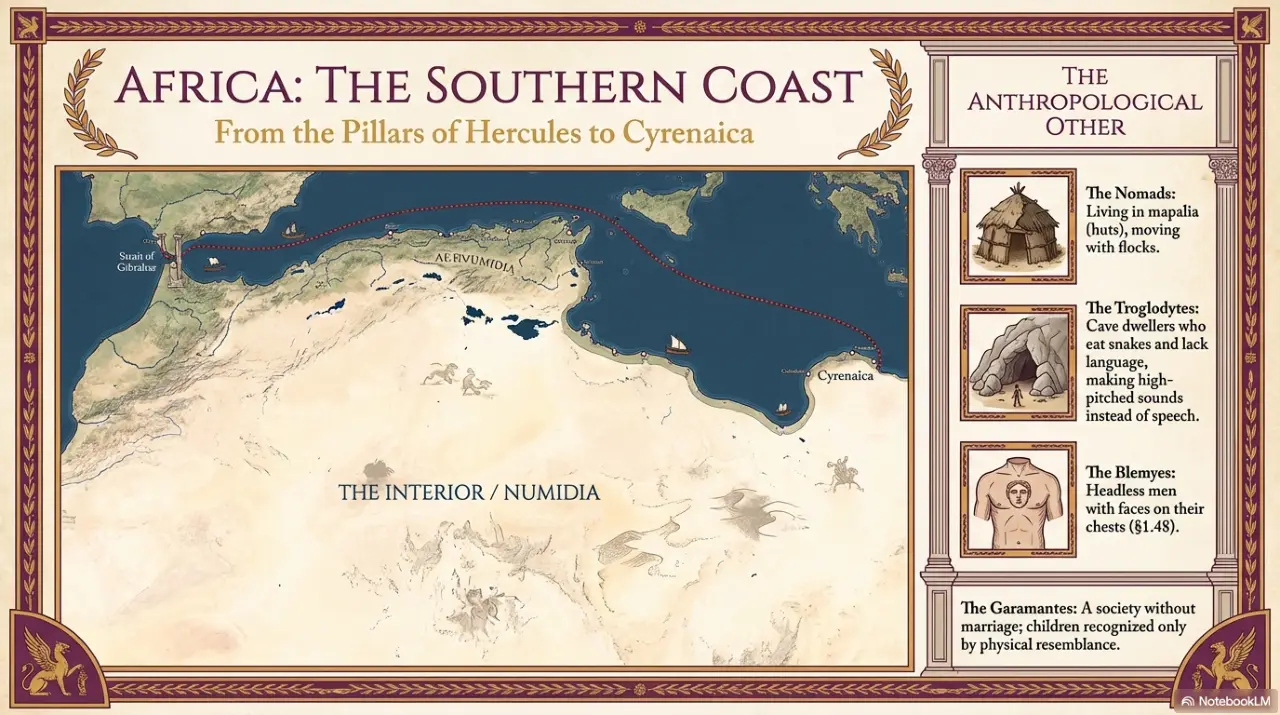
Now there is in the king's palace a room filled with darkness, which the Carthaginians call Ancon, where all were cast with whom the tyrant was angry. In that place, as it happened, many of the eastern merchants had been confined up to that time. For Gelimer was angry with these men, charging them with having urged the emperor on to the war, and they were about to be destroyed, all of them, this having been decided upon by Gelimer on that day on which Ammatas was killed in Decimum; to such an extremity of danger did they come. The guard of this prison, upon hearing what had taken place in Decimum and seeing the fleet inside the point, entered the room and enquired of the men, who had not yet learned the good news, but were sitting in the darkness and expecting death, what among their possessions they would be willing to give up and be saved. And when they said they desired to give everything he might wish, he demanded nothing of all their treasures, but required them all to swear that, if they escaped, they would assist him also with all their power when he came into danger. And they did this. Then he told them them the whole story, and tearing off a plank from the side toward the sea, he pointed out the fleet approaching, and releasing all from the prison went out with them. But the men on the ships, having as yet heard nothing of what the army had done on the land, were completely at a loss, and slackening their sails they sent to the town of Mercurium; there they learned what had taken place at Decimum, and becoming exceedingly joyful sailed on. And when, with a favouring wind blowing, they came to within one hundred and fifty stades of Carthage, Archelaus and the soldiers bade them anchor there, fearing the warning of the general, but the sailors would not obey. For they said that the promontory at that point was without a harbour and also that the indications were that a well-known storm, which the natives call Cypriana, would arise immediately. And they predicted that, if it came upon them in that place, they would not be able to save even one of the ships. And it was as they said. So they slackened their sails for a short time and deliberated; and they did not think they ought to try for Mandracium (for they shrank from violating the commands of Belisarius, and at the same time they suspected that the entrance to Mandracium was closed by the chains, and besides they feared that this harbour was not sufficient for the whole fleet) but Stagnum seemed to them well situated (for it is forty stades distant from Carthage), and there was nothing in it to hinder them, and also it was large enough for the whole fleet. There they arrived about dusk and all anchored, except, indeed, that Calonymus with some of the sailors, disregarding the general and all the others, went off secretly to Mandracium, no one daring to hinder him, and plundered the property of the merchants dwelling on the sea, both foreigners and Carthaginians. On the following day Belisarius commanded those on the ships to disembark, and after marshalling the whole army and drawing it up in battle formation, he marched into Carthage; for he feared lest he should encounter some snare set by the enemy. There he reminded the soldiers at length of how much good fortune had come to them because they had displayed moderation toward the Libyans, and he exhorted them earnestly to preserve good order with the greatest care in Carthage. For all the Libyans had been Romans in earlier times and had come under the Vandals by no will of their own and had suffered many outrages at the hands of these barbarians. For this very reason the emperor had entered into war with the Vandals, and it was not holy that any harm should come from them to the people whose freedom they had made the ground for taking the field against the Vandals. [Sept. 15, 533 A.D.] After such words of exhortation he entered Carthage, and, since no enemy was seen by them, he went up to the palace and seated himself on Gelimer's throne.
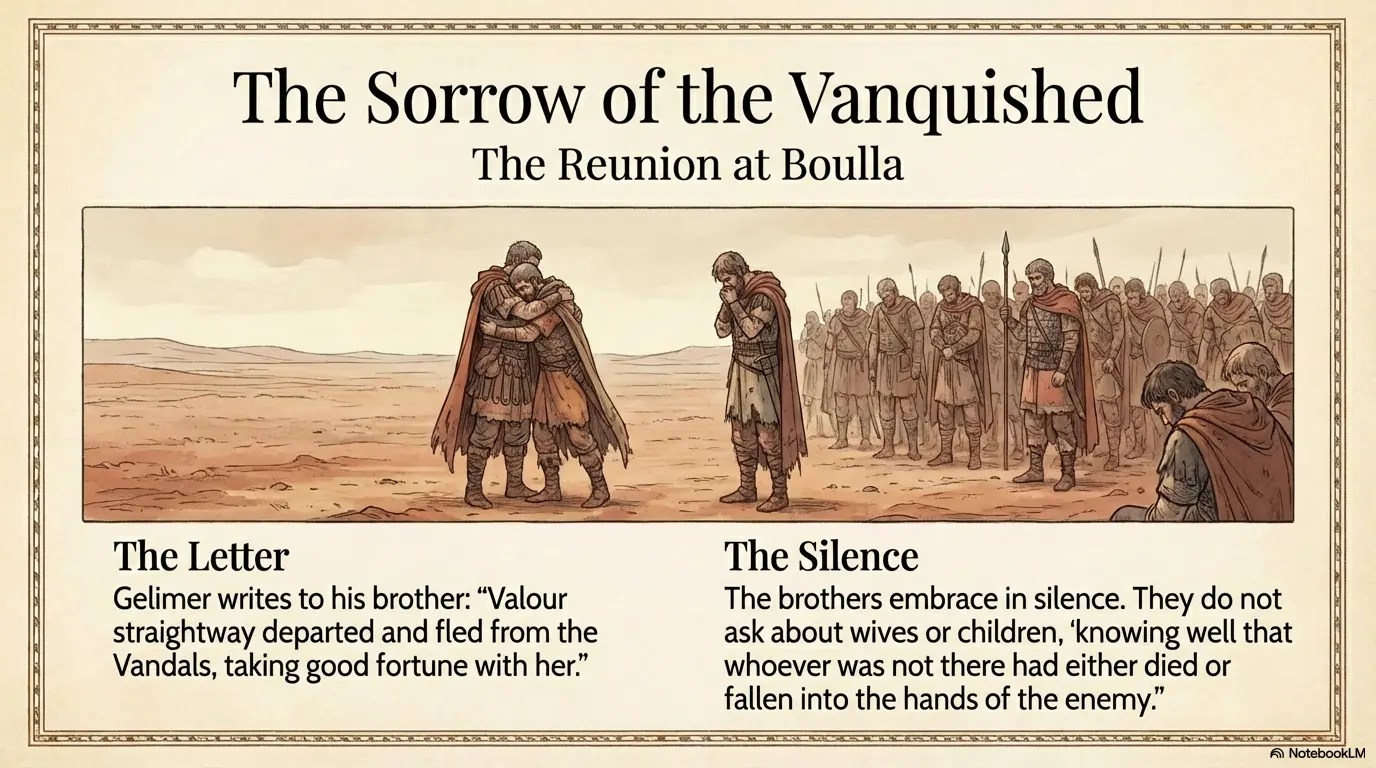
There a crowd of merchants and other Carthaginians came before Belisarius with much shouting, persons whose homes were on the sea, and they made the charge that there had been a robbery of their property on the preceding night by the sailors. And Belisarius bound Calonymus by oaths to bring without fail all his thefts to the light. And Calonymus, taking the oath and disregarding what he had sworn, for the moment made the money his plunder, but not long afterwards he paid his just penalty in Byzantium. For being taken with the disease called apoplexy, he became insane and bit off his own tongue and then died. But this happened at a later time.
Carthage and the army after its victory
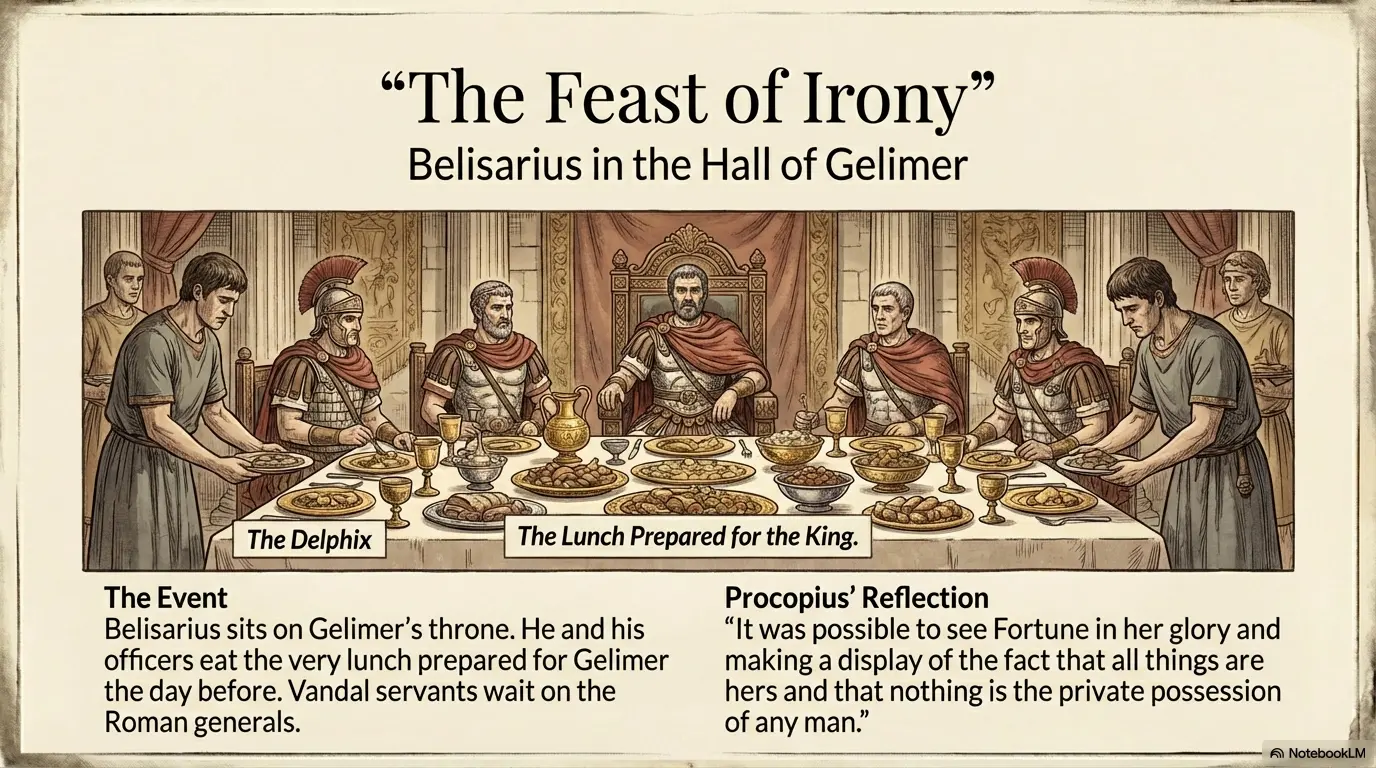
3.21.1. But then, since the hour was appropriate, Belisarius commanded that lunch be prepared for them, in the very place where Gelimer was accustomed to entertain the leaders of the Vandals. This place the Romans call "Delphix," not in their own tongue, but using the Greek word according to the ancient custom. For in the palace at Rome, where the dining couches of the emperor were placed, a tripod had stood from olden times, on which the emperor's cupbearers used to place the cups. Now the Romans call a tripod "Delphix," since they were first made at Delphi, and from this both in Byzantium and wherever there is a king's dining couch they call the room "Delphix"; for the Romans follow the Greek also in calling the emperor's residence "Palatium." For a Greek named Pallas lived in this place before the capture of Troy and built a noteworthy house there, and they called this dwelling "Palatium"; and when Augustus received the imperial power, he decided to take up his first residence in that house, and from this they call the place wherever the emperor resides "Palatium." So Belisarius dined in the Delphix and with him all the notables of the army. And it happened that the lunch made for Gelimer on the preceding day was in readiness. And we feasted on that very food and the domestics of Gelimer served it and poured the wine and waited upon us in every way. And it was possible to see Fortune in her glory and making a display of the fact that all things are hers and that nothing is the private possession of any man. And it fell to the lot of Belisarius on that day to win such fame as no one of the men of his time ever won nor indeed any of the men of olden times. For though the Roman soldiers were not accustomed to enter a subject city without confusion, even if they numbered only five hundred, and especially if they made the entry unexpectedly, all the soldiers under the command of this general showed themselves so orderly that there was not a single act of insolence nor a threat, and indeed nothing happened to hinder the business of the city; but in a captured city, one which had changed its government and shifted its allegiance, it came about that no man's household was excluded from the privileges of the marketplace; on the contrary, the clerks drew up their lists of the men and conducted the soldiers to their lodgings, just as usual, and the soldiers themselves, getting their lunch by purchase from the market, rested as each one wished. Afterwards Belisarius gave pledges to those Vandals who had fled into the sanctuaries, and began to take thought for the fortifications. For the circuit- wall of Carthage had been so neglected that in many places it had become accessible to anyone who wished and easy to attack. For no small part of it had fallen down, and it was for this reason, the Carthaginians said, that Gelimer had not made his stand in the city. For he thought that it would be impossible in a short time to restore such a circuit-wall to a safe condition. And they said that an old oracle had been uttered by the children in earlier times in Carthage, to the effect that "gamma shall pursue beta, and again beta itself shall pursue gamma." And at that time it had been spoken by the children in play and had been left as an unexplained riddle, but now it was perfectly clear to all. For formerly Gizeric had driven out Boniface and now Belisarius was doing the same to Gelimer. This, then, whether it was a rumour or an oracle, came out as I have stated. At that time a dream also came to light, which had been seen often before this by many persons, but without being clear as to how it would turn out. And the dream was as follows. Cyprian, a holy man, is reverenced above all others by the Carthaginians.
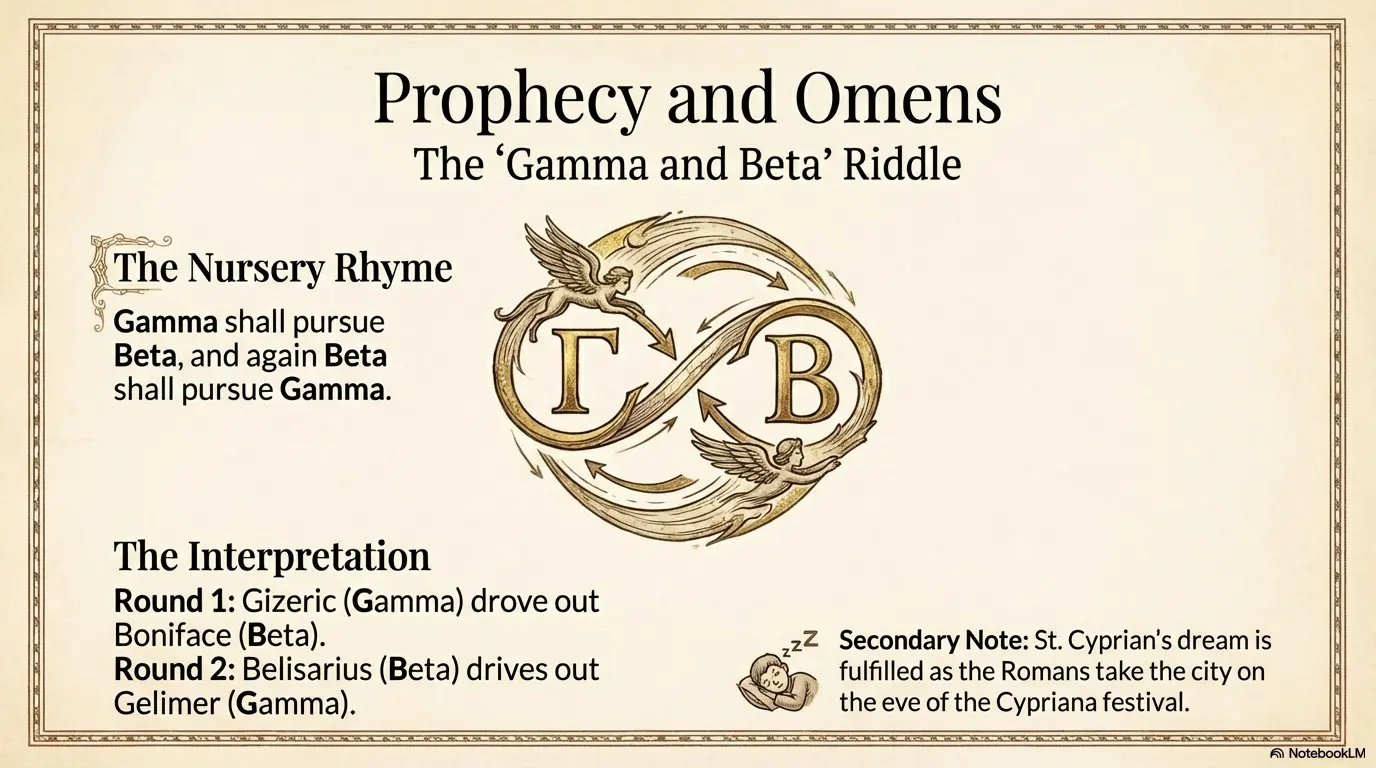
And they have founded a very noteworthy temple in his honour before the city on the sea-shore, in which they conduct all other customary services, and also celebrate there a festival which they call the "Cypriana"; and the sailors are accustomed to name after Cyprian the storm, which I mentioned lately, giving it the same name as the festival, since it is wont to come on at the time at which the Libyans have always been accustomed to celebrate the festival. This temple the Vandals took from the Christians by violence in the reign of Honoric. And they straightway drove out their priests from the temple in great dishonour, and themselves thereafter attended to the sacred festival which, they said, now belonged to the Arians. And the Libyans, indeed, were angry on this account and altogether at a loss, but Cyprian, they say, often sent them a dream saying that there was not the least need for the Christians to be concerned about him; for he himself as time went on would be his own avenger. And when the report of this was passed around and came to all the Libyans, they were expecting that some vengeance would come upon the Vandals at some time because of this sacred festival, but were unable to conjecture how in the world the vision would be realized for them. Now, therefore, when the emperor's expedition had come to Libya, since the time had already come round and would bring the celebration of the festival on the succeeding day, the priests of the Arians, in spite of the fact that Ammatas had led the Vandals to Decimum, cleansed the whole sanctuary and were engaged in hanging up the most beautiful of the votive offerings there, and making ready the lamps and bringing out the treasures from the store-houses and preparing all things with exactness, arranging everything according to its appropriate use. But the events in Decimum turned out in the manner already described. And the priests of the Arians were off in flight, while the Christians who conform to the orthodox faith came to the temple of Cyprian, and they burned all the lamps and attended to the sacred festival just as is customary for them to perform this service, and thus it was known to all what the vision of the dream was foretelling. This, then, came about in this way.
3.22.1. And the Vandals, recalling an ancient saying, marvelled, understanding clearly thereafter that for a man, at least, no hope could be impossible nor any possession secure. And what this saying was and in what manner it was spoken I shall explain. When the Vandals originally, pressed by hunger, were about to remove from their ancestral abodes, a certain part of them was left behind who were reluctant to go and not desirous of following Godigisclus. And as time went on it seemed to those who had remained that they were well off as regards abundance of provisions, and Gizeric with his followers gained possession of Libya.
And when this was heard by those who had not followed Godigisclus, they rejoiced, since thenceforth the country was altogether sufficient for them to live upon. But fearing lest at some time much later either the very ones who had conquered Libya, or their descendants, should in some way or other be driven out of Libya and return to their ancestral homes (for they never supposed that the Romans would let Libya be held for ever), they sent ambassadors to them. And these men, upon coming before Gizeric, said that they rejoiced with their compatriots who had met with such success, but that they were no longer able to guard the land of which he and his men had thought so little that they had settled in Libya. They prayed therefore that, if they laid no claim to their fatherland, they would bestow it as an unprofitable possession upon themselves, so that their title to the land might be made as secure as possible, and if anyone should come to do it harm, they might by no means disdain to die in behalf of it. Gizeric, accordingly, and all the other Vandals thought that they spoke fairly and justly, and they were in the act of granting everything which the envoys desired of them. But a certain old man who was esteemed among them and had a great reputation for discretion said that he would by no means permit such a thing. "For in human affairs," he said, "not one thing stands secure; nay, nothing which now exists is stable for all time for men, while as regards that which does not yet exist, there is nothing which may not come to pass." When Gizeric heard this, he expressed approval and decided to send the envoys away with nothing accomplished. Now at that time both he himself and the man who had given the advice were judged worthy of ridicule by all the Vandals, as foreseeing the impossible. But when these things which have been told took place, the Vandals learned to take a different view of the nature of human affairs and realized that the saying was that of a wise man. Now as for those Vandals who remained in their native land, neither remembrance nor any name of them has been preserved to my time. For since, I suppose, they were a small number, they were either overpowered by the neighbouring barbarians or they were mingled with them not at all unwillingly and their name gave way to that of their conquerors. Indeed, when the Vandals were conquered at that time by Belisarius, no thought occurred to them to go from there to their ancestral homes. For they were not able to convey themselves suddenly from Libya to Europe, especially as they had no ships at hand, but paid the penalty there for all the wrongs they had done the Romans and especially the Zacynthians. For at one time Gizeric, falling suddenly upon the towns in the Peloponnesus, undertook to assault Taenarum. And being repulsed from there and losing many of his followers he retired in complete disorder.
And while he was still filled with anger on account of this, he touched at Zacynthus, and having killed many of those he met and enslaved five hundred of the notables, he sailed away soon afterwards. And when he reached the middle of the Adriatic Sea, as it is called, he cut into small pieces the bodies of the five hundred and threw them all about the sea without the least concern. But this happened in earlier times.
Tricamarum and the collapse of Gelimer's field army
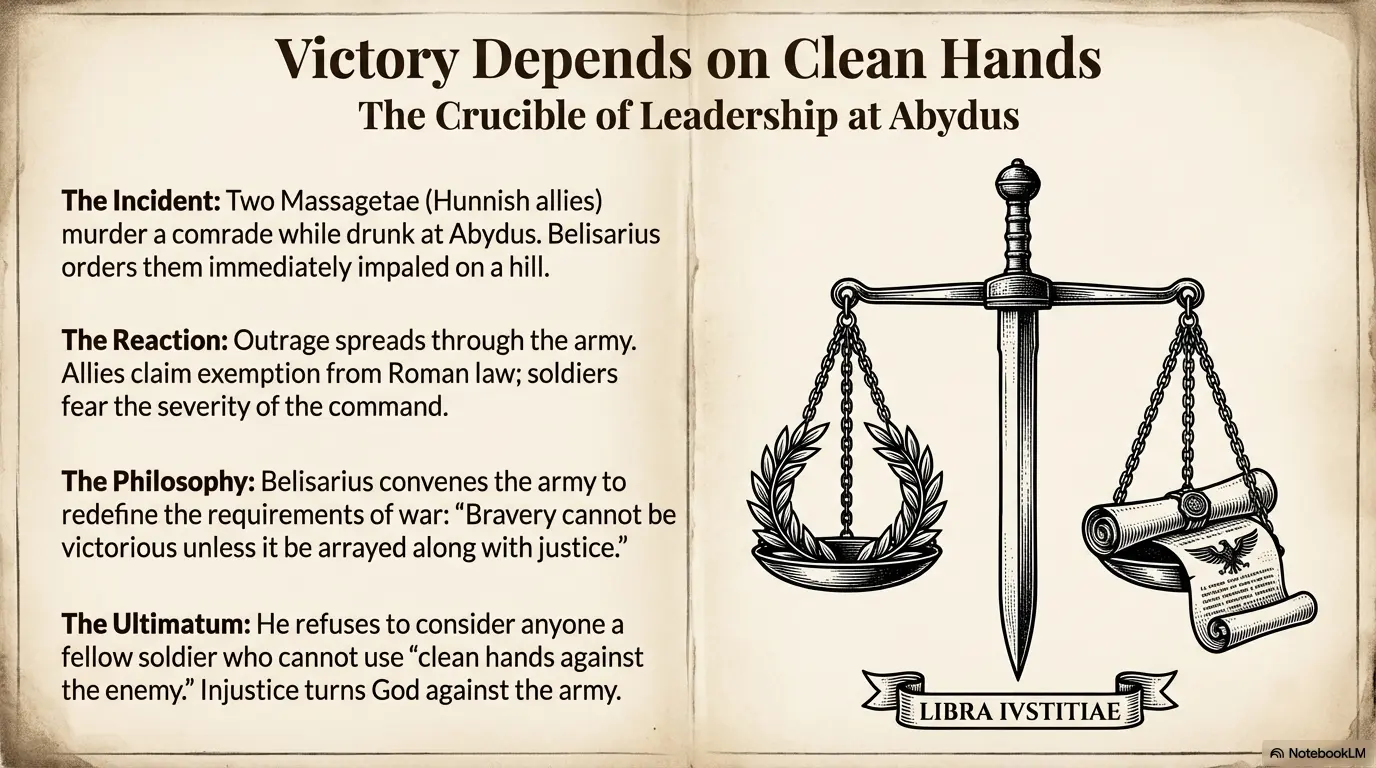
4.1.1. Gelimer, seeing all the Vandals gathered together, led his army against Carthage. And when they came close to it, they tore down a portion of the aqueduct, — a structure well worth seeing — which conducted water into the city, and after encamping for a time they withdrew, since no one of the enemy came out against them. And going about the country there they kept the roads under guard and thought that in this way they were besieging Carthage; however, they did not gather any booty, nor plunder the land, but took possession of it as their own. And at the same time they kept hoping that there would be some treason on the part of the Carthaginians themselves and such of the Roman soldiers as followed the doctrine of Arius. They also sent to the leaders of the Huns, and promising that they would have many good things from the Vandals, entreated them to become their friends and allies. Now the Huns even before this had not been well-disposed toward the cause of the Romans, since they had not indeed come to them willingly as allies (for they asserted that the Roman general Peter had given an oath and then, disregarding what had been sworn, had thus brought them to Byzantium), and accordingly they received the words of the Vandals, and promised that when they should come to real fighting they would turn with them against the Roman army. But Belisarius had a suspicion of all this (for he had heard it from the deserters), and also the circuit-wall had not as yet been completed entirely, and for these reasons he did not think it possible for his men to go out against the enemy for the present, but he was making his preparations within as well as possible. And one of the Carthaginians, Laurus by name, having been condemned on a charge of treason and proved guilty by his own secretary, was impaled by Belisarius on a hill before the city, and as a result of this the others came to feel a sort of irresistible fear and refrained from attempts at treason. And he courted the Massagetae with gifts and banquets and every other manner of flattering attention every day, and thus persuaded them to disclose to him what Gelimer had promised them on condition of their turning traitors in the battle. And these barbarians said that they had no enthusiasm for fighting, for they feared that, if the Vandals were vanquished, the Romans would not send them back to their native land, but they would be compelled to grow old and die right there in Libya; and besides they were also concerned, they said, about the booty, lest they be robbed of it. Then indeed Belisarius gave them pledges that, if the Vandals should be conquered decisively, they would be sent without the least delay to their homes with all their booty, and thus he bound them by oaths in very truth to assist the Romans with all zeal in carrying through the war. And when all things had been prepared by him in the best way possible, and the circuit-wall had been already completed, he called together the whole army and spoke as follows: "As for exhortation, fellow Romans, I do not know that it is necessary to make any to you, — men who have recently conquered the enemy so completely that Carthage here and the whole of Libya is a possession of your valour, and for this reason you will have no need of admonition that prompts to daring. For the spirits of those who have conquered are by no means wont to be overcome. But I think it not untimely to remind you of this one thing, that, if you on the present occasion but prove equal to your own selves in valour, straightway there will be an end for the Vandals of their hopes, and for you of the battle. Hence there is every reason why you should enter into this engagement with the greatest eagerness.
For ever sweet to men is toil coming to an end and reaching its close. Now as for the host of the Vandals, let no one of you consider them. For not by numbers of men nor by measure of body, but by valour of soul, is war wont to be decided. And let the strongest motive which actuates men come to your minds, namely, pride in past achievement. For it is a shame, for those at least who have reason, to fall short of one's own self and to be found inferior to one's own standard of valour. For I know well that terror and the memory of misfortunes have laid hold upon the enemy and compel them to become less brave, for the one fills them with fear because of what has already happened, and the other brushes aside their hope of success. For Fortune, once seen to be bad, straightway enslaves the spirit of those who have fallen in her way. And I shall explain how the struggle involves for you at the present time a greater stake than formerly. For in the former battle the danger was, if things did not go well for us, that we should not take the land of others; but now, if we do not win the struggle, we shall lose the land which is our own. In proportion, then, as it is easier to possess nothing than to be deprived of what one has, just so now our fear touches our most vital concerns more than before. And yet formerly we had the fortune to win the victory with the infantry absent, but now, entering the battle with God propitious and with our whole army, I have hopes of capturing the camp of the enemy, men and all. Thus, then, having the end of the war ready at hand, do not by reason of any negligence put it off to another time, lest you be compelled to seek for the opportune moment after it has run past us. For when the fortune of war is postponed, its nature is not to proceed in the same manner as before, especially if the war be prolonged by the will of those who are carrying it on. For Heaven is accustomed to bring retribution always upon those who abandon the good fortune which is present. But if anyone considers that the enemy, seeing their children and wives and most precious possessions in our hands, will be daring beyond reason and will incur risks beyond the strength which they have, he does not think rightly. For an overpowering passion springing up in the heart in behalf of what is most precious is wont to diminish men's actual strength and does not allow them to make full use of their present opportunities. Considering, then, all these things, it behooves you to go with great contempt against the enemy."
4.2.1. After such words of exhortation, Belisarius sent out all the horsemen on the same day, except five hundred, and also the guardsmen and the standard, which the Romans call "bandum," entrusting them to John the Armenian, and directing him to skirmish only, if opportunity should arise. And he himself on the following day followed with the infantry forces and the five hundred horsemen. And the Massagetae, deliberating among themselves, decided, in order to seem in friendly agreement with both Gelimer and Belisarius, neither to begin fighting for the Romans nor to go over to the Vandals before the encounter, but whenever the situation of one or the other army should be bad, then to join the victors in their pursuit of the vanquished. Thus, then, had this matter been decided upon by the barbarians. And the Roman army came upon the Vandals encamped in Tricamarum, one hundred and fifty stades distant from Carthage. So they both bivouacked there at a considerable distance from one another. And when it was well on in the night, a prodigy came to pass in the Roman camp as follows. The tips of their spears were lighted with a bright fire and the points of them seemed to be burning most vigorously. This was not seen by many, but it filled with consternation the few who did see it, not knowing how it would come out. And this happened to the Romans in Italy again at a much later time. And at that time, since they knew by experience, they believed it to be a sign of victory. But now, as I have said, since this was the first time it had happened, they were filled with consternation and passed the night in great fear.
And on the following day Gelimer commanded the Vandals to place the women and children and all their possessions in the middle of the stockade, although it had not the character of a fort, and calling all together, he spoke as follows: "It is not to gain glory, or to retrieve the loss of empire alone, O fellow Vandals, that we are about to fight, so that even if we wilfully played the coward and sacrificed these our belongings we might possibly live, sitting at home and keeping our own possessions; but you see, surely, that our fortunes have come round to such a pass that, if we do not gain the mastery over the enemy, we shall, if we perish, leave them as masters of these our children and our wives and our land and all our possessions, while if we survive, there will be added our own enslavement and to behold all these enslaved; but if, indeed, we overcome our foes in the war, we shall, if we live, pass our lives among all good things, or, after the glorious ending of our lives, there will be left to our wives and children the blessings of prosperity, while the name of the Vandals will survive and their empire be preserved. For if it has ever happened to any men to be engaged in a struggle for their all, we now more than all others realize that we are entering the battle-line with our hopes for all we have resting wholly upon ourselves. Not for our bodies, then, is our fear, nor in death is our danger, but in being defeated by the enemy. For if we lose the victory, death will be to our advantage. Since, therefore, the case stands so, let no one of the Vandals weaken, but let him proudly expose his body, and from shame at the evils that follow defeat let him court the end of life. For when a man is ashamed of that which is shameful, there is always present with him a dauntless courage in the face of danger. And let no recollection of the earlier battle come into your minds. For it was not by cowardice on our part that we were defeated, but we tripped upon obstacles interposed by fortune and were overthrown. Now it is not the way of the tide of fortune to flow always in the same direction, but every day, as a rule, it is wont to change about. In manliness it is our boast that we surpass the enemy, and that in numbers we are much superior; for we believe that we surpass them no less than tenfold. And why shall I add that many and great are the incentives which, now especially, urge us on to valour, naming the glory of our ancestors and the empire which has been handed down to us by them? For in our case that glory is obscured by our unlikeness to our kindred, while the empire is bent upon fleeing from us as unworthy. And I pass over in silence the wails of these poor women and the tears of our children, by which, as you see, I am now so deeply moved that I am unable to prolong my discourse. But having said this one thing, I shall stop, — that there will be for us no returning to these most precious possessions if we do not gain the mastery over the enemy.
Remembering these things, shew yourselves brave men and do not bring shame upon the fame of Gizeric." After speaking such words, Gelimer commanded his brother Tzazon to deliver an exhortation separately to the Vandals who had come with him from Sardinia. And he gathered them together a little apart from the camp and spoke as follows: "For all the Vandals, fellow soldiers, the struggle is in behalf of those things which you have just heard the king recount, but for you, in addition to all the other considerations, it so happens that you are vying with yourselves. For you have recently been victorious in a struggle for the maintenance of our rule, and you have recovered the island for the empire of the Vandals; there is every reason, therefore, for you to make still greater display of your valour. For those whose hazard involves the greatest things must needs display the greatest zeal for warfare also. Indeed, when men who struggle for the maintenance of their rule are defeated, should it so happen, they have not failed in the most vital part; but when men are engaged in battle for their all, surely their very lives are influenced by the outcome of the struggle. And for the rest, if you shew yourselves brave men at the present time, you will thereby prove with certainty that the destruction of the tyrant Godas was an achievement of valour on your part; but if you weaken now, you will be deprived of even the renown of those deeds, as of something which does not belong to you at all. And yet, even apart from this, it is reasonable to think that you will have an advantage over the rest of the Vandals in this battle. For those who have failed are dismayed by their previous fortune, while those who have encountered no reverse enter the struggle with their courage unimpaired. And this too, I think, will not be spoken out of season, that if we conquer the enemy, it will be you who will win the credit for the greatest part of the victory, and all will call you saviours of the nation of the Vandals. For men who achieve renown in company with those who have previously met with misfortune naturally claim the better fortune as their own. Considering all these things, therefore, I say that you should bid the women and children who are lamenting their fate to take courage even now, should summon God to fight with us, should go with enthusiasm against the enemy, and lead the way for our compatriots into this battle."
4.3.1. After both Gelimer and Tzazon had spoken such exhortations, they led out the Vandals, and at about the time of lunch, when the Romans were not expecting them, but were preparing their meal, they were at hand and arrayed themselves for battle along the bank of the stream. Now the stream at that place is an ever-flowing one, to be sure, but its volume is so small that it is not even given a special name by the inhabitants of the place, but it is designated simply as a brook. So the Romans came to the other bank of this river, after preparing themselves as well as they could under the circumstances, and arrayed themselves as follows. The left wing was held by Martinus and Valerian, John, Cyprian, Althias, and Marcellus, and as many others as were commanders of the foederati [3]; and the right was held by Pappas, Barbatus, and Aïgan, and the others who commanded the forces of cavalry. And in the centre John took his position, leading the guards and spearmen of Belisarius and carrying the general's standard.

And Belisarius also came there at the opportune moment with his five hundred horsemen, leaving the infantry behind advancing at a walk. For all the Huns had been arrayed in another place, it being customary for them even before this not to mingle with the Roman army if they could avoid so doing, and at that time especially, since they had in mind the purpose which has previously been explained, it was not their wish to be arrayed with the rest of the army. Such, then, was the formation of the Romans. And on the side of the Vandals, either wing was held by the chiliarchs, and each one led the division under him, while in the centre was Tzazon, the brother of Gelimer, and behind him were arrayed the Moors. But Gelimer himself was going about everywhere exhorting them and urging them on to daring. And the command had been previously given to all the Vandals to use neither spear nor any other weapon in this engagement except their swords. After a considerable time had passed and no one began the battle, John chose out a few of those under him by the advice of Belisarius and crossing the river made an attack on the centre, where Tzazon crowded them back and gave chase. And the Romans in flight came into their own camp, while the Vandals in pursuit came as far as the stream, but did not cross it. And once more John, leading out more of the guardsmen of Belisarius, made a dash against the forces of Tzazon, and again being repulsed from there, withdrew to the Roman camp. And a third time with almost all the guards and spearmen of Belisarius he took the general's standard and made his attack with much shouting and a great noise. But since the barbarians manfully withstood them and used only their swords, the battle became fierce, and many of the noblest of the Vandals fell, and among them Tzazon himself, the brother of Gelimer.
Then at last the whole Roman army was set in motion, and crossing the river they advanced upon the enemy, and the rout, beginning at the centre, became complete; for each of the Roman divisions turned to flight those before them with no trouble. And the Massagetae, seeing this, according to their agreement among themselves joined the Roman army in making the pursuit, but this pursuit was not continued for a great distance. For the Vandals entered their own camp quickly and remained quiet, while the Romans, thinking that they would not be able to fight it out with them inside the stockade, stripped such of the corpses as had gold upon them and retired to their own camp. And there perished in this battle, of the Romans less than fifty, but of the Vandals about eight hundred. But Belisarius, when the infantry came up in the late afternoon, moved as quickly as he could with the whole army and went against the camp of the Vandals. And Gelimer, realising that Belisarius with his infantry and the rest of his army was coming against him straightway, without saying a word or giving a command leaped upon his horse and was off in flight on the road leading to Numidia. And his kinsmen and some few of his domestics followed him in utter consternation and guarding with silence what was taking place. And for some time it escaped the notice of the Vandals that Gelimer had run away, but when they all perceived that he had fled, and the enemy were already plainly seen, then indeed the men began to shout and the children cried out and the women wailed. And they neither took with them the money they had nor did they heed the laments of those dearest to them, but every man fled in complete disorder just as he could. And the Romans, coming up, captured the camp, money and all, with not a man in it; and they pursued the fugitives throughout the whole night, killing all the men upon whom they happened, and making slaves of the women and children. And they found in this camp a quantity of wealth such as has never before been found, at least in one place. For the Vandals had plundered the Roman domain for a long time and had transferred great amounts of money to Libya, and since their land was an especially good one, nourishing abundantly with the most useful crops, it came about that the revenue collected from the commodities produced there was not paid out to any other country in the purchase of a food supply, but those who possessed the land always kept for themselves the income from it for the ninety-five years during which the Vandals ruled Libya. And from this it resulted that their wealth, amounting to an extraordinary sum, returned once more on that day into the hands of the Romans. So this battle and the pursuit and the capture of the Vandals' camp happened three months after the Roman army came to Carthage, at about the middle of the last month, which the Romans call "December." [533 A.D.]
The surrender and the end of the monarchy
4.6.1. But Pharas, having by this time become weary of the siege for many reasons, and especially because of the winter season, and at the same time thinking that the Moors there would not be able to stand in his way, undertook the ascent of Papua with great zeal. Accordingly he armed all his followers very carefully and began the ascent. But the Moors rushed to the defence, and since they were on ground which was steep and very hard to traverse, their efforts to hinder those making the ascent were easily accomplished. But Pharas fought hard to force the ascent, and one hundred and ten of his men perished in this struggle, and he himself with the remainder was beaten back and retired; and as a result of this he did not dare to attempt the ascent again, since the situation was against him, but he established as careful a guard as possible, in order that those on Papua, being pressed by hunger, might surrender themselves; and he neither permitted them to run away nor anything to be brought in to them from outside.
Then, indeed, it came about that Gelimer and those about him, who were nephews and cousins of his and other persons of high birth, experienced a misery which no one could describe, however eloquent he might be, in a way which would equal the facts. For of all the nations which we know that of the Vandals is the most luxurious, and that of the Moors the most hardy. For the Vandals, since the time when they gained possession of Libya, used to indulge in baths, all of them, every day, and enjoyed a table abounding in all things, the sweetest and best that the earth and sea produce. And they wore gold very generally, and clothed themselves in the Medic garments, which now they call "seric," and passed their time, thus dressed, in theatres and hippodromes and in other pleasureable pursuits, and above all else in hunting. And they had dancers and mimes and all other things to hear and see which are of a musical nature or otherwise merit attention among men. And the most of them dwelt in parks, which were well supplied with water and trees; and they had great numbers of banquets, and all manner of sexual pleasures were in great vogue among them. But the Moors live in stuffy huts both in winter and in summer and at every other time, never removing from them either because of snow or the heat of the sun or any other discomfort whatever due to nature. And they sleep on the ground, the prosperous among them, if it should so happen, spreading a fleece under themselves. Moreover, it is not customary among them to change their clothing with the seasons, but they wear a thick cloak and a rough shirt at all times. And they have neither bread nor wine nor any other good thing, but they take grain, either wheat or barley, and, without boiling it or grinding it to flour or barley-meal, they eat it in a manner not a whit different from that of animals. Since the Moors, then, were of a such a sort, the followers of Gelimer, after living with them for a long time and changing their accustomed manner of life to such a miserable existence, when at last even the necessities of life had failed, held out no longer, but death was thought by them most sweet and slavery by no means disgraceful. Now when this was learned by Pharas, he wrote to Gelimer as follows: "I too am a barbarian and not accustomed to writing and speaking, nor am I skilful in these matters. But that which I am forced as a man to know, having learned from the nature of things, this I am writing you. What in the world has happened to you, my dear Gelimer, that you have cast, not yourself alone, but your whole family besides, into this pit? Is it, forsooth, that you may avoid becoming a slave? But this is assuredly nothing but youthful folly, and making of 'liberty' a mere shibboleth, as though liberty were worth possessing at the price of all this misery! And, after all, do you not consider that you are, even now, a slave to the most wretched of the Moors, since your only hope of being saved, if the best happens, is in them? And yet why would it not be better in every way to be a slave among the Romans and beggared, than to be monarch on Mount Papua with Moors as your subjects? But of course it seems to you the very height of disgrace even to be a fellow slave with Belisarius! Away with the thought, most excellent Gelimer. Are not we, who also are born of noble families, proud that we are now in the service of an emperor? And indeed they say that it is the wish of the Emperor Justinian to have you enrolled in the senate, thus sharing in the highest honour and being a patrician, as we term that rank, and to present you with lands both spacious and good and with great sums of money, and that Belisarius is willing to make himself responsible for your having all these things, and to give you pledges. Now as for all the miseries which fortune has brought you, you are able to bear with fortitude whatever comes from her, knowing that you are but a man and that these things are inevitable; but if fortune has purposed to temper these adversities with some admixture of good, would you of yourself refuse to accept this gladly? Or should we consider that the good gifts of fortune are not just as inevitable as are her undesirable gifts? Yet such is not the opinion of even the utterly senseless; but you, it would seem, have now lost your good judgment, steeped as you are in misfortunes.
Indeed, discouragement is wont to confound the mind and to be transformed to folly. If, however, you can bear your own thoughts and refrain from rebelling against fortune when she changes, it will be possible at this very moment for you to choose that which will be wholly to your advantage, and to escape from the evils which hang over you." When Gelimer had read this letter and wept bitterly over it, he wrote in reply as follows: "I am both deeply grateful to you for the advice which you have given me and I also think it unbearable to be a slave to an enemy who wrongs me, from whom I should pray God to exact justice, if He should be propitious to me, — an enemy who, though he had never experienced any harm from me either in deeds which he suffered or in words which he heard, provided a pretext for a war which was unprovoked, and reduced me to this state of misfortune, bringing Belisarius against me from I know not where. And yet it is not at all unlikely that he also, since he is but a man, though he be emperor too, may have something befall him which he would not choose. But as for me, I am not able to write further. For my present misfortune has robbed me of my thoughts. Farewell, then, dear Pharas, and send me a lyre and one loaf of bread and a sponge, I pray you." When this reply was read by Pharas, he was at a loss for some time, being unable to understand the final words of the letter, until he who had brought the letter explained that Gelimer desired one loaf because he was eager to enjoy the sight of it and to eat it, since from the time when he went up upon Papua he had not seen a single baked loaf. A sponge also was necessary for him; for one of his eyes, becoming irritated by lack of washing, was greatly swollen. And being a skilful harpist he had composed an ode relating to his present misfortune, which he was eager to chant to the accompaniment of a lyre while he wept out his soul. When Pharas heard this, he was deeply moved, and lamenting the fortune of men, he did as was written and sent all the things which Gelimer desired of him. However he relaxed the siege not a whit, but kept watch more closely than before.
4.7.1. And already a space of three months had been spent in this siege and the winter was coming to an end. And Gelimer was afraid, suspecting that his besiegers would come up against him after no great time; and the bodies of most of the children who were related to him were discharging worms in this time of misery. And though in everything he was deeply distressed, and looked upon everything, — except, indeed, death, — with dissatisfaction, he nevertheless endured the suffering beyond all expectation, until it happened that he beheld a sight such as the following. A certain Moorish woman had managed somehow to crush a little corn, and making of it a very tiny cake, threw it into the hot ashes on the hearth. For thus it is the custom among the Moors to bake their loaves. And beside this hearth two children were sitting, in exceedingly great distress by reason of their hunger, the one being the son of the very woman who had thrown in the cake, and the other a nephew of Gelimer; and they were eager to seize the cake as soon as it should seem to them to be cooked. And of the two children the Vandal got ahead of the other and snatched the cake first, and, though it was still exceedingly hot and covered with ashes, hunger overpowered him, and he threw it into his mouth and was eating it, when the other seized him by the hair of the head and struck him over the temple and beat him again and thus compelled him with great violence to cast out the cake which was already in his throat. This sad experience Gelimer could not endure (for he had followed all from the beginning), and his spirit was weakened and he wrote as quickly as possible to Pharas as follows: "If it has ever happened to any man, after manfully enduring terrible misfortunes, to take a course contrary to that which he had previously determined upon, consider me to be such a one, O most excellent Pharas. For there has come to my mind your advice, which I am far from wishing to disregard. For I cannot resist fortune further nor rebel against fate, but I shall follow straightway wherever it seems to her best to lead; but let me receive the pledges, that Belisarius guarantees that the emperor will do everything which you recently promised me.
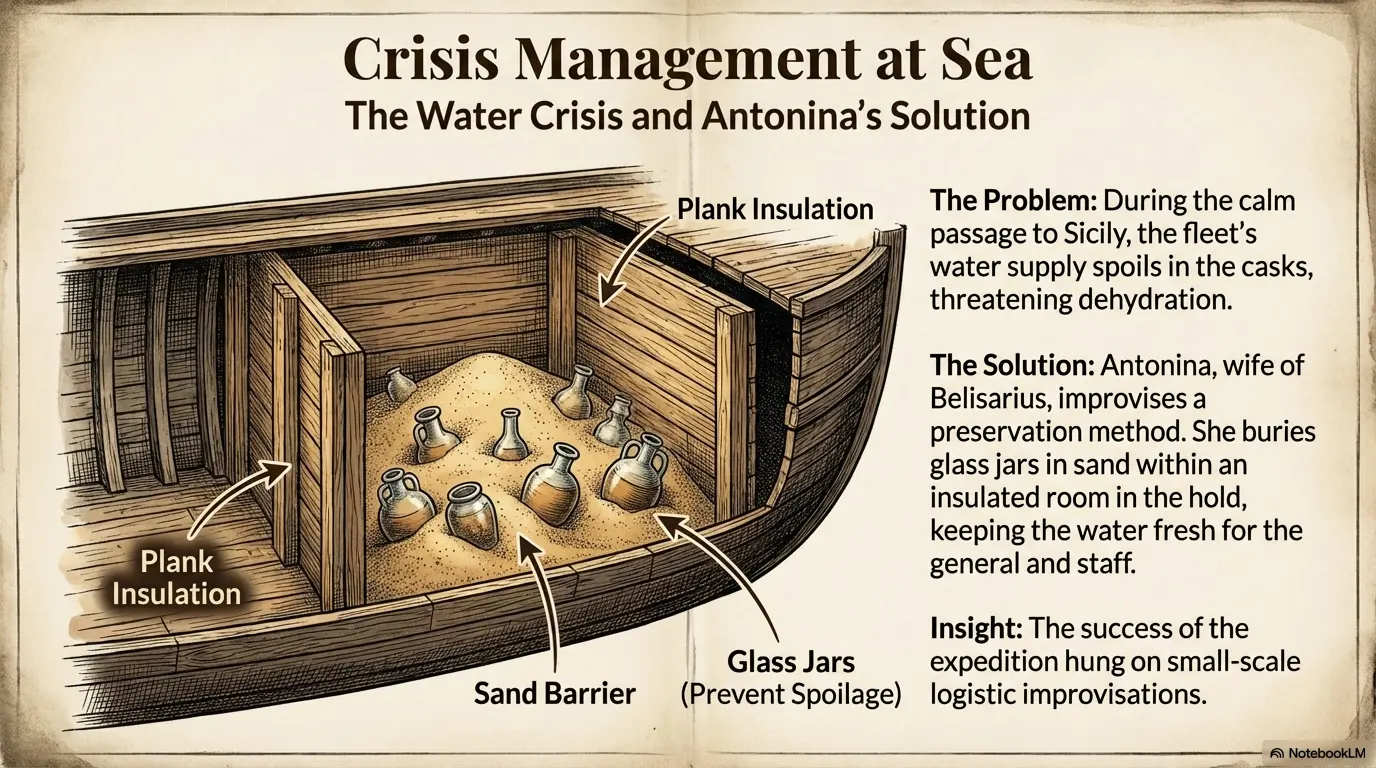
For I, indeed, as soon as you give the pledges, shall put both myself into your hands and these kinsmen of mine and the Vandals, as many as are here with us." Such were the words written by Gelimer in this letter. And Pharas, having signified this to Belisarius, as well as what they had previously written to each other, begged him to declare as quickly as possible what his wish was. And Belisarius (since he was greatly desirous of leading Gelimer alive to the emperor), as soon as he had read the letter, became overjoyed and commanded Cyprian, a leader of foederati, to go to Papua with certain others, and directed them to give an oath concerning the safety of Gelimer and of those with him, and to swear that he would be honoured before the emperor and would lack nothing. And when these men had come to Pharas, they went with him to a certain place by the foot of the mountain, where Gelimer came at their summons, and after receiving the pledges just as he wished he came with them to Carthage. And it happened that Belisarius was staying for a time in the suburb of the city which they call Aclas. Accordingly Gelimer came before him in that place, laughing with such laughter as was neither moderate nor the kind one could conceal, and some of those who were looking at him suspected that by reason of the extremity of his affliction he had changed entirely from his natural state and that, already beside himself, he was laughing for no reason. But his friends would have it that the man was in his sound mind, and that because he had been born in a royal family, and had ascended the throne, and had been clothed with great power and immense wealth from childhood even to old age, and then being driven to flight and plunged into great fear had undergone the sufferings on Papua, and now had come as a captive, having in this way had experience of all the gifts of fortune, both good and evil, for this reason, they believed, he thought that man's lot was worthy of nothing else than much laughter. Now concerning this laughter of Gelimer's, let each one speak according to his judgment, both enemy and friend. But Belisarius, reporting to the emperor that Gelimer was a captive in Carthage, asked permission to bring him to Byzantium with him. At the same time he guarded both him and all the Vandals in no dishonour and proceeded to put the fleet in readiness. Now many other things too great to be hoped for have before now been experienced in the long course of time, and they will continue as long as the fortunes of men are the same as they now are; for those things which seem to reason impossible are actually accomplished, and many times those things which previously appeared impossible, when they have befallen, have seemed to be worthy of wonder; but whether such events as these ever took place before I am not able to say, wherein the fourth descendant of Gizeric, and his kingdom at the height of its wealth and military strength, were completely undone in so short a time by five thousand men coming in as invaders and having not a place to cast anchor. For such was the number of the horsemen who followed Belisarius, and carried through the whole war against the Vandals. For whether this happened by chance or because of some kind of valour, one would justly marvel at it. But I shall return to the point from which I have strayed.
Outcome and critical assessment
Result and caution: the Roman government recovered Carthage and major African territories. The conquest of the kingdom was rapid; the establishment of secure rule across the region was not. Exact battlefield identifications near Carthage remain a different task from locating the city itself. The Vandalic war must therefore be read with W092, not closed as a complete pacification in AD 534.
Historical record: Procopius, Wars 3–4, especially the opening conquest through 4.9; Bury; campaign tables.