Wars · IX. The eastern empire and Justinian's wars
W089 Khusro's invasions and the Lazic war
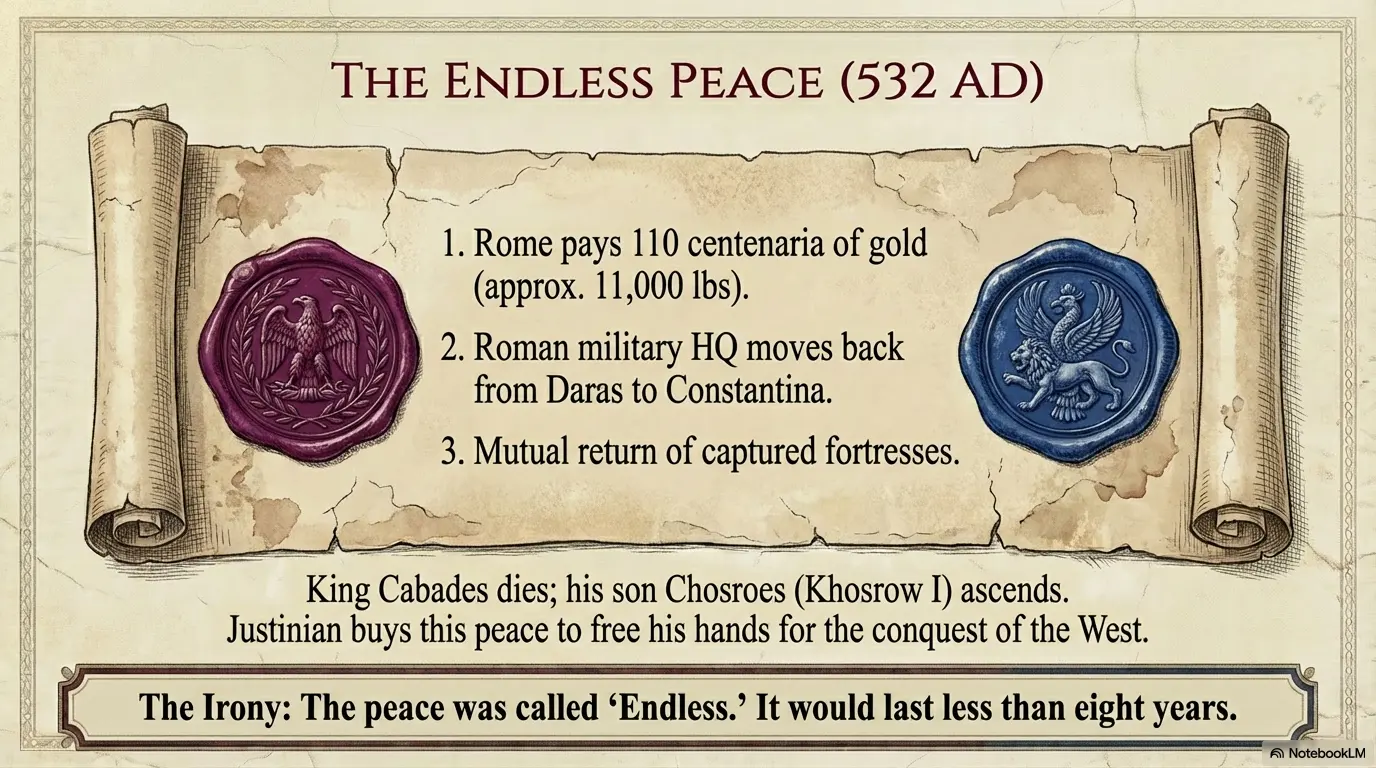
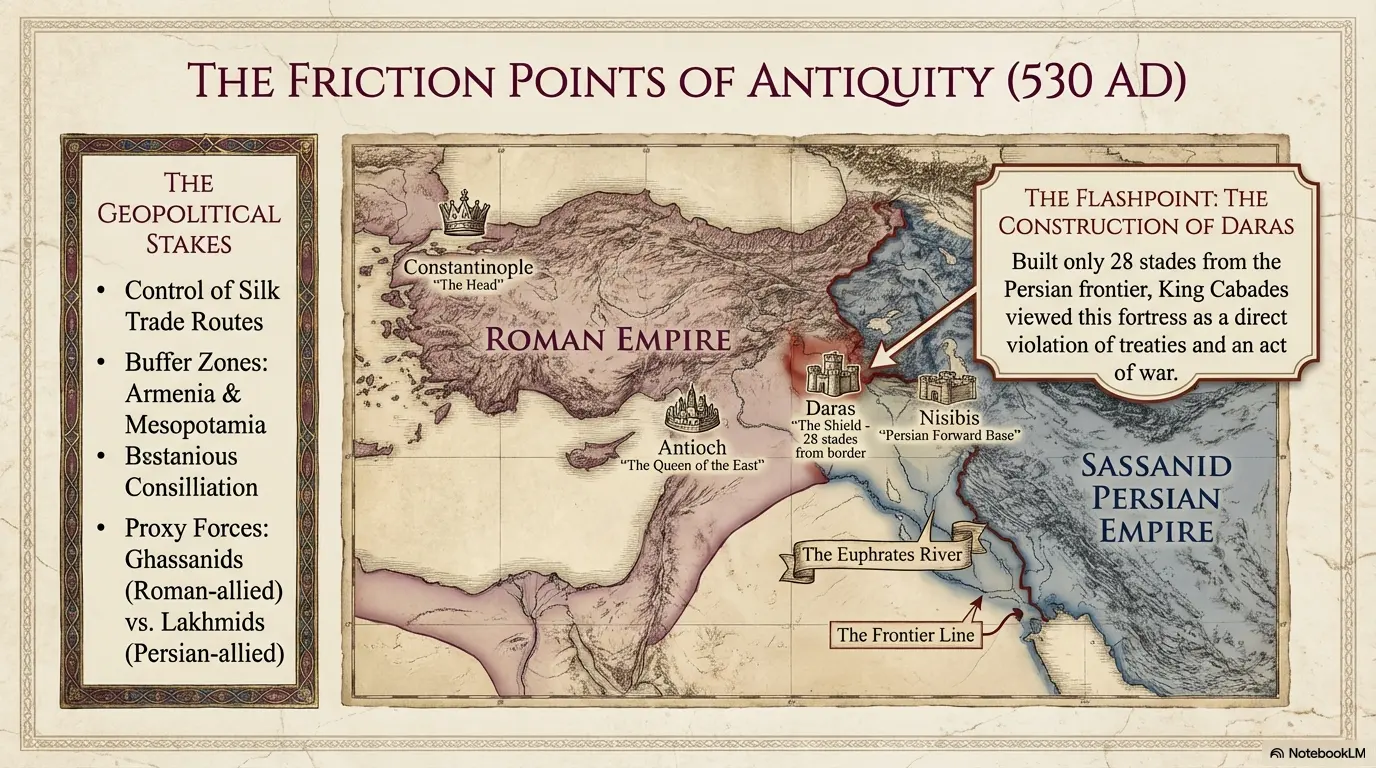
Khusro I invaded in AD 540 and captured Antioch. Subsequent campaigning, sieges and negotiations involved strongholds such as Edessa as well as the Caucasian theater. The contest for Lazica depended on local royal decisions, Persian and Roman garrisons, fortified ports and the difficulties of supplying armies in mountainous and wet country.
Petra in Lazica was a key position; it must not be confused with Petra in Arabia. The recovery of fortified places and the stabilization of Roman influence preceded the broader peace. The treaty conventionally dated to AD 562 was intended to last fifty years and retained Lazica in the Roman sphere through a negotiated arrangement involving payments and other terms.
Command, forces and military problem
| Field | Dossier |
|---|---|
| Roman leadership | Several eastern commanders; local Lazic rulers as independent political actors |
| Opposing or rival parties | Khusro I, Sasanian commanders and changing regional allies |
| Forces and capabilities | Fortress armies, cavalry, shipping and forces dependent on difficult Caucasian routes |
| Operational problem | Defend Syria and Mesopotamia while contesting Black Sea access and Lazic allegiance. |
Campaign geography and operational plates
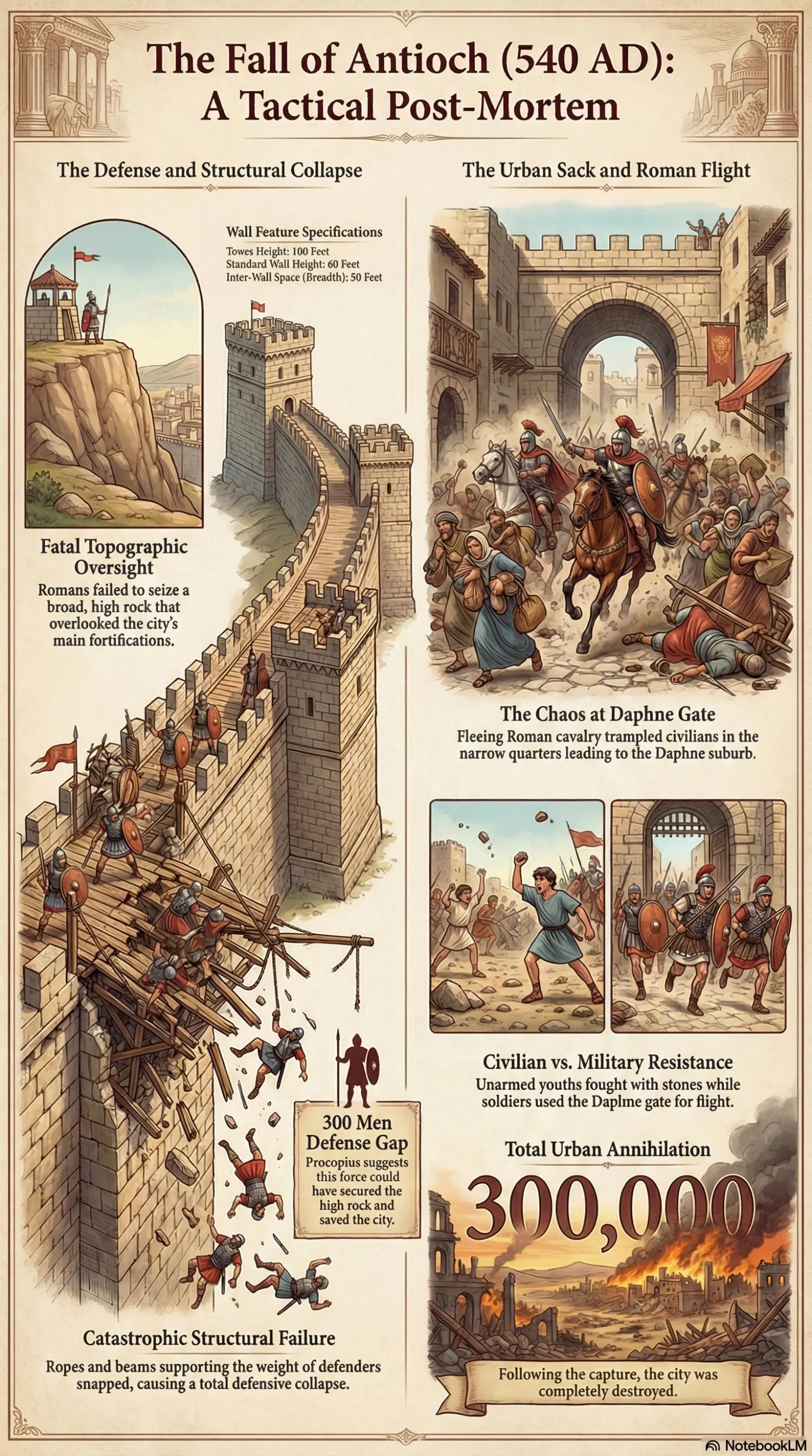
Antioch: the relationship between wall and high ground
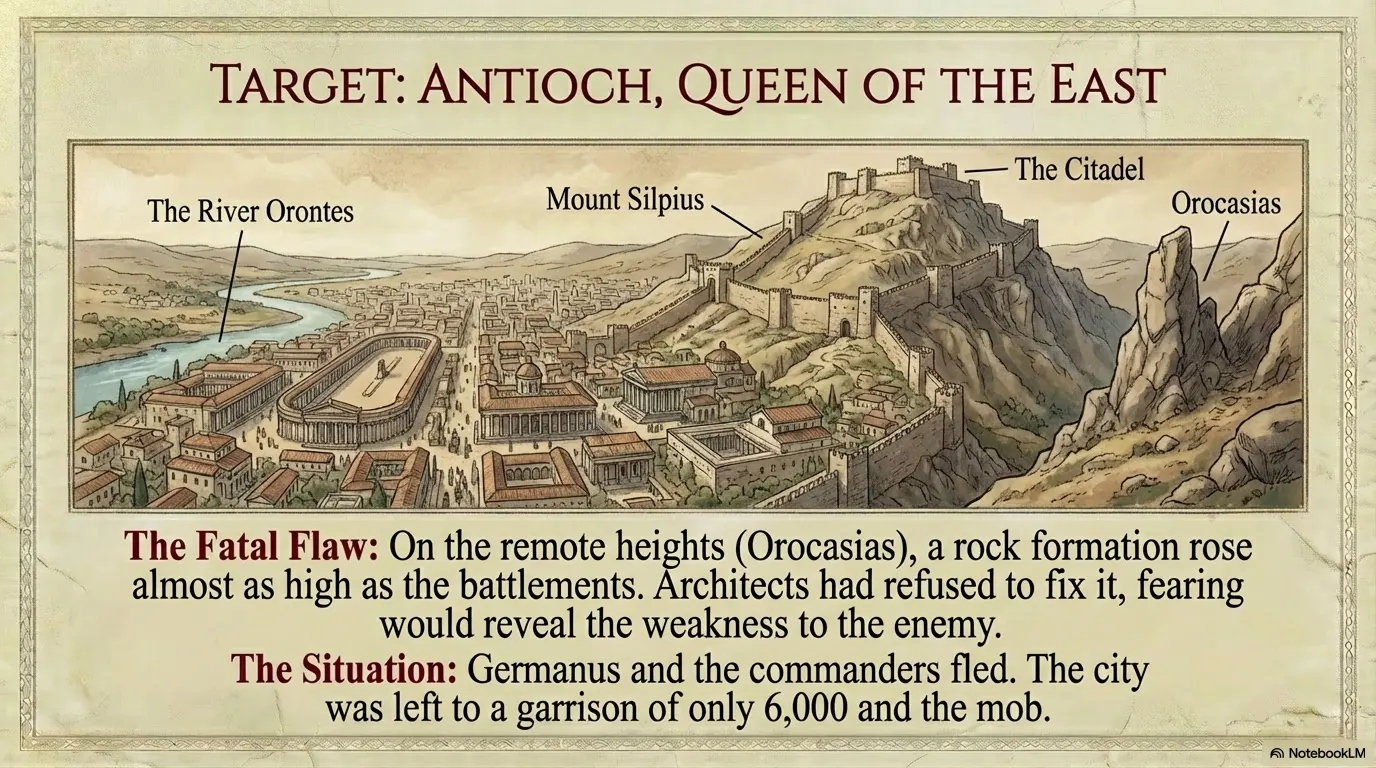
A strong-looking circuit could remain vulnerable where nearby rock or higher ground compromised its height advantage. The figure draws attention to that relationship rather than merely displaying a walled city. Its panorama is not a verified view of Antioch in AD 540, and the garrison number is a reported claim.
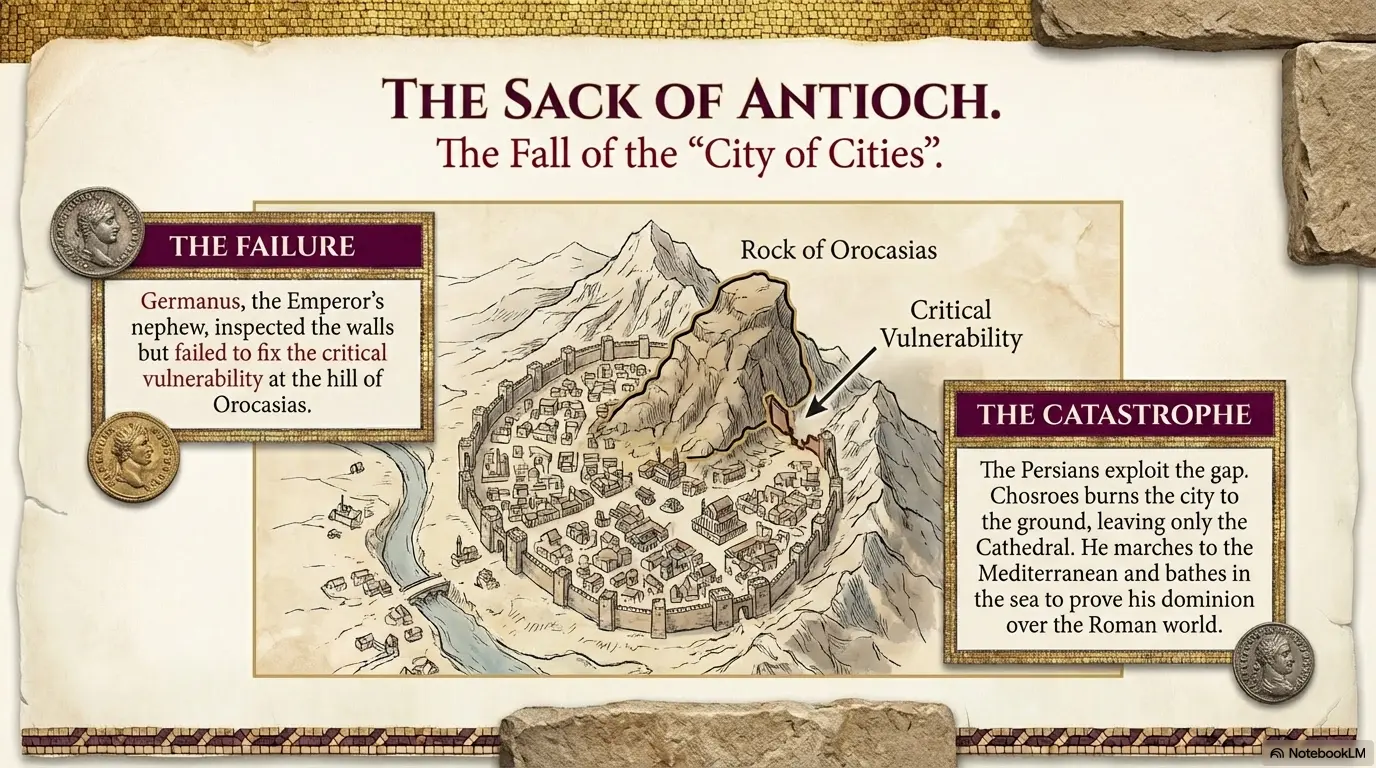
Antioch: a reconstructed failure in the defensive platform
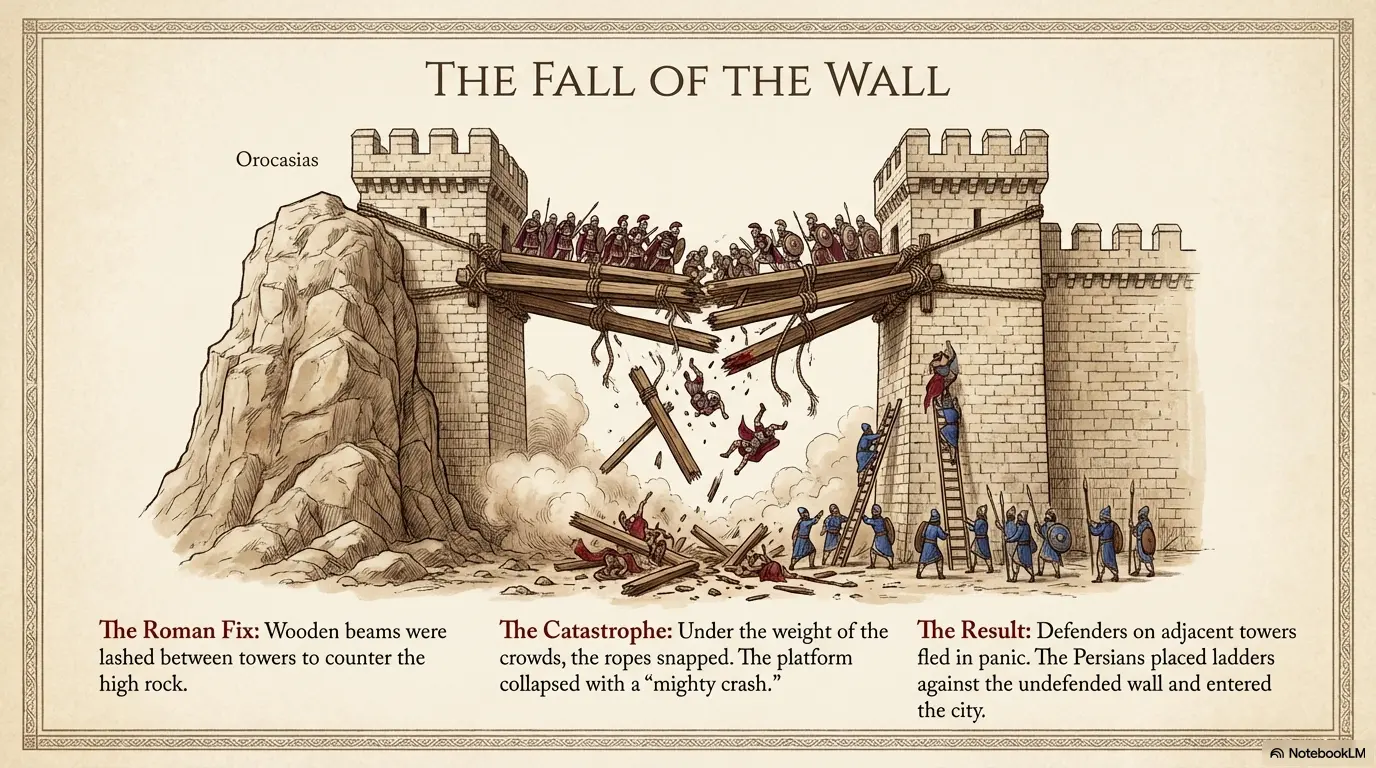
The sketch connects an attempt to cover a weakness with the possibility that an improvised fighting platform could itself fail. The causal sequence comes from the narrative tradition. The illustration makes the mechanism easier to understand but does not constitute structural proof of the load, anchorage or precise failure of the original works.
Contemporary campaign chronicle
The following substantial selections incorporate Procopius' account in H. B. Dewing's public-domain translation. Ancient book, chapter and section numbers are retained. Speeches, reported figures, judgments and divine explanations are the ancient author's testimony, not independently established modern conclusions. Editorial event-date overlays have been removed.
The invasion of Syria and the fate of Antioch
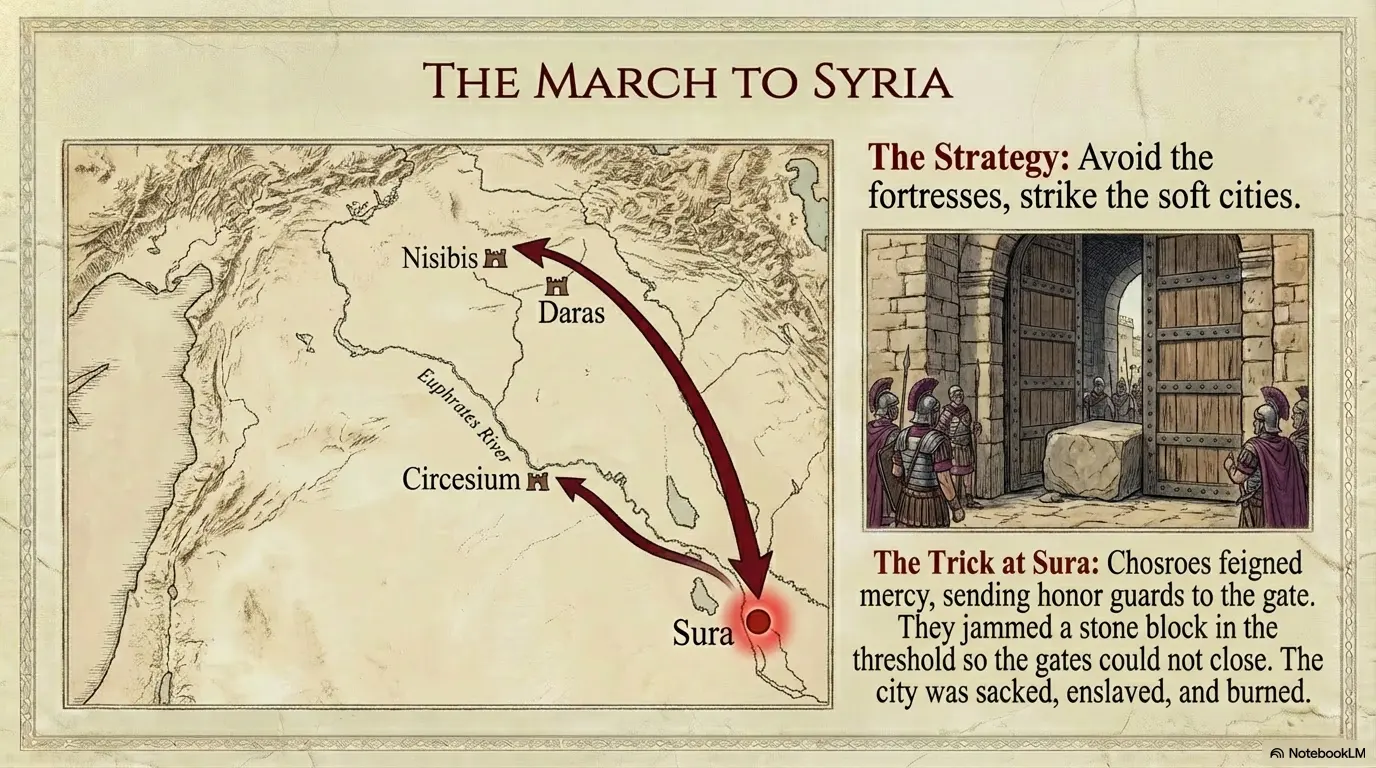
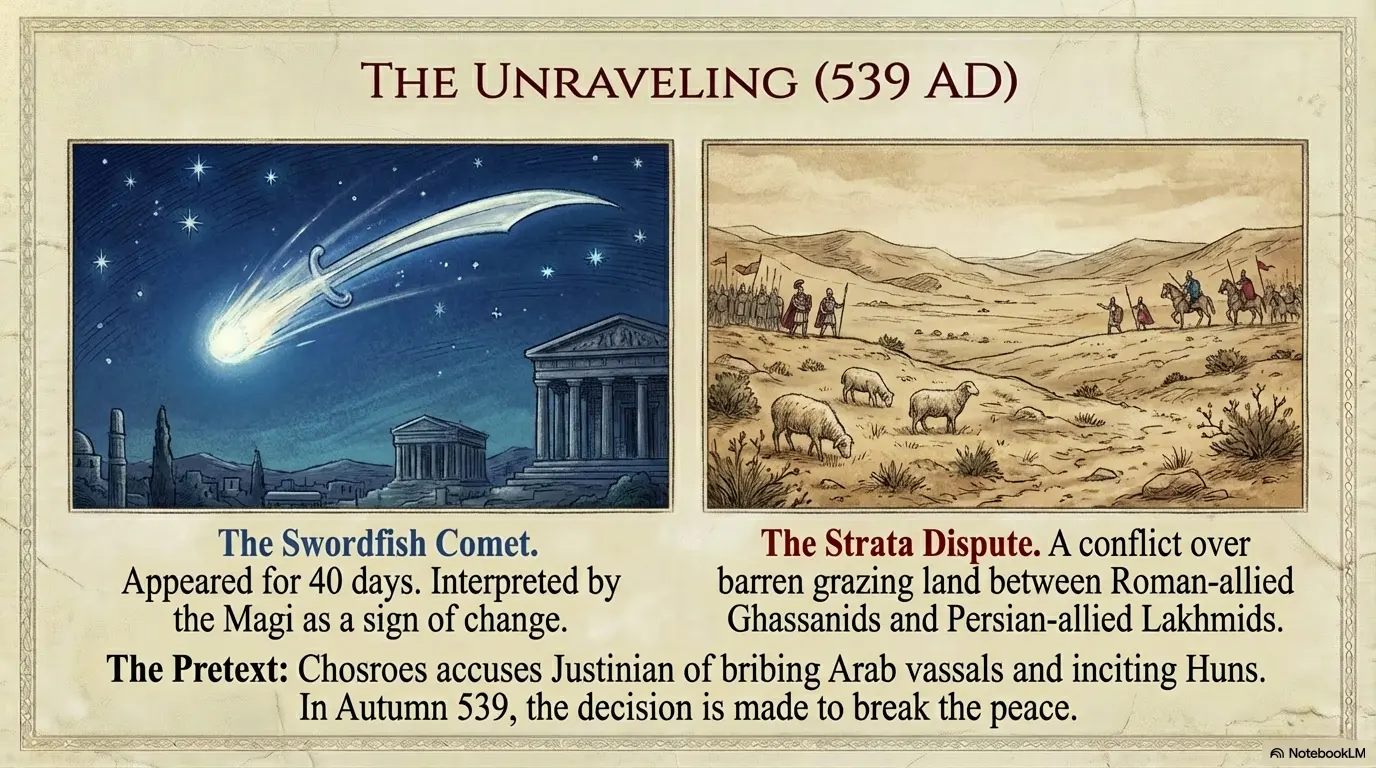
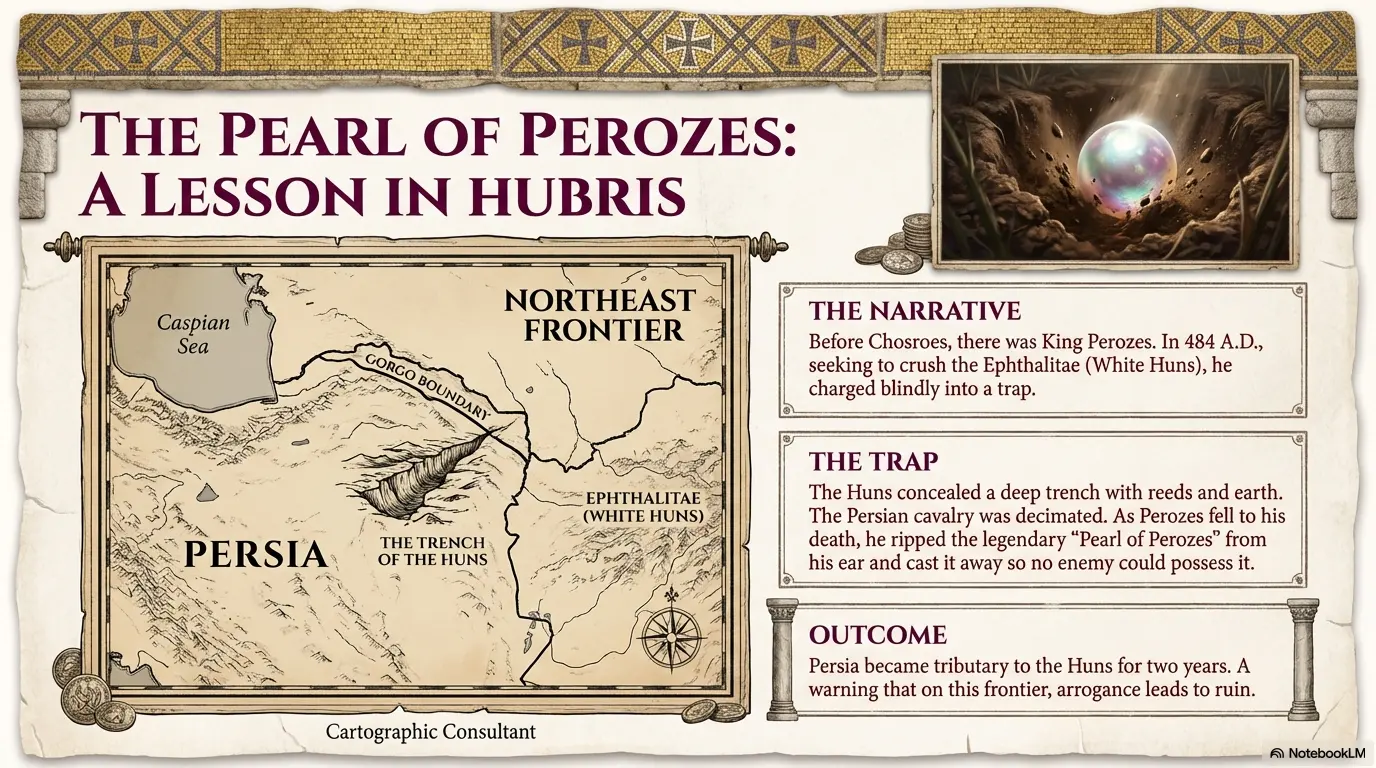
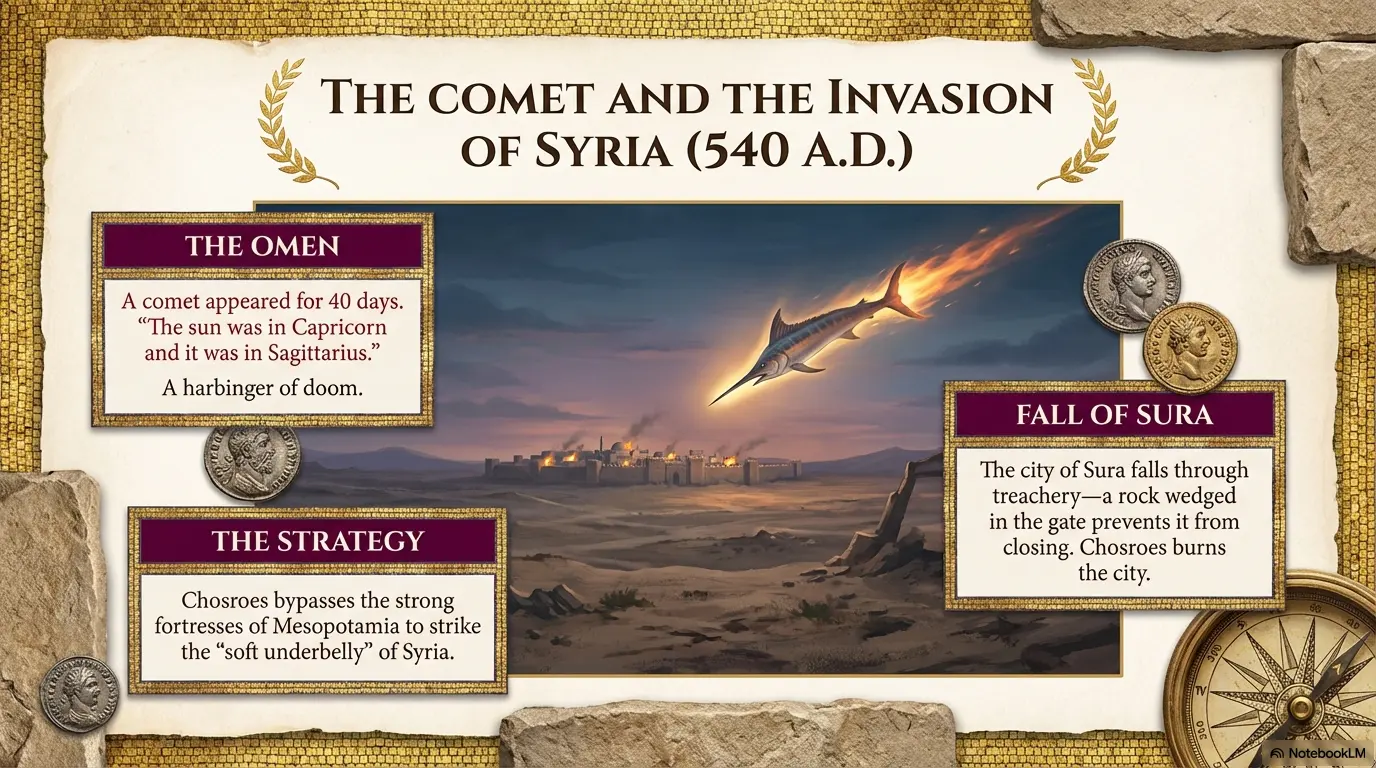
2.5.1. 540 A.D. When the winter was already reaching its close, and the thirteenth year of the reign of the Emperor Justinian was ending, Chosroes, son of Cabades, invaded the land of the Romans at the opening of spring with a mighty army, and openly broke the so-called endless peace. But he did not enter by the country between the rivers, but advanced with the Euphrates on his right. On the other side of the river stands the last Roman stronghold which is called Circesium, an exceedingly strong place, since the River Aborras, a large stream, has its mouth at this point and mingles with the Euphrates, and this fortress lies exactly in the angle which is made by the junction of the two rivers. And a long second wall outside the fortress cuts off the land between the two rivers, and completes the form of a triangle around Circesium. Chosroes, therefore, not wishing to make trial of so strong a fortress and not having in mind to cross the River Euphrates, but rather to go against the Syrians and Cilicians, without any hesitation led his army forward, and after advancing for what, to an unencumbered traveller, is about a three-days' journey along the bank of the Euphrates, he came upon the city of Zenobia; this place Zenobia had built in former times, and, as was natural, she gave her name to the city. Now Zenobia was the wife of Odonathus, the ruler of the Saracens of that region, who had been on terms of peace with the Romans
2.5.6. from of old. This Odonathus rescued for the Romans the Eastern Empire when it had come under the power of the Medes; but this took place in former times. Chosroes then came near to Zenobia, but upon learning that the place was not important and observing that the land was untenanted and destitute of all good things, he feared lest any time spent by him there would be wasted on an affair of no consequence and would be a hindrance to great undertakings, and he attempted to force the place to surrender. But meeting with no success, he hastened his march forward. After again accomplishing a journey of equal extent, he reached the city of Sura, which is on the River Euphrates, and stopped very close to it. There it happened that the horse on which Chosroes was riding neighed and stamped the ground with his foot. And the Magi considered the meaning of this incident and announced that the place would be captured. Chosroes then made camp and led his army against the fortifications to assail the wall. Now it happened that a certain Arsaces, an Armenian by birth, was commander of the soldiers in the town; and he made the soldiers mount the parapets, and fighting from there most valiantly slew many of the enemy, but was himself struck by an arrow and died. And then, since it was late in the day, the Persians retired to their camp in order to assail the wall again on the following day; but the Romans were in despair since their leader was dead, and were purposing to make themselves suppliants of Chosroes.
2.5.13. On the following day, therefore, they sent the bishop of the city to plead for them and to beg that the town be spared; so he took with him some of his attendants, who carried fowls and wine and clean loaves, and came before Chosroes; there he threw himself on the ground, and with tears supplicated him to spare a pitiable population and a city altogether without honour in the eyes of the Romans, and one which in past times had never been of any account to the Persians, and which never would be such thereafter; and he promised that the men of Sura would give him ransom worthy of themselves and the city which they inhabited. But Chosroes was angry with the townsmen because, being the first he had met of all the Romans, they had not willingly received him into their city, but even daring to raise their arms against him had slain a large number of Persian notables. However he did not disclose his anger, but carefully concealed it behind a smooth countenance, in order that by carrying out the punishment of the inhabitants of Sura he might make himself in the eyes of the Romans a fearful person and one not to be resisted. For by acting in this way he calculated that those who would from time to time come in his way would yield to him without trouble.
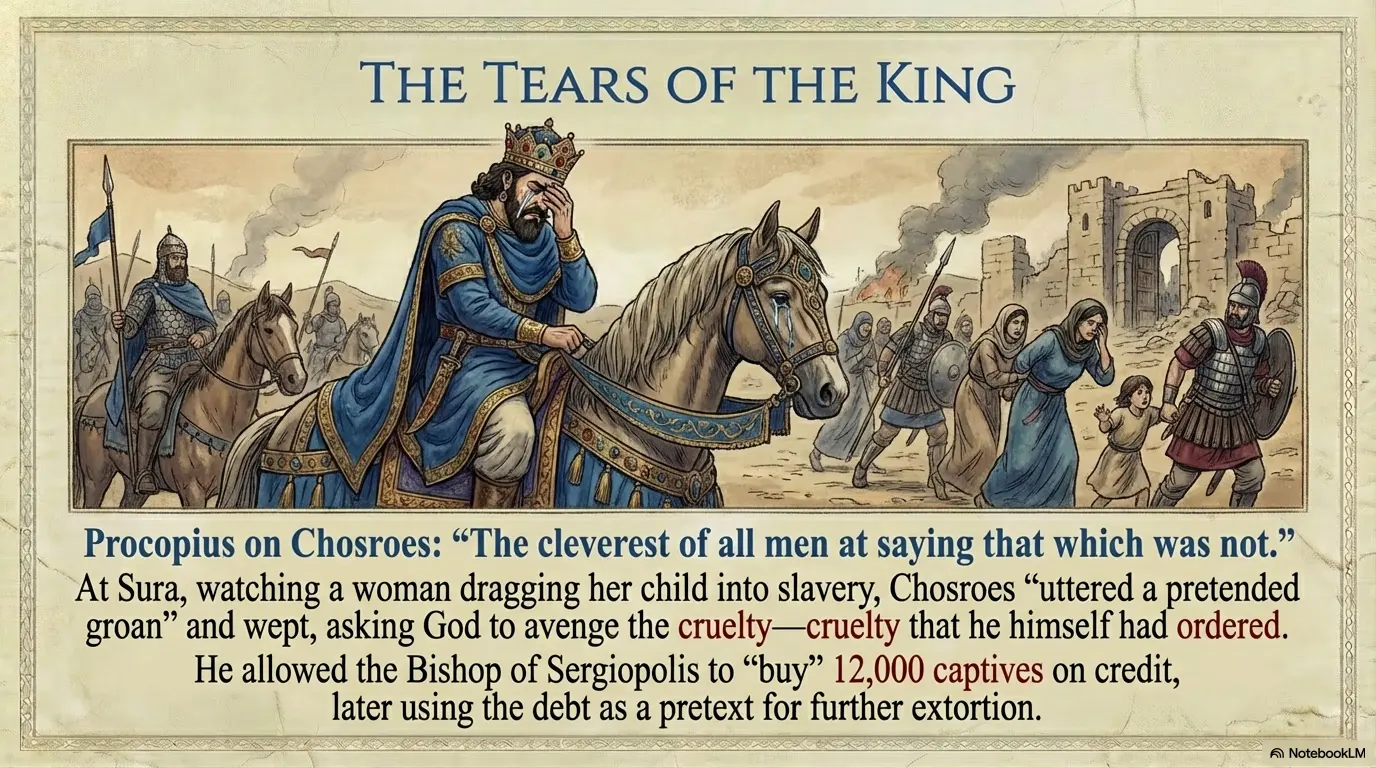
Accordingly with great friendliness he caused the bishop to rise, and receiving the gifts, gave the impression, in a way, that he would immediately confer with the notables of the Persians concerning the ransom of the townsmen, and would settle their request favourably. Thus he dismissed the bishop and his following without any suspicion of the plot, and he sent with him certain of the men of note among the Persians, who were to be ostensibly an escort.
2.5.18. These men he secretly commanded to go with him as far as the wall, encouraging him and cheering him with fair hopes, so that he and all those with him should be seen by those inside rejoicing and fearing nothing. But when the guards had set the gate open and were about to receive them into the city, they were to throw a stone or block of wood between the threshold and the gate and not allow them to shut it, but should themselves for a time stand in the way of those who wished to close it; for not long afterwards the army would follow them. After giving these directions to the men Chosroes made ready the army, and commanded them to advance upon the city on the run whenever he should give the signal. So when they came close to the fortifications, the Persians bade farewell to the bishop and remained outside, and the townsmen, seeing that the man was exceedingly happy and that he was being escorted in great honour by the enemy, forgetting all their difficulties opened the gate wide, and received the priest and his following with clapping of hands and much shouting. And when all got inside, the guards began to push the gate in order to close it, but the Persians flung down a stone, which they had provided, between it and the threshold. And the guards pushed and struggled still more, but were quite unable to get the gate back to the threshold. On the other hand they dared not open it again, since they perceived that it was held by the enemy. But some say that it was not a stone but a block of wood which the Persians threw into the gateway.
2.5.25. When the townsmen had as yet scarcely realized the plot, Chosroes was at hand with his whole army, and the barbarians forced back and flung open the gate, which was soon carried by storm. Straightway, then, Chosroes, filled with wrath, plundered the houses and put to death great numbers of the population; all the remainder he reduced to slavery, and setting fire to the whole city razed it to the ground. Then he dismissed Anastasius, bidding him announce to the Emperor Justinian where in the world he had left Chosroes, son of Cabades. Afterwards either through motives of humanity or of avarice, or as granting a favour to a woman whom he had taken as a captive from the city, Euphemia by name, Chosroes decided to shew some kindness to the inhabitants of Sura; for he had conceived for this woman an extraordinary love (for she was exceedingly beautiful to look upon), and had made her his wedded wife. He sent, accordingly, to Sergiopolis, a city subject to the Romans, named from Sergius, a famous saint, distant from the captured city one hundred and twenty-six stades and lying to the south of it in the so-called Barbarian Plain, and bade Candidus, the bishop of the city, purchase the captives, twelve thousand in number, for two centenaria. But the bishop, alleging that he had no money, refused absolutely to undertake the matter. Chosroes therefore requested him to set down in a document the agreement that he would give the money at a later time, and thus to purchase for a small sum such a multitude of slaves. Candidus did as directed, promising to give the money within a year, and swore the most dire oaths,
2.5.31. specifying that he should receive the following punishment if he should not give the money at the time agreed upon, that he should pay double the amount and should himself be no longer a priest, as one who had neglected his sworn promise. And after setting down these things in writing, Candidus received all the inhabitants of Sura. And some few among them survived, but the majority, unable to support the misery which had fallen to their lot, succumbed soon afterwards. After the settlement of this affair Chosroes led his army forward.
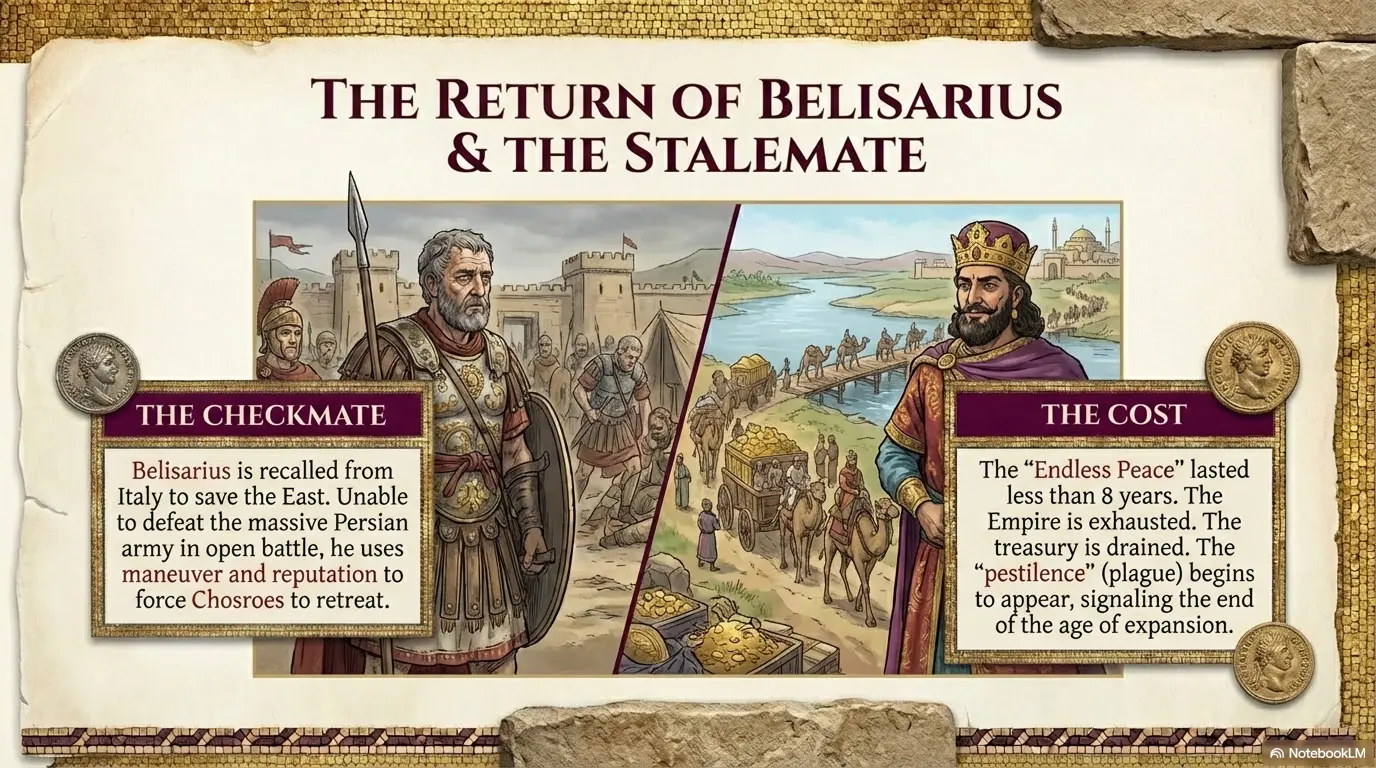
2.6.1. IT had happened a little before this that the emperor had divided into two parts the military command of the East, leaving the portion as far as the River Euphrates under the control of Belisarius who formerly held the command of the whole, while the portion from there as far as the Persian boundary he entrusted to Bouzes, commanding him to take charge of the whole territory of the East until Belisarius should return from Italy. Bouzes therefore at first remained at Hierapolis, keeping his whole army with him; but when he learned what had befallen Sura, he called together the first men of the Hierapolitans and spoke as follows: "Whenever men are confronted with a struggle against an assailant with whom they are evenly matched in strength, it is not at all unreasonable that they should engage in open conflict with the enemy; but for those who are by comparison much inferior
2.6.3. to their opponents it will be more advantageous to circumvent their enemy by some kind of tricks than to array themselves openly against them and thus enter into foreseen danger. How great, now, the army of Chosroes is you are assuredly informed. And if, with this army, he wishes to capture us by siege, and if we carry on the fight from the wall, it is probable that, while our supplies will fail us, the Persians will secure all they need from our land, where there will be no one to oppose them. And if the siege is prolonged in this way, I believe too that the fortification wall will not withstand the assaults of the enemy, for in many places it is most susceptible to attack, and thus irreparable harm will come to the Romans. But if with a portion of the army we guard the wall of the city, while the rest of us occupy the heights about the city, we shall make attacks from there at times upon the camp of our antagonists, and at times upon those who are sent out for the sake of provisions, and thus compel Chosroes to abandon the siege immediately and to make his retreat within a short time; for he will not be at all able to direct his attack without fear against the fortifications, nor to provide any of the necessities for so great an army." So spoke Bouzes; and in his words he seemed to set forth the advantageous course of action, but of what was necessary he did nothing. For he chose out all that portion of the Roman army which was of marked excellence and was off. And where in the world he was neither any of the Romans in Hierapolis, nor the hostile army was able to learn. Such, then, was the course of these events.
2.6.9. But the Emperor Justinian, upon learning of the inroad of the Persians, immediately sent his nephew Germanus with three hundred followers in great disorder, promising that after no great time a numerous army would follow. And Germanus, upon reaching Antioch, went around the whole circuit of the wall; and the greater part of it he found secure, for along that portion of it which lies on the level ground the River Orontes flows, making it everywhere difficult of access, and the portion which is on higher ground rises upon steep hills and is quite inaccessible to the enemy; but when he attained the highest point, which the men of that place are accustomed to call Orocasias, he noticed that the wall at that point was very easy to assail.
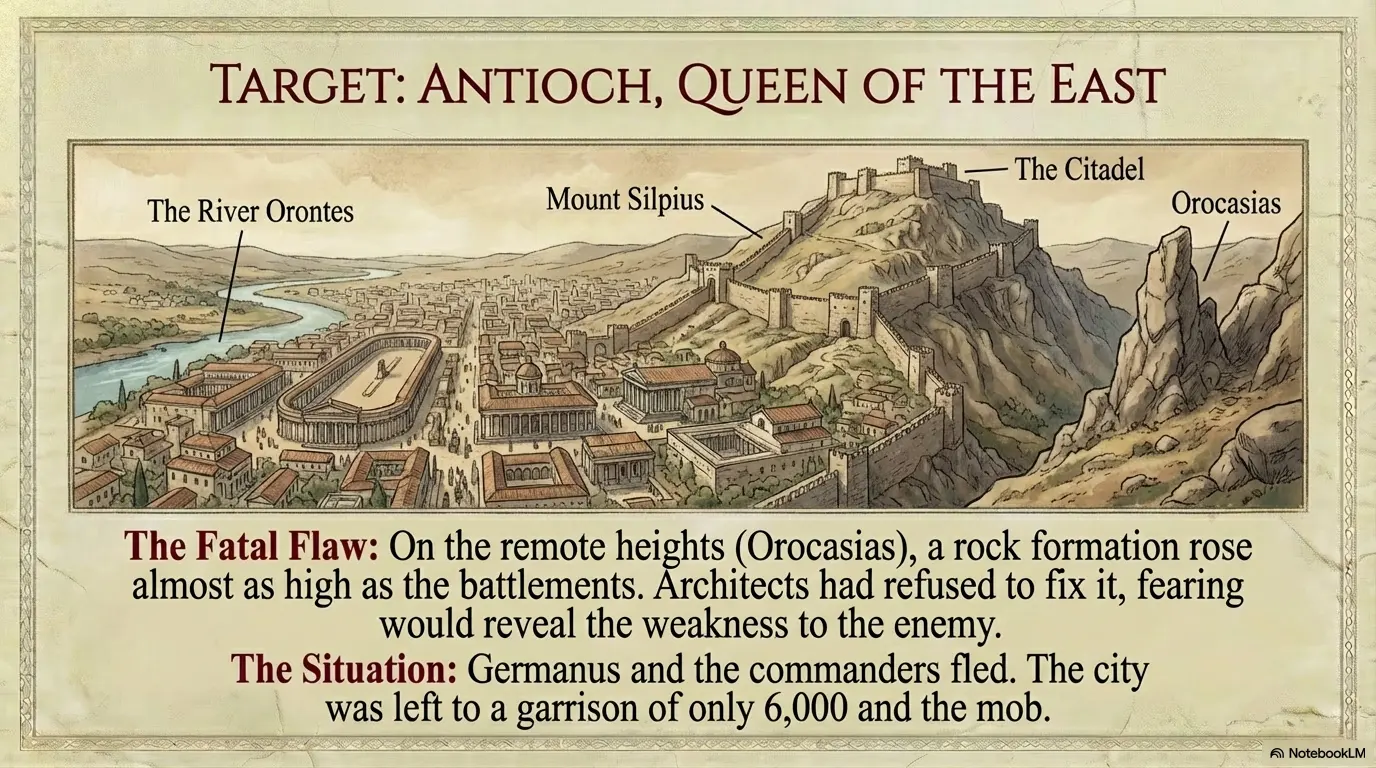
For there happens to be in that place a rock, which spreads out to a very considerable width, and rises to a height only a little less than the fortifications. He therefore commanded that they should either cut off the rock by making a deep ditch along the wall, lest anyone should essay to mount from there upon the fortifications, or that they should build upon it a great tower and connect its structure with the wall of the city. But to the architects of public buildings it seemed that neither one of these things should be done. For, as they said, the work would not be completed in a short time with the attack of the enemy so imminent, while if they began this work and did not carry it to completion, they would do nothing else than shew to the enemy at what point in the wall they should make their attack. Germanus, though disappointed in this plan, had some hope at first because he expected an army from Byzantium.
2.6.15. But when, after considerable time had passed, no army arrived from the emperor nor was expected to arrive, he began to fear lest Chosroes, learning that the emperor's nephew was there, would consider it more important than any other thing to capture Antioch and himself, and for this reason would neglect everything else and come against the city with his whole army. The natives of Antioch also had these things in mind, and they held a council concerning them, at which it seemed most advisable to offer money to Chosroes and thus escape the present danger. Accordingly they sent Megas, the bishop of Beroea, a man of discretion who at that time happened to be tarrying among them, to beg for mercy from Chosroes; and departing from there he came upon the Median army not far from Hierapolis. And coming into the presence of Chosroes, he entreated him earnestly to have pity upon men who had committed no offence against him and who were not able to hold out against the Persian army. For it was becoming to a king least of all men to trample upon and do violence to those who retreated before him and were quite unwilling to array themselves against him; for not one of the things which he was then doing was a kingly or honourable act, because, without affording any time for consideration to the Roman emperor, so that he might either make the peace secure as might seem well to both sovereigns, or make his preparations for war in accordance with a mutual agreement, as was to be expected, he had thus recklessly advanced in arms against the Romans, while their emperor did not as yet know what had
2.6.19. come upon them. When Chosroes heard this, he was utterly unable by reason of his stupidity to order his mind with reason and discretion, but still more than before he was lifted up in spirit. He therefore threatened to destroy all the Syrians and Cilicians, and bidding Megas follow him, he led his army to Hierapolis. When he had come there and established his camp, since he saw that the fortifications were strong and learned that the city was well garrisoned with soldiers, he demanded money from the Hierapolitans, sending to them Paulus as interpreter. This Paulus had been reared in Roman territory and had gone to an elementary school in Antioch, and besides he was said to be by birth of Roman extraction. But in spite of everything the inhabitants were exceedingly fearful for the fortifications, which embraced a large tract of land as far as the hill which rises there, and besides they wished to preserve their land unplundered; accordingly they agreed to give two thousand pounds of silver. Then indeed Megas entreated Chosroes in behalf of all the inhabitants of the East, and would not cease his entreaty, until Chosroes promised him that he would accept ten centenaria of gold and depart from the whole Roman empire.
2.7.1. Thus, then, on that day Megas departed thence and went on the way to Antioch, while Chosroes after receiving the ransom was moving toward Beroea.
2.7.2. This city lies between Antioch and Hierapolis, at a distance from both of two-days' journey for an unencumbered traveller. Now while Megas, who travelled with a small company, advanced very quickly, the Persian army was accomplishing only one half of the distance which he travelled each day. And so on the fourth day he reached Antioch, while the Persians came to the suburb of Beroea. And Chosroes immediately sent Paulus and demanded money of the Beroeans, not only as much as he had received from the Hierapolitans, but double the amount, since he saw that their wall in many places was very vulnerable. As for the Beroeans, since they could by no means place confidence in their fortifications, they gladly agreed to give all, but after giving two thousand pounds of silver, they said that they were not able to give the remainder. And since Chosroes pressed them on this account, on the following night all of them fled for refuge into the fortress which is on the acropolis together with the soldiers who had been stationed there to guard the place. And on the following day men were sent to the city by Chosroes in order to receive the money; but on coming near the fortifications they found all the gates closed, and being unable to discover any man, they reported the situation to the king. And he commanded them to set ladders against the wall and to make trial of mounting it, and they did as directed. Then since no one opposed them, they got inside the fortifications and opened the gates at their leisure, and received into the city the whole army and Chosroes himself.
2.7.11. By this time the king was furious with anger and he fired nearly the whole city. He then mounted the acropolis and decided to storm the fortress. There indeed the Roman soldiers while valiantly defending themselves slew some of the enemy; but Chosroes was greatly favoured by fortune by reason of the folly of the besieged, who had not sought refuge in this fortress by themselves, but along with all their horses and other animals, and by this inconsiderate act they were placed at a great disadvantage and began to be in danger. For since there was only one spring there and the horses and mules and other animals drank from it when they should not have done so, it came about that the water was exhausted. Such, then, was the situation of the Beroeans. Megas, upon reaching Antioch and announcing the terms arranged by him with Chosroes, failed utterly to persuade them to carry out this agreement. For it happened that the Emperor Justinian had sent John, the son of Rufinus, and Julian, his private secretary, as ambassadors to Chosroes. The person holding this office is styled "a secretis" by the Romans; for secrets they are accustomed to call "secreta." These men had reached Antioch and were remaining there. Now Julian, one of the ambassadors, explicitly forbade everybody to give money to the enemy, or to purchase the cities of the emperor, and besides he denounced to Germanus the chief priest Ephraemius, as being eager to deliver over the city to Chosroes. For this reason Megas returned unsuccessful. But Ephraemius, the bishop of Antioch, fearing the attack of the Persians, went into Cilicia.
2.7.18. There too came Germanus not long afterwards, taking with him some few men but leaving the most of them in Antioch. Megas then came in haste to Beroea, and in vexation at what had taken place, he charged Chosroes with having treated the Beroeans outrageously; for while, as it seemed, he had sent him to Antioch to arrange the treaty, he had both plundered the property of the citizens, though they had committed no wrong at all, and had compelled them to shut themselves up in that fortress, and had then set fire to the city and razed it to the ground in defiance of right. To this Chosroes replied as follows: "Verily, my friend, you yourself are responsible for these things, in having compelled us to delay here; for as it is, you have arrived, not at the appointed time, but far behind it.
And as for the strange conduct of your fellow-citizens, my most excellent sir, why should one make speeches of great length? For after agreeing to give us a fixed amount of silver for their own safety, they even now do not think it necessary to fulfil the agreement, but placing such complete confidence in the strength of their position, they are disregarding us absolutely, while we are compelled to undertake the siege of a fortress, as you surely see. But for my part, I have hope that with the help of the gods I shall have vengeance upon them shortly, and execute upon the guilty the punishment for the Persians whom I have lost wrongfully before this wall." So spoke Chosroes, and Megas replied as follows: "If one should consider that as king thou art making these charges against men who are in pitiable and most dishonoured plight, he would be compelled without a word of protest to agree with what thou
Lazica and Petra
2.15.1. But in the meantime Chosroes was leading his army against Colchis, where the Lazi were calling him in for the following reason. The Lazi at first dwelt in the land of Colchis as subjects of the Romans, but not to the extent of paying them
2.15.2. tribute or obeying their commands in any respect, except that, whenever their king died, the Roman emperor would send emblems of the office to him who was about to succeed to the throne. And he, together with his subjects, guarded strictly the boundaries of the land in order that hostile Huns might not proceed from the Caucasus mountains, which adjoin their territory, through Lazica and invade the land of the Romans. And they kept guard without receiving money or troops from the Romans and without ever joining the Roman armies, but they were always engaged in commerce by sea with the Romans who live on the Black Sea. For they themselves have neither salt nor grain nor any other good thing, but by furnishing skins and hides and slaves they secured the supplies which they needed. But when the events came to pass in which Gourgenes, the king of the Iberians, was concerned, as has been told in the preceding narrative, Roman soldiers began to be quartered among the Lazi; and these barbarians were annoyed by the soldiers, and most of all by Peter, the general, a man who was prone to treat insolently those who came into contact with him. This Peter was a native of Arzanene, which is beyond the River Nymphius, a district subject to the Persians from of old, but while still a child he had been captured and enslaved by the Emperor Justinus at the time when Justinus, after the taking of Amida, was invading the land of the Persians with Celer's army. And since his owner showed him great kindness, he attended the school of a grammatist. And at first he became secretary to Justinus, but when, after the death of Anastasius, Justinus took over the
2.15.8. Roman empire, Peter was made a general, and he degenerated into a slave of avarice, if anyone ever did, and shewed himself very fatuous in his treatment of all. And later the Emperor Justinian sent different officers to Lazica, and among them John, whom they called Tzibus, a man of obscure and ignoble descent, but who had climbed to the office of general by virtue of no other thing than that he was the most accomplished villain in the world and most successful in discovering unlawful sources of revenue. This man unsettled and threw into confusion all the relations of the Romans and the Lazi. He also persuaded the Emperor Justinian to build a city on the sea in Lazica, Petra by name; and there he sat as in a citadel and plundered the property of the Lazi. For the salt, and all other cargoes which were considered necessary for the Lazi, it was no longer possible for the merchants to bring into the land of Colchis, nor could they purchase them elsewhere by sending for them, but he set up in Petra the so-called "monopoly" and himself became a retail dealer and overseer of all the handling of these things, buying everything and selling it to the Colchians, not at the customary rates, but as dearly as possible. At the same time, even apart from this, the barbarians were annoyed by the Roman army quartered upon them, a thing which had not been customary previously. Accordingly, since they were no longer able to endure these things, they decided to attach themselves to the Persians and Chosroes, and immediately they
2.15.12. sent to them envoys who were to arrange this without the knowledge of the Romans. These men had been instructed that they should take pledges from Chosroes that he would never give up the Lazi against their will to the Romans, and that with this understanding they should bring him with the Persian army into the land. Accordingly the envoys went to the Persians, and coming secretly before Chosroes they said: "If any people in all time have revolted from their own friends in any manner whatsoever and attached themselves wrongfully to men utterly unknown to them, and after that by the kindness of fortune have been brought back once more with greatest rejoicing to those who were formerly their own, consider, O Most mighty King, that such as these are the Lazi. For the Colchians in ancient times, as allies of the Persians, rendered them many good services and were themselves treated in like manner; and of these things there are many records in books, some of which we have, while others are preserved in thy palace up to the present time. But at a later time it came about that our ancestors, whether neglected by you or for some other reason (for we are unable to ascertain anything certain about this matter), became allies of the Romans. And now we and the king of Lazica give to the Persians both ourselves and our land to treat in any way you may desire. And we beg of you to think thus concerning us: if, on the one hand, we have suffered nothing outrageous at the hands of the Romans, but have been prompted by foolish motives in coming to you, reject this prayer of ours straightway, considering
2.15.18. that with you likewise the Colchians will never be trustworthy (for when a friendship has been dissolved, a second friendship formed with others becomes, owing to its character, a matter of reproach); but if we have been in name friends of the Romans, but in fact their loyal slaves, and have suffered impious treatment at the hands of those who have tyrannized over us, receive us, your former allies, and acquire as slaves those whom you used to treat as friends, and shew your hatred of a cruel tyranny which has risen thus on our borders, by acting worthily of that justice which it has always been the tradition of the Persians to defend. For the man who himself does no wrong is not just, unless he is also accustomed to rescue those who are wronged by others when he has it in his power. But it is worth while to tell a few of the things which the accursed Romans have dared to do against us. In the first place they have left our king only the form of royal power, while they themselves have appropriated the actual authority, and he sits a king in the position of a servant, fearing the general who issues the orders; and they have put upon us a multitude of soldiery, not in order to guard the land against those who harass us (for not one of our neighbours except, indeed, the Romans has disturbed us), but in order that they may confine us as in a prison and make themselves masters of our possessions. And purposing to make more speedy the robbery of what we have, behold, O King, what sort of a design they have formed; the supplies which are in excess among them they compel the Lazi to buy against their will, while those things which are most useful
2.15.24. to them among the products of Lazica these fellows demand to buy, as they put it, from us, the price being determined in both cases by the judgment of the stronger party. And thus they are robbing us of all our gold as well as of the necessities of life, using the fair name of trade, but in fact oppressing us as thoroughly as they possibly can. And there has been set over us as ruler a huckster who has made our destitution a kind of business by virtue of the authority of his office. The cause of our revolt, therefore, being of this sort, has justice on its side; but the advantage which you yourselves will gain if you receive the request of the Lazi we shall forthwith tell. To the realm of Persia you will add a most ancient kingdom, and as a result of this you will have the power of your sway extended, and it will come about that you will have a part in the sea of the Romans through our land, and after thou hast built ships in this sea, O King, it will be possible for thee with no trouble to set foot in the palace in Byzantium. For there is no obstacle between. And one might add that the plundering of the land of the Romans every year by the barbarians along the boundary will be under your control. For surely you also are acquainted with the fact that up till now the land of the Lazi has been a bulwark against the Caucasus mountains. So with justice leading the way, and advantage added thereto, we consider that not to receive our words with favour would be wholly contrary to good judgment." So spoke the envoys. And Chosroes, delighted by their words, promised
2.15.31. to protect the Lazi, and enquired of the envoys whether it was possible for him to enter the land of Colchis with a large army. For he said that previously he had heard many persons report that the land was exceedingly hard to traverse even for an unimpeded traveller, being extremely rugged and covered very extensively by thick forests of wide-spreading trees. But the envoys stoutly maintained to him that the way through the country would be easy for the whole Persian army, if they cut the trees and threw them into the places which were made difficult by precipices. And they promised that they themselves would be guides of the route, and would take the lead in this work for the Persians. Encouraged by this suggestion, Chosroes gathered a great army and made his preparations for the inroad, not disclosing the plan to the Persians except those alone to whom he was accustomed to communicate his secrets, and commanding the envoys to tell no one what was being done; and he pretended that he was setting out into Iberia, in order to settle matters there; for a Hunnic tribe, he kept saying in explanation, had assailed the Persian domain at that point.
2.17.1. But Chosroes and the Median army, after crossing Iberia, reached the territory of Lazica under the leadership of the envoys; there with no one to withstand them they began to cut down the trees which grow thickly over that very mountainous region, rising to a great height, and spreading out their branches remarkably, so that they made the country absolutely impassable for the army; and these they threw into the rough places, and thus rendered the road altogether easy. And when they arrived in the centre of Colchis (the place where the tales of the poets say that the adventure of Medea and Jason took place), Goubazes, the king of the Lazi, came
2.17.2. and did obeisance to Chosroes, the son of Cabades, as Lord, putting himself together with his palace and all Lazica into his hand. Now there is a coast city named Petra in Colchis, on the sea which is called the Euxine, which in former times had been a place of no importance, but which the Emperor Justinian had rendered strong and otherwise conspicuous by means of the circuit-wall and other buildings which he erected.
When Chosroes ascertained that the Roman army was in that place with John, he sent an army and a general, Aniabedes, against them in order to capture the place at the first onset. But John, upon learning of their approach, gave orders that no one should go outside the fortifications nor allow himself to be seen from the parapet by the enemy, and he armed the whole army and stationed them in the vicinity of the gates, commanding them to keep silence and not allow the least sound of any kind to escape from them. So the Persians came close to the fortifications, and since nothing of the enemy was either seen or heard by them they thought that the Romans had abandoned the city and left it destitute of men. For this reason they closed in still more around the fortifications, so as to set up ladders immediately, since no one was defending the wall. And neither seeing nor hearing anything of the enemy, they sent to Chosroes and explained the situation. And he sent the greater part of the army, commanding them to make an attempt upon the fortifications from all sides, and he directed one of the officers to make use of the engine known as a ram around the gate, while he himself, seated on
2.17.9. the hill which lies very close to the city, became a spectator of the operations. And straightway the Romans opened the gates all of a sudden, and unexpectedly fell upon and slew great numbers of the enemy, and especially those stationed about the ram; the rest with difficulty made their escape together with the general and were saved. And Chosroes, filled with rage, impaled Aniabedes, since he had been outgeneralled by John, a tradesman and an altogether unwarlike man. But some say that not Aniabedes, but the officer commanding the men who were working the ram was impaled. And he himself broke camp with the whole army, and coming close to the fortifications of Petra, made camp and began a siege. On the following day he went completely around the fortifications, and since he suspected that they could not support a very strong attack, he decided to storm the wall. And bringing up the whole army there, he opened the action, commanding all to shoot with their bows against the parapet. The Romans, meanwhile, in defending themselves, made use of their engines of war and all their bows. At first, then, the Persians did the Romans little harm, although they were shooting their arrows thick and fast, while at the same time they suffered severely at the hands of the Romans, since they were being shot at from an elevation. But later on (since it was fated that Petra be captured by Chosroes), John by some chance was shot in the neck and died, and as a result of this the other Romans ceased to care for anything. Then indeed the barbarians withdrew to their camp; for it was already growing dark; but on the following day they planned to assail the fortifications by an excavation, as follows.
The Armenian reverse at Anglon
2.25.1. Now Doubios is a land excellent in every respect, and especially blessed with a healthy climate and abundance of good water; and from Theodosiopolis it is removed a journey of eight days. In that region there are plains suitable for riding, and many very populous villages are situated in very close proximity to one another, and numerous merchants conduct their business in them. For from India and the neighbouring regions of Iberia and from practically all the nations of Persia and some of those under Roman sway they bring in merchandise and carry on their dealings with each other there. And the priest of the Christians is called "Catholicos" in the Greek tongue, because he presides alone over the whole region.
2.25.5. Now at a distance of about one hundred and twenty stades from Doubios on the right as one travels from the land of the Romans, there is a mountain difficult of ascent and moreover precipitous, and a village crowded into very narrow space by the rough country about, Anglon by name. Thither Nabedes withdrew with his whole army as soon as he learned of the inroad of the enemy, and, confident in his strength of position, he shut himself in. Now the village lies at the extremity of the mountain, and there is a strong fortress bearing the same name as this village on the steep mountain side. So Nabedes with stones and carts blocked up the entrances into the village and thus made it still more difficult of access. And in front of it he dug a sort of trench and stationed the army there, having filled some old cabins with ambuscades of infantrymen. Altogether the Persian army amounted to four thousand men. While these things were being done in this way, the Romans reached a place one day's journey distant from Anglon, and capturing one of the enemy who was going out as a spy they enquired
2.25.10. where in the world Nabedes was then. And he asserted that the man had retired from Anglon with the whole Median army. And when Narses heard this, he was indignant, and he heaped reproaches and abuse upon his fellow-commanders for their hesitation. And others, too, began to do the very same thing, casting insults upon one another; and from then on, giving up all thought of battle and danger, they were eager to plunder the country thereabout. The troops broke camp, accordingly, and without the guidance of generals and without observing any definite formation, they moved forward in complete confusion; for neither had they any countersign among themselves, as is customary in such perilous situations, nor were they arranged in their proper divisions. For the soldiers marched forward, mixed in with the baggage train, as if going to the ready plunder of great wealth. But when they came near to Anglon, they sent out spies who returned to them announcing the array of the enemy. And the generals were thunder-struck by the unexpectedness of it, but they considered it altogether disgraceful and unmanly to turn back with an army of such great size, and so they disposed the army in its three divisions, as well as the circumstances permitted, and advanced straight toward the enemy. Now Peter held the right wing and Valerianus the left, while Martinus and his men arrayed themselves in the centre. And when they came close to their opponents, they halted, preserving their formation, but not without disorder. The cause for this was to be found in the difficulty of the ground, which was very badly broken up, and in the fact that they
2.25.18. were entering battle in a formation arranged on the spur of the moment. And up to this time the barbarians, who had gathered themselves into a small space, were remaining quiet, considering the strength of their antagonists, since the order had been given them by Nabedes not under any circumstances to begin the fighting, but if the enemy should assail them, to defend themselves with all their might. And first Narses with the Eruli and those of the Romans who were under him, engaged with the enemy, and after a hard hand-to-hand struggle, he routed the Persians who were before him. And the barbarians in flight ascended on the run to the fortress, and in so doing they inflicted terrible injury upon one another in the narrow way. And then Narses urged his men forward and pressed still harder upon the enemy, and the rest of the Romans joined in the action. But all of a sudden the men who were in ambush, as has been said, came out from the cabins along the narrow alleys, and killed some of the Eruli, falling unexpectedly upon them, and they struck Narses himself a blow on the temple. And his brother Isaac carried him out from among the fighting men, mortally wounded. And he died shortly afterwards, having proved himself a brave man in this engagement. Then, as was to be expected, great confusion fell upon the Roman army, and Nabedes let out the whole Persian force upon his opponents.
And the Persians, shooting into great masses of the enemy in the narrow alleys, killed a large number without difficulty, and particularly of the Eruli who had at the first fallen upon the enemy with Narses and were fighting for the most part without protection.
2.25.26. For the Eruli have neither helmet nor corselet nor any other protective armour, except a shield and a thick jacket, which they gird about them before they enter a struggle. And indeed the Erulian slaves go into battle without even a shield, and when they prove themselves brave men in war, then their masters permit them to protect themselves in battle with shields. Such is the custom of the Eruli. And the Romans did not withstand the enemy and all of them fled as fast as they could, never once thinking of resistance and heedless of shame or of any other worthy motive. But the Persians, suspecting that they had not turned thus to a shameless flight, but that they were making use of some ambuscades against them, pursued them as far as the rough ground extended and then turned back, not daring to fight a decisive battle on level ground, a few against many. The Romans, however, and especially all the generals, supposing that the enemy were continuing the pursuit without pause, kept fleeing still faster, wasting not a moment; and they were urging on their horses as they ran with whip and voice, and throwing their corselets and other accoutrements in haste and confusion to the ground. For they had not the courage to array themselves against the Persians if they overtook them, but they placed all hope of safety in their horses' feet, and, in short, the flight became such that scarcely any one of their horses survived, but when they stopped running, they straightway fell down and expired.
2.25.33. And this proved a disaster for the Romans so great as to exceed anything that had ever befallen them previously. For great numbers of them perished and still more fell into the hands of the enemy. And their weapons and draught animals which were taken by the enemy amounted to such an imposing number that Persia seemed as a result of this affair to have become richer. And Adolius, while passing through a fortified place during this retreat—it was situated in Persarmenia—was struck on the head by a stone thrown by one of the inhabitants of the town, and died there. As for the forces of Justus and Peranius, they invaded the country about Taraunon, and after gathering some little plunder, immediately returned.
The siege of Edessa
2.26.1. 544 A.D. And in the following year, Chosroes, the son of Cabades, for the fourth time invaded the land of the Romans, leading his army towards Mesopotamia. Now this invasion was made by this Chosroes not against Justinian, the Emperor of the Romans, nor indeed against any other man, but only against the God whom the Christians reverence. For when in the first invasion he retired, after failing to capture Edessa, both he and the Magi, since they had been worsted by the God of the Christians, fell into a great dejection. Wherefore Chosroes, seeking to allay it, uttered a threat in the palace that he would make slaves of all the inhabitants of Edessa and bring them to the land of Persia, and would turn the city into a pasture for sheep.
2.26.5. Accordingly when he had approached the city of Edessa with his whole army, he sent some of the Huns who were following him against that portion of the fortifications of the city which is above the hippodrome, with the purpose of doing no further injury than seizing the flocks which the shepherds had stationed there along the wall in great numbers: for they were confident in the strength of the place, since it was exceedingly steep, and supposed that the enemy would never dare to come so very close to the wall. So the barbarians were already laying hold of the sheep, and the shepherds were trying most valiantly to prevent them. And when a great number of Persians had come to the assistance of the Huns, the barbarians succeeded in detaching something of a flock from there, but Roman soldiers and some of the populace made a sally upon the enemy and the battle became a hand-to-hand struggle; meanwhile the flock of its own accord returned again to the shepherds. Now one of the Huns who was fighting before the others was making more trouble for the Romans than all the rest. And some rustic made a good shot and hit him on the right knee with a sling, and he immediately fell headlong from his horse to the ground, which thing heartened the Romans still more. And the battle which had begun early in the morning ended at midday, and both sides withdrew from the engagement thinking that they had the advantage. So the Romans went inside the fortifications, while the barbarians pitched their tents and made camp in a body about seven stades from the city. Then Chosroes either saw some vision or else the thought occurred to him that if, after making two
2.26.12. attempts, he should not be able to capture Edessa, he would thereby cover himself with much disgrace. Accordingly he decided to sell his withdrawal to the citizens of Edessa for a great sum of money. On the following day, therefore, Paulus the interpreter came along by the wall and said that some of the Roman notables should be sent to Chosroes. And they with all speed chose out four of their illustrious men and sent them. When these men reached the Median camp, they were met according to the king's order by Zaberganes, who first terrified them with many threats and then enquired of them which course was the more desirable for them, whether that leading to peace, or that leading to war. And when the envoys agreed that they would choose peace rather than the dangers of war, Zaberganes replied: "Therefore it is necessary for you to purchase this for a great sum of money." And the envoys said that they would give as much as they had provided before, when he came against them after capturing Antioch.
And Zaberganes dismissed them with laughter, telling them to deliberate most carefully concerning their safety and then to come again to the Persians. And a little later Chosroes summoned them, and when they came before him, he recounted how many Roman towns he had previously enslaved and in what manner he had accomplished it; then he threatened that the inhabitants of Edessa would receive more direful treatment at the hands of the Persians, unless they should give them all the wealth which they had inside the fortifications; for only on this condition, he said, would the army depart.
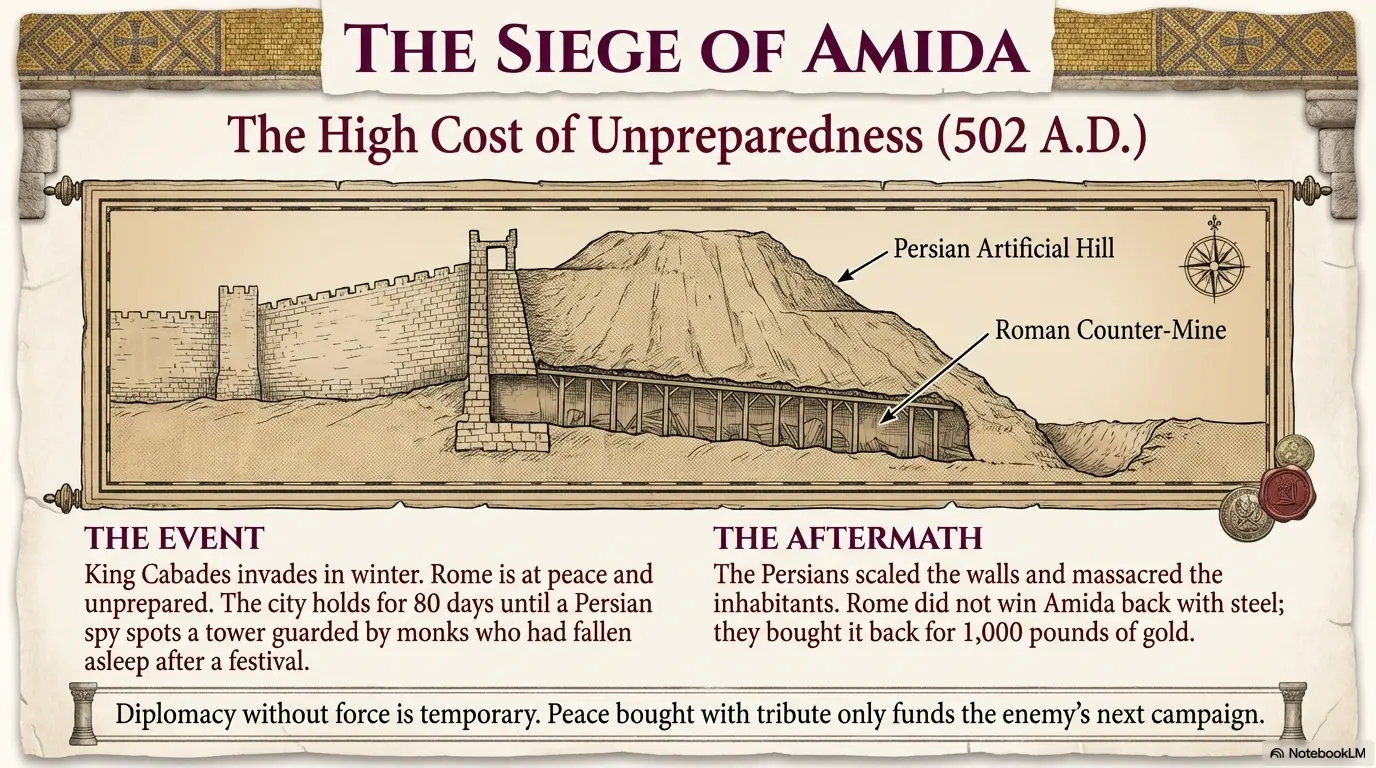
2.26.21. When the envoys heard this, they agreed that they would purchase peace from Chosroes, if only he would not prescribe impossible conditions for them: but the outcome of a conflict, they said, was plainly seen by no one at all before the struggle. For there was never a war whose outcome might be taken for granted by those who waged it. Thereupon Chosroes in anger commanded the envoys to be gone with all speed. On the eighth day of the siege he formed the design of erecting an artificial hill against the circuit wall of the city; accordingly he cut down trees in great numbers from the adjacent districts and, without removing the leaves, laid them together in a square before the wall, at a point which no missile from the city could reach; then he heaped an immense amount of earth right upon the trees and above that threw on a great quantity of stones, not such as are suitable for building, but cut at random, and only calculated to raise the hill as quickly as possible to a great height. And he kept laying on long timbers in the midst of the earth and the stones, and made them serve to bind the structure together, in order that as it became high it should not be weak. But Peter, the Roman general (for he happened to be there with Martinus and Peranius), wishing to check the men who were engaged in this work, sent some of the Huns who were under his command against them. And they, by making a sudden attack, killed a great number; and one of the guardsmen, Argek by name, surpassed all others, for he alone killed twenty-seven. From that time on, however, the barbarians kept a careful guard, and there was no further opportunity for anyone to go out against them.
2.26.28. But when the artisans engaged in this work, as they moved forward, came within range of missiles, then the Romans offered a most vigorous resistance from the city wall, using both their slings and their bows against them. Wherefore the barbarians devised the following plan. They provided screens of goat's hair cloth, of the kind which are called Cilician, making them of adequate thickness and height, and attached them to long pieces of wood which they always set before those who were working on the "agesta" (for thus the Romans used to call in the Latin tongue the thing which they were making). Behind this neither ignited arrows nor any other weapon could reach the workmen, but all of them were thrown back by the screens and stopped there. And then the Romans, falling into a great fear, sent the envoys to Chosroes in great trepidation, and with them Stephanus, a physician of marked learning among those of his time at any rate, who also had once cured Cabades, the son of Perozes, when ill, and had been made master of great wealth by him. He, therefore, coming into the presence of Chosroes with the others, spoke as follows: "It has been agreed by all from of old that kindness is the mark of a good king.
Therefore, most mighty King, while busying thyself with murders and battles and the enslavement of cities it will perhaps be possible for thee to win the other names, but thou wilt never by any means have the reputation of being 'good.' And yet least of all cities should Edessa suffer any adversity at thy hand. For there was I born, who, without any foreknowledge of what was coming to pass, fostered thee from childhood and counselled
2.26.35. thy father to appoint thee his successor in the kingdom, so that to thee I have proved the chief cause of the kingship of Persia, but to my fatherland of her present woes. For men, as a general thing, bring down upon their own heads the most of the misfortunes which are going to befall them. But if any remembrance of such benefaction comes to thy mind, do us no further injury, and grant me this requital, by which, O King, thou wilt escape the reputation of being most cruel." Such were the words of Stephanus. But Chosroes declared that he would not depart from there until the Romans should deliver to him Peter and Peranius, seeing that, being his hereditary slaves, they had dared to array themselves against him. And if it was not their pleasure to do this, the Romans must choose one of two alternatives, either to give the Persians five hundred centenaria of gold, or to receive into the city some of his associates who would search out all the money, both gold and silver, as much as was there, and bring it to him, allowing everything else to remain in the possession of the present owners. Such then were the words which Chosroes hurled forth, being in hopes of capturing Edessa with no trouble. And the ambassadors (since all the conditions which he had announced to them seemed impossible), in despair and great vexation, proceeded to the city. And when they had come inside the city-wall, they reported the message from Chosroes, and the whole city was filled with tumult and lamentation. Now the artificial hill was rising to a great height and was being pushed forward with much haste.
2.26.42. And the Romans, being at a loss what to do, again sent off the envoys to Chosroes. And when they had arrived in the enemy's camp, and said that they had come to make entreaty concerning the same things, they did not even gain a hearing of any kind from the Persians, but they were insulted and driven out from there with a great tumult, and so returned to the city. At first, then, the Romans tried to over-top the wall opposite the hill by means of another structure. But since the Persian work was already rising far above even this, they stopped their building and persuaded Martinus to make the arrangements for a settlement in whatever way he wished. He then came up close to the enemy's camp and began to converse with some of the Persian commanders. But they, completely deceiving Martinus, said that their king was desirous of peace, but that he was utterly unable to persuade the Roman Emperor to have done with his strife with Chosroes and to establish peace with him at last. And they mentioned as evidence of this the fact that Belisarius, who in power and dignity was far superior to Martinus, as even he himself would not deny, had recently persuaded the king of the Persians, when he was in the midst of Roman territory, to withdraw from there into Persia, promising that envoys from Byzantium would come to him at no distant time and establish peace securely, but that he had done none of the things agreed upon, since he had found himself unable to overcome the determination of the Emperor Justinian.
2.27.1. In the meantime the Romans were busying themselves as follows: They made a tunnel from the city underneath the enemy's embankment, commanding the diggers not to leave this work until they should get under the middle of the hill. By this means they were planning to burn the embankment. But as the tunnel advanced to about the middle of the hill, a sound of blows, as it were, came to the ears of those Persians who were standing above. And perceiving what was being done, they too began from above and dug on both sides of the middle, so that they might catch the Romans who were doing the damage there. But the Romans found it out and abandoned this attempt, throwing earth into the place which had been hollowed out, and then began to work on the lower part of the embankment at the end which was next to the wall, and by taking out timbers and stones and earth they made an open space just like a chamber; then they threw in there dry trunks of trees of the kind which burn most easily, and saturated them with oil of cedar and added quantities of sulphur and bitumen. So, then, they were keeping these things in readiness; and meanwhile the Persian commanders in frequent meetings with Martinus were carrying on conversations with him in the same strain as the one I have mentioned, making it appear that they would receive proposals in regard to peace. But when at last their hill had been completed, and had been raised to a great elevation, approaching the circuit-wall of the city and
2.27.6. rising far above it in height, then they sent Martinus away, definitely refusing to arrange the treaty, and they intended from then on to devote themselves to active warfare. Accordingly the Romans straightway set fire to the tree-trunks which had been prepared for this purpose. But when the fire had burned only a certain portion of the embankment, and had not yet been able to penetrate through the whole mass, the wood was already entirely exhausted. But they kept throwing fresh wood into the pit, not slackening their efforts for a moment. And when the fire was already active throughout the whole embankment, some smoke appeared at night rising from every part of the hill, and the Romans, who were not yet willing to let the Persians know what was being done, resorted to the following device: They filled small pots with coals and fire and threw these and also ignited arrows in great numbers to all parts of the embankment. And the Persians who were keeping guard there, began to go about in great haste and extinguish these, and they supposed that the smoke arose from them. But since the trouble increased, the barbarians rushed up to help in great numbers, and the Romans, shooting them from the wall, killed many. And Chosroes too came there about sunrise, followed by the greater part of the army, and, upon mounting the hill, he first perceived what the trouble was. For he disclosed the fact that the cause of the smoke was underneath, not in the missiles which the enemy were hurling, and he ordered the whole army to come to the rescue with all speed.
The Black Sea theater in the later war
8.1.1. The narrative which I have written up to this point has been composed, as far as possible, on the principle of separating the material into parts which relate severally to the countries in which the different wars took place, and these parts have already been published and have appeared in every corner of the Roman empire. But from this point onward I shall no longer follow this principle of arrangement. For after my writings had appeared before the public, I was no longer able to add to each the events which happened afterwards, but all the later developments in these wars, and in the war against Persia as well, now that I have published the previous parts, will be written down in full in this present narrative, and thus the record which I shall make of these events will of necessity be composite.
Now all that took place up to the fourth year of the five-year truce which was made between the Romans and the Persians has already been recounted by me in the previous books. But in the succeeding year a Persian army in vast numbers invaded the land of Colchis. In command of this army was a Persian, Chorianes by name, a man of wide experience in many wars, and a large number of barbarians of the tribe of the Alani followed him as allies. When this army had come to a part of Lazica, which is called Mocheresis, they made camp in a suitable position and remained there. Now there is a river in that place, the Hippis, not a large or navigable stream, but actually passable for both horsemen and foot-soldiers, and it was on the right of this that they made their entrenchment, not along the bank, but at a considerable distance from it.
8.1.7. At this point in my narrative it has seemed to me not inappropriate to pause a moment, in order that the geography of Lazica may be clear to those who read this history and that they may know what races of men inhabit that region, so that they may not be compelled to discuss matters which are obscure to them, like men fighting shadows; I shall therefore give an account of the distribution of the peoples who live about the Euxine Sea, as it is called, not that I am ignorant that these things have been written down by some of the men of earlier times also, but because I believe that not all their statements are accurate. Some of these writers, for example, have stated that the territory of the Trapezuntines is adjoined either by the Sani, who at the present day are called Tzani, or by the Colchians, calling another people Lazi, who are actually addressed by this name at the present day. And yet neither of these statements is true. For, in the first place, the Tzani live at a very great distance from the coast as neighbours of the Armenians in the interior, and many mountains stand between, which are thoroughly impassable and altogether precipitous, and there is an extensive area always devoid of human habitation, canyons from which it is impossible to climb out, forested heights, and impassable chasms — all these prevent the Tzani from being on the sea. In the second place, it is impossible that the Lazi should not be the Colchians, because they inhabit the banks of the Phasis River; and the Colchians have merely changed their name at the present time to Lazi, just as nations of men and many other things do. But apart from this, a long period of time has elapsed since these accounts were written, and has brought about constant changes along with the march of events, with the result that many of the conditions which formerly obtained have been replaced by new conditions, because of the migration of nations and successive changes of rulers and of names. These things it has seemed to me very necessary to investigate, not relating the mythological tales about them nor other antiquated material, nor even telling in what part of the Euxine Sea the poets say Prometheus was bound (for I consider that history is very widely separated from mythology), but stating accurately and in order both the names of each of those places and the facts that apply to them at the present day.
8.2.1. This Pontus, then, begins from Byzantium and Calchedon and ends at the land of the Colchians. And as one sails into it, the land on the right is inhabited by the Bithynians, and next after them by the Honoriatae and the Paphlagonians, who have, besides other towns, the coast cities of Heraclea and Amastris; beyond them are the people called Pontici as far as the city of Trapezus and its boundaries. In that region are a number of towns on the coast, among which are Sinope and Amisus, and close to Amisus is the town called Themiscyra and the river Thermodon, where they say the army of the Amazons originated. But concerning the Amazons I shall write a little later. From here the territory of the Trapezuntines extends to the village of Susurmena and the place called Rhizaeum, which is two days' journey distant from Trapezus as one goes toward Lazica along the coast. But now that I have mentioned Trapezus, I must not omit the very strange thing which takes place there; for the honey which is produced in all the places around Trapezus is bitter, this being the only place where it is at variance with its established reputation. On the right of these places rise all the mountains of Tzanica, and beyond them are the Armenians, who are subject to the Romans.
8.2.6. Now from these mountains of Tzanica the Boas River descends, a stream which, after passing into innumerable jungles and traversing a mountainous region, flows along by the land of Lazica and empties into the Euxine Sea, as it is called, but no longer keeping the name of Boas. For when it gets near the sea it loses this name and thereafter bears another, which it acquires from the character which it now displays. This name which the natives apply to it for the rest of its course is Acampsis, and they so name it, obviously, because it is impossible to force a way through it after it has entered the sea, since it discharges its stream with such force and swiftness, causing a great disturbance of the water before it, that it goes out for a very great distance into the sea and makes it impossible to coast along at that point. And those who are navigating in that part of the Pontus, whether sailing toward Lazica or even putting out from there, are not able to hold a straight course in their voyage; for they are quite unable to push through the river's current, but they must needs put out to a very great distance into the sea there, going somewhere near the middle of the Pontus, and only in this way can they escape the force of the river's discharge. So much, then, may be said regarding the Boas River.
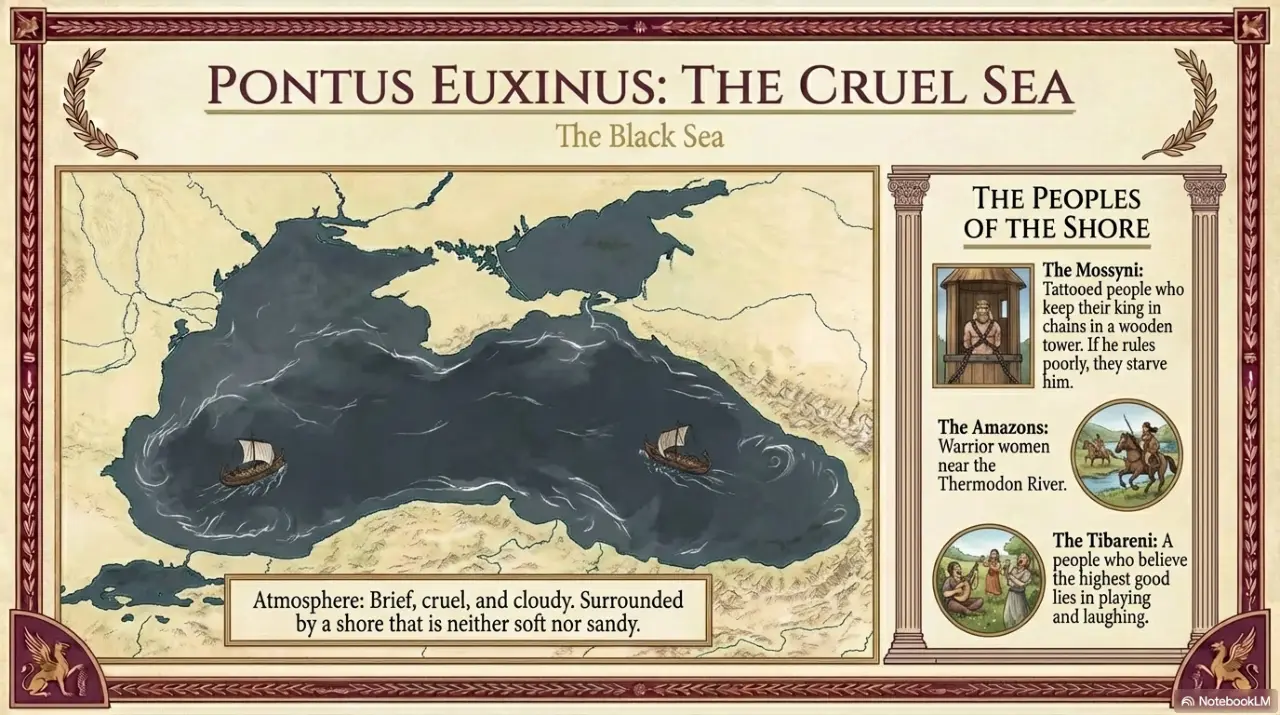
8.2.10. Beyond Rhizaeum there is found a territory occupied by independent peoples, who live between the Romans and the Lazi. And there is a certain village there named Athenae, not, as some suppose, because colonists from Athens settled there, but because a certain woman named Athenaea in early times ruled over the land, and the tomb of this woman is there even to my day. Beyond Athenae are Archabis and Apsarus, an ancient city which is about three days' journey from Rhizaeum. This was called Apsyrtus in ancient times, having come to be named after the man on account of his catastrophe. For in that place the natives say that Apsyrtus was removed from the world by the plot of Medea and Jason, and that from this circumstance the place received its name; for he died on that spot and the place was named after him. But an extremely long time has elapsed since these events, while countless generations of men have flourished, and the mere passage of time has thus availed to efface from memory the succession of incidents from which this name arose and to transform the name of the place to the form in which it appears at the present. There is also a tomb of this Apsyrtus to the east of the city. This was a populous city in ancient times, and a great expanse of wall surrounded it, while it was adorned with a theatre and hippodrome and all the rest of those things by which the size of a city is commonly indicated. But at the present nothing of these is left except the foundations of the buildings.
8.2.15. It is now clear that one might with good reason wonder at those who assert that the Colchians are adjacent to the Trapezuntines. For on this hypothesis it would appear that after Jason in company with Medea had captured the fleece, he actually did not flee toward Hellas and his own land, but backward to the Phasis River and the barbarians in the most remote interior. Now they say that in the time of the Roman Emperor Trajan detachments of Roman soldiers were stationed there and as far as the Lazi and Saginae. But at the present time people live there who are neither subjects of the Romans nor of the king of the Lazi, except indeed that the bishops of the Lazi appoint their priests, seeing they are Christians. And wishing, as they do, to live in peace and friendship with both peoples, they have made a permanent agreement to provide an escort for those who from time to time travel from the one country to the other; and it appears that they have been doing this even down to my time. For they escort the messengers despatched from the one king to the other, sailing in boats of their own. However, they have become in no way tributary down to the present time. On the right of these places very abrupt mountains tower overhead and a barren land extends to an indefinite distance. And beyond this the so-called Persarmenians dwell, as well as the Armenians who are subjects of the Romans, extending as far as the confines of Iberia.
8.2.21. From the city of Apsarus to Petra and the boundary of Lazica, where the Euxine Sea reaches its limit, is a journey of one day. Now as this sea comes to an end here, its coast takes the form of a crescent. And the distance across this crescent amounts to about five hundred and fifty stades, while the entire country behind it is Lazica and is known under this name. Behind them in the interior are Scymnia and Suania; these nations happen to be subjects of the Lazi. Indeed, although these peoples do have magistrates of their own blood, still, whenever any of the magistrates reaches the end of his life, it is always customary for another one to be appointed in his place by the king of the Lazi. At the side of this land and bordering upon Iberia proper for the most part dwell the Meschi, who have been from ancient times subjects of the Iberians, having their dwellings on the mountains. But the mountains of the Meschi are not rough nor unproductive of crops, but they abound in all good things, since the Meschi, for their part, are skilful farmers and there are actually vineyards in their country. However, this land is hemmed in by mountains which are very lofty and covered by forests so that they are exceedingly difficult to pass through. And these mountains extend as far as the Caucasus, while behind them toward the east is Iberia, extending as far as Persarmenia.
8.2.27. Now through the mountains which rise here the Phasis River emerges, having its source in the Caucasus and its mouth at the middle of the crescent of the Pontus. Because of this some consider that it forms the boundary between the two continents; for the land on the left as one goes down this stream is Asia, but that on the right is named Europe.
Now it so happens that all the habitations of the Lazi are on the European side, while on the opposite side there is neither fortress nor stronghold nor any village of consequence held by the Lazi, except indeed the city of Petra which the Romans built there in earlier times. It was somewhere in this part of Lazica, as the inhabitants say, that the famous fleece was placed for safe keeping, that fleece on account of which, as the poets tell the tale, the Argo was fashioned. But in saying this they are, in my opinion, not telling the truth at all. For I think that Jason would not have eluded Aeetes and got away from there with the fleece in company with Medea, unless both the palace and the other dwellings of the Colchians had been separated by the Phasis River from the place in which that fleece was lying; indeed the poets who have recorded the story imply that this was the case. So the Phasis, flowing as I have said, empties into the Euxine Sea approximately at the very point where it comes to an end. Now at the one end of the crescent, that, namely, which is in Asia, was the city of Petra, while on the opposite coast which forms a part of Europe the territory is held by the Apsilii; these Apsilii are subjects of the Lazi and have been Christians from ancient times, just as all the other nations which I have mentioned up to this point in my narrative.
Outcome and critical assessment
Result and caution: neither empire eliminated its rival. The treaty's later breach belongs beyond this edition. Procopius does not narrate the entire history through AD 562; the closing settlement requires later witnesses and historical synthesis.
Historical record: Procopius, Wars 2 and 8; Bury, eastern-war and peace discussions. Encyclopaedia Iranica's Justinian entry discusses the debated 561/562 date.