Wars · IX. The eastern empire and Justinian's wars
W100 The Kutrigur invasion and Belisarius' last defense
Battles and sieges
Belisarius' defense against Zabergan 559 ADThe invasion
Zabergan's Kutrigur forces crossed the Danube and threatened several directions. The pressure on the approaches to Constantinople required a response under Belisarius, while other defenders opposed attacks toward the Chersonese and Greece. The invaders were checked rather than converted into permanent occupiers of the capital's hinterland. Bury, chapter 20.
Belisarius' response is remembered for using a small experienced core, local resources and deception to magnify the force's apparent strength. The detailed account belongs to Agathias, whose work continues the military history after the end of Procopius' principal narrative. Its precision and dramatic arrangement must be assessed separately from the secure general fact of the successful defense.
Walls and active defense
The episode demonstrates the difference between possessing a defensive structure and maintaining it with an effective military system. The Anastasian Wall could not guarantee security without adequate condition, observation, manning and forces able to respond to a penetration. A barrier could delay, channel or deter; it was not a substitute for command and mobile action.
The defenders also had to consider the geography of several possible attacks. An opponent frustrated in one direction could still damage another district, extract supplies or threaten routes. The effectiveness of local defense should therefore be judged in relation to the entire invasion rather than only the celebrated encounter nearest the capital. Modern study of the wall and the campaign preserves this distinction between fortification and its actual use. The Anastasian Wall.
Result and significance
The invasion ended without the capture of Constantinople or a permanent Kutrigur settlement at its gates. Fighting, diplomatic pressure and the calculation of the invaders' own security all belonged to the outcome. Belisarius' success demonstrated continuing adaptability rather than the effortless operation of an unlimited military establishment.
The war is a fitting final military episode in the Justinianic sequence because it places the capital's immediate defense beside the reconquests in Africa and Italy and the continuing eastern rivalry. Those operations belonged to one state competing for finite money, men, transport and attention. Their coexistence explains the pressure of the reign more clearly than a triumphal list of distant acquisitions alone.
Command, forces and military problem
| Field | Dossier |
|---|---|
| Roman leadership | Belisarius and other eastern defenders |
| Opposing or rival parties | Zabergan and Kutrigur forces |
| Forces and capabilities | Veterans, local reinforcements, mobile opponents and defended approaches |
| Operational problem | Check separated invasions while preserving the capital and communications. |
Campaign geography and operational plates
Thrace: the approaches to the capital
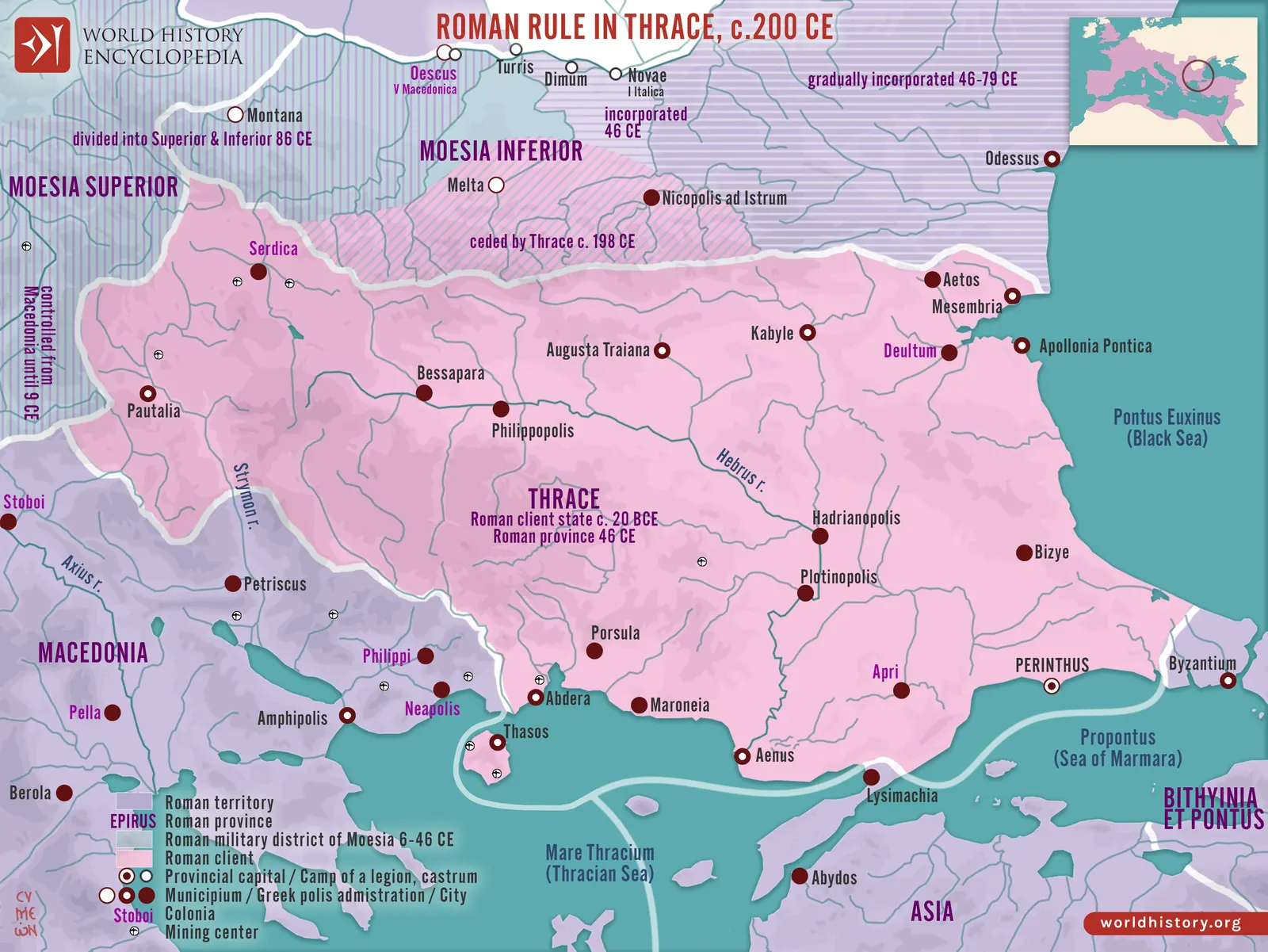
Adrianople and the road systems toward the Bosporus explain why invasions in Thrace posed a different problem from fighting on the far side of the Danube. The settlement network remained historically important, but the map does not reconstruct the defenses or exact administrative organization of AD 378, Attila's campaigns or the invasion of AD 559.
Historical record: Agathias, Histories 5.11–25, as the principal ancient reading locus; local Gibbon, chapter 43; the two external cross-checks linked above. Agathias is not misrepresented as a separately checked complete text in the directory.