Wars · VI. The high empire and the third-century emergencies
W065 The emergence of Sasanian power and the third-century Persian wars
Battles and sieges
Capture of Valerian 260 ADThe Sasanian overthrow of Arsacid power created a new dynasty that challenged Rome's eastern position. Campaigns under Severus Alexander and Gordian III were followed by the settlement under Philip. Shapur I's invasions brought severe Roman losses, including the disaster associated with Barbalissos and the capture of Antioch.
The capture of Valerian in AD 260 was an exceptional political and military catastrophe. Regional resistance and recovery involved Odaenathus of Palmyra and Roman commanders. Neither side's claims should be taken as a complete, impartial account of the fighting.
Command, forces and military problem
| Field | Dossier |
|---|---|
| Roman leadership | Severus Alexander, Gordian III, Philip, Valerian and regional recovery leaders |
| Opposing or rival parties | Ardashir I, Shapur I and Sasanian forces |
| Forces and capabilities | Imperial field armies, fortified cities, cavalry and regional military networks |
| Operational problem | Respond to a new monarchy's pressure while imperial succession repeatedly disrupts command. |
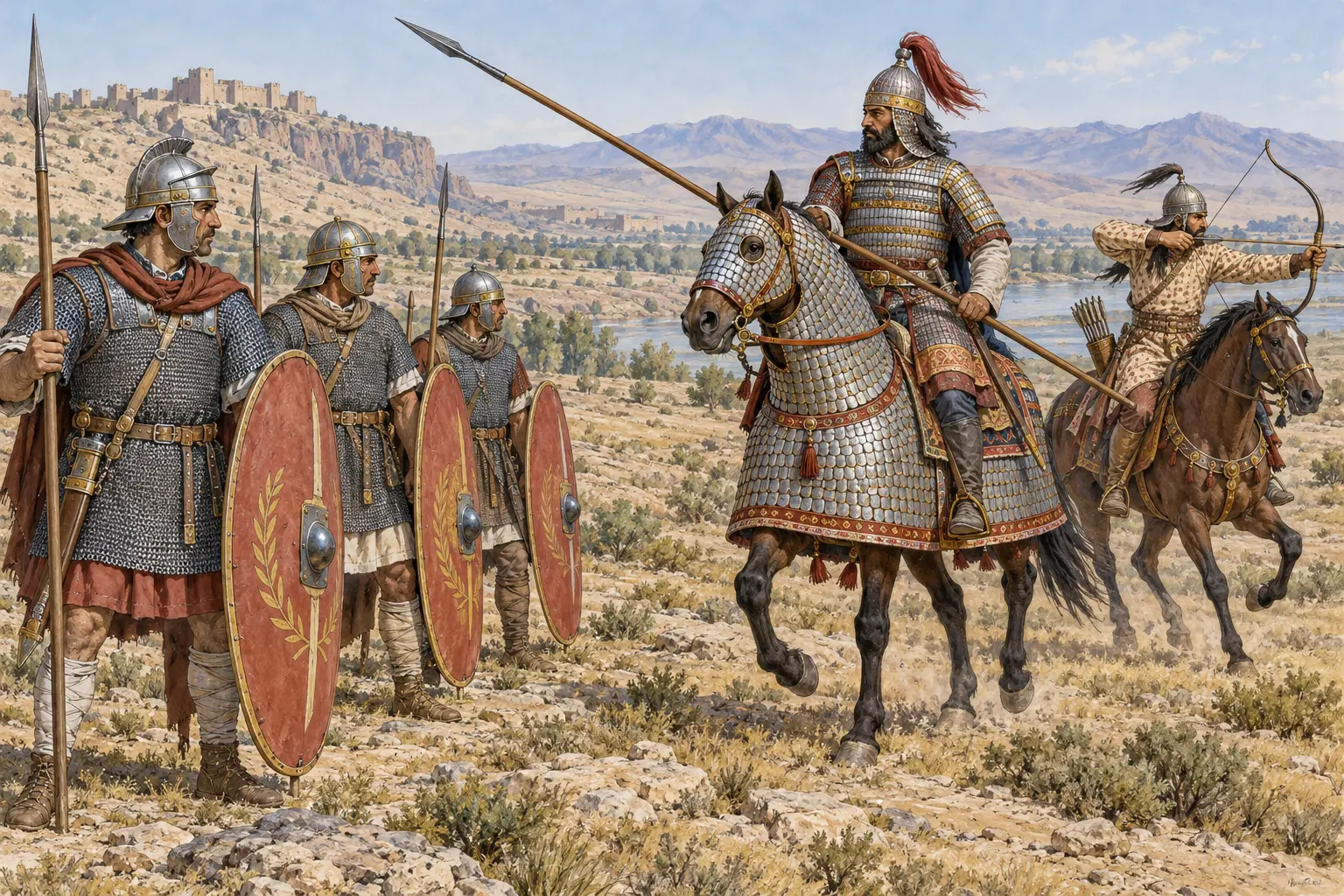
Campaign geography and operational plates
The Levant: coast, inland cities and desert approaches
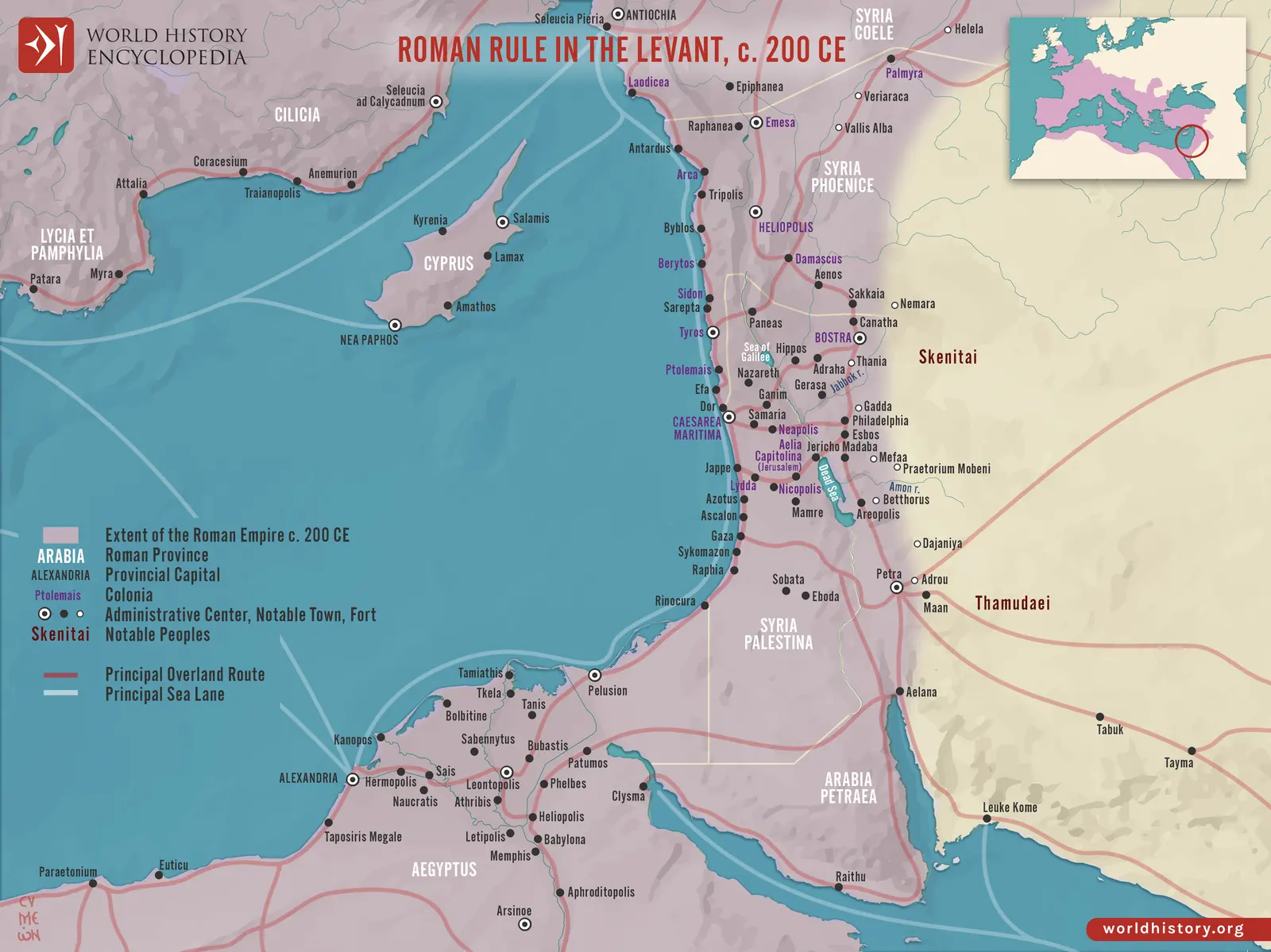
The coast and the inland routes through Syria, Judaea and Arabia connect theaters often discussed separately. Defended cities, ports and approaches to the Euphrates formed part of the military landscape. The map's later provincial organization is distinct from the political settings of the first Jewish revolt, the Bar Kokhba war and third-century eastern invasions.
The empire’s competing centers around AD 270
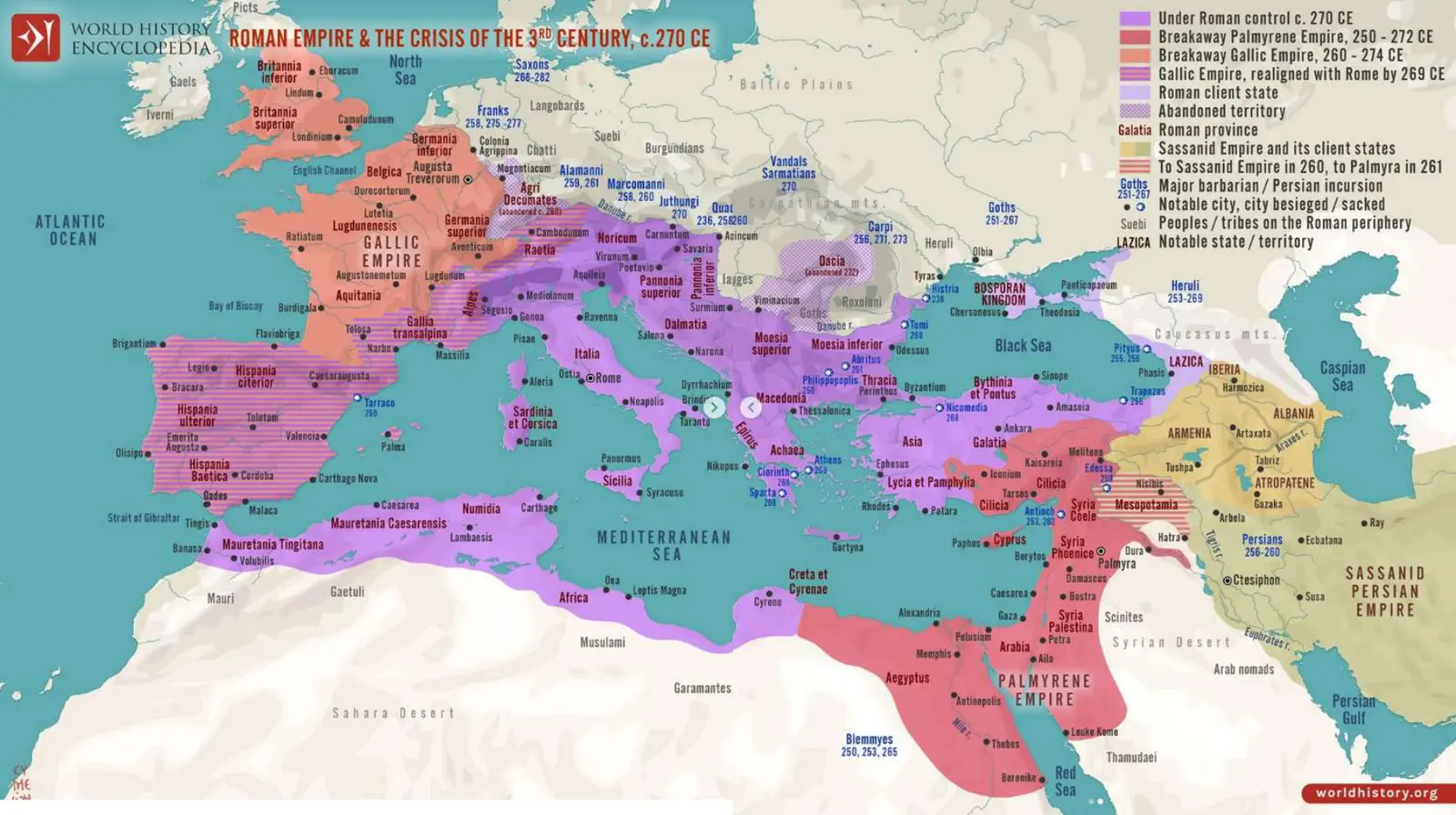
The eastern and Gallic centers of power were separated from Aurelian's immediate Italian and Balkan concerns. Their existence made reunification a sequence of campaigns rather than one battle on a continuous front. Colored areas describe a political reconstruction, not a guarantee that every district was controlled with equal strength.
Extended campaign study
The account below develops the operations and their interpretation. Reported numbers and reconstructed tactical details retain the uncertainties described in the dossier.
The Emperors of the Frontier (235–249)
The half-century the ancients called nothing and the moderns call the Third-Century Crisis begins as a military phenomenon and must be narrated as one: between 235 and 284 some twenty men held the purple with senatorial recognition and perhaps as many again claimed it without, and of that first twenty all but two died violently — the empire's political system reduced to its army groups' competitive proclamations, conducted while the perimeter was breached at both ends by enemies who had learned, in the account's central lesson, to attack simultaneously. The first phase's pattern was set by Maximinus Thrax (235–238), the ranker-emperor who never entered Rome, campaigned successfully across the Rhine and on the Danube, and was destroyed not by an enemy but by fiscal war on his own propertied class: the African revolt of the two Gordians, the Senate's desperate elevation of its own commissioners Pupienus and Balbinus, the Guard's murder of both, and Maximinus's death before the walls of Aquileia at his own soldiers' hands during a siege they could not feed — six emperors in the single year 238, and the significant novelty that the Senate had fought a field campaign and lost it to the Praetorians who then handed the throne to a thirteen-year-old. Gordian III's six years (238–244) restored appearances and were run by the praetorian prefect Timesitheus, whose eastern campaign against Ardashir's son Shapur I recovered Mesopotamia's fortresses — Hatra, which had defeated Trajan and Severus, fell in 240/241 not to Rome but to Persia, and its garrison-graffiti stop — before the prefect's death and the young emperor's own at Zaitha near Circesium in 244; the two versions of that death are the account's clearest single specimen of its source-problem, the Roman tradition reporting a mutiny arranged by the successor Philip, the Persian rock-inscription at Naqsh-e Rustam declaring flatly that Gordian was killed in battle at Misiche and that Philip paid five hundred thousand denarii for peace and became tributary.
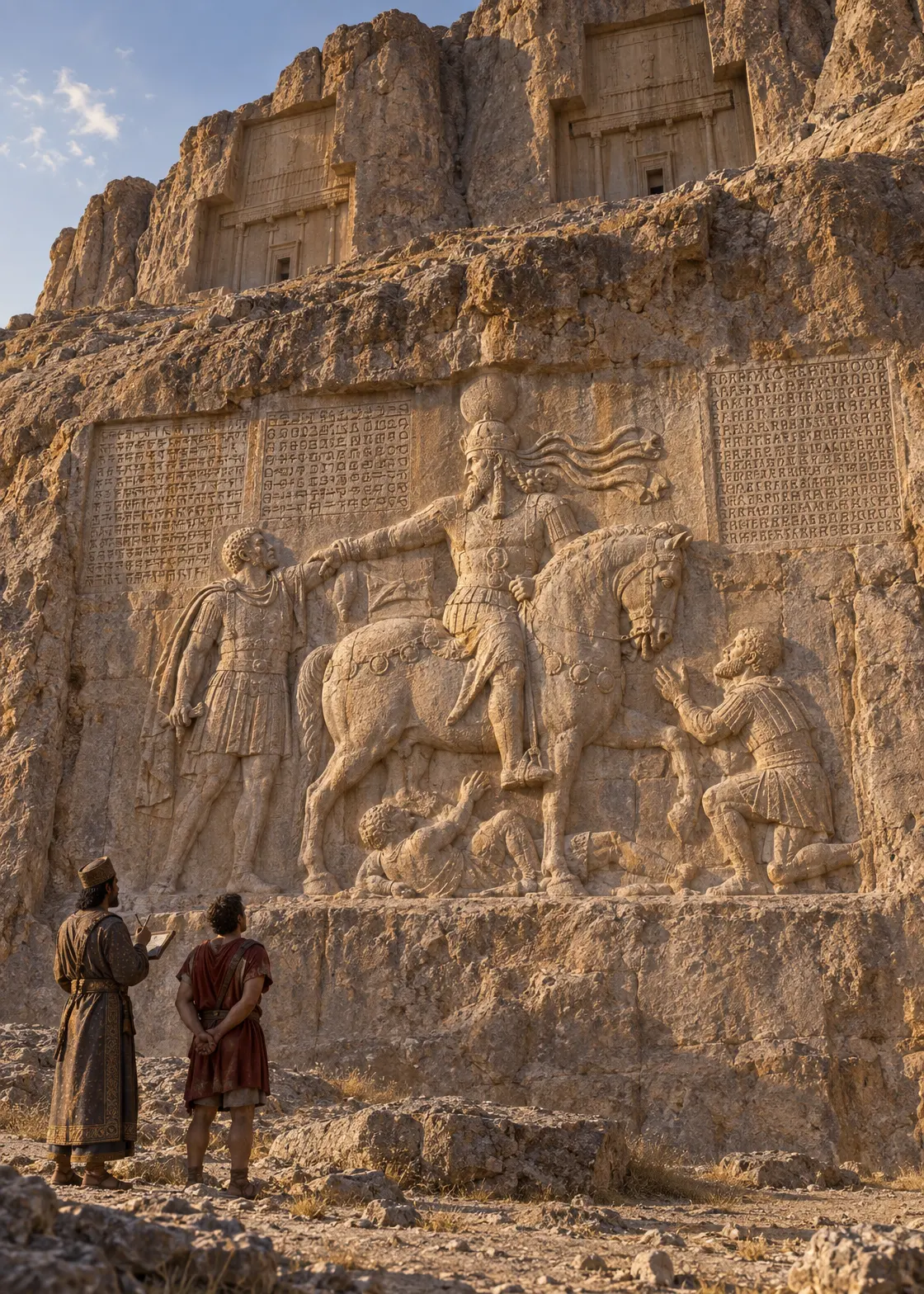
Philip the Arab's five years (244–249) carried the empire's millennium — the Secular Games of 248, the thousandth year from the founding, celebrated in a capital whose currency was collapsing while the lower Danube gave way: the Carpi and, behind them, the Goths crossing in force, the Balkan provinces raided to the Aegean, and the general sent to restore the front, Decius, proclaimed by his own troops and destroying Philip at Verona.
Abritus, Dura, and Edessa (249–260)
In 250 the Gothic king Cniva crossed the Danube with a great host, took Philippopolis with a slaughter the tradition counts at a hundred thousand, and was intercepted in 251 in the marshes at Abritus in the Dobruja by Decius and his son — where, in the boggy ground the Goths had chosen, the Roman army was destroyed and the emperor killed with his heir, the first Roman emperor to fall in battle against a foreign enemy: his body was never recovered from the mud. In the same years the plague returned — the Plague of Cyprian, from 251, whose mortality the Christian bishops describe as pastoral crisis and whose demographic effect the papyri register as a second thinning — and the frontier's collapse became general: the Alamanni into Gaul and Italy (Aemilianus's brief revolt, Valerian's elevation in 253), the Franks to the Pyrenees and by sea to Spain and Africa, the Goths taking to the Black Sea in captured shipping to raid Bithynia, Trebizond, Ephesus, and eventually Athens, the Carpi and Sarmatians into Dacia, and in the east Shapur into Syria: Antioch, the empire's third city, sacked in 253 and again in 260. The garrison-town of Dura-Europos on the Euphrates, taken in the mid-250s, is the account's forensic exhibit — a city killed and abandoned mid-siege, its Roman military archive on papyrus in situ, its painted synagogue and Christian house-church buried in the defensive embankment, and beneath Tower 19 the countermine where a Persian sulphur-and-bitumen fire trapped a Roman assault party: nineteen skeletons in mail with their coins in their purses, and the earliest physical evidence of chemical warfare known to archaeology. And in 260, near Edessa, the war's third act: the emperor Valerian, campaigning with a plague-weakened army, was defeated and taken alive — the only Roman emperor ever captured by a foreign enemy — with his praetorian prefect, his senators, and his staff. The empire's answer that year was not recovery but fragmentation, treated next: with the Rhine armies proclaiming Postumus and the East passing to the client-dynasty of Palmyra, the world-state's territorial unity ended for a decade, and the account's readers may take this paragraph as the low-water mark of the entire compendium — the perimeter broken at every point, the coinage nearly silverless, the capital's population halved by plague, an emperor in a Persian palace, and no Roman historian left alive whose account of it we possess.
Outcome and critical assessment
Result and caution: Rome retained an eastern empire but suffered major reverses. Shapur's inscriptions and Roman literary accounts have different omissions and purposes. The circumstances of Gordian's death and Valerian's capture remain contested. Stories about Valerian's treatment after capture are not accepted here as certain merely because they are vivid.
Historical record: IR-VII, chapter 7; Dio for the earlier transition; Herodian, book 6; Eutropius, book 9; Historia Augusta, with explicit caution.