Wars · VI. The high empire and the third-century emergencies
W066 Gothic and other incursions in the third century
Groups described by Roman writers as Goths and other northern peoples crossed or operated around the lower Danube and Black Sea. Seaborne movement extended the threat to coastal cities and the Aegean. Decius' defeat and death at Abritus in AD 251 was a major crisis, followed by further campaigning under later rulers.
The victory at Naissus conventionally dated to AD 269 and operations under Claudius II and Aurelian contributed to recovery. The attribution and sequence of particular victories can be difficult to disentangle in late and abbreviated sources.
Command, forces and military problem
| Field | Dossier |
|---|---|
| Roman leadership | Decius, Gallienus, Claudius II, Aurelian and others |
| Opposing or rival parties | Changing northern coalitions described as Gothic, Herulian or Scythian |
| Forces and capabilities | Land and maritime raiding forces, provincial garrisons and concentrated Roman armies |
| Operational problem | Meet penetrations at several scales without interpreting one victory as the end of all incursions. |
The Danube and Black Sea as connected theaters
The third-century incursions were enabled by more than the ability to cross one river. Coastal movement and seized or constructed shipping made the Black Sea a route toward cities and resources beyond the immediate frontier. A force moving by sea could avoid some land defenses and oblige Rome to defend places whose normal security depended on a wider political balance.
Roman armies consequently faced several kinds of operation: intercepting mobile groups, relieving threatened cities, fighting concentrated forces and dealing with raiders returning with captives and plunder. Those tasks demanded different dispositions. A victory over one assembled force did not remove every smaller group or immediately repair destroyed settlements.
Abritus and the continuity of the crisis
Decius' defeat and death in AD 251 represented a catastrophe for imperial command. The circumstances of the fighting and the role of difficult ground are discussed in the later tradition, but the emperor's death is more secure than a complete tactical reconstruction. The political consequences intensified an existing succession problem: an army and government had to replace an emperor while external threats continued.
Later operations under Gallienus, Claudius II and Aurelian contributed to recovery. The fragmented evidence makes it difficult to distribute credit for every victory, and later imperial reputations influenced that distribution. The Naissus victory is therefore preserved with its conventional attribution and date while recognizing the limitations of the sources.
Force composition and the cost to the provinces
The opposing forces were mixed. Names such as Goths, Heruls or "Scythians" in a classicizing author do not establish a single permanent order of battle. Roman forces likewise combined different troop types and detachments; the crisis encouraged the concentration of mobile forces without abolishing the need to garrison threatened places.
Captivity, displacement and damage to urban and rural resources formed a principal consequence. The story should not be told solely as the destruction and replacement of emperors. Equally, a map of named attacks must not imply that every intervening district was continuously occupied or destroyed. The appropriate geographic image is one of multiple penetrations and contested communications, with local conditions changing over time.
Campaign geography and operational plates
Abrittus: divided forces and dangerous ground
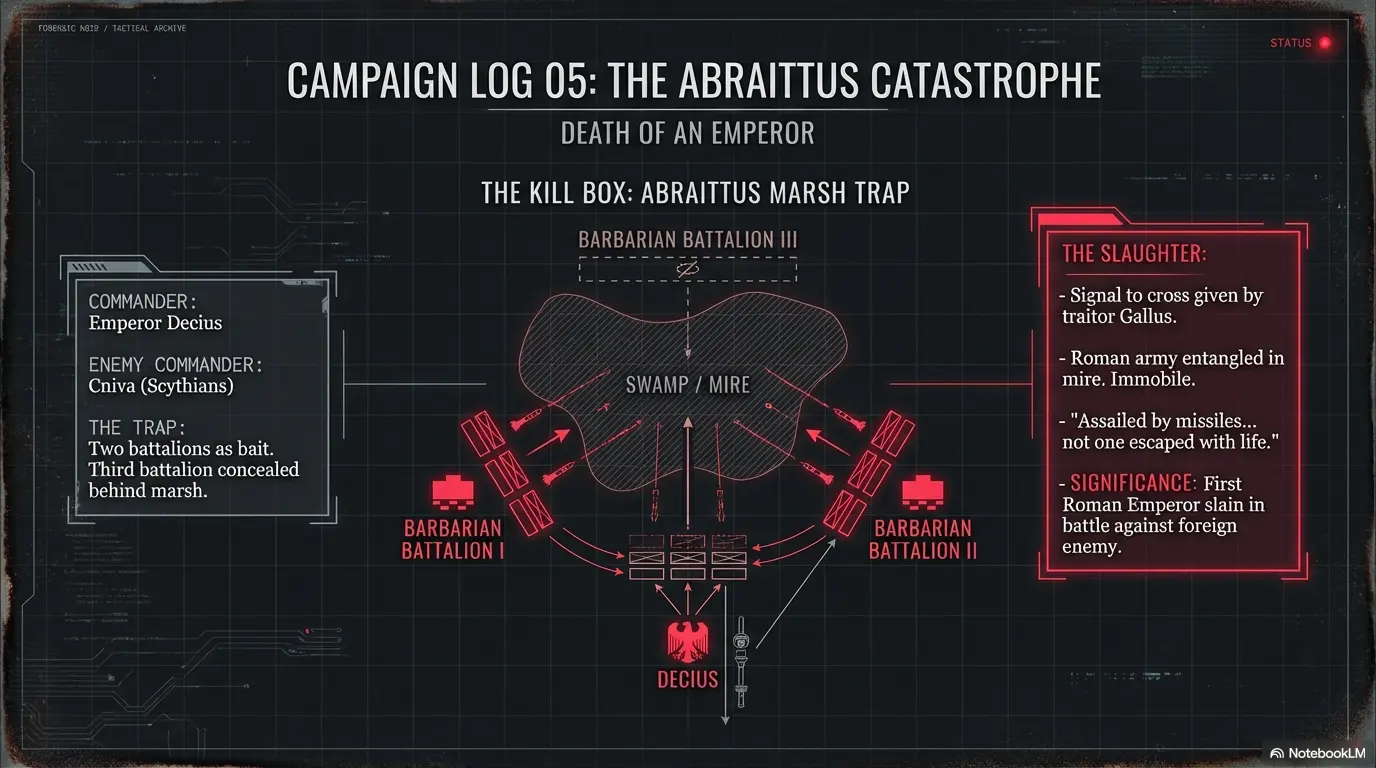
The essential operational problem is the danger of advancing into unfamiliar, obstructed ground while the opponent retains forces beyond the first contact. The figure illustrates that possibility. It cannot independently establish the location of every hostile body, the precise state of the marsh or the full sequence of the imperial army's destruction.
Outcome and critical assessment
Result and caution: repeated Roman successes did not make every frontier permanently secure. The name "Gothic war" can hide separate coalitions, different kinds of movement and several decades of conflict. Do not draw one exact migration route from a list of later ethnonyms, and do not turn the ancient invasion totals into population statistics.
Historical record: IR-VII, chapters 7–8; Eutropius, book 9; Jordanes, retrospective Gothic tradition; Historia Augusta, requiring particularly close control.