Wars · VI. The high empire and the third-century emergencies
W067 Aurelian's reunification wars
Battles and sieges
Palmyra 272 ADDefeat of Tetricus 274 ADAurelian confronted immediate threats in Italy and then moved against the separate political centers that had emerged during the crisis. The Palmyrene regime of Zenobia and Vaballathus had extended its power across major eastern provinces. Aurelian's campaign defeated its forces and took Palmyra; renewed resistance was followed by harsher destruction.
In AD 274 he defeated Tetricus and ended the separate western regime conventionally called the Gallic Empire. These victories rejoined major imperial territories under one ruler, while the withdrawal from trans-Danubian Dacia acknowledged that recovery could include contraction.
Command, forces and military problem
| Field | Dossier |
|---|---|
| Roman leadership | Aurelian and his commanders |
| Opposing or rival parties | Zenobia and Vaballathus in the East; Tetricus in the West |
| Forces and capabilities | Imperial and regional Roman armies with different recruitment and fiscal bases |
| Operational problem | Restore political unity while choosing which frontier commitments can actually be maintained. |
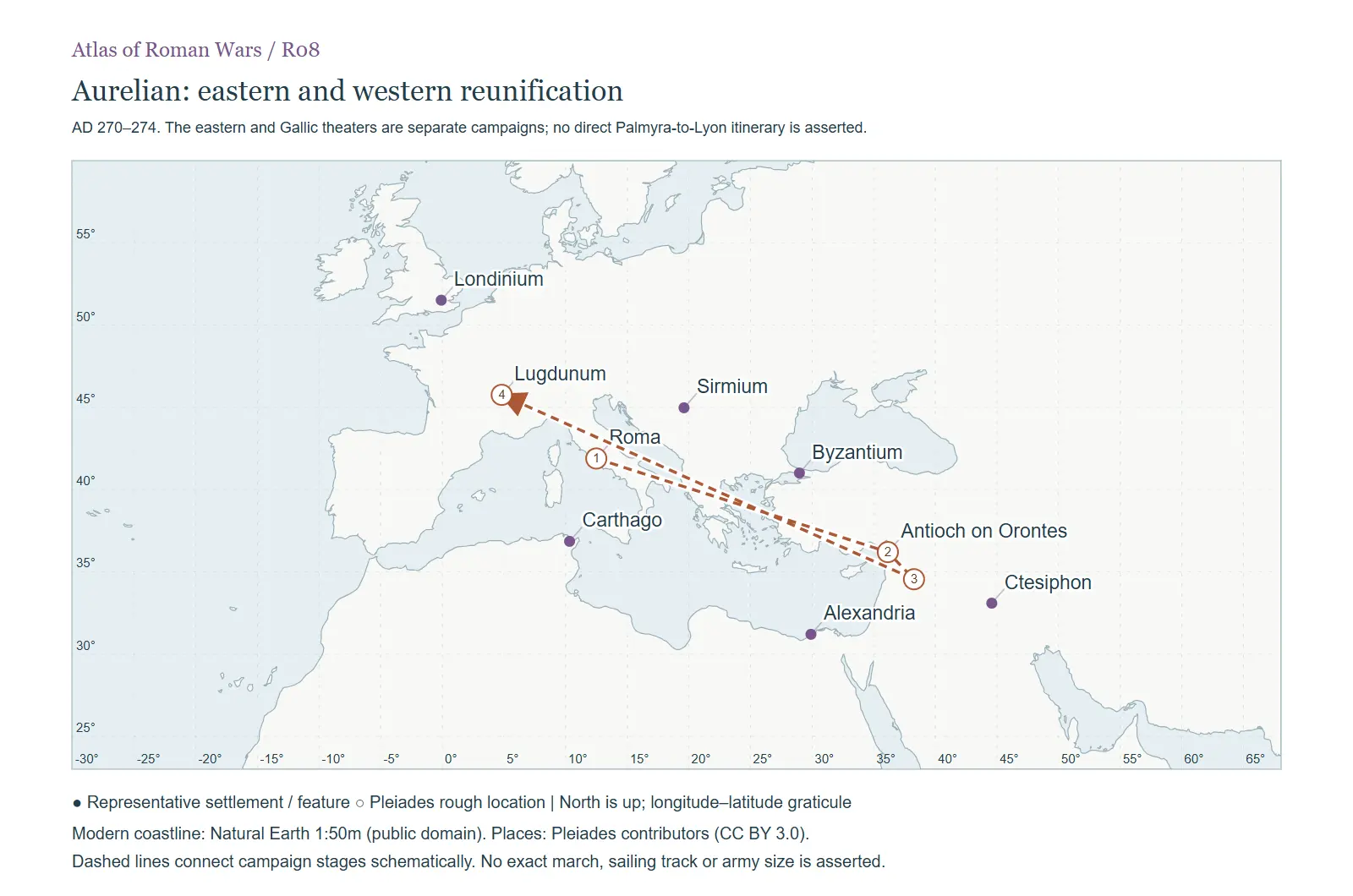
Campaign geography and operational plates
The empire’s competing centers around AD 270
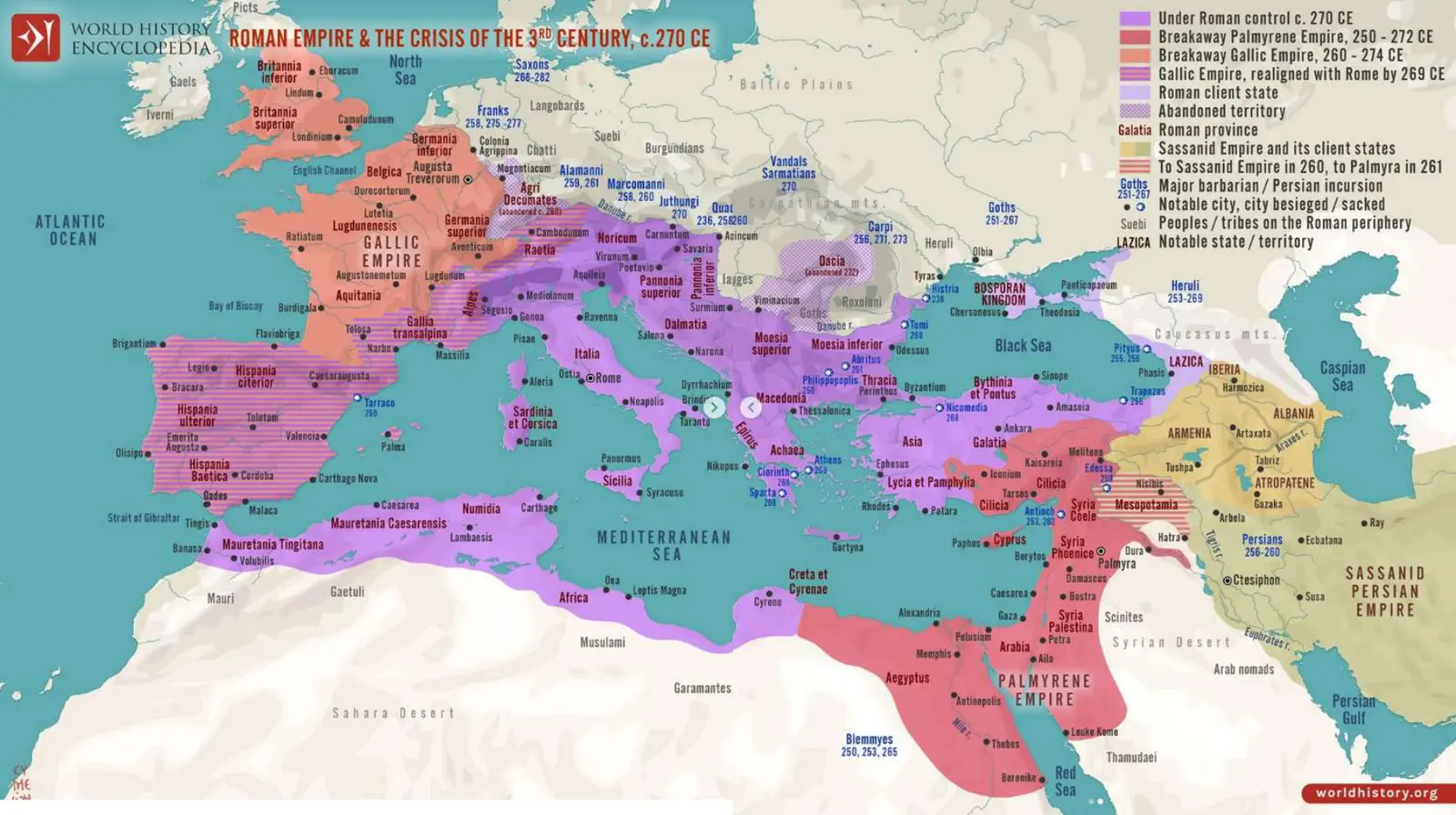
The eastern and Gallic centers of power were separated from Aurelian's immediate Italian and Balkan concerns. Their existence made reunification a sequence of campaigns rather than one battle on a continuous front. Colored areas describe a political reconstruction, not a guarantee that every district was controlled with equal strength.
Immae: withdrawal, pursuit and cavalry fatigue
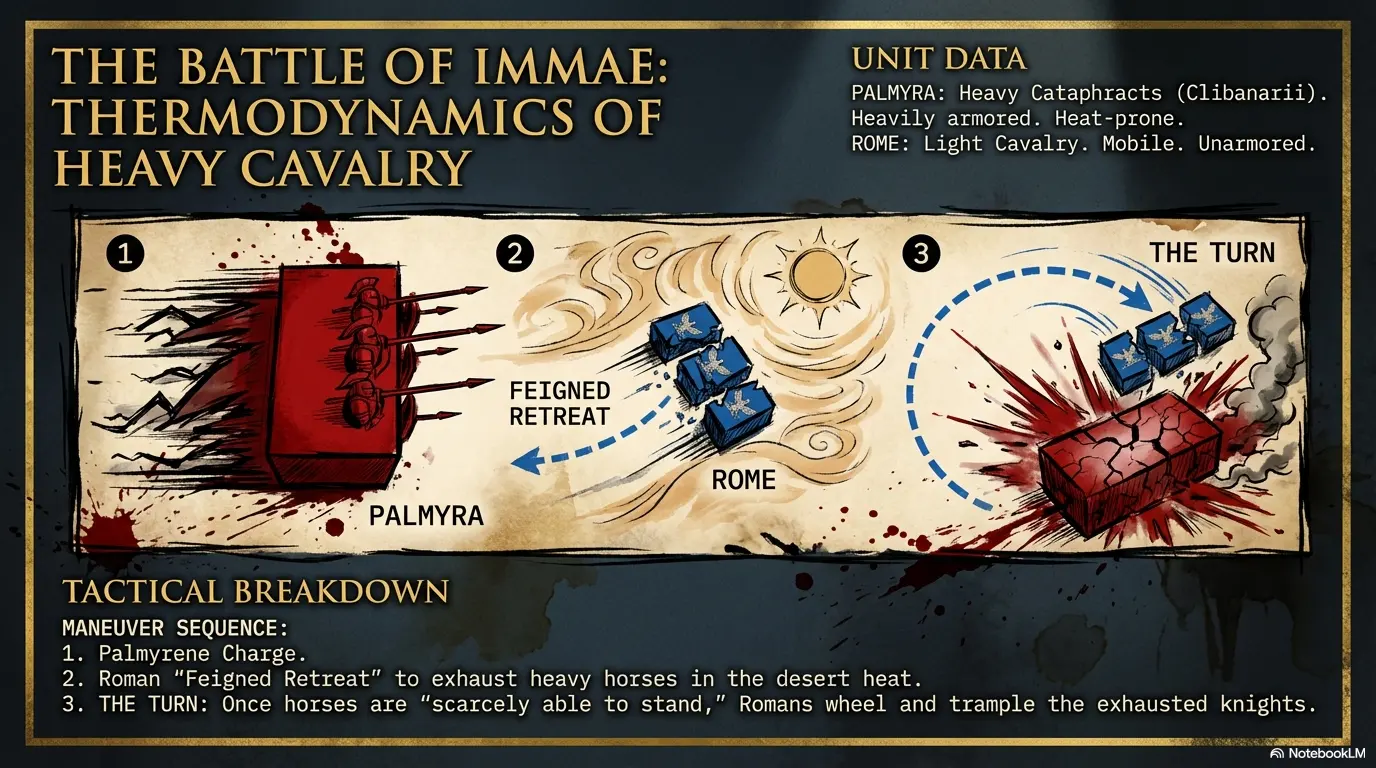
The diagram makes a sequence visible: disengagement, pursuit and a renewed Roman attack against a force whose cohesion or endurance had changed. The relationship matters more than the neat curve of the arrows. It does not establish an exact distance of pursuit, temperature, armor weight or fatigue threshold.
Extended campaign study
The account below develops the operations and their interpretation. Reported numbers and reconstructed tactical details retain the uncertainties described in the dossier.
Gallienus and the Threefold Empire (260–268)
The recovery began in the worst year and with the worst-served reputation in Roman historiography. Gallienus, sole emperor after his father's capture, ruled eight years over an empire from which the Rhine armies had seceded under Postumus — the imperium Galliarum of Book VI reborn with senate, consuls, and coinage, holding Gaul, Britain, and Spain and, the point the hostile tradition suppresses, holding the Rhine frontier competently while it did so — and in which the East had passed to Odaenathus of Palmyra, the caravan-city's prince who avenged Valerian by driving Shapur back from the Euphrates and was rewarded with the extraordinary title corrector totius Orientis: a client left to govern Rome's eastern half because Rome could not. Between them Gallienus held Italy, Africa, the Danube, and Illyricum against Alamannic invasions (checked at Mediolanum in 260 and 268), a Gothic sea-storm that sacked Athens, Corinth, Sparta, and Argos, and a chain of usurpations he suppressed one by one; and while doing it he executed the account's decisive military reform. Barred from senatorial command by the crisis's own logic, he completed the transfer of legionary command to equestrian praefecti — after Gallienus no senator commands a legion, the constitutional revolution of the Principate's military settlement finished by attrition — and, more consequentially, assembled at Mediolanum a central mobile field army built around massed cavalry: the equites corps of Dalmatian and Moorish horse, promoted, paid, and stationed centrally rather than distributed along the perimeter. This was the structural answer to the crisis's structural problem: a linear frontier cannot meet simultaneous attacks, but a linear frontier plus a mobile reserve can meet them in sequence. Every emperor for the next two centuries fought with the instrument Gallienus improvised, and his own officers — the Illyrian cavalry generals Claudius, Aurelian, and Probus — were its first products, and his assassins: he was killed at Mediolanum in 268 besieging the last usurper of his reign, by a conspiracy of the men who would spend the next sixteen years using his army to save the empire he was afterward blamed for losing.
Aurelian, Restitutor Orbis (270–275)
Aurelian's five years reversed the crisis in every dimension, and the chapter narrates them as the narrative's fastest campaign-sequence. He began by fighting for Italy: the Vandals thrown back across the Danube, and then the Iuthungi and Alamanni, who broke into the peninsula and beat him at Placentia — the war's crisis, the road to Rome open — before being destroyed at Fanum Fortunae and Ticinum in 271.
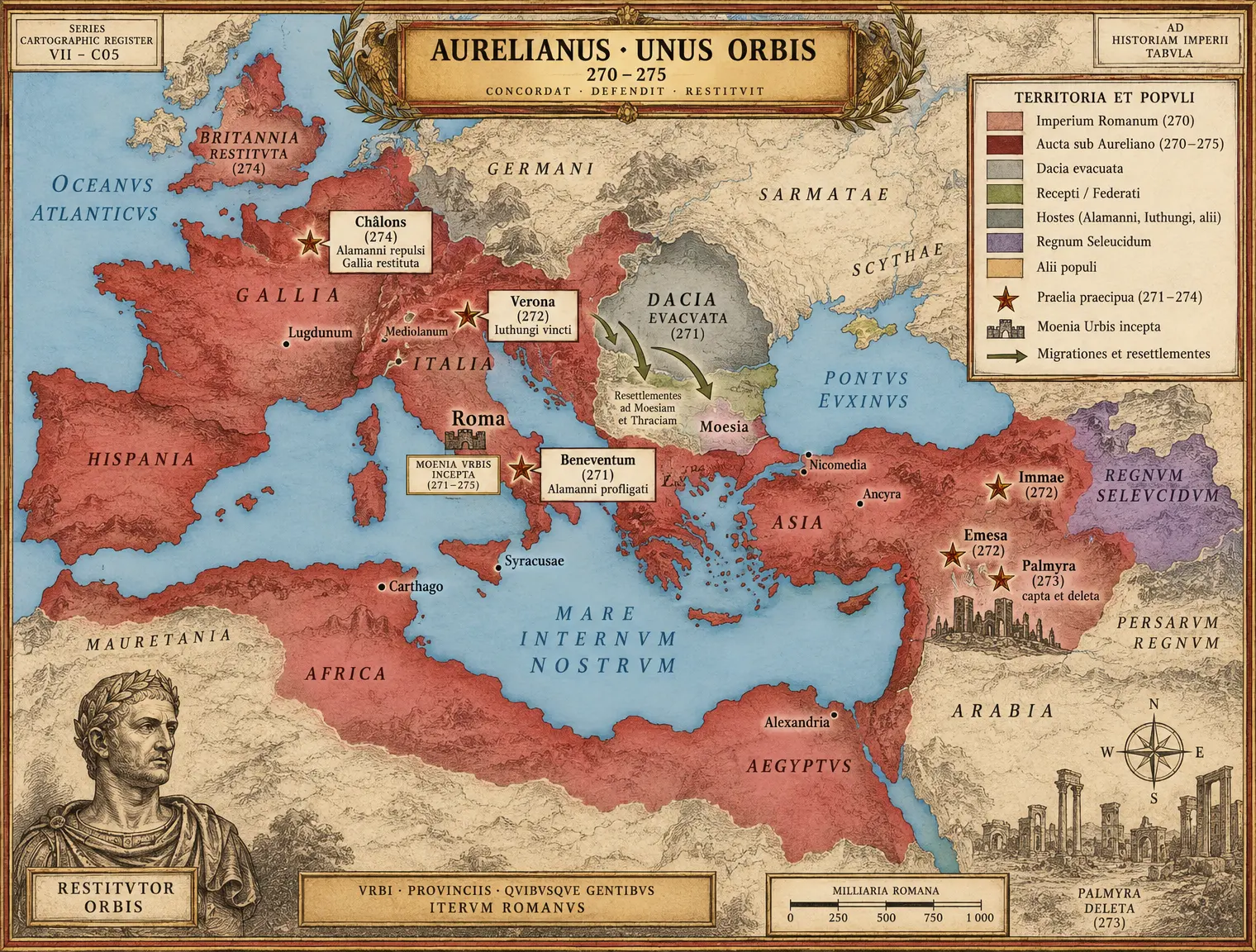
That emergency produced the account's greatest monument: the wall of Rome, nineteen kilometers of brick-faced concrete with three hundred and eighty-one towers and eighteen gates, begun in 271 and built in less than a decade, incorporating whatever stood in its path — an amphitheater, tombs, an aqueduct's arches, the Pyramid of Cestius — the capital of the world, unwalled since the kings, putting on armor because the army could no longer promise that no enemy would reach it. Then the reunification. In 272 he marched east against Palmyra, where Odaenathus's widow Zenobia, regent for her son Vaballathus, had converted the corrector's mandate into an empire — Syria, Arabia, Asia Minor to Ankara, and in 270 Egypt, the grain-source — and defeated her generals at Immae near Antioch and at Emesa with the same tactic twice: a feigned cavalry withdrawal drawing Palmyra's magnificent armored clibanarii into pursuit and exhaustion, then the infantry, then the Palestinian club-men against the armored horse. Palmyra was besieged, taken, and, when it revolted the next year, destroyed; Zenobia was captured at the Euphrates and walked, in gold chains, in the triumph of 274. Between the two Palmyrene campaigns he turned west: the Gallic empire, its fourth ruler Tetricus commanding an army that no longer believed in it, met him at Châlons in 274 and dissolved — Tetricus, by the tradition, having negotiated his own defeat, and receiving a governorship in Italy for it. The empire was whole for the first time in fourteen years, and its restorer took the title the coinage proclaims — RESTITUTOR ORBIS — reformed the currency toward a stabilized silver-washed aurelianianus, put the mint's own rioting workers down at the cost, Dio's successors say, of thousands of lives in Rome, dedicated the temple of the Unconquered Sun as an imperial monotheism-in-waiting, and was murdered in Thrace in 275 by his own staff officers, tricked into it by a secretary who had forged a proscription-list to save himself.
Outcome and critical assessment
Result and caution: Aurelian restored political unity but did not restore every earlier frontier or resolve succession permanently. Palmyrene and Gallic regimes emerged within Roman political and military life; calling them simply foreign invasions is misleading. Stories of a prearranged surrender by Tetricus require source-specific caution.
Historical record: IR-VII, chapter 8; Eutropius, book 9; Historia Augusta, unreliable in many details; later narrative traditions identified in the manuscript.