Wars · VI. The high empire and the third-century emergencies
W068 Carausius, Allectus and the tetrarchic recovery campaigns
Battles and sieges
Recovery of Britain 296 ADCarausius built a rival imperial position in Britain and parts of the Channel region, using maritime forces and the language of Roman legitimacy. Allectus succeeded him before Constantius recovered Britain in AD 296. The Channel crossing and the imperial representation of liberation belong together, but not as identical kinds of evidence.
Meanwhile, Diocletian, Maximian and their colleagues campaigned on several fronts, including the suppression of rebellion in Egypt. The multiple-ruler system addressed the practical difficulty of responding to simultaneous threats across the empire.
Command, forces and military problem
| Field | Dossier |
|---|---|
| Roman leadership | Diocletian, Maximian, Constantius and their commanders |
| Opposing or rival parties | Carausius, Allectus and separate regional revolts and frontier opponents |
| Forces and capabilities | Several imperial armies, naval forces and rival Roman garrisons |
| Operational problem | Respond simultaneously to regional challenges and recover Britain across the Channel. |
Campaign geography and operational plates
The tetrarchic military and political system
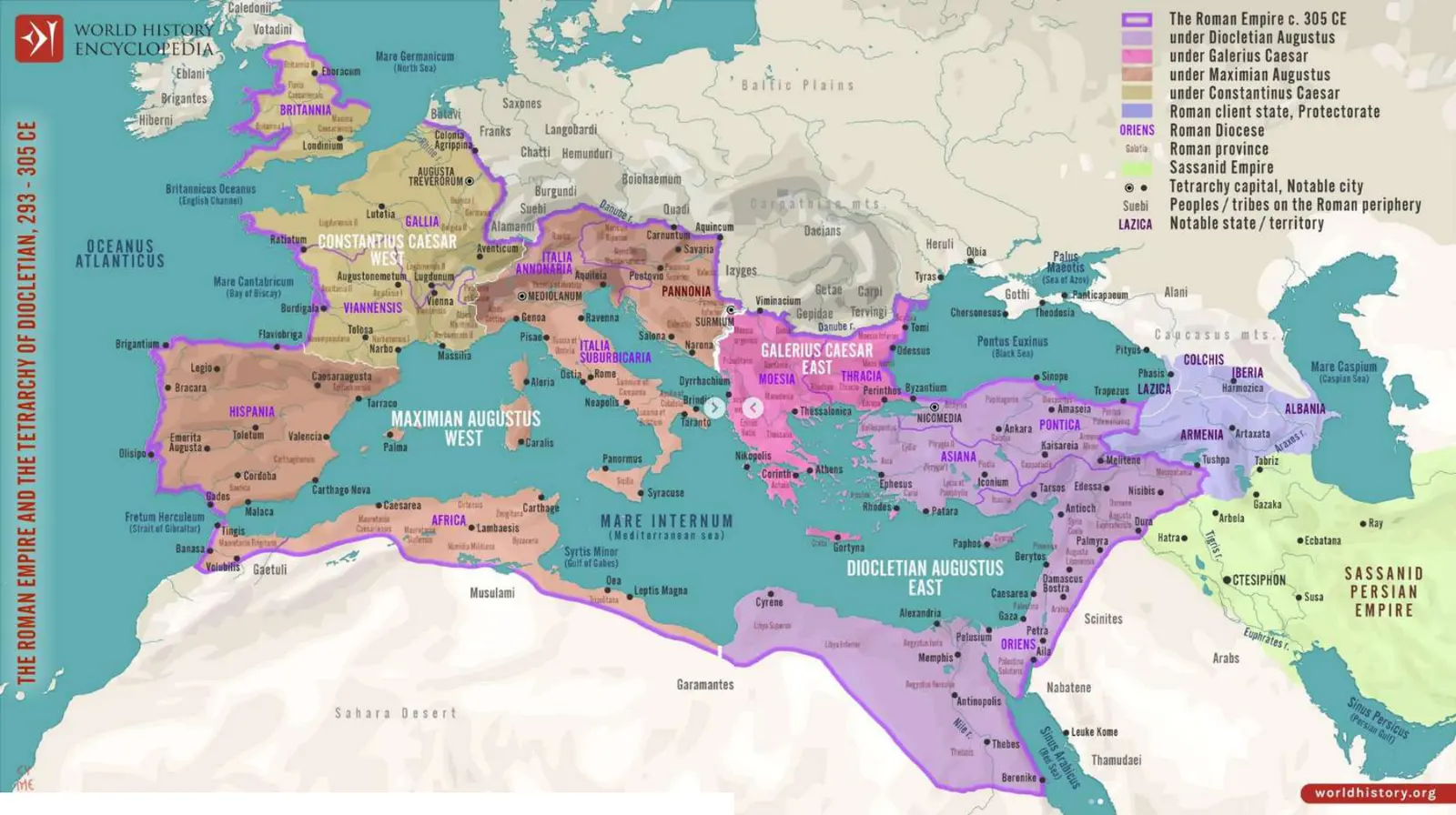
Several rulers could concentrate on different frontiers while still presenting a united imperial order. The map supplies the geographical setting for the recovery of Britain and related operations. It does not imply that responsibility lines were permanent state borders or that cooperation survived every later succession dispute.
Extended campaign study
The account below develops the operations and their interpretation. Reported numbers and reconstructed tactical details retain the uncertainties described in the dossier.
Diocletian: The Reorganized War (284–305)
The structure came first: within a year Diocletian had taken Maximian as colleague for the West (Augustus by 286), and in 293 completed the Tetrarchy with two Caesars, Constantius and Galerius — four emperors, four courts, four field armies, stationed not at Rome (which Diocletian visited once, late, and left early) but at the working capitals the strategy dictated: Nicomedia, Sirmium, Mediolanum, Trier. The system's military logic was the crisis's lesson: simultaneity answered with plurality, an emperor for every threatened front, usurpation pre-empted by making the probable usurpers colleagues. Narses, Shapur's son, attacked Armenia in 296; Galerius, beaten in open country between Carrhae and Callinicum in 297 — the reign's one defeat, answered, the tradition says, by the emperor letting his purple-clad Caesar walk a mile before his carriage — rebuilt, struck through Armenia in 298, surprised the royal camp at Satala, captured the king's treasury, harem, and wives, and dictated the Peace of Nisibis of 299: Mesopotamia confirmed Roman with five trans-Tigris satrapies, Armenia enlarged under its Roman client, Nisibis the sole legal emporium — the most one-sidedly victorious eastern settlement in Roman history, and it held for forty years. Behind the wars, the machine: the provinces doubled in number and grouped under dioceses, civil and military career-paths severed, the army expanded (the fourth-century establishment's paper strength perhaps half a million) and re-equipped from state fabricae, the frontiers rebuilt in the squat, thick-walled, artillery-bearing fort-architecture whose remains from Britain's Saxon Shore to the Syrian strata Diocletiana are the reign's signature in stone; the whole funded by the new census and the annona's regularization — the crisis's emergency requisitions converted into the empire's permanent tax.
Outcome and critical assessment
Result and caution: imperial control was restored in Britain and other challenged areas. Coinage can establish the rival rulers' claims more directly than later stories establish every campaign detail. The restoration was not a record of "every war won": Galerius' initial defeat against Persia, discussed next, is an important counterexample.
Historical record: IR-VIII, chapter 1; Eutropius, book 9; panegyrical and numismatic evidence identified by the manuscript, not newly independently audited here.