Wars · I. The making of Roman Italy
W011 Cisalpine Gallic and Ligurian wars
Roman operations against northern Italian peoples spanned several generations. The great Gallic invasion defeated at Telamon in 225 BC was followed by campaigns in the Po basin, including Clastidium in 222 BC. These victories did not settle northern Italy permanently: Hannibal later drew support there, and renewed Roman campaigning followed the Second Punic War.
The geography joined Alpine approaches, the broad Po plain, Apennine passes and coastal Ligurian country. Theaters differed sharply, so a single universal "Roman versus Gaul" tactical model is misleading. Roads, colonies, confiscation and forced relocation were instruments of consolidation alongside battlefield victories.
Command, forces and military problem
| Field | Dossier |
|---|---|
| Roman leadership | Papus, Atilius Regulus, Marcellus and later Republican commanders |
| Opposing or rival parties | Different Gallic and Ligurian peoples and coalitions |
| Forces and capabilities | Infantry and cavalry in plains warfare; separate campaigns in mountain country |
| Operational problem | Defeat invasions and impose lasting control through roads, colonies and repeated campaigns. |
Extended campaign study
The account below develops the operations and their interpretation. Reported numbers and reconstructed tactical details retain the uncertainties described in the dossier.
The Cisalpine Gallic War: Telamon and Clastidium (225–222 BC)
While Carthaginian power was being consolidated in Spain, the Roman state was conducting its own program of expansion in the Po valley of northern Italy. The Cisalpine Gauls — principally the Boii (in the Bologna region), the Insubres (around modern Milan), the Cenomani (around Brescia), and remaining smaller tribes — had been independent neighbors of the Roman alliance system since the destruction of the Senones in 283 BC. Roman colonization in the ager Gallicus and at Ariminum in 268 had brought the Roman frontier to the southern edge of Cisalpine Gaul; subsequent Roman roads (the Via Flaminia, begun in 220 BC under the censor Gaius Flaminius, would not be completed for several years but its line of advance was already understood) extended Roman strategic reach into the region. The Roman Lex Flaminia of 232 BC, which authorized colonial settlement of the ager Gallicus by Roman citizens (not by Latin colony, an unusual departure from precedent), was understood by the Cisalpine tribes as preparing the way for direct Roman conquest of their own territories.
The Gallic response was the assembly, in 225 BC, of the largest tribal coalition that the Cisalpine peoples had mounted in over a century. The Boii, Insubres, and various smaller tribes were joined by trans-Alpine reinforcements from the Gaesatae — Gallic warrior bands from the upper Rhône valley, brought south at Insubrian pay to swell the coalition force. The total Gallic army, by Polybius's figure (which is doubtless inflated but probably reflects an army of unusual size), was about seventy thousand foot and ten thousand cavalry — perhaps eighty thousand men in all, with their families and dependents accompanying. This force assembled in the upper Po valley in the early summer of 225 BC and began to move south through the Apennine passes into Etruria, with the announced intention of advancing on Rome.
The Roman strategic response was the concentration of an unprecedented force: two consular armies (about eighty thousand citizen and Latin soldiers in total), supplemented by allied contingents from peninsular Italy and by the levy of additional manpower drawn from the socii. Polybius preserves what is probably an accurate copy of the Roman manpower roster of 225 BC — a document that the Senate had compiled in preparation for this campaign — that indicates the total available manpower of Roman Italy at this moment was approximately seven hundred thousand foot and seventy thousand cavalry, a figure that exceeds the manpower available to any single Hellenistic kingdom and that constitutes one of the most important Polybian passages for the demographic and military study of the period.
The two consular armies of 225 — Lucius Aemilius Papus, operating from Rimini in the north, and Gaius Atilius Regulus, operating from Sardinia and crossing back to the Italian mainland by sea — converged on the Gallic invasion force as it withdrew from Etruria back toward its own country, after the Gauls had completed a substantial raid through northern Etruria but had failed to engage the principal Roman force on terms favorable to themselves. The two Roman armies met the Gallic army at Telamon (modern Talamone, on the Tuscan coast near Grosseto) in the late summer of 225 BC. The tactical situation was the most favorable a Roman commander could hope for: the Gallic army was trapped between two converging Roman forces with no possibility of withdrawal.
The Battle of Telamon (225 BC)
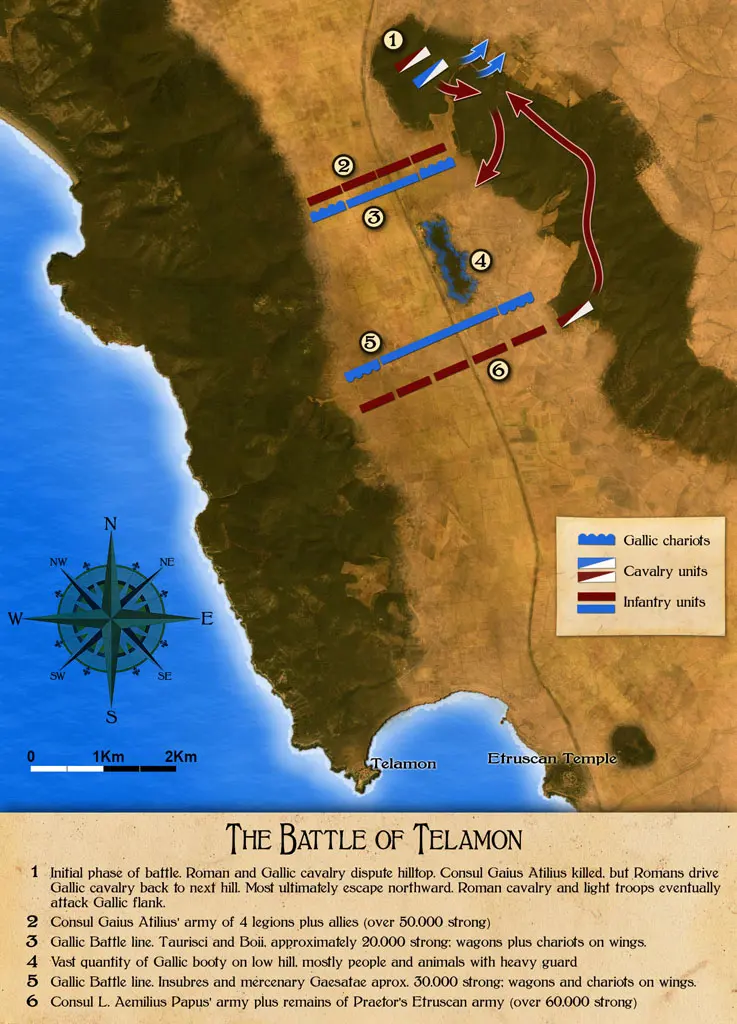
The engagement was fought on the coast at Telamon, with the Roman army of Papus on the north and the army of Regulus on the south, the Gauls compressed between them on a ridge of high ground that they had occupied in the hope of conducting an orderly withdrawal. The Gallic deployment was characteristic of their style: a great mass of warriors organized by tribes, with the foot in the center and the cavalry on the wings, the warriors arrayed in the long undisciplined line that the Gauls of the period preferred.
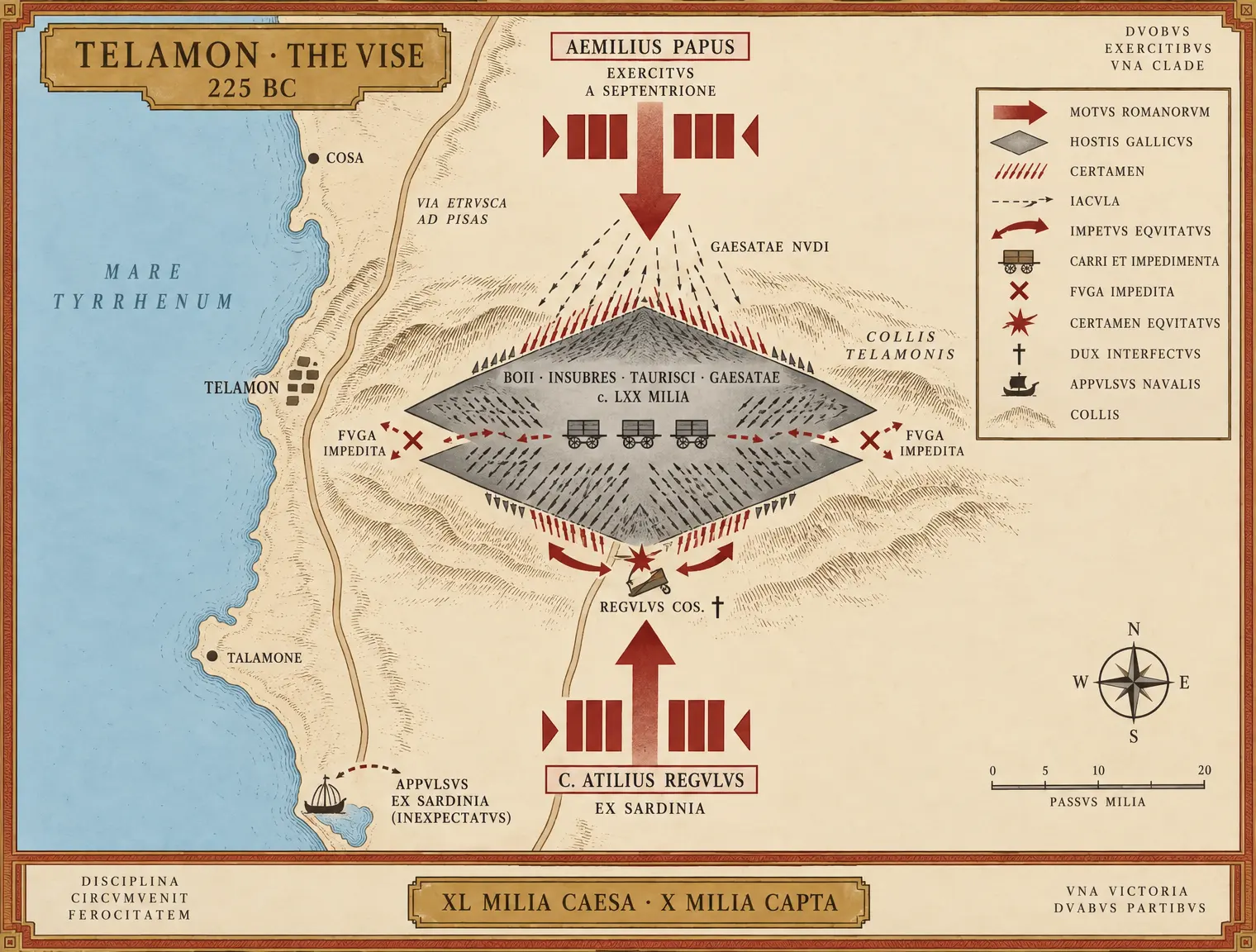
The Gaesatae — the trans-Alpine reinforcements, who fought according to the most ancient Gallic style — appeared in the front rank stripped naked, with only their swords and oblong shields, their bodies painted with woad in patterns of war. The sight was meant to be terrifying to the enemy; the practical effect, against Roman velites armed with javelins at thirty paces, was that the unprotected Gaesatae were killed or wounded in disproportionate numbers in the first phase of the engagement.
The Gauls, attacked from both sides simultaneously and unable to maneuver, fought with the desperate ferocity of a trapped force. The Roman cavalry, deployed on the wings of both consular armies, engaged the Gallic cavalry and broke it after extended fighting; the Roman cavalry then attacked the Gallic infantry from the flanks while the legions pressed the engagement from front and rear. The Gallic line, attacked from four directions and compressed into ever-smaller space, was systematically destroyed. By evening, approximately forty thousand Gauls were killed and ten thousand captured, while the bulk of the Gallic cavalry and a portion of the foot escaped northward through gaps in the Roman line. Roman losses were severe — the consul Regulus was killed in the engagement, and approximately six thousand Roman and allied soldiers fell with him — but the engagement was a decisive Roman tactical victory.
Telamon was, in some respects, the largest land battle ever fought in Italy up to that time, with perhaps a hundred and sixty thousand combatants engaged. It was also the last major engagement against a Cisalpine Gallic coalition; the destruction of the army of 225 effectively broke the Gallic capacity for offensive operations against Rome. The follow-up Roman campaigns in 224, 223, and 222 BC were offensive operations into Cisalpine Gallic territory aimed at completing the conquest. The Boii were subdued in 224 by Lucius Aemilius Papus (now serving a second consulship). The Insubres were attacked in 223 by Gaius Flaminius and Publius Furius Philus, who engaged the Insubrian army on the Po river in a confused engagement that resulted in Roman tactical victory but no decisive territorial change. The decisive year was 222 BC, under the consuls Marcus Claudius Marcellus and Gnaeus Cornelius Scipio Calvus.
The Battle of Clastidium and the Spolia Opima (222 BC)
The campaign of 222 BC began with the Roman objective of taking the Insubrian capital of Mediolanum (modern Milan). The Insubres responded by hiring further Gaesatae reinforcements from the trans-Alpine country and concentrating their forces in the central Po valley. A force of about ten thousand Gaesatae under the king Viridomarus advanced down the road toward the Roman position at the small fortified town of Clastidium (modern Casteggio, on the Po between Piacenza and Milan), intending to engage a Roman force that was investing the town.
The Roman force at Clastidium was a relatively small detachment under the consul Marcellus, perhaps six thousand foot and a few hundred cavalry, drawn from the larger consular army that was operating elsewhere. Marcellus, learning of the Gaesatae approach and recognizing both the strategic opportunity and the personal one (the prospect of single combat against the Gallic king, in the manner that Roman heroic tradition celebrated), advanced to meet Viridomarus with his available force. The engagement, fought on a plain near Clastidium, was opened by Marcellus himself: he engaged Viridomarus in single combat at the head of the Roman line, killed the Gallic king with a thrown javelin followed by a sword stroke, and stripped his body of the elaborate Gallic royal armor. This was the spolia opima — the supreme spoils, won by a Roman commander killing the supreme commander of the opposing army in single combat. The Roman tradition recognized the spolia opima as the highest of all military honors, more prestigious than the triumph itself; only three Roman commanders in the entire history of the Republic were credited with winning it (Romulus against Acro of Caenina, Aulus Cornelius Cossus against the Etruscan king Lars Tolumnius, and now Marcellus against Viridomarus). Marcellus deposited the captured armor in the temple of Jupiter Feretrius on the Capitoline, in the rite that the tradition had preserved from the Romulan-era foundation. The Gaesatae army, demoralized by the death of their king and engaged by the now-confident Roman force, broke and was destroyed.
The campaign continued. Mediolanum was taken in the same year; Acerrae and Comum were captured shortly after; the Insubres surrendered on terms in the winter of 222/221 BC. The Cisalpine Gallic conquest was, in essence, complete by the beginning of 221 BC, with the Roman frontier now established at the foot of the Alps. The strategic value of the conquest was substantial: it secured the entire Po valley as Roman territory, eliminated the recurring Gallic threat to northern Italy, opened the road for the eventual Roman alliance with the trans-Alpine populations of southern Gaul, and added a substantial new manpower base to the Roman alliance system. The conquered Gallic populations would be slowly integrated into the Roman alliance system over the next generation, with Latin colonies founded at Cremona and Placentia in 218 BC (immediately before the outbreak of the Hannibalic War, in fact, with the colonists arriving at their new settlements just as Hannibal's army was beginning the crossing of the Alps). The integration would not be complete — the Boii and Insubres would join Hannibal in 218 with substantial forces, betraying the Roman alliance only six years after their subjugation — but the institutional process had been set in motion.
Tactical illustrations
Outcome and critical assessment
Result and caution: Roman control expanded, but resistance and coercive resettlement continued. The Ligurian deportations belong to the costs of conquest, not a peaceful epilogue. Marcellus' killing of an enemy commander at Clastidium was celebrated as spolia opima; its commemorative prominence should not obscure the larger war.
Historical record: IR-II, chapter 3; IR-IV, Italian and western background; Polybius, book 2; Livy, later surviving books.