Wars · III. Mediterranean hegemony and its resistance
W026 The Lusitanian wars and Viriathus
Roman campaigns, raids, broken agreements and violence against surrendering communities formed the setting for Viriathus' leadership. His forces used mobility and difficult terrain to frustrate Roman armies. The conflict cannot be understood by assuming that Rome already possessed a securely governed peninsula after the defeat of Carthage.
Roman commanders alternated negotiation and renewed offensive operations. Viriathus' assassination removed an important leader, after which resistance was reduced further. Local alliances, seasonal movement and the ability to maintain armed followings are more useful geographic concepts here than a sharp modern-style frontier line.
Command, forces and military problem
| Field | Dossier |
|---|---|
| Roman leadership | Several Roman governors, including Galba and Caepio |
| Opposing or rival parties | Viriathus and changing Lusitanian allies |
| Forces and capabilities | Mobile regional forces against armies dependent on routes, towns and negotiated access |
| Operational problem | Turn temporary victories into control without reliable submission after broken agreements. |
Campaign geography and operational plates
Iberia: river systems and the interior
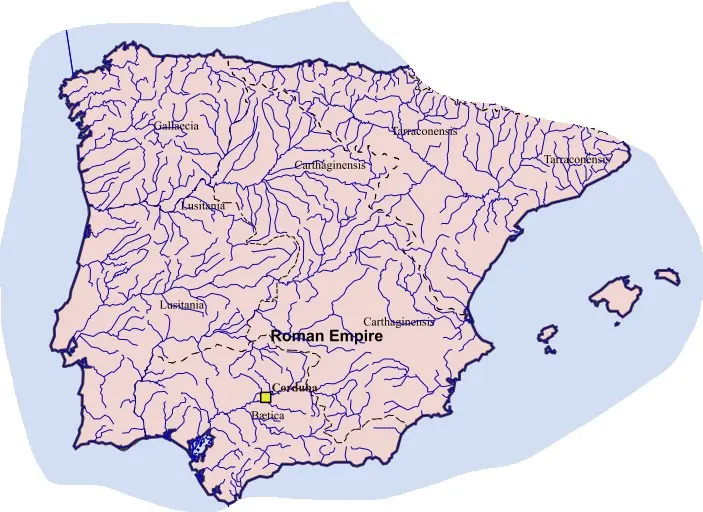
The river network supplies a useful complement to the atlas's settlement locators. Valleys offered access while uplands divided communities and complicated pursuit. Modern hydrographic detail is an orientation aid, not evidence that a particular ancient army followed every accessible valley or possessed reliable maps of the whole peninsula.
Extended campaign study
The account below develops the operations and their interpretation. Reported numbers and reconstructed tactical details retain the uncertainties described in the dossier.
The Strategic Problem of Iberia
The Iberian peninsula had been formally organized as Roman territory in 197 BC, when the Senate created the two Spanish provinces (Hispania Citerior on the northeastern Mediterranean coast and Hispania Ulterior on the southern and western interior) under the administration of two annually-elected praetors. The decision to provincialize Spain reflected the strategic-military realities that the post-Zama settlement had established: the Iberian territories that had been won from Carthage by Scipio Africanus's campaigns of 210 through 206 BC could not be politically integrated under conventional alliance or supervisory frameworks of the kind that the eastern wars would shortly experiment with, because the Iberian populations lacked the institutional-political traditions (Greek city-state autonomy, Hellenistic monarchical organization) that the supervisory framework required. Direct provincial administration was therefore the institutional solution that the senatorial decision-making process arrived at in 197 BC — making Spain the second and third provinces of the Roman state (after Sicily, organized as a province since the close of the First Punic War in 241 BC, and the smaller Sardinia-Corsica province organized in 238).
The institutional commitment of provincialization, however, did not produce political stability. The Iberian peninsula in 197 BC was a complex political-military mosaic of distinct populations — Iberians proper on the Mediterranean coast, Celtiberians in the central plateau, Lusitanians in the western interior, Vaccaei in the upper Duero valley, Vettones, Carpetani, Turdetani, and numerous smaller tribal groupings — each with its own political-cultural traditions, its own historical relations with the Carthaginian and Roman powers, and its own attitudes toward the new Roman provincial system. The Carthaginian provincial system that had preceded the Roman one had been, in operational terms, a network of fortified positions and tributary relationships with the principal tribal confederations; the Roman provincial system attempted, with somewhat greater institutional formality, the same basic configuration. The political-military stability of the system depended on the continued acquiescence of the major tribal populations in the tributary-administrative requirements that the provincial system imposed, and on the continued operational competence of the provincial administrators (the praetors and their staffs) in managing the relationship with the tribal populations.
The pattern of Spanish provincial administration across the period 197 through 154 BC was, accordingly, one of recurrent low-level military operations punctuated by occasional major revolts. The praetors of the Spanish provinces conducted, in most years, military operations of various scales against particular tribal populations who had refused tributary payment, attacked Roman commercial-administrative positions, or otherwise resisted the provincial system. The operations were generally successful in restoring the immediate tributary requirements but did not produce permanent political-military pacification; the tribal populations recognized the conditional and provisional character of their submission to the provincial system and were prepared, when local political-military conditions permitted, to resume the resistance. The institutional logic of the Spanish provincial system was, in effect, that of permanent low-grade military engagement against the various tribal populations of the peninsula — a strategic configuration substantially different from the Mediterranean supervisory hegemony that the eastern wars were producing, and one that imposed substantial institutional costs on the Roman state in terms of military commitment, fiscal expense, and provincial-administrative personnel.
The Lusitanian and Celtiberian Wars (154–151 BC) and the Viriathic Resistance (147–139 BC)
The major Spanish war that occupied the central portion of the second century BC began in 154 BC with the simultaneous outbreak of two related revolts: the Lusitanian revolt in the western peninsula (modern Portugal and western Spain), led initially by the chieftain Punicus and subsequently by Caesarus, and the Celtiberian revolt in the central peninsula, led by the chieftains of the great fortified city of Numantia in the upper Duero valley. The two revolts were coordinated to some degree by tribal political-military intercommunication that the Roman provincial intelligence did not adequately monitor, and produced across the years 154 through 151 BC a series of operational reverses for the Roman provincial commanders that the political class at Rome regarded with substantial concern.
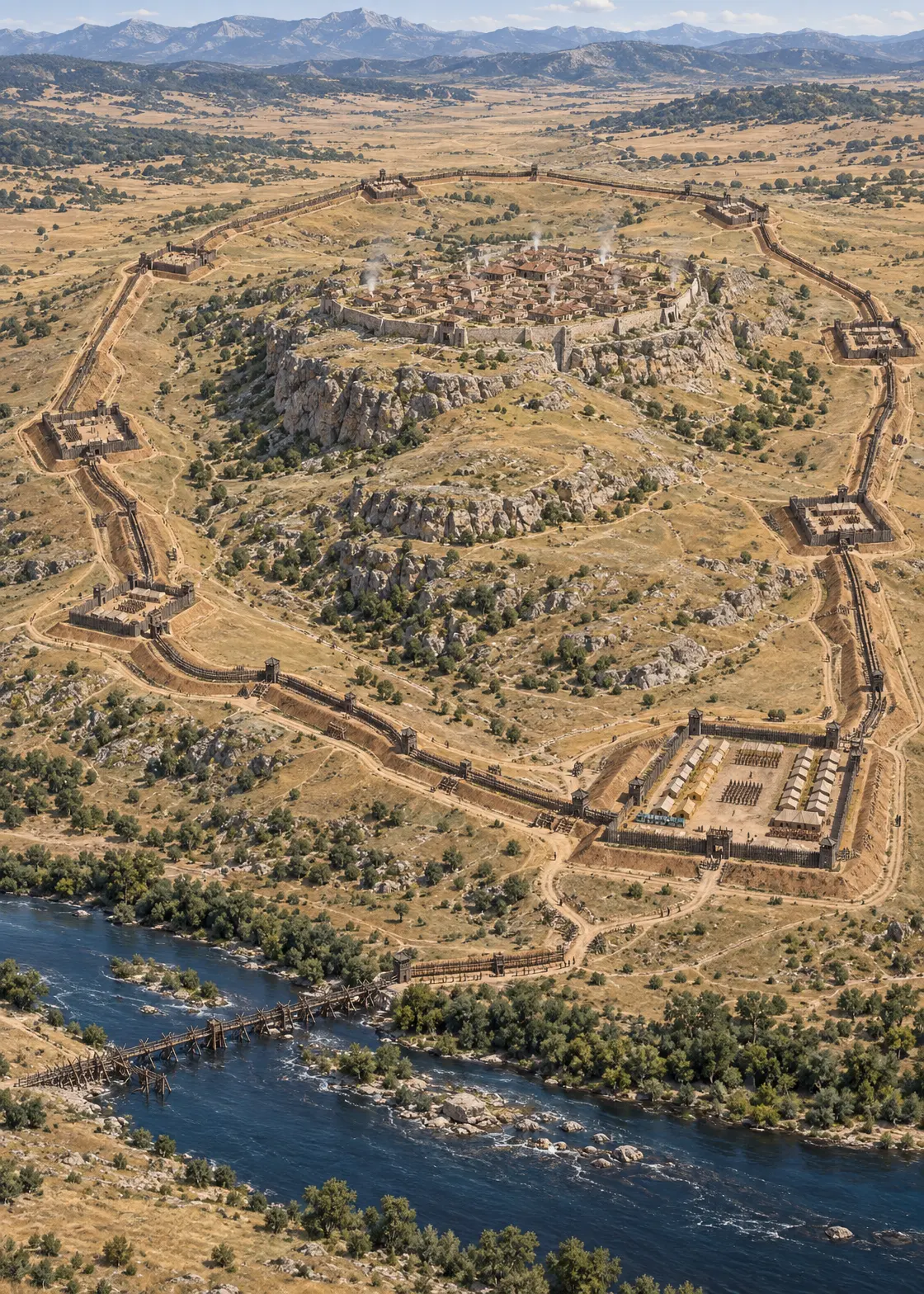
The principal Roman commanders of the early war (the consul Quintus Fulvius Nobilior in 153 BC, the consul Marcus Claudius Marcellus in 152, the consul Lucius Licinius Lucullus in 151, and various subordinate figures) conducted operations whose operational competence varied substantially. Nobilior's campaign of 153 BC produced a significant Roman defeat near Numantia and led to the development among the Roman political class of a strong reluctance to serve in the Spanish provinces — a reluctance that, by 151 BC, had reached the point at which the senatorial selection of provincial commanders was being conducted with substantial difficulty as candidates declined to accept the assignments. The political crisis was resolved by the public volunteering of Scipio Aemilianus (then a young senatorial figure of approximately thirty, with substantial military reputation from his service under his adoptive father at Pydna in 168 BC and from subsequent operations) for service as a military tribune in the Spanish theater — a public-spirited act that the contemporary Roman political tradition recognized as exceptional and that materially assisted the senatorial leadership in completing the provincial appointments. Lucullus's campaign of 151 BC subsequently produced a more successful series of operations, including the reduction of several Celtiberian positions, but it was conducted with the kind of operational severity (the famous massacre of the surrendered population of Cauca, conducted by Lucullus's troops against the explicit terms of the surrender agreement that had been concluded) that produced lasting political-cultural consequences for the Roman provincial position in the peninsula.
The death of the Lusitanian chieftain Caesarus and the assassination of several Lusitanian leaders by the praetor Servius Sulpicius Galba in 150 BC — under circumstances of treachery that the Roman political tradition itself recognized as exceptionally dishonorable, with Galba conducting a fake surrender ceremony at which several thousand Lusitanians were either massacred or sold into slavery contrary to the surrender terms — produced the strategic-political conditions that led to the principal Spanish-resistance figure of the period: Viriathus.
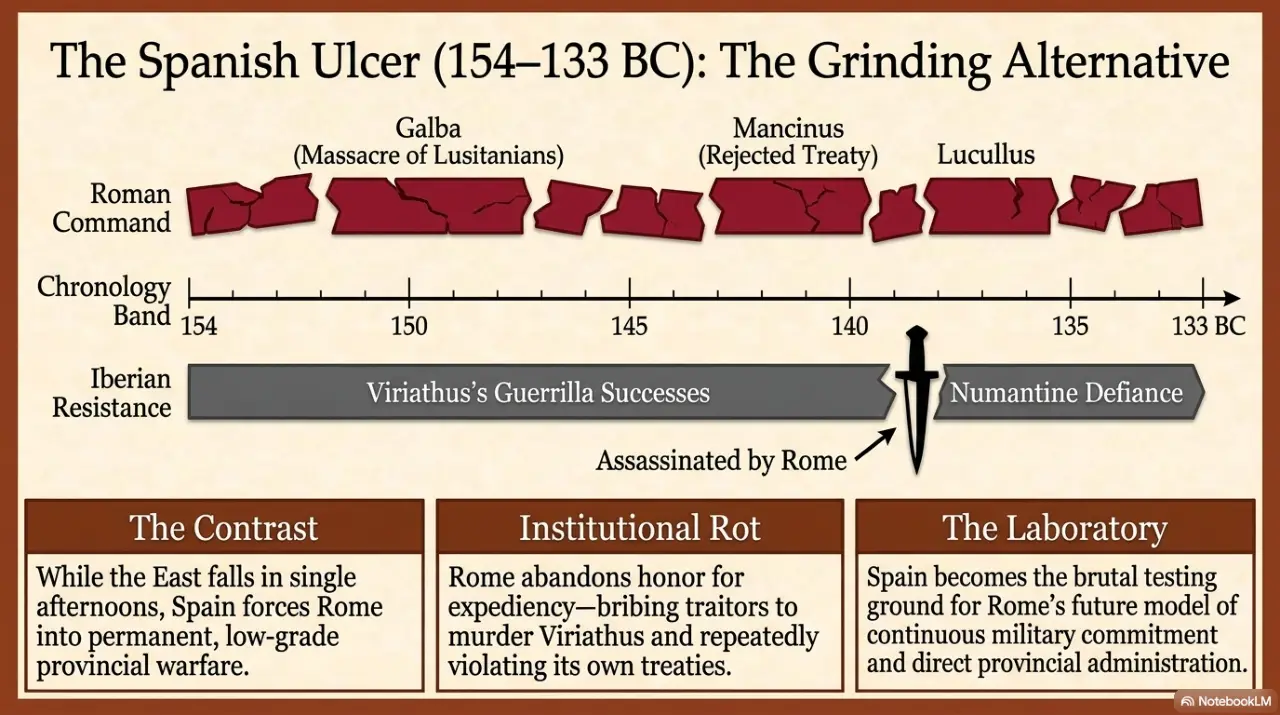
Viriathus was a Lusitanian shepherd-turned-warrior whose biography, as preserved by Appian (Hispanica 60–75) and by Diodorus (33), combines authentic elements of Iberian tribal-resistance leadership with the dramatic-literary elaboration that the figure would attract in subsequent literary tradition. He had been one of the survivors of the Galban massacre of 150 BC, escaped from the killing by speed or by political-personal connection, and had spent the subsequent two years recruiting Lusitanian and Celtiberian warriors for a war of resistance against the Roman provincial system. His military-operational approach was the systematic application of guerrilla tactics adapted to the Iberian geographic-strategic environment: rapid mobility across the broken country of the central and western peninsula, refusal of set-piece engagement with Roman heavy infantry, systematic ambush of Roman supply convoys and isolated detachments, exploitation of intelligence advantages provided by the local population, and the political-rhetorical framing of the resistance as the vindication of Iberian honor against the bad-faith Roman provincial conduct that the Galban massacre had exemplified.
Viriathus's military career across the years 147 through 139 BC was, by any conventional measure, the most successful tribal-resistance career of any individual figure in any Roman provincial war of the second century BC. He defeated, in successive engagements across the period, the praetors Gaius Vetilius (147 BC, ambush near Tribola — Vetilius killed), Gaius Plautius (146 BC, an extended series of small engagements that destroyed Plautius's military reputation), Claudius Unimanus (146 BC, defeated), Gaius Nigidius (146 BC, defeated), the proconsul Quintus Fabius Maximus Aemilianus (145–144 BC, defeated in initial engagements but stabilizing the Roman position by the end of the period), and the consul Quintus Fabius Maximus Servilianus (141 BC, defeated and compelled to negotiate a peace treaty that the Roman Senate subsequently repudiated). The political-strategic consequence was the development across the Spanish provinces of a substantial anti-Roman political-military coalition that included not merely Viriathus's Lusitanian core but also Celtiberian, Vaccaei, and various smaller tribal contingents, with the strategic objective of expelling the Roman provincial system from the peninsula.
The Roman response to Viriathus's continued operational success was the assignment of the consul Quintus Servilius Caepio to the Spanish command in 139 BC, with explicit senatorial authorization to bring the war to conclusion by whatever means proved necessary. Caepio's solution was, as the sources unanimously record, the political-personal procurement of Viriathus's assassination through the bribery of three of Viriathus's senior subordinates (named Audax, Ditalco, and Minurus by the sources). The assassins entered Viriathus's tent at night while he was asleep, killed him in his bed, and presented themselves to Caepio for the agreed payment; Caepio, in a remark preserved by Appian (Hispanica 74) that the Roman tradition would record as the moral nadir of the entire Spanish campaign, refused payment on the principle that "Rome does not pay traitors" — leaving the assassins unrewarded and unprotected, with the political-strategic consequence that the assassination did not produce the kind of Lusitanian political reconciliation that the Roman intention might have anticipated but instead intensified the lasting bitterness of the Iberian-Roman political relationship. Viriathus's funeral, conducted by his surviving followers with the kind of dignity that the Iberian-Lusitanian cultural tradition permitted, included the proverbial three days of mourning and a substantial human-sacrificial component that the Roman sources record with the cultural-anthropological interest characteristic of the Hellenistic-period ethnographic tradition. The Lusitanian resistance, deprived of its principal leadership, was substantially suppressed across the subsequent two years; the strategic-political consequences would extend beyond the immediate military settlement, however, into the long subsequent development of Iberian-Roman political relations across the following two generations.
Outcome and critical assessment
Result and caution: Roman power expanded, but the campaigns did not produce instant uniform control of western Iberia. Descriptions of "guerrilla war" are modern analytical shorthand; they should not hide the varied size, organization or political objectives of the forces involved. Dates in inherited summaries differ and should not be silently merged.
Historical record: IR-IV, Iberian background; Appian, Iberian Wars; conquest chronology, with its compressed dates treated as leads.