Wars · VIII. The western imperial system under pressure
W079 Stilicho's wars: Africa, Italy and the Gothic challenge
The western government faced several distinct emergencies. Gildo's challenge in Africa in AD 397–398 threatened a crucial provincial and supply relationship; forces under his brother Mascezel defeated him. Alaric's presence and ambitions required a different mixture of negotiation and war, including fighting in Italy at Pollentia and Verona in AD 402–403.
The invasion associated with Radagaisus in AD 405–406 brought another coalition into Italy. Stilicho assembled forces and defeated it near Faesulae. These campaigns show both the western government's continuing capacity and its dependence on difficult choices about recruitment, allies and concentration.
Command, forces and military problem
| Field | Dossier |
|---|---|
| Roman leadership | Stilicho, Mascezel and other western commanders |
| Opposing or rival parties | Gildo; Alaric; Radagaisus in distinct campaigns |
| Forces and capabilities | Field armies, African and Italian resources and several allied contingents |
| Operational problem | Prioritize simultaneous emergencies while preserving access to revenues, recruits and Italy. |
Campaign geography and operational plates
The divided imperial world around AD 400
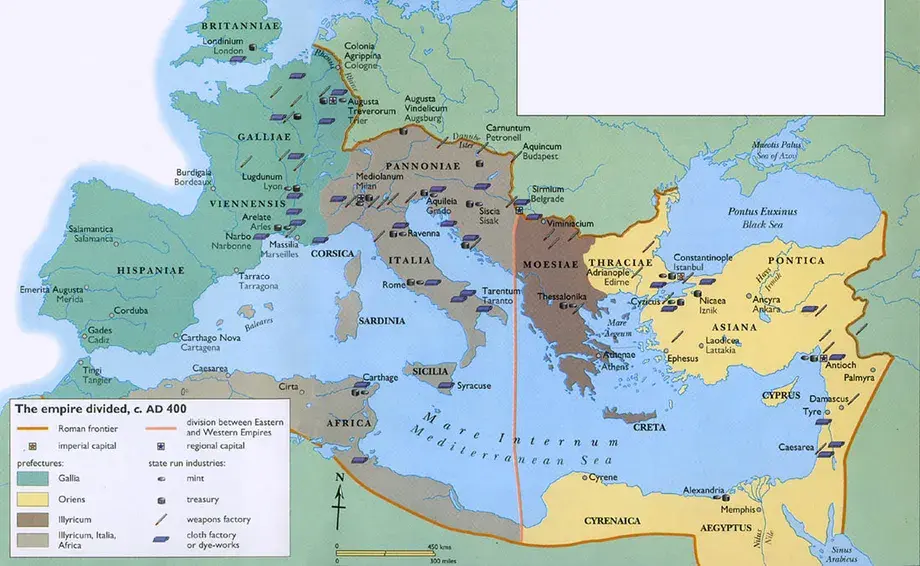
The western court depended on resources and forces spread from Britain and Gaul to Africa and Italy. The eastern court occupied another large and connected sphere. These geographical facts help explain why disputes over army control and Balkan operations mattered. A boundary between administrations did not create two unrelated civilizations or eliminate communication between the courts.
Stilicho in the Peloponnese
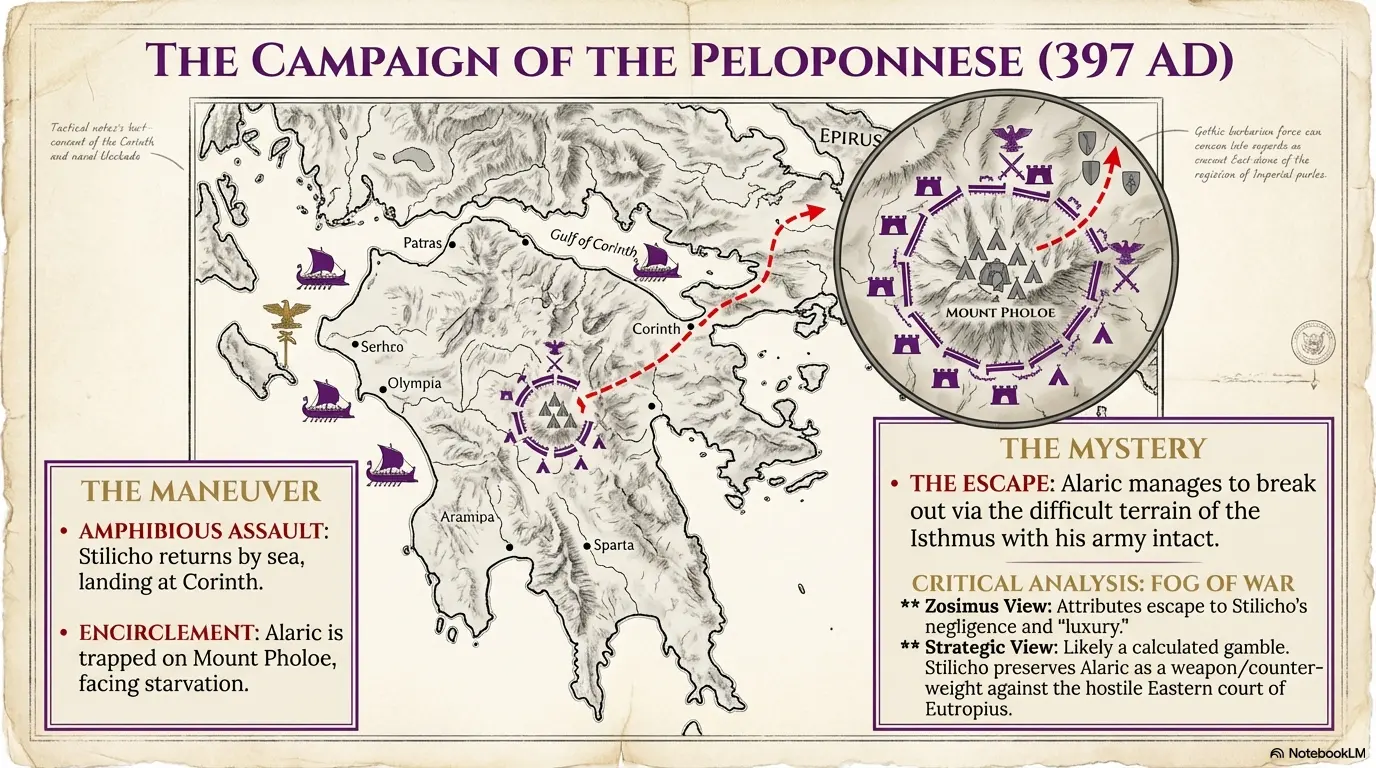
The combination of a sea approach, inland pursuit and difficult terrain made containment harder than a simple encircling line suggests. The figure is useful for asking how an army could appear trapped yet escape. It does not resolve the competing explanations involving command decisions, diplomacy and the quality of the containment.
The Gildonic war: grain, ships and political pressure
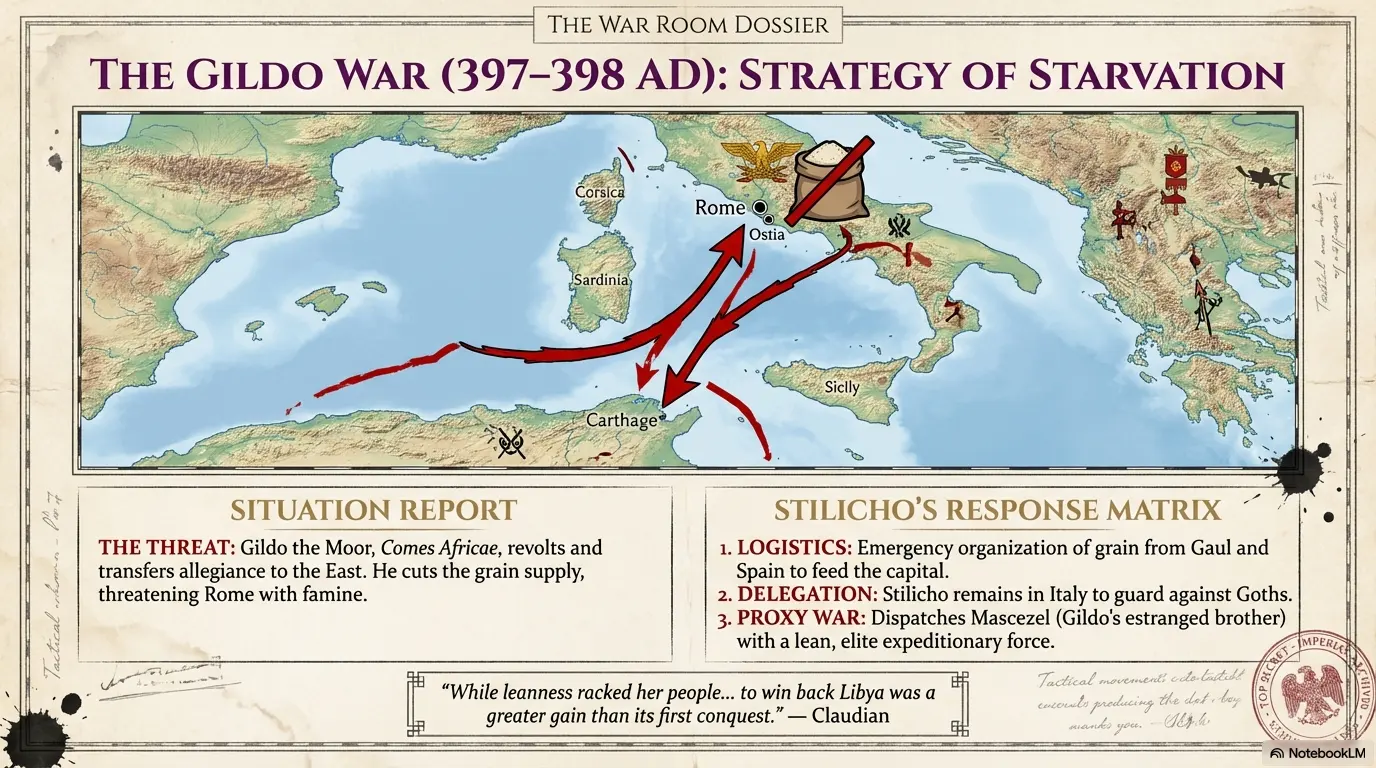
Africa's importance lay partly in its place in the provisioning of Rome. A challenge there could therefore create pressure beyond the immediate battlefield. The map links political allegiance, maritime protection and food supply. It should not be read as a complete surviving plan of convoy movements or as proof of one precisely measured famine timetable.
Pollentia: camp, attack and the limits of victory
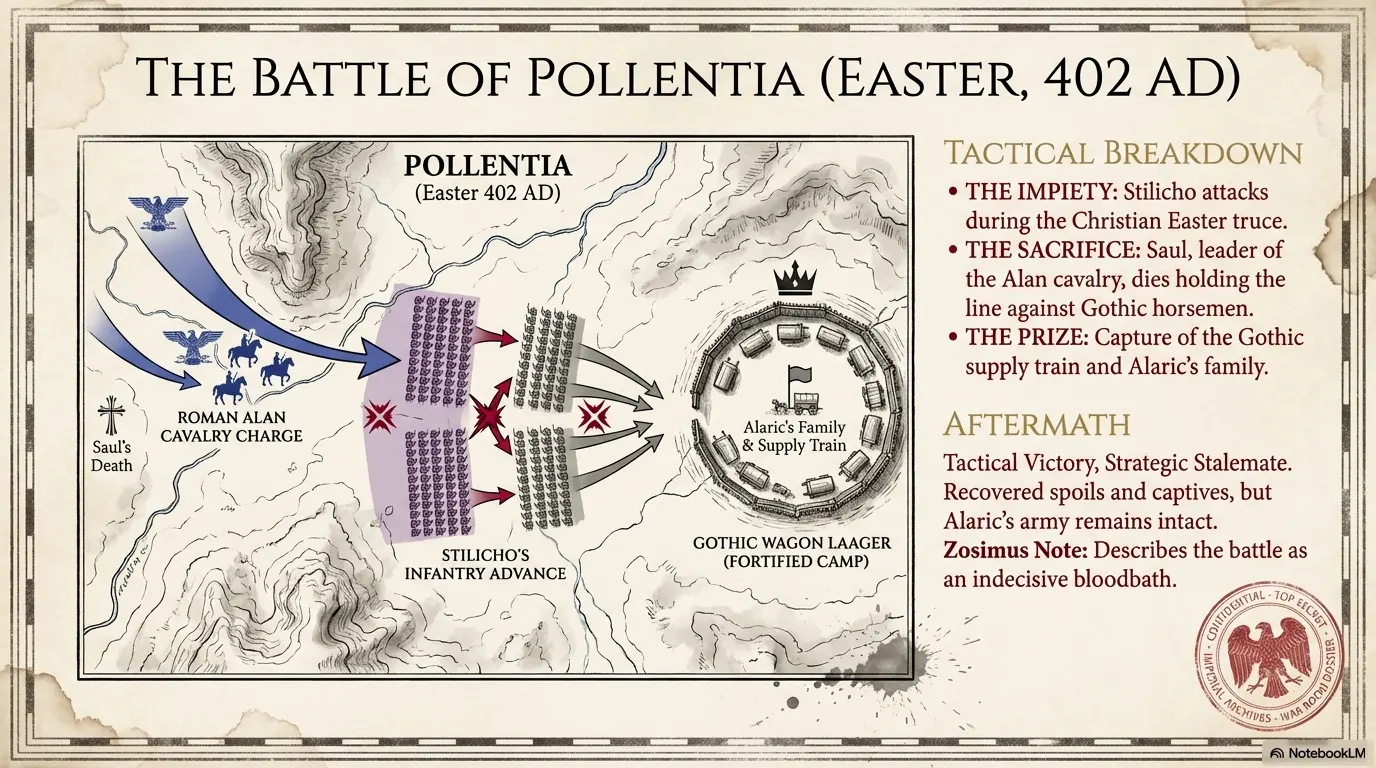
The figure separates a field attack from the control of a camp and its contents. Those objectives could produce important results without destroying Alaric's army. Its reconstruction should be compared with the dossier's distinction between tactical success, disputed claims of victory and the continuing ability of the opposing force to operate.
Faesulae: containing Radagaisus’ army
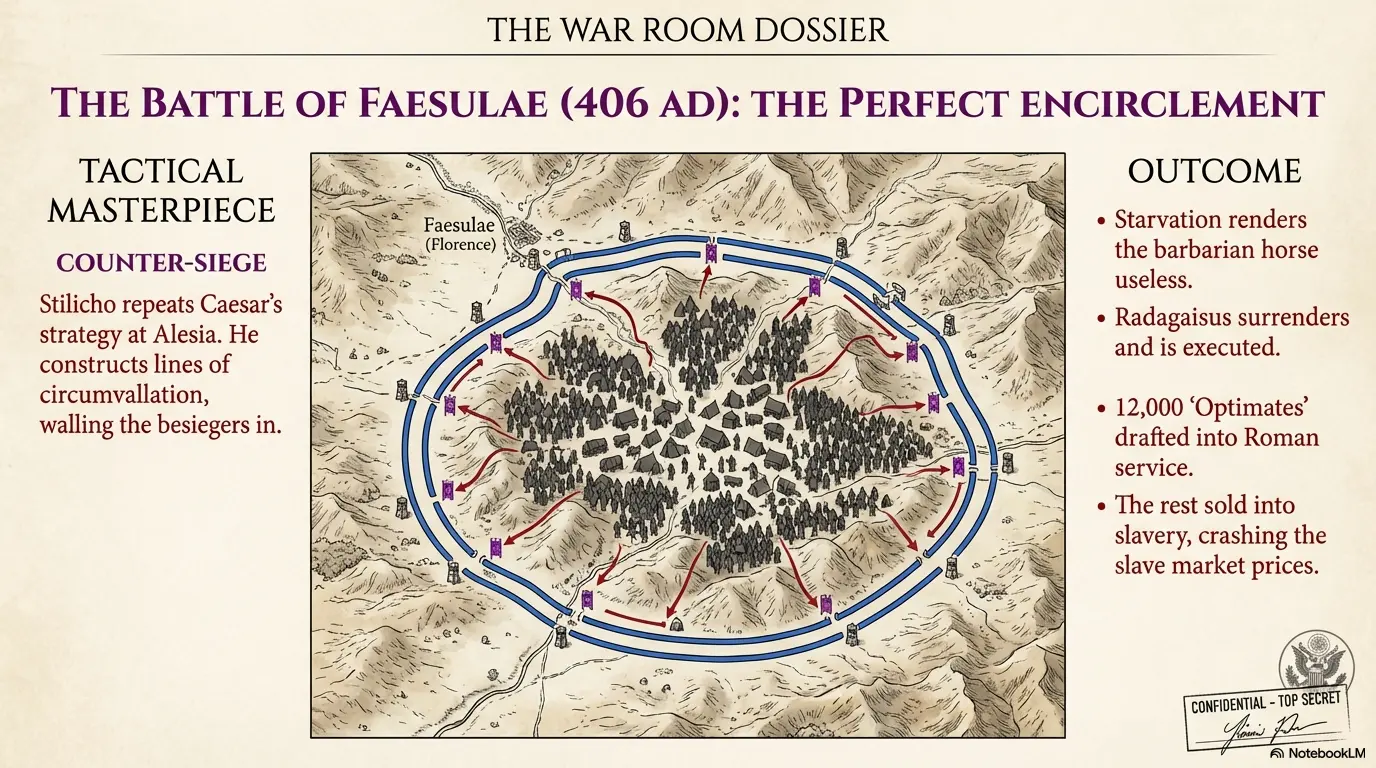
The encircling lines express the attempt to restrict movement and access to supplies. They are not a measured plan of the surviving fieldworks. The comparison with a siege is useful because attrition and surrender can decide a campaign without the kind of symmetrical pitched battle often expected from a battle diagram.
Extended campaign study
The account below develops the operations and their interpretation. Reported numbers and reconstructed tactical details retain the uncertainties described in the dossier.
The Generalissimo's War (395–408)
The West after Theodosius was governed from behind the throne, and the account's remaining chapters are structured by that fact: the emperors — Honorius reigning twenty-eight years without once commanding in the field — recede to Ravenna (the court moved into the marshes in 402, the capital choosing unassailability over everything), and policy passes to the magistri militum whose succession is the real fifth-century king-list. Stilicho fought Alaric to draws he declined to make destructions — in Greece in 395 and 397 (the eastern government protesting his presence), in Italy at Pollentia and Verona in 402 when the Goths first invaded it (Easter Sunday battle, the royal camp and Alaric's family taken, the king allowed to withdraw; the tradition's charge that Stilicho spared him as a tool is the hostile version of the visible policy that Gothic manpower was worth more hired than dead) — and his defense of Italy was real: the invasion of Radagaisus in 405/6, a vast pagan confederacy out of the middle Danube (the sources' four hundred thousand graded to the modern tens of thousands), was destroyed entire at Faesulae by blockade, the king executed, twelve thousand of his warriors taken into the army, and so many enslaved that the market broke. No Roman field army met them. The crossing rolled through Gaul for three years — the coin-hoard horizon and the burnt villa-belt map it; Jerome's letter catalogues the cities, Moguntiacum captured and destroyed, Worms fallen after long siege, Rheims, Amiens, Arras... Toulouse spared thus far by its bishop — while Britain, cut off, raised its own emperors, the last of them Constantine III crossing to Gaul with the island's remaining field troops in 407: the departure from which, in the retrospect the chapter's Note will grade, Roman Britain never returned. Stilicho, holding Italy against Alaric's renewed pressure (the Senate, at his insistence, voting the king four thousand pounds of gold as arrears — "not peace but a pact of servitude," the senator Lampadius protested, and was believed), was destroyed by the politics his monopoly had created: the anti-barbarian party at Honorius's court, the mutiny at Ticinum that massacred his officer-corps, and on 22 August 408, at Ravenna, the generalissimo — who had declined to raise his own visibly loyal barbarian regiments in his defense — stepped out of sanctuary and was executed on his ward's warrant.
Outcome and critical assessment
Result and caution: several immediate threats were defeated without a durable resolution of western command politics. Claudian's poetry is an advocate for Stilicho, not an impartial operations journal. Alaric and Radagaisus commanded distinct movements; merging all "Goths" into one army obscures the political situation.
Historical record: IR-VIII, chapter 4; Claudian, relevant political poems; Orosius, book 7; later retrospective narratives.