Wars · VIII. The western imperial system under pressure
W083 Attila's Balkan, Gallic and Italian wars
Hunnic power under Attila placed severe pressure on the eastern empire through invasion, tribute demands and diplomacy. Balkan cities suffered repeated attacks. Attila's western campaign in AD 451 encountered a coalition associated with Aetius and the Visigothic king Theodoric I.
The battle conventionally called the Catalaunian Plains checked Attila's Gallic campaign but did not destroy his power. His invasion of Italy in AD 452 included the capture of Aquileia. Withdrawal followed a combination of constraints and negotiation; a single dramatic encounter cannot securely explain the entire decision.
Command, forces and military problem
| Field | Dossier |
|---|---|
| Roman leadership | Aetius and allied rulers in the West; eastern commanders in the Balkans |
| Opposing or rival parties | Attila and his coalition |
| Forces and capabilities | Imperial, royal and allied forces; tribute and negotiation support the military system |
| Operational problem | Concentrate a coalition without assuming that checking one invasion destroys the opposing power. |
Campaign geography and operational plates
Thrace: the approaches to the capital
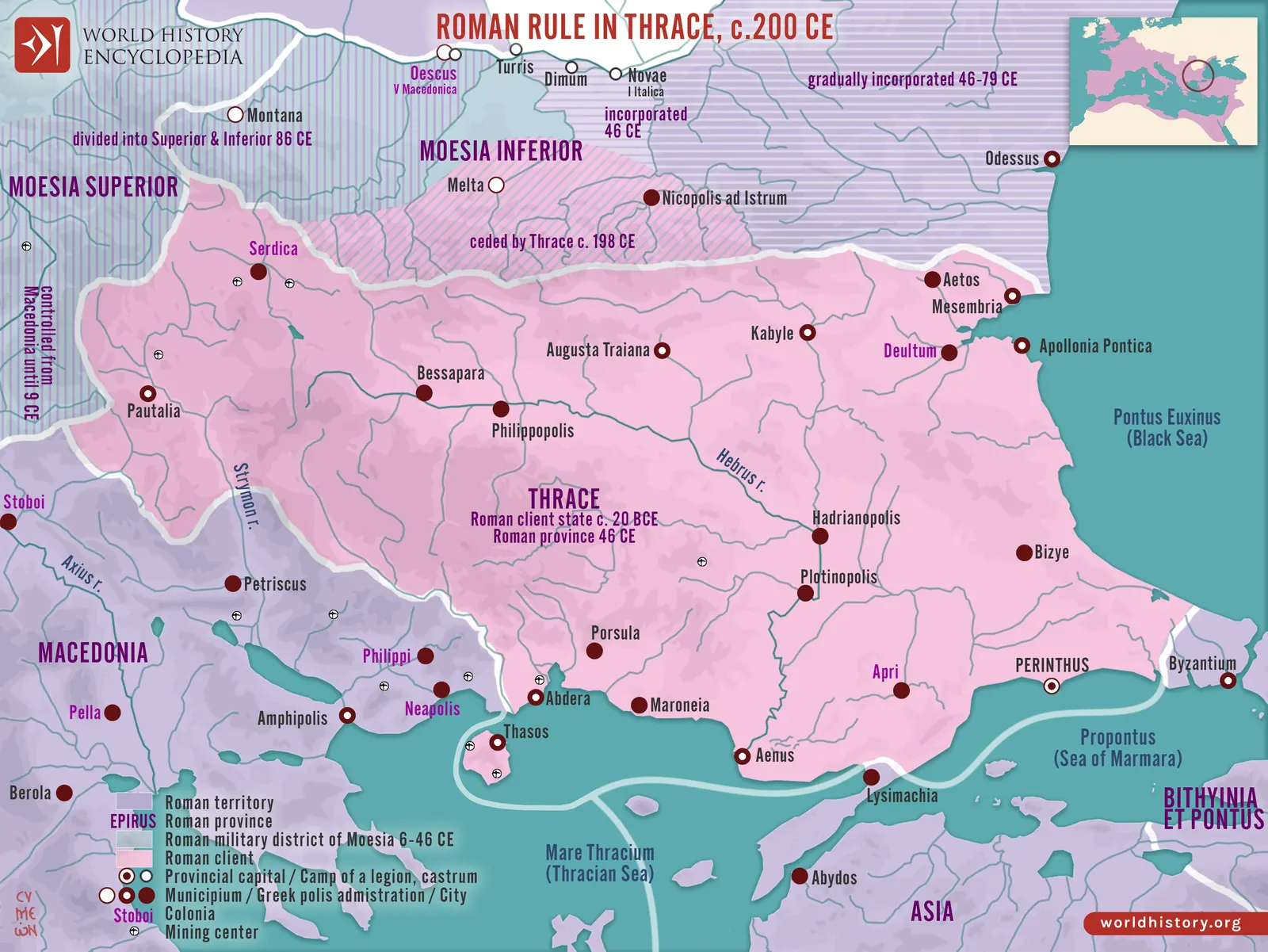
Adrianople and the road systems toward the Bosporus explain why invasions in Thrace posed a different problem from fighting on the far side of the Danube. The settlement network remained historically important, but the map does not reconstruct the defenses or exact administrative organization of AD 378, Attila's campaigns or the invasion of AD 559.
Attila in Gaul, AD 451
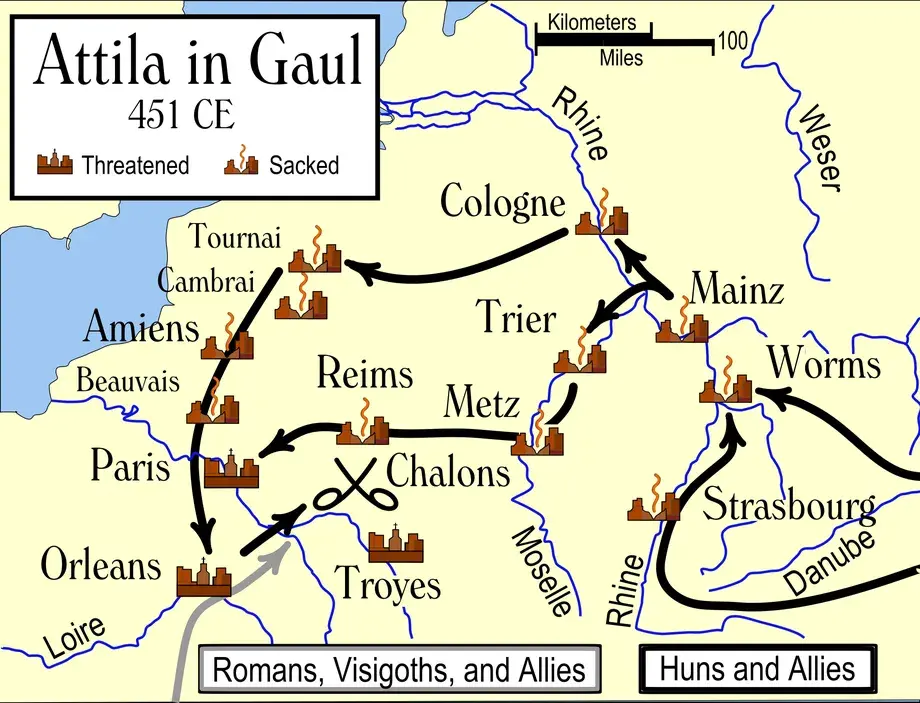
The convergence toward Orléans and the return toward the battle region give the campaign a structure beyond the famous encounter on the Catalaunian Plains. The distinction between threatened and sacked places matters. Route lines remain reconstructions, and the map does not settle the exact location of the final battlefield.
The coalition against Attila in Gaul
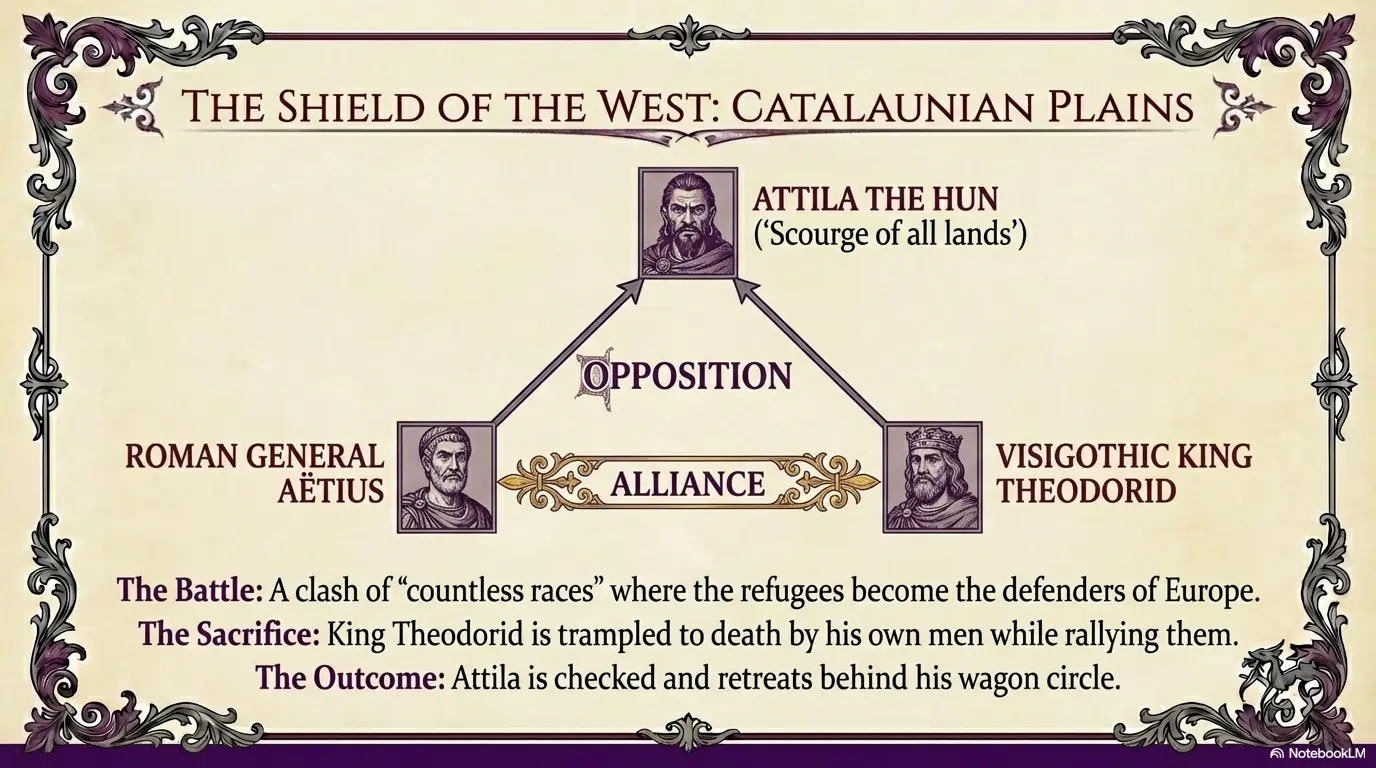
The opposing coalitions included parties with distinct interests, rather than two uniform national armies. Theodoric here is the Visigothic king killed in AD 451, not the later Ostrogothic ruler of Italy. The diagram explains the immediate relationship without making the coalition permanent or treating the outcome as the destruction of Hunnic power.
Extended campaign study
The account below develops the operations and their interpretation. Reported numbers and reconstructed tactical details retain the uncertainties described in the dossier.
The Catalaunian Plains, Italy, and the Two Murders (451–454)
The campaign of 451 was the largest the West had seen in a century. Attila crossed the Rhine in spring with the Hun army and the subject nations — Gepids under Ardaric, Amal Goths, Rugians, Sciri, Thuringians, the East's whole tributary world — sacked Metz, and drove on Orléans, whose Alan garrison-king was negotiating surrender; Aetius, with the small Italian field force, achieved the diplomatic masterpiece his whole career had rehearsed: the Visigothic kingdom brought into the field — old Theodoric I marching with his nation — with Burgundians, Salian Franks, Saxons, Armorican Bagaudae-levies, and his own regulars: the coalition Jordanes calls, without irony available to him, "the Roman side." Orléans was relieved at the wall's breach-point (the tradition's timing, graded homiletic), and Attila fell back into Champagne to ground of his choosing: the CATALAUNIAN PLAINS (the campi Mauriaci near Troyes; the field, in the series' recurring pattern, unlocated). Aquileia — the fortress-city that had turned every invader since the Marcomannic wars — was taken after a three-month siege and erased so completely that Jordanes's generation could scarcely find it (its refugees' flight into the lagoons is the seed, in tradition, of Venice); the Po cities opened or burned; Milan was occupied and the famous panel of Roman emperors enthroned above dead Scythians repainted, at Attila's order, with the roles reversed; and the empire, its field force spent at the Plains and its granary Vandal, sent not an army but the embassy of 452: the consular Avienus, the prefect Trigetius, and Pope Leo, meeting Attila at the Mincio — after which the Hun withdrew. Attila died within the year — a burst vessel on the night of his last wedding, drowned in his own blood, the kingdom buried with him: at the Nedao in Pannonia (454) the subject nations under Ardaric's Gepids destroyed the Hun empire in one battle, and the steppe power that had bent both empires for a decade dispersed into the Balkans' federate settlements within a generation. The West's deliverance completed its own decapitation: in September 454 Valentinian III — resentful ward, thirty-five years emperor and never once a commander — summoned Aetius to the palace at Ravenna to audit accounts, and killed him at the council-table with his own sword, the eunuchs finishing the work; the epitaph the tradition preserves was spoken to the emperor's face by a courtier asked to approve: you have cut off your right hand with your left.
Outcome and critical assessment
Result and caution: the western coalition survived, while Attila retained power until his death in AD 453. The Catalaunian battlefield's exact location, date and casualty totals remain uncertain. Jordanes' account is retrospective and politically shaped. Theodoric I, killed in AD 451, is not Theodoric the Amal, the later ruler of Italy.
Historical record: IR-VIII, chapter 5; Jordanes, Getica, especially the Attila narrative; Priscus' fragmentary tradition as identified in the manuscript, without claiming a complete local Priscus edition was checked.