Wars · IV. The Republic at war with itself
W045 Actium and the conquest of Egypt
Battles and sieges
Actium 31 BCThe breakdown between Octavian and Antony was presented by Octavian's side as a struggle against Cleopatra, but the forces and stakes remained deeply Roman. Agrippa's operations against bases and communications helped constrain Antony and Cleopatra near Actium. The naval battle of 31 BC was one stage of a wider blockade and campaign.
The escape of Antony and Cleopatra did not restore their strategic position. Octavian advanced into Egypt in 30 BC; their deaths were followed by the annexation of the kingdom. Egyptian revenue and control of its resources strengthened the victorious ruler.
Command, forces and military problem
| Field | Dossier |
|---|---|
| Roman leadership | Octavian and Agrippa |
| Opposing or rival parties | Antony and Cleopatra VII |
| Forces and capabilities | Large fleets, land armies and eastern and western supply networks |
| Operational problem | Isolate the opposing concentration, break its maritime position and complete the Egyptian campaign. |
Campaign geography and operational plates
Actium: fleets, camps and the gulf entrance
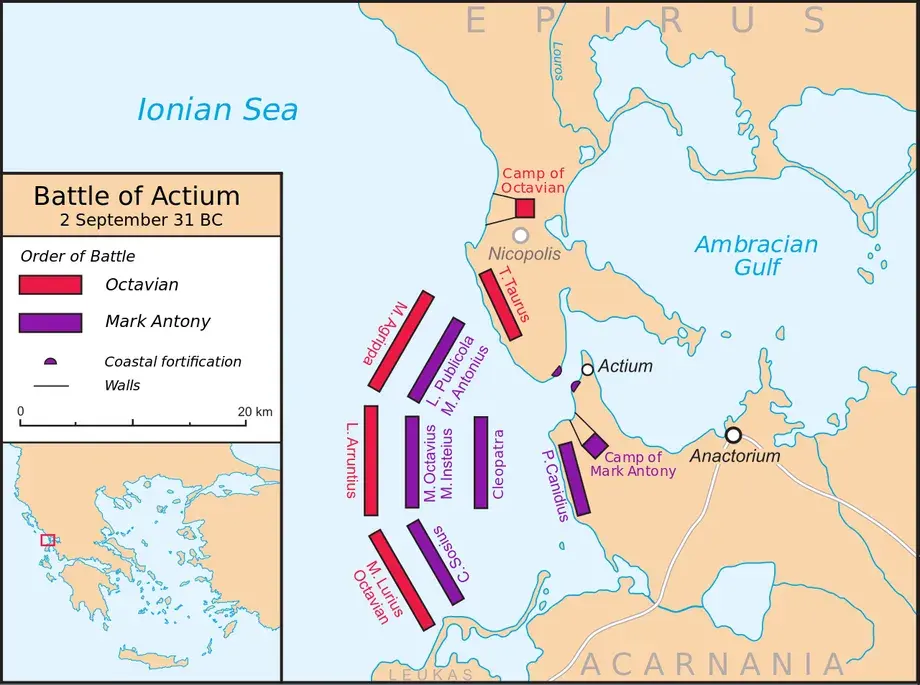
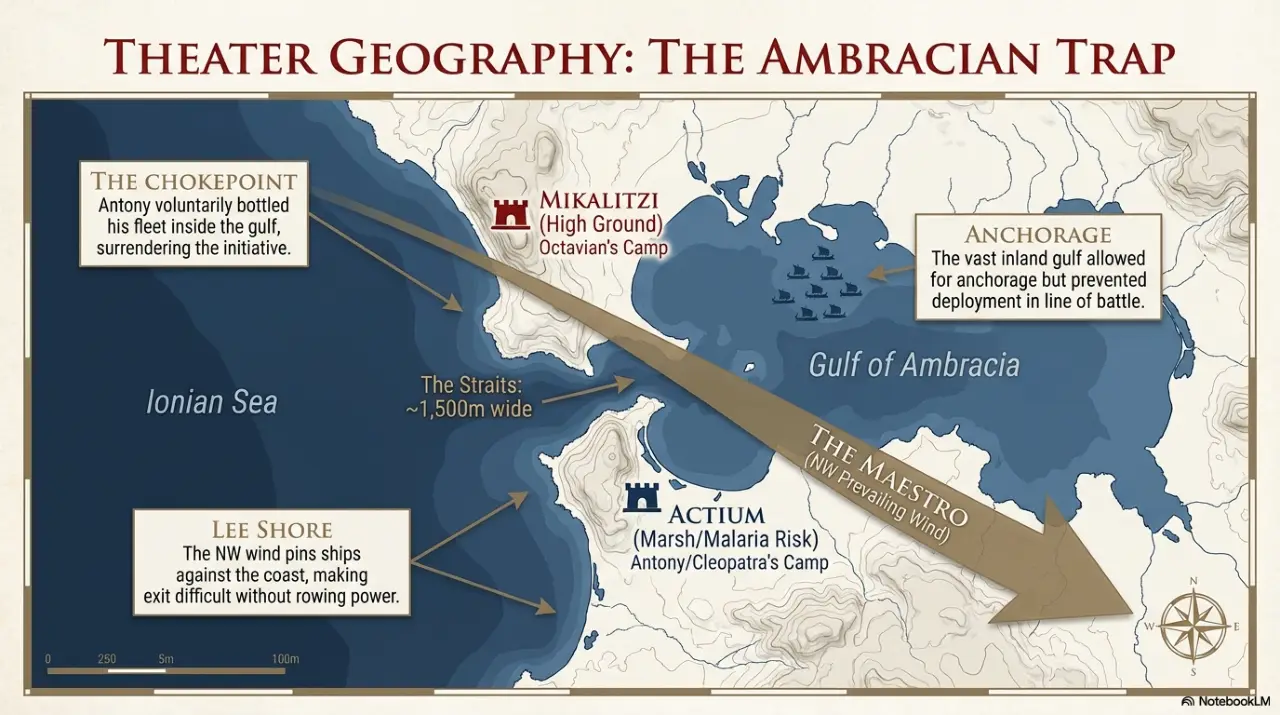
The narrow entrance to the Ambracian Gulf distinguishes Actium from an encounter on an unrestricted sea. Shore camps, access to water and the ability to leave the gulf formed part of the battle problem. Colored blocks indicate the competing fleets; they do not represent a verified ship-by-ship order of battle.
Extended campaign study
The account below develops the operations and their interpretation. Reported numbers and reconstructed tactical details retain the uncertainties described in the dossier.
Actium (32–31 BC), and the Last Day of Alexandria (30 BC)
In the East: Antony's Parthian war of 36, the revenge for Carrhae mounted with a hundred thousand men and ruined by its own siege-train's loss and the Median winter — the retreat's twenty-seven days of testudo-marches, poisoned roots, and eighteen engagements costing, Plutarch's figures, thirty-two thousand men without a battle lost, the commander at his human best amid the wreck and calling into his tent for the sword before each new crisis passed; and the Armenian face-saving campaign of 34 that furnished the Donations of Alexandria — the ceremony in the Gymnasium enthroning Cleopatra as Queen of Kings with Caesarion beside her proclaimed Caesar's true son, and Antony's children by her invested with kingdoms from Armenia to Cyrene. With that ceremony the war of weapons was preceded, for three years, by the greatest propaganda war of antiquity, and Octavian won it before a ship sailed: Antony's Roman marriage discarded by letter, Octavia's public dignity turned into a weapon her brother wielded weekly; the defectors Plancus and Titius guiding Octavian to the Vestals' custody of Antony's will, seized and read to the Senate — the bequests to Cleopatra's children, the burial clause beside her in Alexandria — its authenticity doubted then and now and its effect total; the consecrated fetial spear thrown at last, in the archaic rite revived by the master of new forms, against Cleopatra alone: Rome's war would be foreign, and Antony merely the queen's lost Roman.
The campaign itself Agrippa decided before the fleets met. Antony wintered 32–31 at Actium on the Ambracian Gulf with five hundred ships and the East's treasury embarked; Agrippa took Methone behind him, cut the Peloponnesian supply-chain port by port, and let the malarial summer, desertion (the consular Ahenobarbus rowing over to die of fever in Octavian's camp; Dellius, the historian of the Parthian retreat, carrying the battle-plans across at the last), and the crews' famine reduce the Antonian fleet to perhaps two hundred and thirty effective hulls.
The council's alternatives — Canidius urging the army's retreat into Macedonia to fight on land, the queen's party the fleet's breakout for Egypt — were resolved by the detail the old soldiers read like an omen: the order to embark the sails, never carried into a fight a commander meant to finish. The fleet burned or struck by evening; the nineteen legions ashore, abandoned by Canidius in the night, negotiated a week and then marched over entire; and the victor of the last battle of the Roman Republic was, as at Naulochus, Agrippa — the dedication at Nicopolis, the victory-city above the straits, naming nonetheless the man for whom the age would be named. Antony ran the ship south in a three-day silence at the prow, head in his hands; Egypt gave him a year of theatrical despair — the Timoneum hermitage on the Alexandrian mole, the drinking-society rechristened from the Inimitable Livers to the Partners in Death — while the queen tested poisons on prisoners, Plutarch reports, in search of the painless one, and both negotiated secretly with the approaching conqueror, who wanted the treasure intact, the queen for the triumph, and nothing else. On the first of August 30, at the gates of Alexandria, the fleet and cavalry went over in an hour and the last battle of the last civil war was a skirmish already decided; Antony, on the false report of Cleopatra's death — sent, the tradition says, from the mausoleum where she had barricaded with the treasure and the combustibles — called on his slave Eros for the sword and received instead the slave's own suicide, botched his stroke into his belly, and, learning the report false, was hauled dying by ropes through the mausoleum's upper window by the queen and her two women, to die in her arms with a soldier's last advice about trusting Procleius. The queen outlived him nine days of negotiation, inventory, and one audience with Octavian in which each performed for the other; warned by a sympathizer of the triumph-date, she visited the tomb, dined, and was found on the golden couch in royal dress, dead, her women dying at her feet — the asp in the fig-basket the version Plutarch reports while admitting no one knows the truth of it, two faint marks on the arm, the hollow hairpin the rival tradition, Octavian's snake-charming Psylli summoned too late either way, and the serpent, whatever the fact, awarded the official verdict by the victor, whose triumph carried her effigy with the coiled asp. She was thirty-nine, the last of the Ptolemies, and buried — the one clause of Antony's scandalous will its destroyer honored — beside him. Caesarion, seventeen, caught fleeing toward India, was killed on the advice of the philosopher Areius, who amended Homer for the occasion: no good thing is a multitude of Caesars; Antony's eldest son was dragged from sanctuary and killed; the remaining children walked in the triumph and were raised, in the age's strangest domestic arrangement, by Octavia. What was actually ended, and what was founded, the Epilogue must weigh.
Outcome and critical assessment
Result and caution: Octavian became the dominant Roman ruler and subsequently established the political settlement associated with Augustus. Actium did not itself create every institution of the Principate on the day of battle. Accounts of Cleopatra's motives and conduct are saturated with the victors' politics and later literary interpretation.
Historical record: IR-V, chapter 8 and epilogue; Dio, books 50–51; Plutarch, Antony.