Legions · The legions, by number
36 Legio XV Primigenia
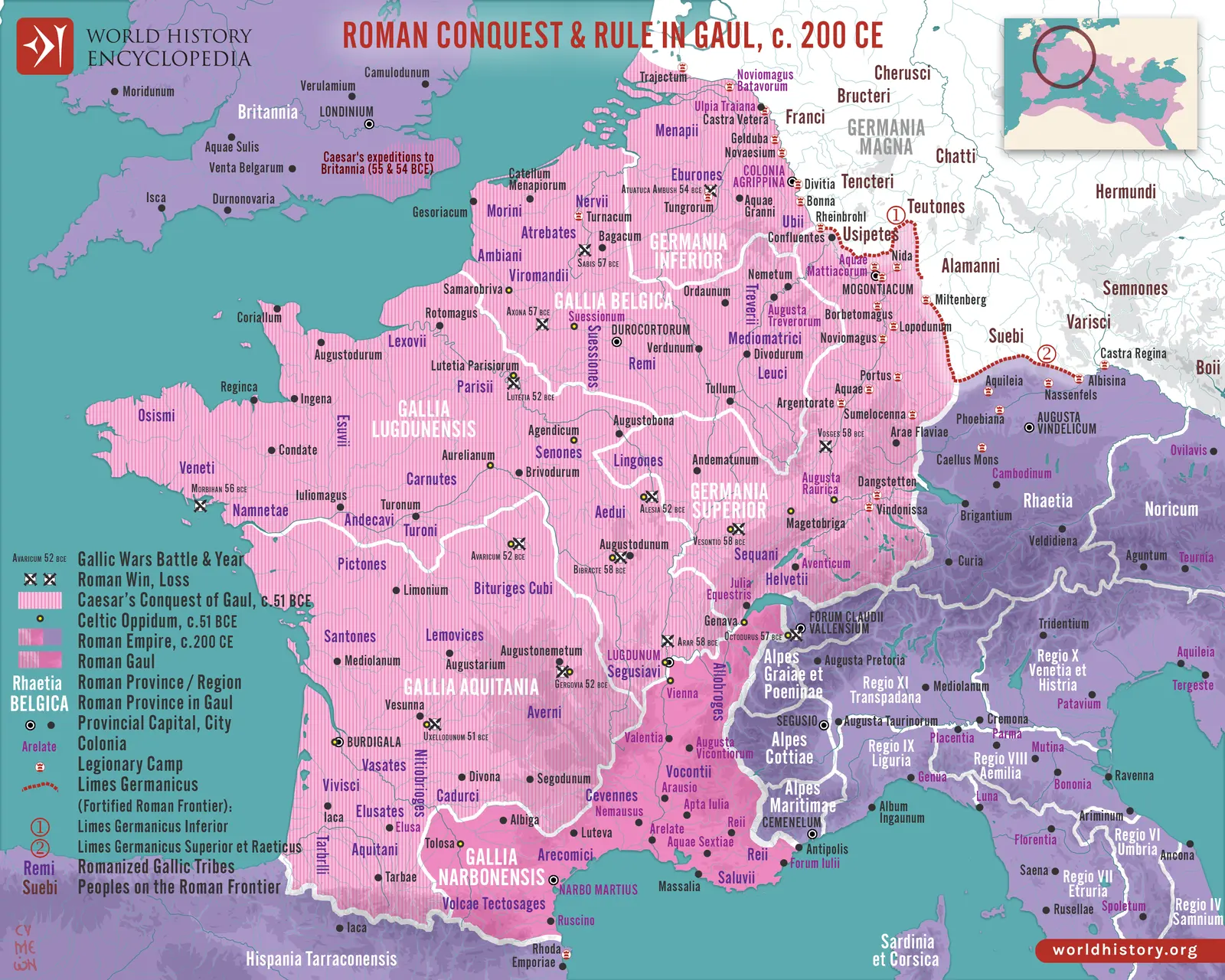
Its independent biography is relatively short and ends in the Rhine catastrophe of 69–70. Detachments participated in the civil-war struggle while the frontier establishment became entangled in the Batavian revolt.
Endpoint: the Vetera disaster and loss of separate institutional identity in 70. Related identities: XV Apollinaris, which survived to a much later eastern administrative horizon. The shared number did not make the latter a replacement named by changing one epithet.
Selected chronology
- c.39: foundation under Caligula.
- 40s: move from Mainz to Vetera.
- 69: succession-war detachments and frontier crisis.
- 70: surrender and destruction of the Vetera establishment.
A new legion in an old military district
XV Primigenia entered a Rhine system already occupied by experienced legions and auxiliary troops. Recruitment under Caligula did not create the provincial landscape from nothing; the regiment inherited roads, camps, supply relationships, and neighboring commands. Its later move from Mainz to Vetera altered its immediate duties without changing its number.
The surname’s connection with Fortuna Primigenia expressed divine favor. The title appears less consistently than a modern catalogue might suggest, reminding the reader that contemporary naming could be shorter and more variable than the fully expanded names used in reference books.
Detachments and the siege
The civil war sent fighting troops toward Italy while weakening the frontier establishment. The body left at Vetera shared the Fifth’s increasingly desperate position during the Batavian revolt. Attempts at relief could not be understood in isolation from changing imperial allegiances, supply problems, and the uncertainty of neighboring units.
Siege warfare reversed the familiar image of Roman soldiers surrounding someone else’s fortress. Here legionaries were themselves confined, hungry, dependent on relief, and vulnerable to decisions beyond the walls. The surrender and killings ended the Fifteenth’s independent corporate history.
Distinction and legacy
The regiment must remain separate from XV Apollinaris, whose later eastern life was not a continuation of Primigenia under another epithet. Its history is short relative to older legions, but not insubstantial: foundation, deployment, participation in imperial politics, detachment, siege, and destruction form a complete institutional arc. A distinctive badge should not be invented merely to make the surviving visual record resemble that of the Twentieth or Thirteenth.