Legions · The legions, by number
37 Legio XVI Gallica
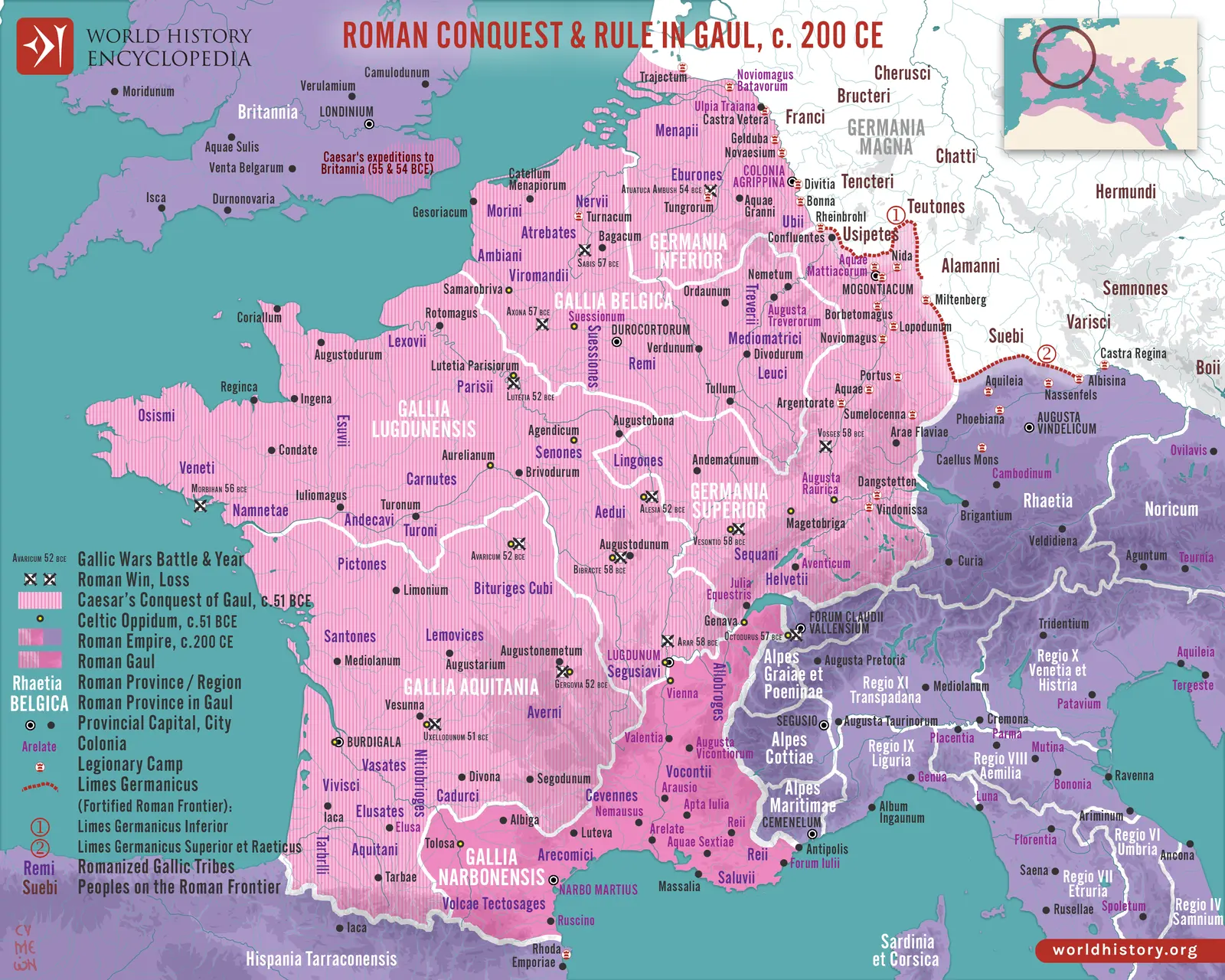
The Sixteenth participated in the succession wars and the collapse of Roman control on the Rhine in 69–70. Vespasian’s response produced a new XVI Flavia Firma and an eastern geographical life. A substantial personnel relationship is accepted in the modern reconstruction, but the refoundation should remain visible as an event.
Endpoint: disappearance of the Gallica identity in the Flavian reorganization of 70. Successor relationship: XVI Flavia Firma, dossier L21.
Selected chronology
- c.41–40 BCE: conventional Octavianic foundation.
- Early empire: Rhine service, including Mainz.
- Middle first century: Neuss phase.
- 69–70: civil war and the Rhine collapse.
- 70: refoundation as XVI Flavia Firma.
The old Sixteenth on the Rhine
XVI Gallica’s name and early history connect it with the military creations of the civil-war age. Its later Rhine residence gave it a provincial social world far removed from the campaigns for which it had originally been raised. Garrison service meant repeated recruitment, the construction and maintenance of installations, and the development of relationships with nearby communities.
Mainz and Neuss represent different phases of that service. Shared regional geography did not mean an unchanged command relationship: frontier establishments could be rearranged as new regiments arrived, old ones departed, or an emperor sought to prevent dangerous concentrations of force.
The breakdown of 69–70
The Sixteenth’s participation in the succession struggle and the subsequent rebellion compromised its standing with the victorious Flavian regime. The crisis exposed how armies could be pulled in several directions at once: loyalty to an emperor, obedience to a local commander, relations with neighboring peoples, and the immediate pressure to survive.
Disgrace did not require the physical elimination of every trained soldier. The new regime had practical reasons to preserve manpower while separating it from the old setting. Refoundation as XVI Flavia Firma and transfer east accomplished both purposes.
What survived the refoundation
The number and a substantial personnel relationship linked the old and new Sixteenths, but the dynastic name and geographical reassignment marked a genuine institutional event. Veterans who crossed into the new formation carried experience and memory; recruits afterward inherited a selectively reconstructed past. The Gallica dossier ends at that transition. The later campaigns and engineering works at Satala, Samosata, and Sura belong under Flavia Firma rather than being projected backward into an imaginary uninterrupted Rhine legion.