Wars · IX. The eastern empire and Justinian's wars
W087 The Iberian war: Dara and Callinicum
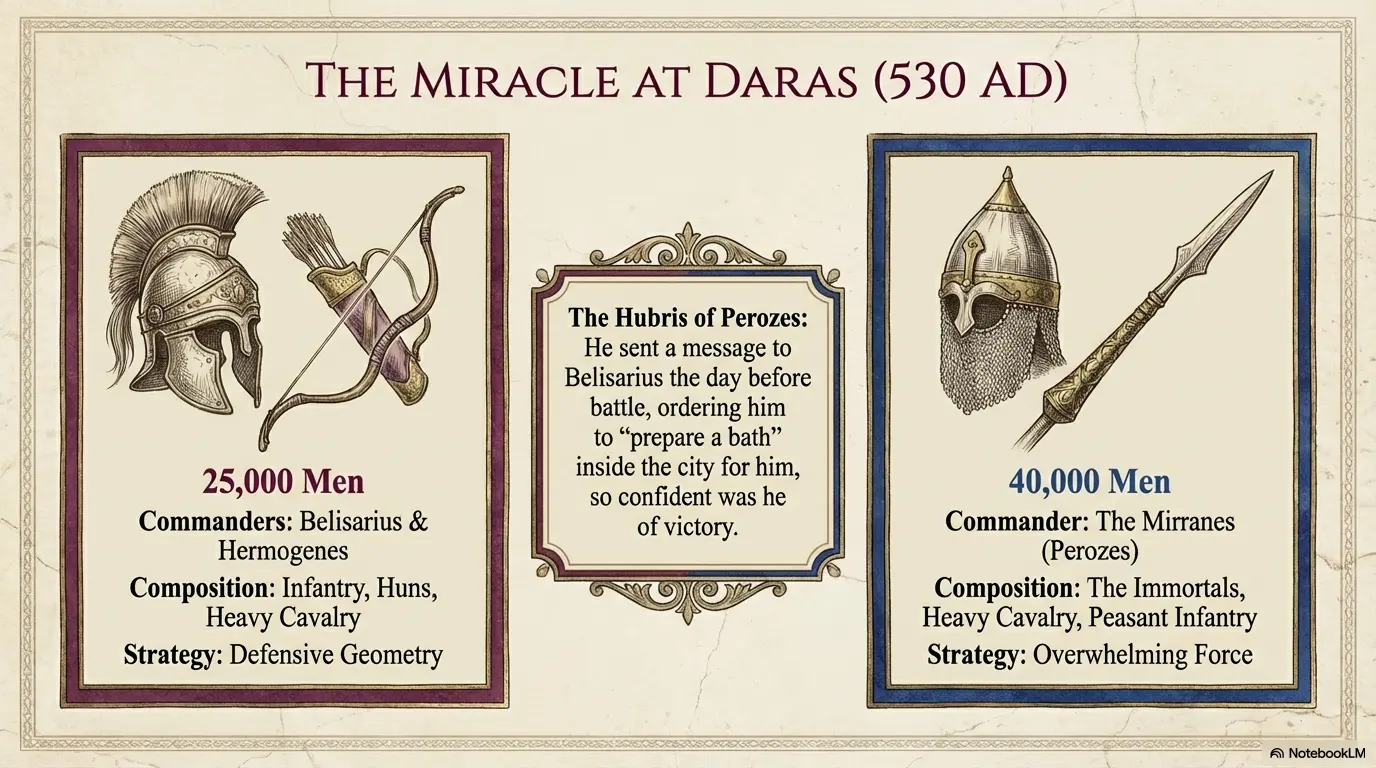
Disputes over Caucasian Iberia contributed to renewed conflict. This Iberia is the Caucasian kingdom, not the Spanish peninsula. Campaigns on several fronts led to the Roman victory at Dara in AD 530, where Belisarius and Hermogenes used prepared ground and coordinated forces against a Persian army.
At Callinicum in AD 531, a Persian and allied Arab force fought Belisarius' army in a very different setting along the Euphrates. Roman defeat there did not settle the whole war. The succession of Khusro I and negotiations led to the "Eternal Peace" of AD 532.
Command, forces and military problem
| Field | Dossier |
|---|---|
| Roman leadership | Belisarius, Hermogenes, Sittas and other commanders |
| Opposing or rival parties | Kavadh I's generals and allied forces; Khusro I at the settlement |
| Forces and capabilities | Cavalry, infantry, prepared defenses and allied Arab contingents |
| Operational problem | Handle several eastern theaters and negotiate without mistaking one battle for the war's result. |
Campaign geography and operational plates
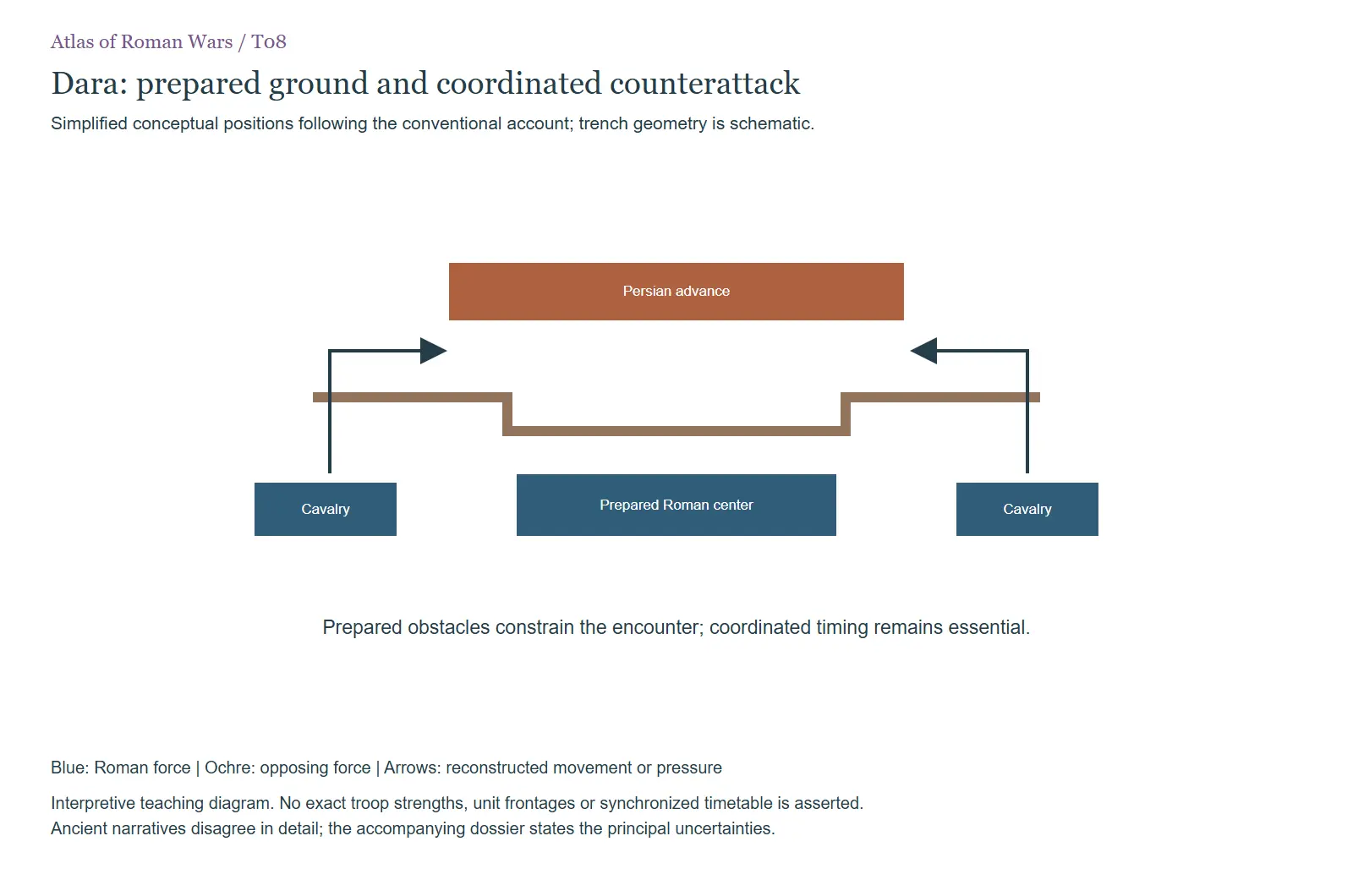
Dara: trenches, intervals and coordinated counterattack
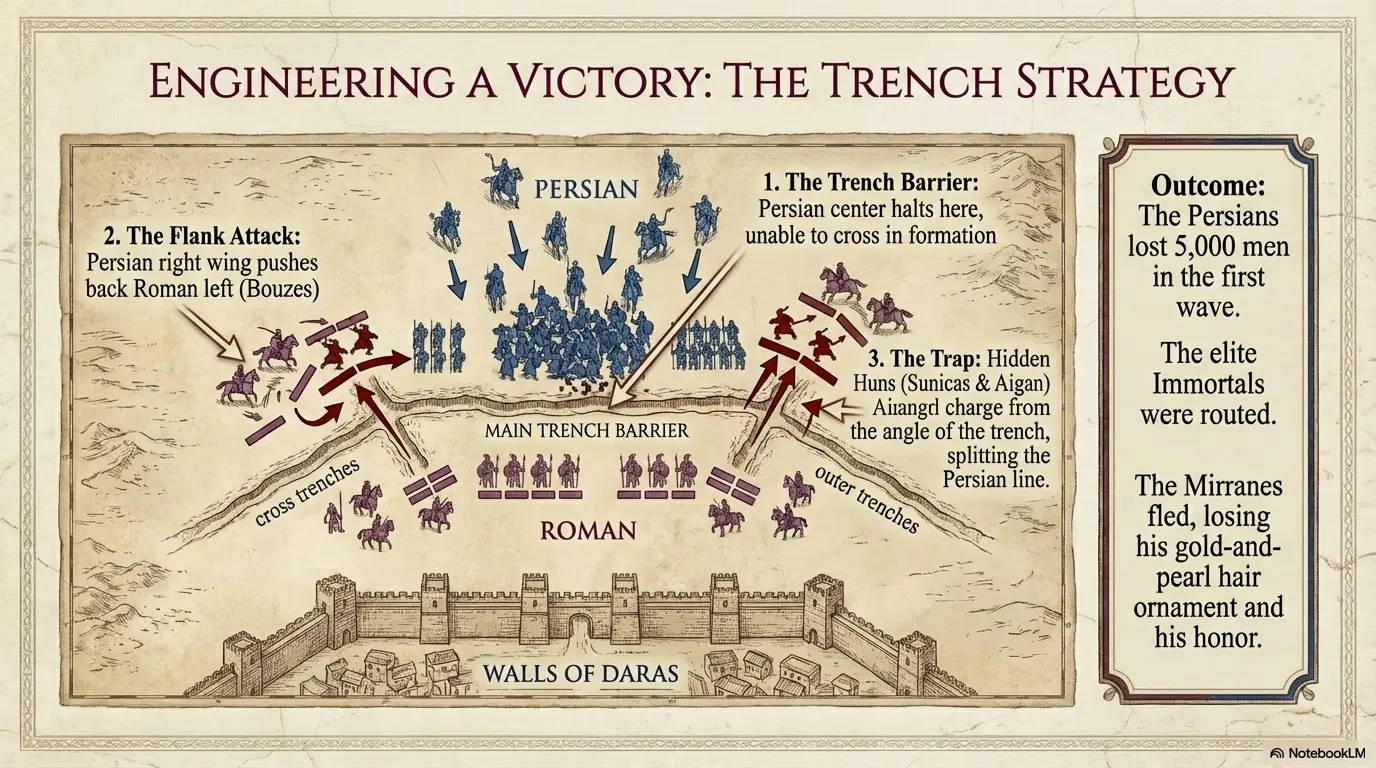
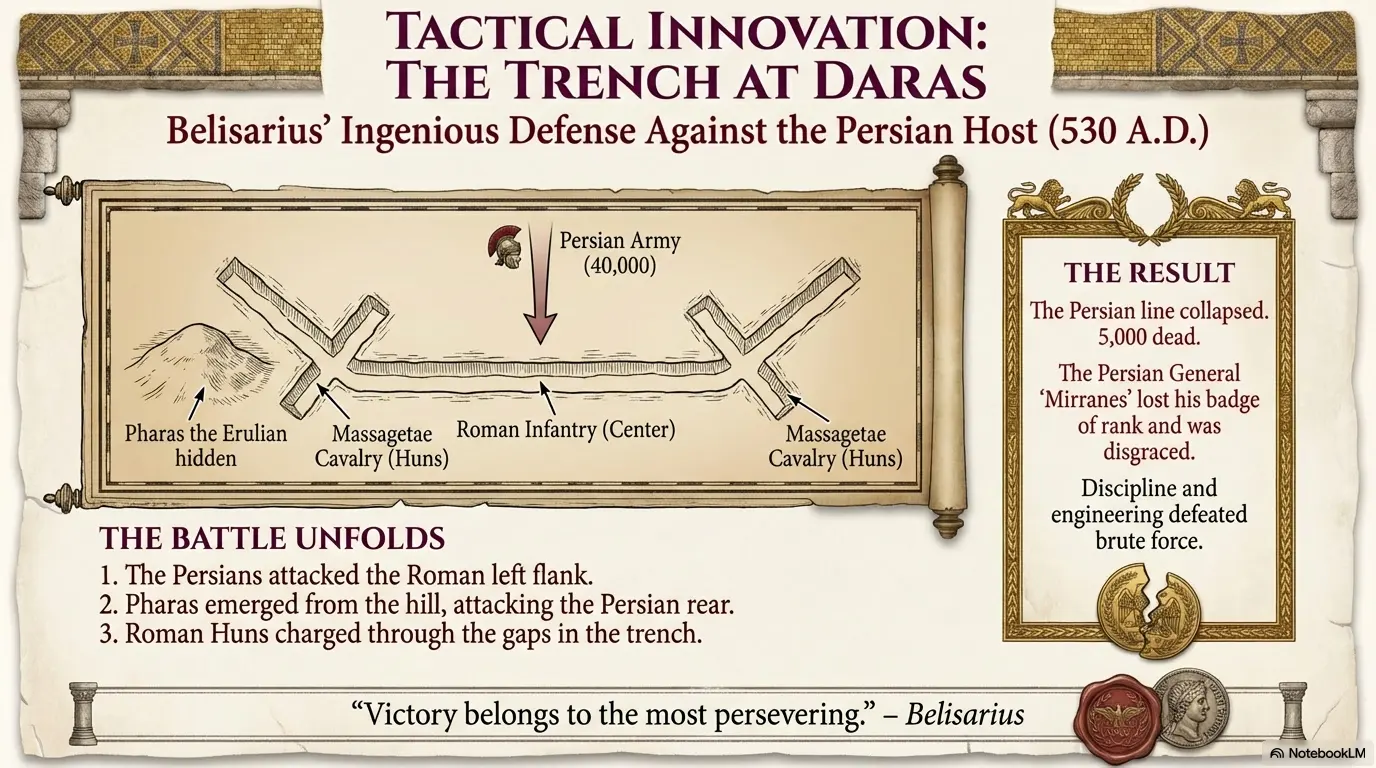
The prepared obstacle constrained where troops could approach and created opportunities for forces placed near its ends or intervals. The diagram complements the atlas's simpler tactical plate by making the interaction with the defended city visible. Its arrows should not be treated as a synchronized minute-by-minute reconstruction.
Contemporary campaign chronicle
The following substantial selections incorporate Procopius' account in H. B. Dewing's public-domain translation. Ancient book, chapter and section numbers are retained. Speeches, reported figures, judgments and divine explanations are the ancient author's testimony, not independently established modern conclusions. Editorial event-date overlays have been removed.
The opening campaigns and the Iberian crisis
1.12.1. Immediately after this, Cabades, though eager to make some kind of an invasion into the land of the Romans, was utterly unable to do so on account of the following obstacle which happened to arise.
1.12.2. The Iberians, who live in Asia, are settled in the immediate neighbourhood of the Caspian Gates, which lie to the north of them. Adjoining them on the left towards the west is Lazica, and on the right towards the east are the Persian peoples. This nation is Christian and they guard the rites of this faith more closely than any other men known to us, but they have been subjects of the Persian king, as it happens, from ancient times. And just then Cabades was desirous of forcing them to adopt the rites of his own religion. And he enjoined upon their king, Gourgenes, to do all things as the Persians are accustomed to do them, and in particular not under any circumstances to hide their dead in the earth, but to throw them all to the birds and dogs. For this reason, then, Gourgenes wished to go over to the Emperor Justinus, and he asked that he might receive pledges that the Romans would never abandon the Iberians to the Persians. And the emperor gave him these pledges with great eagerness, and he sent Probus, the nephew of the late emperor Anastasius, a man of patrician rank, with a great sum of money to Bosporus, that he might win over with money an army of Huns and send them as allies to the Iberians.
This Bosporus is a city by the sea, on the left as one sails into the so-called Euxine Sea, twenty days journey distant from the city of Cherson, which is the limit of the Roman territory. Between these cities everything is held by the Huns.
1.12.8. Now in ancient times the people of Bosporus were autonomous, but lately they had decided to become subject to the Emperor Justinus. Probus, however, departed from there without accomplishing his mission, and the emperor sent Peter as general with some Huns to Lazica to fight with all their strength for Gourgenes. Meanwhile Cabades sent a very considerable army against Gourgenes and the Iberians, and as general a Persian bearing the title of "varizes," Boes by name. Then it was seen that Gourgenes was too weak to withstand the attack of the Persians, for the help from the Romans was insufficient, and with all the notables of the Iberians he fled to Lazica, taking with him his wife and children and also his brothers, of whom Peranius was the eldest. And when they had reached the boundaries of Lazica, they remained there, and, sheltering themselves by the roughness of the country, they took their stand against the enemy. And the Persians followed after them but did nothing deserving even of mention since the circumstance of the rough country was against them.
1.12.14. Thereafter the Iberians presented themselves at Byzantium and Petrus came to the emperor at his summons; and from then on the emperor demanded that he should assist the Lazi to guard their country, even against their will, and he sent an army and Eirenaeus in command of it. Now there are two fortresses in Lazica which one comes upon immediately upon entering their country from the boundaries of Iberia, and the defence of them had been from of old in charge of the natives, although they experienced great hardship in this matter; for neither corn nor wine nor any other good thing is produced there. Nor indeed can anything be carried in from elsewhere on account of the narrowness of the paths, unless it be carried by men.
1.12.17. However, the Lazi were able to live on a certain kind of millet which grows there, since they were accustomed to it. These garrisons the emperor removed from the place and commanded that Roman soldiers should be stationed there to guard the fortresses. And at first the Lazi with difficulty brought in provisions for these soldiers, but later they gave up the service and the Romans abandoned these forts, whereupon the Persians with no trouble took possession of them. This then happened in Lazica.
1.12.20. And the Romans, under the leadership of Sittas and Belisarius, made an inroad into Persarmenia, a territory subject to the Persians, where they plundered a large tract of country and then withdrew with a great multitude of Armenian captives. These two men were both youths and wearing their first beards, body-guards of the general Justinian, who later shared the empire with his uncle Justinus. But when a second inroad had been made by the Romans into Armenia, Narses and Aratius unexpectedly confronted them and engaged them in battle. These men not long after this came to the Romans as deserters, and made the expedition to Italy with Belisarius; but on the present occasion they joined battle with the forces of Sittas and Belisarius and gained the advantage over them. An invasion was also made near the city of Nisibis by another Roman army under command of Libelarius of Thrace. This army retired abruptly in flight although no one came out against them. And because of this the emperor reduced Libelarius from his office and appointed Belisarius commander of the troops in Daras. It was at that time that Procopius, who wrote this history, was chosen as his adviser.
Dara: preparation, positions and fighting
1.13.1. Not long after this Justinus, who had declared his nephew Justinian emperor with him, died, and thus the empire came to Justinian alone. This Justinian commanded Belisarius to build a fortress in a place called Mindouos, which is over against the very boundary of Persia, on the left as one goes to Nisibis. He accordingly with great haste began to carry out the decision of the emperor, and the fort was already rising to a considerable height by reason of the great number of artisans. But the Persians forbade them to build any further, threatening that, not with words alone but also with deeds, they would at no distant time obstruct the work. When the emperor heard this, inasmuch as Belisarius was not able to beat off the Persians from the place with the army he had, he ordered another army to go thither, and also Coutzes and Bouzes, who at that time commanded the soldiers in Libanus. These two were brothers from Thrace, both young and inclined to be rash in engaging with the enemy. So both armies were gathered together and came in full force to the scene of the building operations, the Persians in order to hinder the work with all their power, and the Romans to defend the labourers. And a fierce battle took place in which the Romans were defeated, and there was a great slaughter of them, while some also were made captive by the enemy. Among these was Coutzes himself. All these captives the Persians led away to their own country, and, putting them in chains, confined them permanently in a cave; as for the fort, since no one defended it any longer, they razed what had been built to the ground.
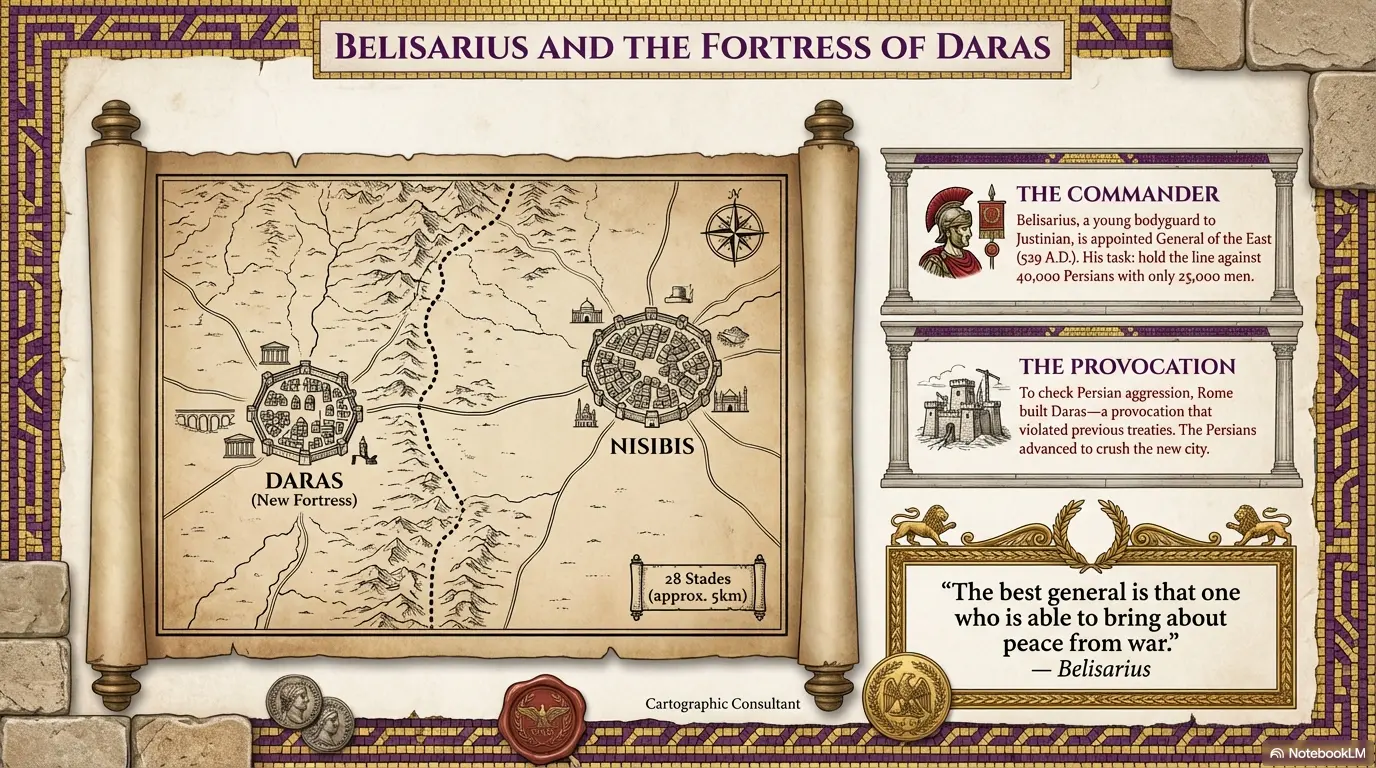
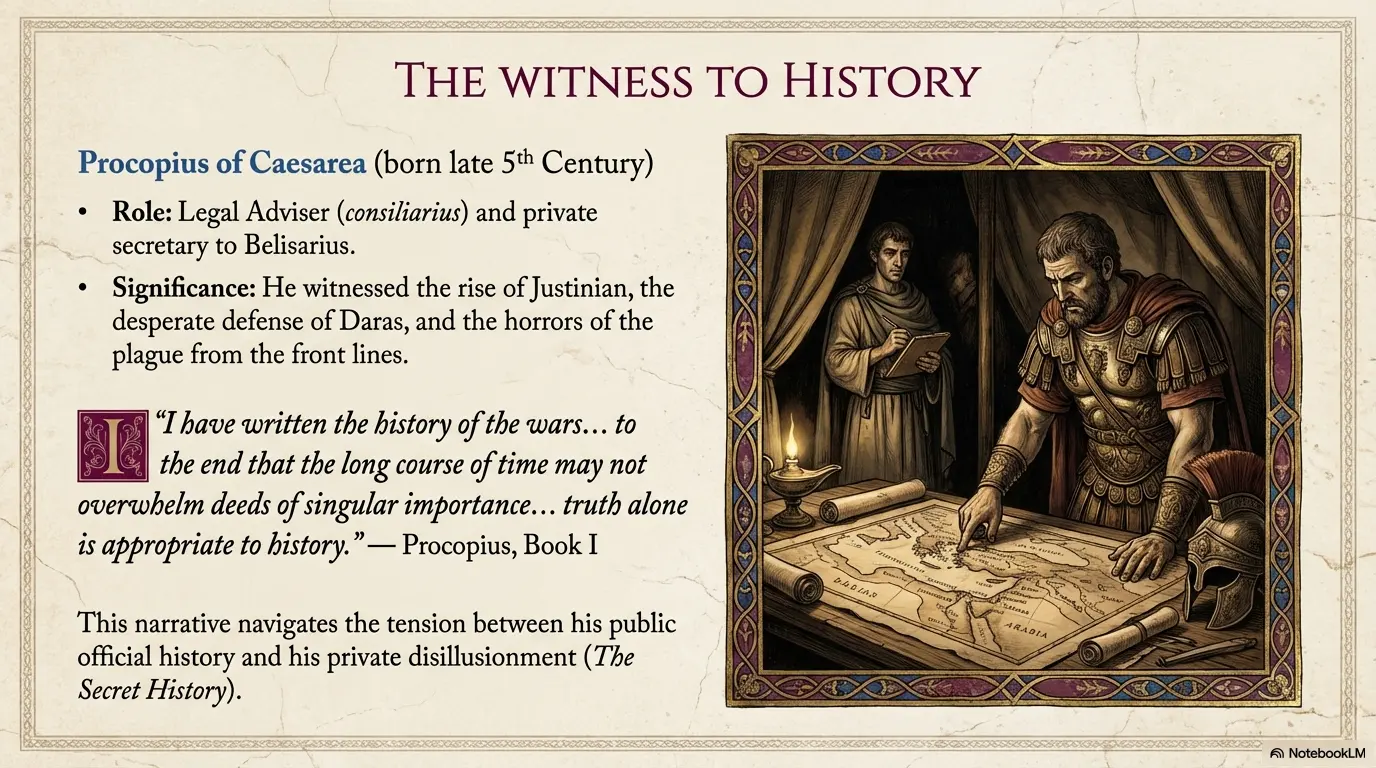
1.13.9. After this the Emperor Justinian appointed Belisarius General of the East and bade him make an expedition against the Persians. And he collected a very formidable army and came to Daras. Hermogenes also came to him from the emperor to assist in setting the army in order, holding the office of magister; this man was formerly counsellor to Vitalianus at the time when he was at war with the Emperor Anastasius. The emperor also sent Rufinus as ambassador, commanding him to remain in Hierapolis on the Euphrates River until he himself should give the word. For already much was being said on both sides concerning peace. Suddenly, however, someone reported to Belisarius and Hermogenes that the Persians were expected to invade the land of the Romans, being eager to capture the city of Daras. And when they heard this, they prepared for the battle as follows. [July, 530]
1.13.13. Not far from the gate which lies opposite the city of Nisibis, about a stone's throw away, they dug a deep trench with many passages across it. Now this trench was not dug in a straight line, but in the following manner. In the middle there was a rather short portion straight, and at either end of this there were dug two cross trenches at right angles to the first; and starting from the extremities of the two cross trenches, they continued two straight trenches in the original direction to a very great distance. Not long afterwards the Persians came with a great army, and all of them made camp in a place called Ammodios, at a distance of twenty stades from the city of Daras.
1.13.16. Among the leaders of this army were Pityaxes and the one-eyed Baresmanas. But one general held command over them all, a Persian, whose title was "mirranes" (for thus the Persians designate this office), Perozes by name. This Perozes immediately sent to Belisarius bidding him make ready the bath: for he wished to bathe there on the following day. Accordingly the Romans made the most vigorous preparations for the encounter, with the expectation that they would fight on the succeeding day.
1.13.19. At sunrise, seeing the enemy advancing against them, they arrayed themselves as follows. The extremity of the left straight trench which joined the cross trench, as far as the hill which rises here, was held by Bouzes with a large force of horsemen and by Pharas the Erulian with three hundred of his nation. On the right of these, outside the trench, at the angle formed by the cross trench and the straight section which extended from that point, were Sunicas and Aigan, Massagetae by birth, with six hundred horsemen, in order that, if those under Bouzes and Pharas should be driven back, they might, by moving quickly on the flank, and getting in the rear of the enemy, be able easily to support the Romans at that point.
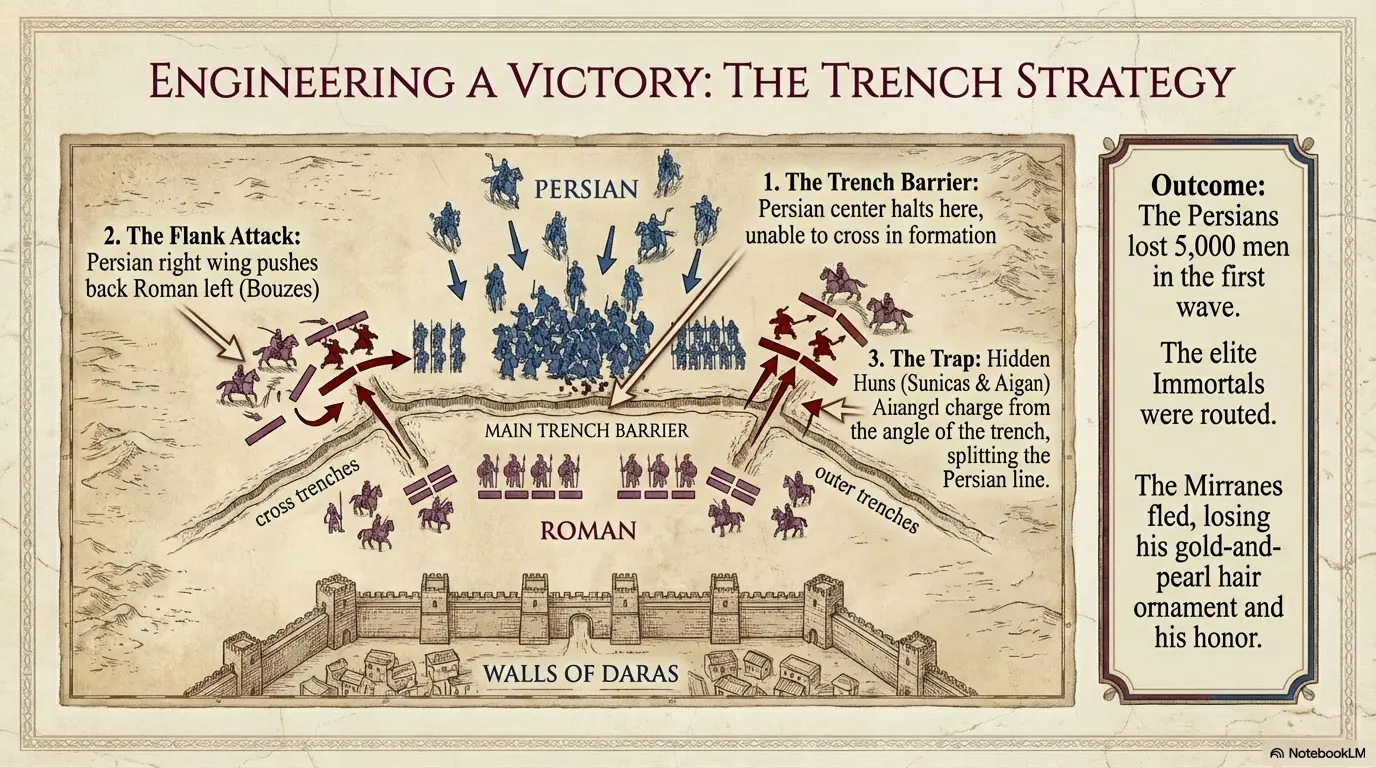
On the other wing also they were arrayed in the same manner; for the extremity of the straight trench was held by a large force of horsemen, who were commanded by John, son of Nicetas, and by Cyril and Marcellus; with them also were Germanus and Dorotheus; while at the angle on the right six hundred horsemen took their stand, commanded by Simmas and Ascan, Massagetae, in order that, as has been said, in case the forces of John should by any chance be driven back, they might move out from there and attack the rear of the Persians. Thus all along the trench stood the detachments of cavalry and the infantry. And behind these in the middle stood the forces of Belisarius and Hermogenes. Thus the Romans arrayed themselves, amounting to five-and-twenty thousand; but the Persian army consisted of forty thousand horse and foot, and they all stood close together facing the front, so as to make the front of the phalanx as deep as possible. Then for a long time neither side began battle with the other, but the Persians seemed to be wondering at the good order of the Romans, and appeared at a loss what to do under the circumstances.
1.13.25. In the late afternoon a certain detachment of the horsemen who held the right wing, separating themselves from the rest of the army, came against the forces of Bouzes and Pharas. And the Romans retired a short distance to the rear. The Persians, however, did not pursue them, but remained there, fearing, I suppose, some move to surround them on the part of the enemy. Then the Romans who had turned to flight suddenly rushed upon them. And the Persians did not withstand their onset and rode back to the phalanx, and again the forces of Bouzes and Pharas stationed themselves in their own position. In this skirmish seven of the Persians fell, and the Romans gained possession of their bodies; thereafter both armies remained quietly in position. But one Persian, a young man, riding up very close to the Roman army, began to challenge all of them,
1.13.29. calling for whoever wished to do battle with him. And no one of the whole army dared face the danger, except a certain Andreas, one of the personal attendants of Bouzes, not a soldier nor one who had ever practised at all the business of war, but a trainer of youths in charge of a certain wrestling school in Byzantium.
1.13.31. Through this it came about that he was following the army, for he cared for the person of Bouzes in the bath; his birthplace was Byzantium. This man alone had the courage, without being ordered by Bouzes or anyone else, to go out of his own accord to meet the man in single combat. And he caught the barbarian while still considering how he should deliver his attack, and hit him with his spear on the right breast. And the Persian did not bear the blow delivered by a man of such exceptional strength, and fell from his horse to the earth. Then Andreas with a small knife slew him like a sacrificial animal as he lay on his back, and a mighty shout was raised both from the city wall and from the Roman army. But the Persians were deeply vexed at the outcome and sent forth another horseman for the same purpose, a manly fellow and well favoured as to bodily size, but not a youth, for some of the hair on his head already shewed grey. This horseman came up along the hostile army, and, brandishing vehemently the whip with which he was accustomed to strike his horse, he summoned to battle whoever among the Romans was willing.
1.13.35. And when no one went out against him, Andreas, without attracting the notice of anyone, once more came forth, although he had been forbidden to do so by Hermogenes. So both rushed madly upon each other with their spears, and the weapons, driven against their corselets, were turned aside with mighty force, and the horses, striking together their heads, fell themselves and threw off their riders. And both the two men, falling very close to each other, made great haste to rise to their feet, but the Persian was not able to do this easily because his size was against him, while Andreas, anticipating him (for his practice in the wrestling school gave him this advantage), smote him as he was rising on his knee, and as he fell again to the ground dispatched him. Then a roar went up from the wall and from the Roman army as great, if not greater, than before; and the Persians broke their phalanx and withdrew to Ammodios, while the Romans, raising the pæan, went inside the fortifications; for already it was growing dark. Thus both armies passed that night.
1.14.1. On the following day ten thousand soldiers arrived who had been summoned by the Persians from the city of Nisibis, and Belisarius and Hermogenes wrote to the mirranes as follows: "The first blessing is peace, as is agreed by all men who have even a small share of reason. It follows that if any one should be a destroyer of it, he would be most responsible not only to those near him but also to his whole nation for the troubles which come. The best general, therefore, is that one who is able to bring about peace from war. But you, when affairs were well settled between the Romans and the Persians, have seen fit to bring upon us a war without cause,
1.14.3. although the counsels of each king are looking toward peace, and although our envoys are already present in the neighbourhood, who will at no distant time settle all the points of dispute in talking over the situation together, unless some irreparable harm coming from your invasion proves sufficient to frustrate for us this hope. But lead away as soon as possible your army to the land of the Persians, and do not stand in the way of the greatest blessings, lest at some time you be held responsible by the Persians, as is probable, for the disasters which will come to pass." When the mirranes saw this letter brought to him, he replied as follows: "I should have been persuaded by what you write, and should have done what you demand, were the letter not, as it happens, from Romans, for whom the making of promises is easy, but the fulfilment of the promises in deed most difficult and beyond hope, especially if you sanction the agreement by any oaths. We, therefore, despairing in view of your deception, have been compelled to come before you in arms, and as for you, my dear Romans, consider that from now on you will be obliged to do nothing else than make war against the Persians. For here we shall be compelled either to die or grow old until you accord to us justice in deed." Such was the reply which the mirranes wrote back.
1.14.7. And again Belisarius and his generals wrote as follows: "O excellent mirranes, it is not fitting in all things to depend upon boasting, nor to lay upon one's neighbours reproaches which are justified on no grounds whatever. For we said with truth that Rufinus had come to act as an envoy and was not far away, and you yourself will know this at no remote time.
1.14.9. But since you are eager for deeds of war, we shall array ourselves against you with the help of God, who will, we know, support us in the danger, being moved by the peaceful inclination of the Romans, but rebuking the boastfulness of the Persians and your decision to resist us when we invite you to peace. And we shall array ourselves against you, having prepared for the conflict by fastening the letters written by each of us on the top of our banners." Such was the message of this letter. And the mirranes again answered as follows: "Neither are we entering upon the war without our gods, and with their help we shall come before you, and I expect that on the morrow they will bring the Persians into Daras. But let the bath and lunch be in readiness for me within the fortifications." When Belisarius and his generals read this, they prepared themselves for the conflict.
1.14.13. On the succeeding day the mirranes called together all the Persians at about sunrise and spoke as follows: "I am not ignorant that it is not because of words of their leaders, but because of their individual bravery and their shame before each other that the Persians are accustomed to be courageous in the presence of dangers. But seeing you considering why in the world it is that, although the Romans have not been accustomed heretofore to go into battle without confusion and disorder, they recently awaited the advancing Persians with a kind of order which is by no means characteristic of them, for this reason I have decided to speak some words of exhortation to you, so that it may not come about that you be deceived by reason of holding an opinion which is not true. For I would not have you think that the Romans have suddenly become better warriors, or that they have acquired any more valour or experience,
1.14.15. but that they have become more cowardly than they were previously; at any rate they fear the Persians so much that they have not even dared to form their phalanx without a trench. And not even with this did they begin any fighting, but when we did not join battle with them at all, joyfully and considering that matters had gone better for them than they had hoped, they withdrew to the wall. For this reason too it happened that they were not thrown into confusion, for they had not yet come into the dangers of battle. But if the fighting comes to close quarters, fear will seize upon them, and this, together with their inexperience, will throw them, in all probability, into their customary disorder. Such, therefore, is the case with regard to the enemy; but do you, O men of Persia, call to mind the judgment of the King of Kings. For if you do not play the part of brave men in the present engagement, in a manner worthy of the valour of the Persians, an inglorious punishment will fall upon you." With this exhortation the mirranes began to lead his army against the enemy. Likewise Belisarius and Hermogenes gathered all the Romans before the fortifications, and encouraged them with the following words: "You know assuredly that the Persians are not altogether invincible, nor too strong to be killed, having taken their measure in the previous battle; and that, although superior to them in bravery and in strength of body, you were defeated only by reason of being rather heedless of your officers, no one can deny. This thing you now have the opportunity to set right with no trouble.
1.14.22. For while the adversities of fortune are by no means such as to be set right by an effort, reason may easily become for a man a physician for the ills caused by himself. If therefore you are willing to give heed to the orders given, you will straightway win for yourselves the superiority in battle. For the Persians come against us basing their confidence on nothing else than our disorder. But this time also they will be disappointed in this hope, and will depart just as in the previous encounter. And as for the great numbers of the enemy, by which more than anything else they inspire fear, it is right for you to despise them. For their whole infantry is nothing more than a crowd of pitiable peasants who come into battle for no other purpose than to dig through walls and to despoil the slain and in general to serve the soldiers. For this reason they have no weapons at all with which they might trouble their opponents, and they only hold before themselves those enormous shields in order that they may not possibly be hit by the enemy. Therefore if you shew yourselves brave men in this struggle, you will not only conquer the Persians for the present, but you will also punish them for their folly, so that they will never again make an expedition into the Roman territory."
1.14.28. When Belisarius and Hermogenes had finished this exhortation, since they saw the Persians advancing against them, they hastily drew up the soldiers in the same manner as before. And the barbarians, coming up before them, took their stand facing the Romans. But the mirranes did not array all the Persians against the enemy, but only one half of them, while he allowed the others to remain behind.
1.14.30. These were to take the places of the men who were fighting and to fall upon their opponents with their vigour intact, so that all might fight in constant rotation. But the detachment of the so-called Immortals alone he ordered to remain at rest until he himself should give the signal. And he took his own station at the middle of the front, putting Pityaxes in command on the right wing, and Baresmanas on the left. In this manner, then, both armies were drawn up. Then Pharas came before Belisarius and Hermogenes, and said: "It does not seem to me that I shall do the enemy any great harm if I remain here with the Eruli; but if we conceal ourselves on this slope, and then, when the Persians have begun the fight, if we climb up by this hill and suddenly come upon their rear, shooting from behind them, we shall in all probability do them the greatest harm." Thus he spoke, and, since it pleased Belisarius and his staff, he carried out this plan.
1.14.34. But up to midday neither side began battle. As soon, however, as the noon hour was passed, the barbarians began the fight, having postponed the engagement to this time of the day for the reason that they are accustomed to partake of food only towards late afternoon, while the Romans have their meal before noon; and for this reason they thought that the Romans would never hold out so well, if they assailed them while hungry. At first, then, both sides discharged arrows against each other, and the missiles by their great number made, as it were, a vast cloud; and many men were falling on both sides, but the missiles of the barbarians flew much more thickly. For fresh men were always fighting in turn, affording to their enemy not the slightest opportunity to observe what was being done; but even so the Romans did
1.14.36. not have the worst of it. For a steady wind blew from their side against the barbarians, and checked to a considerable degree the force of their arrows. Then, after both sides had exhausted all their missiles, they began to use their spears against each other, and the battle had come still more to close quarters. On the Roman side the left wing was suffering especially. For the Cadiseni, who with Pityaxes were fighting at this point, rushing up suddenly in great numbers, routed their enemy, and crowding hard upon the fugitives, were killing many of them. When this was observed by the men under Sunicas and Aigan, they charged against them at full speed. But first the three hundred Eruli under Pharas from the high ground got in the rear of the enemy and made a wonderful display of valorous deeds against all of them and especially the Cadiseni. And the Persians, seeing the forces of Sunicas too already coming up against them from the flank, turned to a hasty flight. And the rout became complete, for the Romans here joined forces with each other, and there was a great slaughter of the barbarians. On the Persian right wing not fewer than three thousand perished in this action, while the rest escaped with difficulty to the phalanx and were saved. And the Romans did not continue their pursuit, but both sides took their stand facing each other in line. Such was the course of these events.
1.14.44. But the mirranes stealthily sent to the left a large body of troops and with them all the so-called Immortals. And when these were noticed by Belisarius and Hermogenes, they ordered the six hundred men under Sunicas and Aigan to go to the angle on the right, where the troops of Simmas and Ascan were stationed, and behind them they placed many of Belisarius men. So the Persians who held the left wing under the leadership of Baresmanas, together with the Immortals, charged on the run upon the Romans opposite them, who failed to withstand the attack and beat a hasty retreat. Thereupon the Romans in the angle, and all who were behind them, advanced with great ardour against the pursuers. But inasmuch as they came upon the barbarians from the side, they cut their army into two parts, and the greater portion of them they had on their right, while some also who were left behind were placed on their left. Among these happened to be the standard bearer of Baresmanas, whom Sunicas charged and struck with his spear.
Armenia and Satala
1.15.1. And Cabades sent another army into the part of Armenia which is subject to the Romans. This army was composed of Persarmenians and Sunitae, whose land adjoins that of the Alani. There were also Huns with them, of the stock called Sabiri, to the number of three thousand, a most warlike race. And Mermeroes, a Persian, had been made general of the whole force.
1.15.2. When this army was three days' march from Theodosiopolis, they established their camp and, remaining in the land of the Persarmenians, made their preparations for the invasion. Now the general of Armenia was, as it happened, Dorotheus, a man of discretion and experienced in many wars. And Sittas held the office of general in Byzantium, and had authority over the whole army in Armenia. These two, then, upon learning that an army was being assembled in Persarmenia, straightway sent two body-guards with instructions to spy out the whole force of the enemy and report to them. And both of these men got into the barbarian camp, and after noting everything accurately, they departed. And they were travelling toward some place in that region, when they happened unexpectedly upon hostile Huns. By them one of the two, Dagaris by name, was made captive and bound, while the other succeeded in escaping and reported everything to the generals. They then armed their whole force and made an unexpected assault upon the camp of their enemy; and the barbarians, panic-stricken by the unexpected attack, never thought of resistance, but fled as best each one could. Thereupon the Romans, after killing a large number and plundering the camp, immediately marched back.
1.15.9. Not long after this Mermeroes, having collected the whole army, invaded the Roman territory, and they came upon their enemy near the city of Satala. There they established themselves in camp and remained at rest in a place called Octava, which is fifty-six stades distant from the city. Sittas therefore led out a thousand men and concealed them behind one of the many hills which surround the plain in which the city of Satala
1.15.10. lies. Dorotheus with the rest of the army he ordered to stay inside the fortifications, because they thought that they were by no means able to withstand the enemy on level ground, since their number was not fewer than thirty thousand, while their own forces scarcely amounted to half that number. On the following day the barbarians came up close to the fortifications and busily set about closing in the town. But suddenly, seeing the forces of Sittas who by now were coming down upon them from the high ground, and having no means of estimating their number, since owing to the summer season a great cloud of dust hung over them, they thought they were much more numerous than they were, and, hurriedly abandoning their plan of closing in the town, they hastened to mass their force into a small space. But the Romans anticipated the movement and, separating their own force into two detachments, they set upon them as they were retiring from the fortifications; and when this was seen by the whole Roman army, they took courage, and with a great rush they poured out from the fortifications and advanced against their opponents. They thus put the Persians between their own troops, and turned them to flight. However, since the barbarians were greatly superior to their enemy in numbers, as has been said, they still offered resistance, and the battle had become a fierce fight at close quarters. And both sides kept making advances upon their opponents and retiring quickly, for they were all cavalry. Thereupon Florentius, a Thracian, commanding a detachment of horse, charged into the enemy's centre, and seizing the general's standard, forced it to the ground, and
1.15.15. started to ride back. And though he himself was overtaken and fell there, hacked to pieces, he proved to be the chief cause of the victory for the Romans. For when the barbarians no longer saw the standard, they were thrown into great confusion and terror, and retreating, got inside their camp, and remained quiet, having lost many men in the battle; and on the following day they all returned homeward with no one following them up, for it seemed to the Romans a great and very noteworthy thing that such a great multitude of barbarians in their own country had suffered those things which have just been narrated above, and that, after making an invasion into hostile territory, they should retire thus without accomplishing anything and defeated by a smaller force.
1.15.18. At that time the Romans also acquired certain Persian strongholds in Persarmenia, both the fortress of Bolum and the fortress called Pharangium, which is the place where the Persians mine gold, which they take to the king. It happened also that a short time before this they had reduced to subjection the Tzanic nation, who had been settled from of old in Roman territory as an autonomous people; and as to these things, the manner in which they were accomplished will be related here and now. As one goes from the land of Armenia into Persarmenia the Taurus lies on the right, extending into Iberia and the peoples there, as has been said a little before this, while on the left the road which continues to descend for a great distance is overhung by exceedingly precipitous mountains, concealed forever by clouds and snow, from which the Phasis River
1.15.21. issues and flows into the land of Colchis. In this place from the beginning lived barbarians, the Tzanic nation, subject to no one, called Sani in early times; they made plundering expeditions among the Romans who lived round about, maintaining a most difficult existence, and always living upon what they stole; for their land produced for them nothing good to eat. Wherefore also the Roman emperor sent them each year a fixed amount of gold, with the condition that they should never plunder the country thereabout. And the barbarians had sworn to observe this agreement with the oaths peculiar to their nation, and then, disregarding what they had sworn, they had been accustomed for a long time to make unexpected attacks and to injure not only the Armenians, but also the Romans who lived next to them as far as the sea; then, after completing their inroad in a short space of time, they would immediately betake themselves again to their homes. And whenever it so happened that they chanced upon a Roman army, they were always defeated in the battle, but they proved to be absolutely beyond capture owing to the strength of their fastnesses. In this way Sittas had defeated them in battle before this war; and then by many manifestations of kindness in word and in deed he had been able to win them over completely. For they changed their manner of life to one of a more civilized sort, and enrolled themselves among the Roman troops, and from that time they have gone forth against the enemy with the rest of the Roman army. They also abandoned their own religion for a more righteous faith, and all of them became Christians. Such then was the history of the Tzani.
1.15.26. Beyond the borders of this people there is a canyon whose walls are both high and exceedingly steep, extending as far as the Caucasus mountains. In it are populous towns, and grapes and other fruits grow plentifully. And this cañon for about the space of a three days' journey is tributary to the Romans, but from there begins the territory of Persarmenia; and here is the gold-mine which, with the permission of Cabades, was worked by one of the natives, Symeon by name. When this Symeon saw that both nations were actively engaged in the war, he decided to deprive Cabades of the revenue. Therefore he gave over both himself and Pharangium to the Romans, but refused to deliver over to either one the gold of the mine. And as for the Romans, they did nothing, thinking it sufficient for them that the enemy had lost the income from there, and the Persians were not able against the will of the Romans to force the inhabitants of the place to terms, because they were baffled by the difficult country.
1.15.31. At about the same time Narses and Aratius who at the beginning of this war, as I have stated above, had an encounter with Sittas and Belisarius in the land of the Persarmenians, came together with their mother as deserters to the Romans; and the emperor's steward, Narses, received them (for he too happened to be a Persarmenian by birth), and he presented them with a large sum of money. When this came to the knowledge of Isaac, their youngest brother, he secretly opened negotiations with the Romans, and delivered over to them the fortress of Bolum, which lies very near the limits of Theodosiopolis.
1.15.32. For he directed that soldiers should be concealed somewhere in the vicinity, and he received them into the fort by night, opening stealthily one small gate for them. Thus he too came to Byzantium.
Callinicum and the limits of pursuit
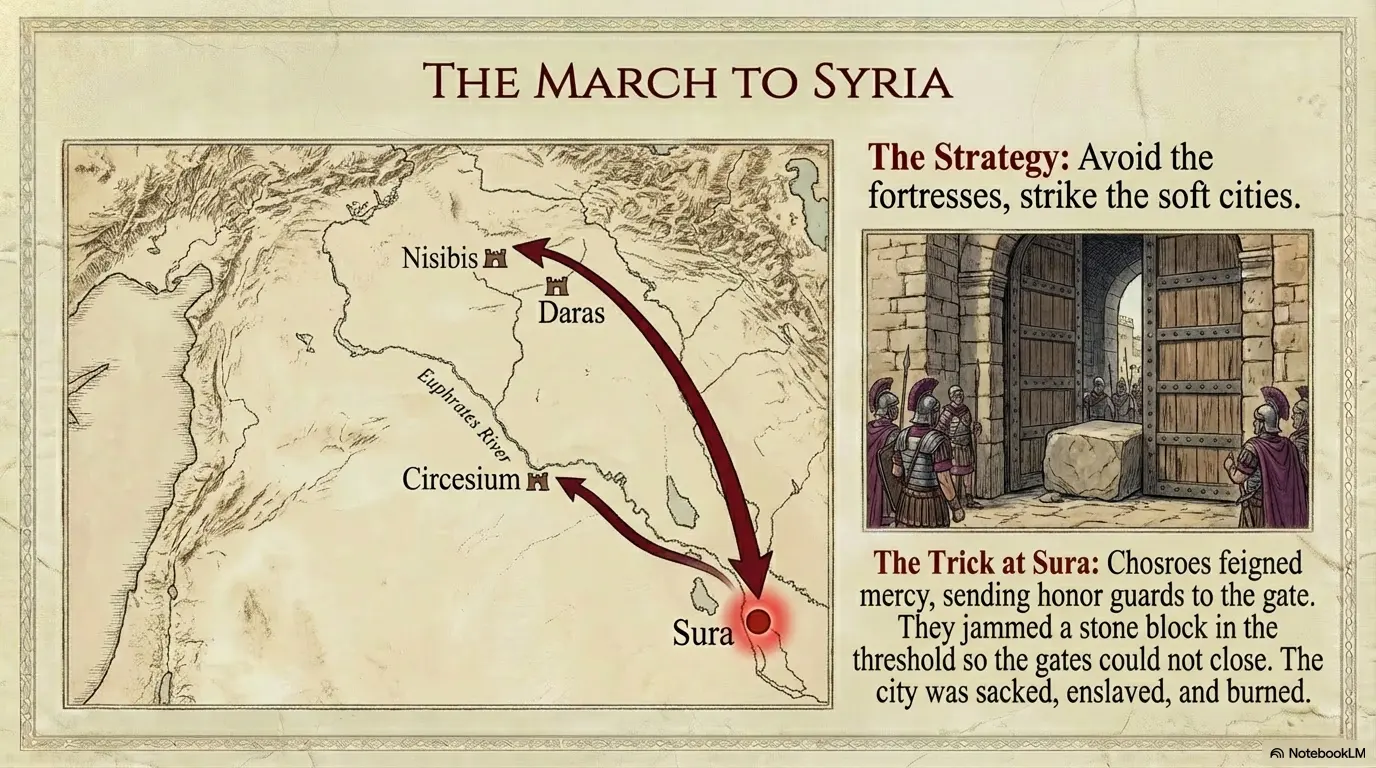
1.18.1. This man's suggestion at that time therefore pleased Cabades, and he chose out fifteen thousand men, putting in command of them Azarethes, a Persian, who was an exceptionally able warrior, and he bade Alamoundaras lead the expedition. So they crossed the River Euphrates in Assyria, and, after passing over some uninhabited country, they suddenly and unexpectedly threw their forces into the land of the so-called Commagenae. This was the first invasion made by the Persians from this point into Roman soil, as far as we know from tradition or by any other means, and it paralyzed all the Romans with fear by its unexpectedness. And when this news came to the knowledge of Belisarius, at first he was at a loss, but afterwards he decided to go to the rescue with all speed. So he established a sufficient garrison in each city in order that Cabades with another hostile army might not come there and find the towns of Mesopotamia utterly unguarded, and himself with the rest of the army went to meet the invasion; and crossing the River Euphrates they moved forward in great haste. Now the Roman army amounted to about twenty thousand foot and horse, and among them not less than two thousand were Isaurians. The commanders of cavalry were all the same ones who had previously fought the battle at Daras with Mirranes and the Persians, while the infantry were commanded by one of the body-guards of the Emperor Justinian, Peter by name. The Isaurians, however, were under the command of Longinus and Stephanacius.
1.18.7. Arethas also came there to join them with the Saracen army. When they reached the city of Chalcis, they encamped and remained there, since they learned that the enemy were in a place called Gabboulon, one hundred and ten stades away from Chalcis. When this became known to Alamoundaras and Azarethes, they were terrified at the danger, and no longer continued their advance, but decided to retire homeward instantly. Accordingly they began to march back, with the River Euphrates on the left, while the Roman army was following in the rear. And in the spot where the Persians bivouacked each night the Romans always tarried on the following night. For Belisarius purposely refused to allow the army to make any longer march because he did not wish to come to an engagement with the enemy, but he considered that it was sufficient for them that the Persians and Alamoundaras, after invading the land of the Romans, should retire from it in such a fashion, betaking themselves to their own land without accomplishing anything. And because of this all secretly mocked him, both officers and soldiers, but not a man reproached him to his face.
Finally the Persians made their bivouac on the bank of the Euphrates just opposite the city of Callinicus. From there they were about to march through a country absolutely uninhabited by man, and thus to quit the land of the Romans; for they purposed no longer to proceed as before, keeping to the bank of the river. The Romans had passed the night in the city of Sura, and, removing from there, they came upon the enemy just in the act of preparing for the departure.
1.18.15. Now the feast of Easter was near and would take place on the following day; this feast is reverenced by the Christians above all others, and on the day before it they are accustomed to refrain from food and drink not only throughout the day, but for a large part of the night also they continue the fast. Then, therefore, Belisarius, seeing that all his men were passionately eager to go against the enemy, wished to persuade them to give up this idea (for this course had been counselled by Hermogenes also, who had come recently on an embassy from the emperor); he accordingly called together all who were present and spoke as follows: "O Romans, whither are you rushing? and what has happened to you that you are purposing to choose for yourselves a danger which is not necessary? Men believe that there is only one victory which is unalloyed, namely to suffer no harm at the hands of the enemy, and this very thing has been given us in the present instance by fortune and by the fear of us that overpowers our foes.
Therefore it is better to enjoy the benefit of our present blessings than to seek them when they have passed. For the Persians, led on by many hopes, undertook an expedition against the Romans, and now, with everything lost, they have beaten a hasty retreat. So that if we compel them against their will to abandon their purpose of withdrawing and to come to battle with us, we shall win no advantage whatsoever if we are victorious,—for why should one rout a fugitive?—while if we are unfortunate, as may happen, we shall both be deprived of the victory which we now have, not robbed of it by the enemy, but flinging it away ourselves, and also we shall abandon the land of the emperor to lie open hereafter to the attacks of
1.18.20. the enemy without defenders. Moreover this also is worth your consideration, that God is always accustomed to succour men in dangers which are necessary, not in those which they choose for themselves. And apart from this it will come about that those who have nowhere to turn will play the part of brave men even against their will, while the obstacles which are to be met by us in entering the engagement are many; for a large number of you have come on foot and all of us are fasting. I refrain from mentioning that some even now have not arrived." So spoke Belisarius. But the army began to insult him, not in silence nor with any concealment, but they came shouting into his presence, and called him weak and a destroyer of their zeal; and even some of the officers joined with the soldiers in this offence, thus displaying the extent of their daring. And Belisarius, in astonishment at their shamelessness, changed his exhortation and now seemed to be urging them on against the enemy and drawing them up for battle, saying that he had not known before their eagerness to fight, but that now he was of good courage and would go against the enemy with a better hope. He then formed the phalanx with a single front, disposing his men as follows: on the left wing by the river he stationed all the infantry, while on the right where the ground rose sharply he placed Arethas and all his Saracens; he himself with the cavalry took his position in the centre. Thus the Romans arrayed themselves.
1.18.27. And when Azarethes saw the enemy gathering in battle line, he exhorted his men with the following words: "Persians as you are, no one would deny that you would not give up your valour in exchange for life, if a choice of the two should be offered. But I say that not even if you should wish, is it within your power to make the choice between the two.
For as for men who have the opportunity to escape from danger and live in dishonour it is not at all unnatural that they should, if they wish, choose what is most pleasant instead of what is best; but for men who are bound to die, either gloriously at the hands of the enemy or shamefully led to punishment by your Master, it is extreme folly not to choose what is better instead of what is most shameful. Now, therefore, when things stand thus, I consider that it befits you all to bear in mind not only the enemy but also your own Lord and so enter this battle." After Azarethes also had uttered these words of exhortation, he stationed the phalanx opposite his opponents, assigning the Persians the right wing and the Saracens the left. Straightway both sides began the fight, and the battle was exceedingly fierce. For the arrows, shot from either side in very great numbers, caused great loss of life in both armies, while some placed themselves in the interval between the armies and made a display of valorous deeds against each other, and especially among the Persians they were falling by the arrows in great numbers. For while their missiles were incomparably more frequent, since the Persians are almost all bowmen and they learn to make their shots much more rapidly than any other men, still the bows which sent the arrows were weak and not very
1.18.33. tightly strung, so that their missiles, hitting a corselet, perhaps, or helmet or shield of a Roman warrior, were broken off and had no power to hurt the man who was hit. The Roman bowmen are always slower indeed, but inasmuch as their bows are extremely stiff and very tightly strung, and one might add that they are handled by stronger men, they easily slay much greater numbers of those they hit than do the Persians, for no armour proves an obstacle to the force of their arrows. Now already two-thirds of the day had passed, and the battle was still even. Then by mutual agreement all the best of the Persian army advanced to attack the Roman right wing, where Arethas and the Saracens had been stationed. But they broke their formation and moved apart, so that they got the reputation of having betrayed the Romans to the Persians. For without awaiting the oncoming enemy they all straightway beat a hasty retreat. So the Persians in this way broke through the enemy's line and immediately got in the rear of the Roman cavalry. Thus the Romans, who were already exhausted both by the march and the labour of the battle,—and besides this they were all fasting so far on in the day,— now that they were assailed by the enemy on both sides, held out no longer, but the most of them in full flight made their way to the islands in the river which were close by, while some also remained there and performed deeds both amazing and remarkable against the enemy. Among these was Ascan who, after killing many of the notables among the Persians, was gradually hacked to pieces and finally fell, leaving
1.18.38. to the enemy abundant reason to remember him. And with him eight hundred others perished after shewing themselves brave men in this struggle, and almost all the Isaurians fell with their leaders, without even daring to lift their weapons against the enemy. For they were thoroughly inexperienced in this business, since they had recently left off farming and entered into the perils of warfare, which before that time were unknown to them. And yet just before these very men had been most furious of all for battle because of their ignorance of warfare, and were then reproaching Belisarius with cowardice.
They were not in fact all Isaurians but the majority of them were Lycaones. Belisarius with some few men remained there, and as long as he saw Ascan and his men holding out, he also in company with those who were with him held back the enemy; but when some of Ascan's troops had fallen, and the others had turned to flee wherever they could, then at length he too fled with his men and came to the phalanx of infantry, who with Peter were still fighting, although not many in number now, since the most of them too had fled. There he himself gave up his horse and commanded all his men to do the same thing and on foot with the others to fight off the oncoming enemy. And those of the Persians who were following the fugitives, after pursuing for only a short distance, straightway returned and rushed upon the infantry and Belisarius with all the others. Then the Romans turned their backs to the river so that no movement to surround them might be executed by the enemy, and as best they could under the circumstances were defending themselves against
1.18.44. their assailants. And again the battle became fierce, although the two sides were not evenly matched in strength; for foot-soldiers, and a very few of them, were fighting against the whole Persian cavalry. Nevertheless the enemy were not able either to rout them or in any other way to overpower them. For standing shoulder to shoulder they kept themselves constantly massed in a small space, and they formed with their shields a rigid, unyielding barricade, so that they shot at the Persians more conveniently than they were shot at by them. Many a time after giving up, the Persians would advance against them determined to break up and destroy their line, but they always retired again from the assault unsuccessful. For their horses, annoyed by the clashing of the shields, reared up and made confusion for themselves and their riders. Thus both sides continued the struggle until it had become late in the day. And when night had already come on, the Persians withdrew to their camp, and Belisarius accompanied by some few men found a freight-boat and crossed over to the island in the river, while the other Romans reached the same place by swimming.
On the following day many freight-boats were brought to the Romans from the city of Callinicus and they were conveyed thither in them, and the Persians, after despoiling the dead, all departed homeward. However they did not find their own dead less numerous than the enemy's. When Azarethes reached Persia with his army, although he had prospered in the battle, he found Cabades exceedingly ungrateful, for the following reason. It is a custom among the Persians that, when they are about to march against any of their
1.18.52. foes, the king sits on the royal throne, and many baskets are set there before him; and the general also is present who is expected to lead the army against the enemy; then the army passes along before the king, one man at a time, and each of them throws one weapon into the baskets; after this they are sealed with the king's seal and preserved; and when this army returns to Persia, each one of the soldiers takes one weapon out of the baskets. A count is then made by those whose office it is to do so of all the weapons which have not been taken by the men, and they report to the king the number of the soldiers who have not returned, and in this way it becomes evident how many have perished in the war. Thus the law has stood from of old among the Persians. Now when Azarethes came into the presence of the king, Cabades enquired of him whether he came back with any Roman fortress won over to their side, for he had marched forth with Alamoundaras against the Romans, with the purpose of subduing Antioch.
And Azarethes said that he had captured no fortress, but that he had conquered the Romans and Belisarius in battle. So Cabades bade the army of Azarethes pass by, and from the baskets each man took out a weapon just as was customary. But since many weapons were left, Cabades rebuked Azarethes for the victory and thereafter ranked him among the most unworthy. So the victory had this conclusion for Azarethes.
The peace negotiations
1.21.1. Hermogenes, as soon as the battle on the Euphrates had taken place, came before Cabades to negotiate with him, but he accomplished nothing regarding the peace on account of which he had come, since he found him still swelling with rage against the Romans; for this reason he returned unsuccessful. And Belisarius came to Byzantium at the summons of the emperor, having been removed from the office which he held, in order that he might march against the Vandals; but Sittas, as had been decreed by the Emperor Justinian, went to the East in order to guard that portion of the empire. And the Persians once more invaded Mesopotamia with a great army under command of Chanaranges and Aspebedes and Mermeroes. Since no one dared to engage with them, they made camp and began the siege of Martyropolis, where Bouzes and Bessas had been stationed in command of the garrison. This city lies in the land called Sophanene, two hundred and forty stades distant from the city of Amida toward the north; it is just on the River Nymphius which
1.21.6. divides the land of the Romans and the Persians. So the Persians began to assail the fortifications, and, while the besieged at first withstood them manfully, it did not seem likely that they would hold out long. For the circuit-wall was quite easily assailable in most parts, and could be captured very easily by a Persian siege, and besides they did not have a sufficient supply of provisions, nor indeed had they engines of war nor anything else that was of any value for defending themselves. Meanwhile Sittas and the Roman army came to a place called Attachas, one hundred stades distant from Martyropolis, but they did not dare to advance further, but established their camp and remained there. Hermogenes also was with them, coming again as ambassador from Byzantium. At this point the following event took place. It has been customary from ancient times both among the Romans and the Persians to maintain spies at public expense; these men are accustomed to go secretly among the enemy, in order that they may investigate accurately what is going on, and may then return and report to the rulers. Many of these men, as is natural, exert themselves to act in a spirit of loyalty to their nation, while some also betray their secrets to the enemy. At that time a certain spy who had been sent from the Persians to the Romans came into the presence of the Emperor Justinian and revealed many things which were taking place among the barbarians, and, in particular, that the nation of the Massagetae, in order to injure the Romans, were on the very point of going out into the land of Persia, and that from there they were prepared to march into the territory of the
1.21.13. Romans, and unite with the Persian army. When the emperor heard this, having already a proof of the man's truthfulness to him, he presented him with a handsome sum of money and persuaded him to go to the Persian army which was besieging the Martyropolitans, and announce to the barbarians there that these Massagetae had been won over with money by the Roman emperor, and were about to come against them that very moment. The spy carried out these instructions, and coming to the army of the barbarians he announced to Chanaranges and the others that an army of Huns hostile to them would at no distant time come to the Romans. And when they heard this, they were seized with terror, and were at a loss how to deal with the situation. At this juncture it came about that Cabades became seriously ill, and he called to him one of the Persians who were in closest intimacy with him, Mebodes by name, and conversed with him concerning Chosroes and the kingdom, and said he feared the Persians would make a serious attempt to disregard some of the things which had been decided upon by him. But Mebodes asked him to leave the declaration of his purpose in writing, and bade him be confident that the Persians would never dare to disregard it. So Cabades set it down plainly that Chosroes should become king over the Persians. The document was written by Mebodes himself, and Cabades immediately passed from among men. [Sept. 13, 531] And when everything had been performed as prescribed by law in the burial of the king, then Caoses,
1.21.20. confident by reason of the law, tried to lay claim to the office, but Mebodes stood in his way, asserting that no one ought to assume the royal power by his own initiative but by vote of the Persian notables. So Caoses committed the decision in the matter to the magistrates, supposing that there would be no opposition to him from there. But when all the Persian notables had been gathered together for this purpose and were in session, Mebodes read the document and stated the purpose of Cabades regarding Chosroes, and all, calling to mind the virtue of Cabades, straightway declared Chosroes King of the Persians. Thus then Chosroes secured the power. But at Martyropolis, Sittas and Hermogenes were in fear concerning the city, since they were utterly unable to defend it in its peril, and they sent certain men to the enemy, who came before the generals and spoke as follows: "It has escaped your own notice that you are becoming wrongfully an obstacle to the king of the Persians and to the blessings of peace and to each state. For ambassadors sent from the emperor are even now present in order that they may go to the king of the Persians and there settle the differences and establish a treaty with him; but do you as quickly as possible remove from the land of the Romans and permit the ambassadors to act in the manner which will be of advantage to both peoples. For we are ready also to give as hostages men of repute concerning these very things, to prove that they will be actually accomplished at no distant date." Such were the words of the ambassadors of the Romans.
1.21.26. It happened also that a messenger came to them from the palace, who brought them word that Cabades had died and that Chosroes, son of Cabades, had become king over the Persians, and that in this way the situation had become unsettled. And as a result of this the generals heard the words of the Romans gladly, since they feared also the attack of the Huns. The Romans therefore straightway gave as hostages Martinus and one of the body-guards of Sittas, Senecius by name; so the Persians broke up the siege and made their departure promptly. And the Huns not long afterward invaded the land of the Romans, but since they did not find the Persian army there, they made their raid a short one, and then all departed homeward.
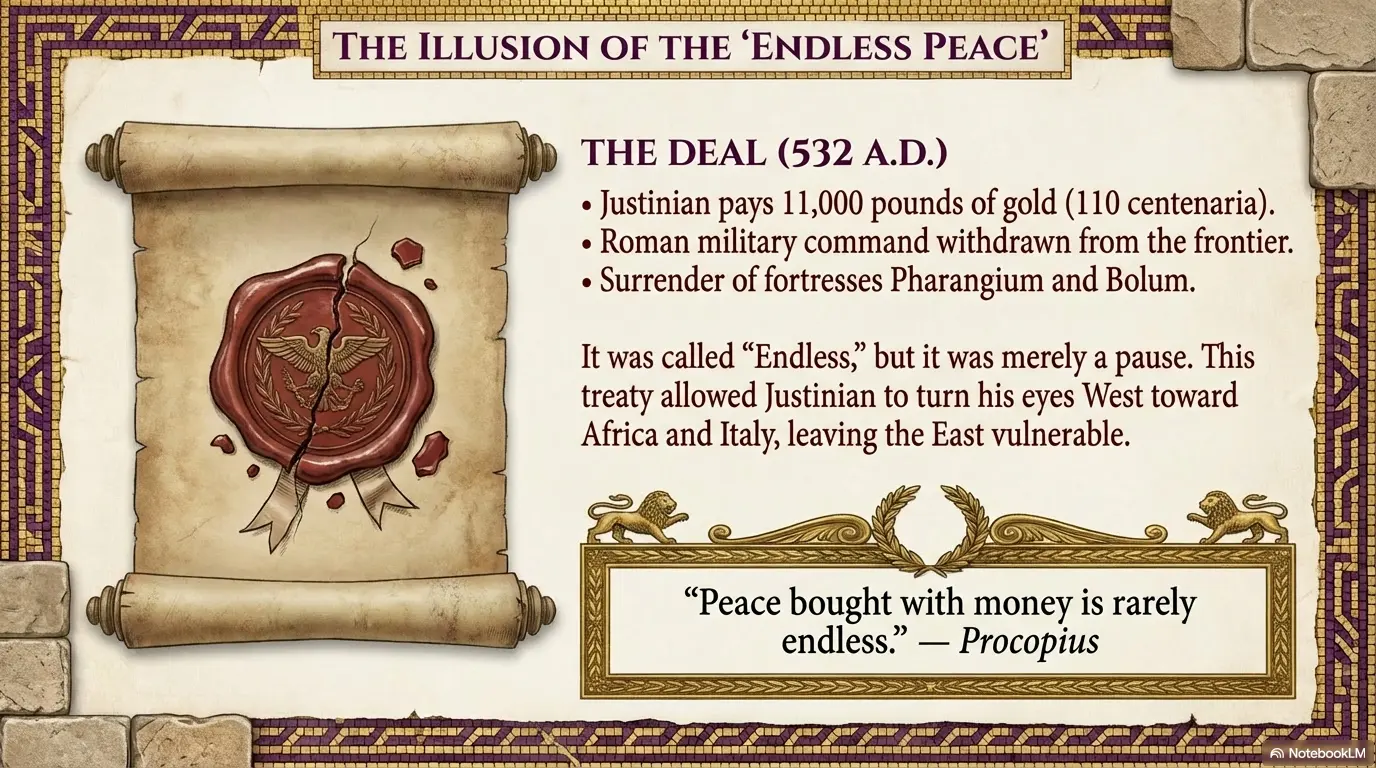
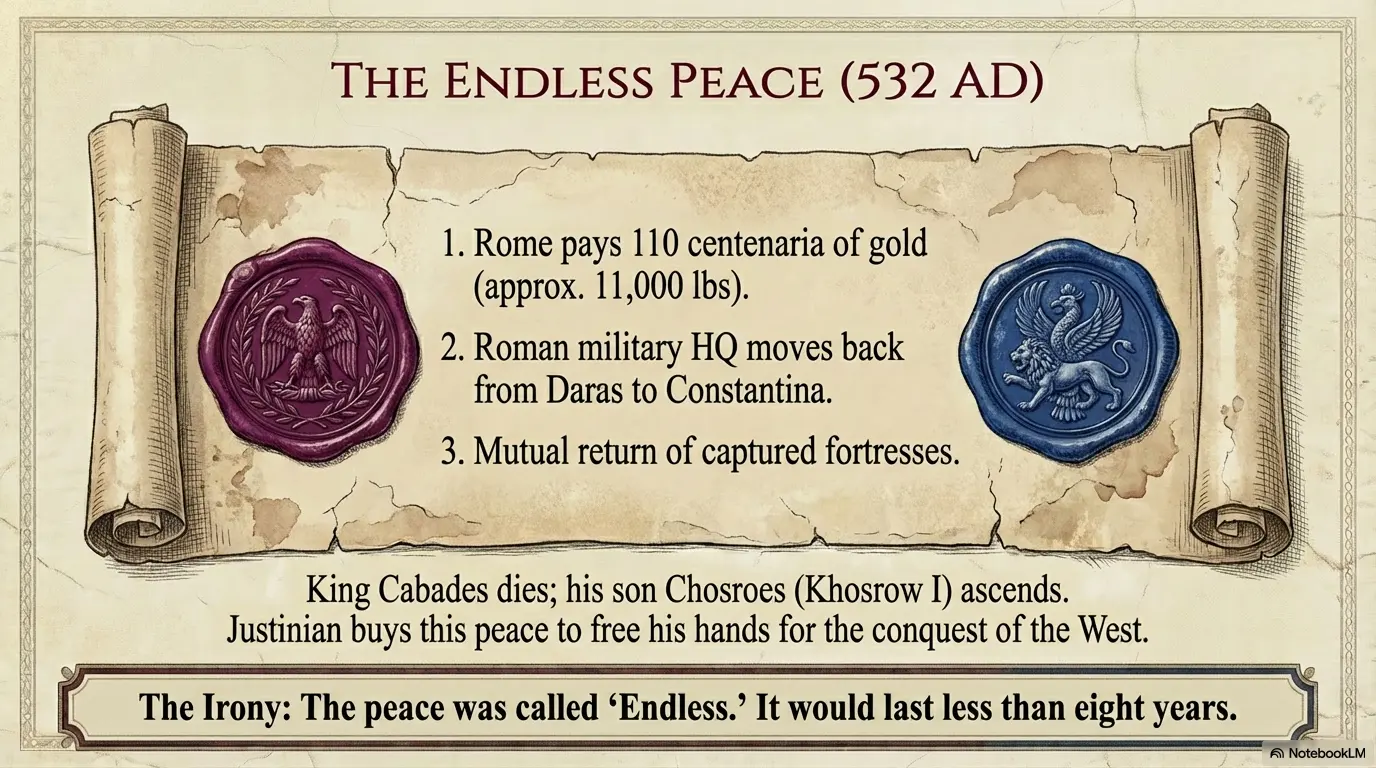
1.22.1. Straightway Rufinus and Alexander and Thomas came to act as ambassadors with Hermogenes, and they all came before the Persian king at the River Tigris. And when Chosroes saw them, he released the hostages. Then the ambassadors coaxed Chosroes, and spoke many beguiling words most unbecoming to Roman ambassadors. By this treatment Chosroes became tractable, and agreed to establish a peace with them that should be without end for the price of one hundred and ten "centenaria," on condition that the commander of troops in Mesopotamia should be no longer at Daras, but should spend all his time in Constantina, as was customary in former times; but the fortresses in
1.22.3. Lazica he refused to give back, although he himself demanded that he should receive back from the Romans both Pharangium and the fortress of Bolum. (Now the "centenarium" weighs one hundred pounds, for which reason it is so called; for the Romans call one hundred "centum"). He demanded that this gold be given him, in order that the Romans might not be compelled either to tear down the city of Daras or to share the garrison at the Caspian Gates with the Persians. However the ambassadors, while approving the rest, said that they were not able to concede the fortresses, unless they should first make enquiry of the emperor concerning them. It was decided, accordingly, that Rufinus should be sent concerning them to Byzantium, and that the others should wait until he should return. And it was arranged with Rufinus that seventy days' time be allowed until he should arrive. When Rufinus reached Byzantium and reported to the emperor what Chosroes' decision was concerning the peace, the emperor commanded that the peace be concluded by them on these terms. In the meantime, however, a report which was not true reached Persia saying that the Emperor Justinian had become enraged and put Rufinus to death. Chosroes indeed was much perturbed by this, and, already filled with anger, he advanced against the Romans with his whole army. But Rufinus met him on the way as he was returning not far from the city of Nisibis. Therefore they proceeded to this city themselves, and, since they were about to establish the peace, the ambassadors began to convey the money thither.
1.22.11. But the Emperor Justinian was already repenting that he had given up the strong holds of Lazica, and he wrote a letter to the ambassadors expressly commanding them by no means to hand them over to the Persians. For this reason Chosroes no longer saw fit to make the treaty; and then it came to the mind of Rufinus that he had counselled more speedily than safely in bringing the money into the land of Persia. Straightway, therefore, he threw himself on the earth, and lying prone he entreated Chosroes to send the money back with them and not march immediately against the Romans, but to put off the war to some other time. And Chosroes bade him rise from the ground, promising that he would grant all these things. So the ambassadors with the money came to Daras and the Persian army marched back. 532 A.D. Then indeed the fellow-ambassadors of Rufinus began to regard him with extreme suspicion themselves, and they also denounced him to the emperor, basing their judgment on the fact that Chosroes had been persuaded to concede him everything which he asked of him. However, the emperor showed him no disfavour on account of this. At a time not long after this Rufinus himself and Hermogenes were again sent to the court of Chosroes, and they immediately came to agreement with each other concerning the treaty, subject to the condition that both sides should give back all the places which each nation had wrested from the other in that war, and that there should no longer be any military post in Daras; as for the Iberians, it was agreed that the decision rested with them whether they should remain there in Byzantium or return to their own fatherland.
1.22.16. And there were many who remained, and many also who returned to their ancestral homes. Thus, then, they concluded the so-called "endless peace," when the Emperor Justinian was already in the sixth year of his reign. And the Romans gave the Persians Pharangium and the fortress of Bolum together with the money, and the Persians gave the Romans the strongholds of Lazica. The Persians also returned Dagaris to the Romans, and received in return for him another man of no mean station. This Dagaris in later times often conquered the Huns in battle when they had invaded the land of the Romans, and drove them out; for he was an exceptionally able warrior. Thus both sides in the manner described made secure the treaty between them.
Outcome and critical assessment
Result and caution: a negotiated settlement, including a substantial Roman payment, ended this phase. Dara and Callinicum should not be treated as two repetitions of one tactical problem. Procopius' defense or criticism of particular commanders must be distinguished from a full independent inquiry into responsibility. "Saracen" in the translation requires attention to the particular allied groups involved.
Historical record: Procopius, Wars 1.12–22; Bury. Local tactical tables are finding aids, not independent corroborating witnesses.