Wars · III. Mediterranean hegemony and its resistance
W019 The First Macedonian War
Philip V's agreement with Hannibal brought Macedon into conflict with Rome during the Hannibalic War. Roman strategy sought to contain Philip and protect the Adriatic connection without diverting unlimited resources from Italy. Operations relied heavily on regional allies, including the Aetolian League.
The theater's ports and coastal routes mattered because Macedonian access to Italy was a strategic possibility Rome wanted to restrict. Fighting nevertheless followed Greek and Adriatic political interests as well as the interests of the two larger powers. The Peace of Phoenice ended the war in 205 BC.
Command, forces and military problem
| Field | Dossier |
|---|---|
| Roman leadership | Laevinus, Sulpicius and allied Greek commanders |
| Opposing or rival parties | Philip V and his regional allies |
| Forces and capabilities | Naval and coastal operations combined with allied land warfare |
| Operational problem | Contain Macedonian intervention without abandoning the main war against Hannibal. |
Campaign geography and operational plates
The Balkans: Adriatic approaches and interior corridors
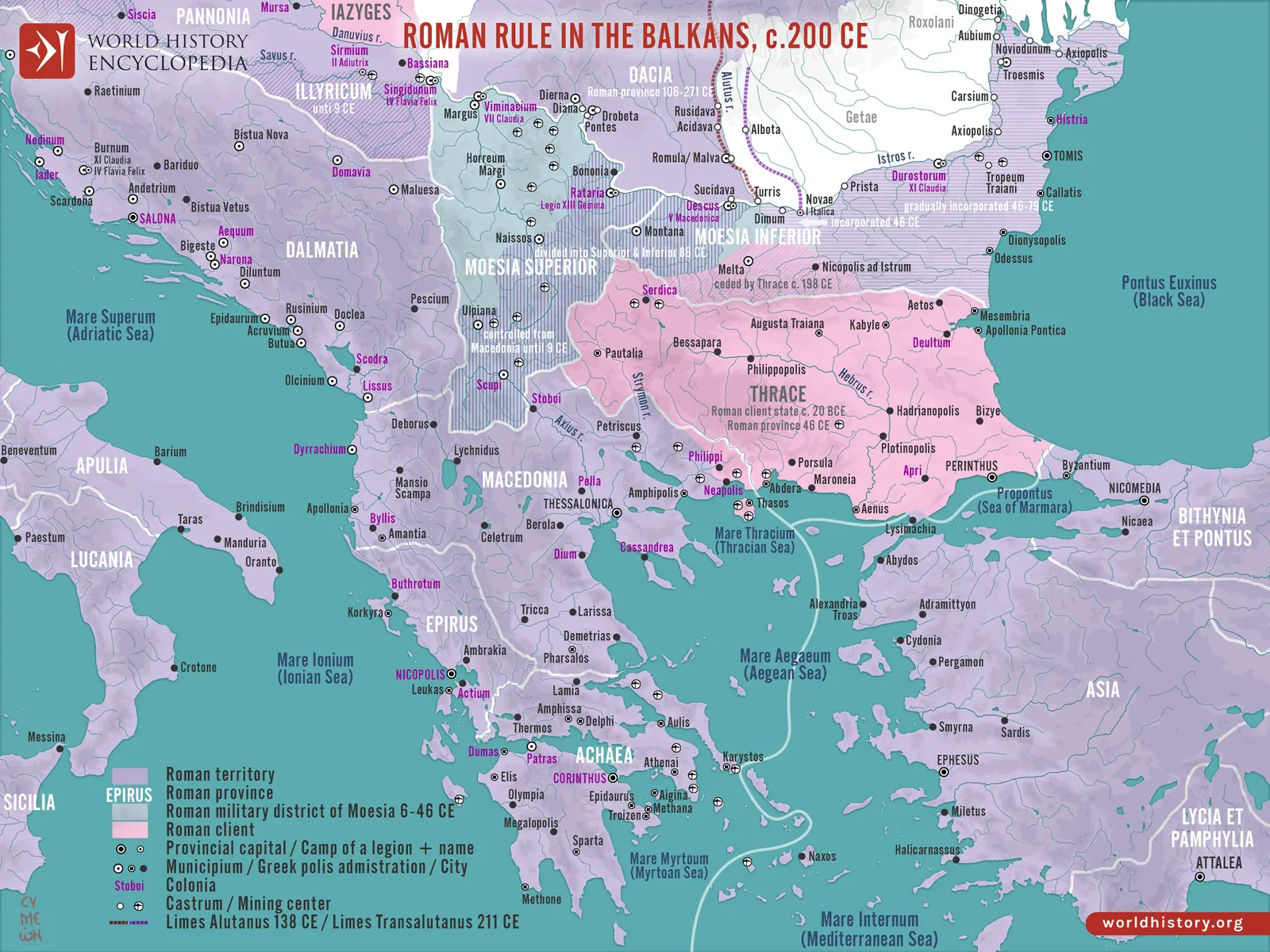
The Adriatic coast, Macedonian approaches and Danubian interior were connected but operationally distinct. Coastal access did not remove the difficulties of reaching defended inland communities. Later roads and military stations help explain the mature imperial network; they should not be read backward as infrastructure available to the first Republican expeditions.
Extended campaign study
The account below develops the operations and their interpretation. Reported numbers and reconstructed tactical details retain the uncertainties described in the dossier.
The Macedonian Complication (215 BC)
While the Italian alliance system was being tested by the post-Cannae defections, a strategic complication of major proportions was developing in the Greek east. Philip V of Macedon, then twenty-three years old and recently established on the throne as the third Antigonid king of his dynasty, had been watching the Roman war with Carthage with the calculating attention of a Hellenistic monarch looking for opportunity. Philip's strategic interests in the western Mediterranean were principally focused on the Adriatic coast: the Illyrian principalities of the eastern Adriatic had been brought under Roman protection by the wars of 229 and 219 (treated in Book II), and Philip regarded the Roman strategic presence on the Illyrian coast as a constraint on Macedonian expansion that he wished to remove. The Roman catastrophe at Cannae appeared to Philip to provide the opportunity for such removal.
Philip's diplomatic agents reached Hannibal's camp in southern Italy in the spring of 215 BC. The negotiations that followed produced a treaty between Macedon and Carthage that has, by remarkable good fortune, been preserved in substantially complete form. A Macedonian delegation under one Xenophanes was returning to Greece after concluding the treaty when their ship was intercepted by a Roman naval patrol in the Adriatic; the treaty document, along with letters of Philip to Hannibal, were captured intact and forwarded to Rome. Polybius (7.9), who clearly had access to the captured document or to senatorial copies of it, preserves the treaty's text in full. The terms committed Macedon and Carthage to mutual military assistance, recognized the territorial integrity of each, committed the Macedonians to military operations against the Roman possessions in Illyria, and (in a provision that would prove the most strategically significant) anticipated a future Carthaginian-Macedonian joint operation against Rome itself. The treaty was, as a diplomatic document, of the formal kind that the Hellenistic monarchies regularly concluded with one another; what was extraordinary was the Carthaginian-Hellenistic combination it implied. Rome was now facing not merely the war with Carthage but the prospect of a coordinated Mediterranean coalition that would unite the major commercial empire of the western sea with the principal land-power of the Greek world.
The Roman strategic response to the Macedonian treaty was the First Macedonian War (214–205 BC), a campaign conducted on what was, by Roman standards of the period, a small scale, but with strategic objectives of considerable subtlety. The Roman conception, articulated principally by the praetor Marcus Valerius Laevinus who was assigned to the Adriatic theater, was that Philip should be prevented from delivering any actual military assistance to Hannibal — which meant maintaining Roman naval superiority in the Adriatic and the Ionian, supporting the Illyrian principalities that had been allied with Rome since 229, and constructing a coalition of Greek powers (principally the Aetolian League, traditional opponents of Macedon) that would tie Philip down in the Greek theater. The objective was accomplished. Philip's military operations across the next decade were conducted entirely in Illyria and the Greek world; no Macedonian troops crossed to Italy; no joint Carthaginian-Macedonian operation was undertaken. The First Macedonian War concluded in 205 BC with the Peace of Phoenice, by which Rome accepted Philip's gains in Illyria in exchange for his disengagement from the Carthaginian alliance — terms that were strategically tolerable to Rome because by 205 the Italian theater was largely secure and the Spanish theater was won.
Outcome and critical assessment
Result and caution: neither Macedon nor Rome destroyed the other; the peace left unresolved relationships that later produced a new war. The alliance belongs after Cannae, not immediately after Trasimene as an inherited summary suggests. The first war is not the beginning of an uninterrupted Roman campaign lasting to Pydna.
Historical record: IR-III, Macedonian theater; Polybius, books 7–11; Livy, books 23–29.