Wars · VI. The high empire and the third-century emergencies
W060 The Bar Kokhba war
The revolt led by Simon bar Kokhba established a substantial challenge to Roman rule. The relationship between the revolt, plans for Aelia Capitolina and imperial policies remains debated. Roman suppression required a major military effort under commanders including Julius Severus.
Rather than assuming a succession of easily located pitched battles, the reader should attend to defended settlements, caves, communications, resources and the gradual reduction of rebel-held ground. Letters and documents associated with the revolt provide evidence of organization that differs in kind from later Roman narrative.
Command, forces and military problem
| Field | Dossier |
|---|---|
| Roman leadership | Hadrian's commanders, notably Julius Severus |
| Opposing or rival parties | Simon bar Kokhba and the revolt's military organization |
| Forces and capabilities | A major Roman concentration against defended settlements and concealed or fortified positions |
| Operational problem | Reduce organized resistance while sustaining a prolonged provincial campaign. |
Campaign geography and operational plates
The Levant: coast, inland cities and desert approaches
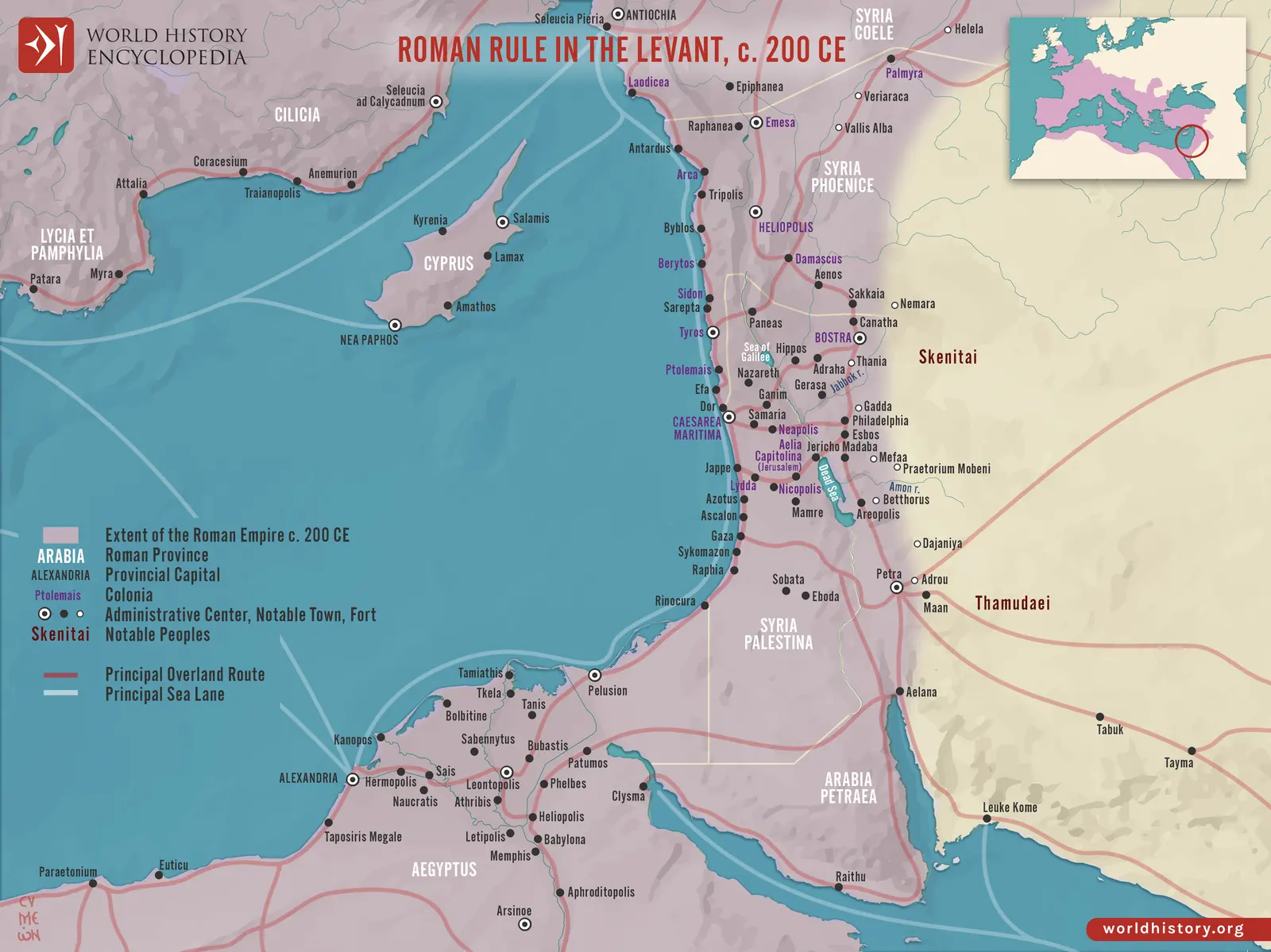
The coast and the inland routes through Syria, Judaea and Arabia connect theaters often discussed separately. Defended cities, ports and approaches to the Euphrates formed part of the military landscape. The map's later provincial organization is distinct from the political settings of the first Jewish revolt, the Bar Kokhba war and third-century eastern invasions.
Extended campaign study
The account below develops the operations and their interpretation. Reported numbers and reconstructed tactical details retain the uncertainties described in the dossier.
The Renunciation and the Perimeter
The reign opened with the account's first great strategic decision, taken in weeks and defended for a lifetime: Hadrian — Trajan's ward, cousin, and legate of Syria, his adoption announced from the deathbed chamber with a timing his enemies never stopped auditing — abandoned the eastern conquests entire. Armenia reverted to client-kingship, Mesopotamia and Assyria were evacuated, Parthamaspates was compensated with Osrhoene's edge, and the Euphrates resumed its old office; within the year the reign's dangerous men — Lusius Quietus dismissed from his Moorish command and killed with three other consulars in the affair of the "four ex-consuls" that stained the accession — were gone, and the new policy had its manifesto in the new coinage's grammar: not CAPTA but DISCIPLINA AUGUSTI, not conquest but the army itself as the advertised achievement. Hadrian spent more of his reign with the frontier armies than any emperor before him, and the perimeter he toured he fixed: in Germany, the continuous oak palisade thrown along the limes line — the empire's first unbroken artificial frontier, hundreds of miles of split trunks whose post-trenches archaeology still sections; in Africa, the fossatum's desert ditch-and-wall; and in Britain, from Tyne to Solway, the work that bears the name: eighty Roman miles of stone and turf, mile-castles and turrets at engineered intervals, sixteen forts, the great ditch and the rearward vallum zone — a system, not a rampart, built by the legions whose centurial quarry-and-course inscriptions sign it foot by foot, and whose purpose (the one sentence of the Historia Augusta the archaeology endorses: to separate the Romans and the barbarians) was less to stop armies than to convert movement itself into an administered thing: the gate, the toll, the patrol, the watched economy of a managed exterior.
The instrument the perimeter enclosed he drilled to its historical peak. Under that regime the army of the 120s–130s was the finest peacetime force of antiquity — and the reign's one great war demonstrated what the account's thesis requires: that its tests now came from within the perimeter as readily as beyond it.
Bar Kokhba (132–136)
The third Jewish war was the worst, and the least narrated. Shim'on ben Kosiba — Bar Kokhba, "son of the star," in the messianic reading his coinage's iconography endorses; Bar Koziba, "son of the lie," in the tradition that survived him — commanded a prepared insurgency: the underground hideout-complexes honeycombing the Judaean hills (excavated by the hundred: ventilation-shafted, water-stored, connected by crawl-tunnels — a countryside pre-fitted for war beneath its villages), a rebel administration minting over-struck denarii ("Year One of the Redemption of Israel," struck across the emperor's face), and a chain of command whose actual field-orders, on papyrus in Hebrew, Aramaic, and Greek, came out of the Cave of Letters in Yadin's 1960–61 seasons: the commander's own dispatches — requisitions of wheat and salt, a shipment of the four festival species for Sukkot in wartime, and the discipline of a hard-pressed chief ("I call heaven to witness... I shall put you in chains") — the only rebel commander's correspondence surviving from the ancient world. The war itself must be read from Dio's four epitome-paragraphs and the ground: no field battles — the insurgency declined them — but a countryside war of posts and tunnels that mauled the garrison beyond anything the tradition dared total (the XXII Deiotariana vanishes from the army lists in this generation, its fate probable and unproven; the war-diplomas show drafts converging from the whole empire); Hadrian summoned his best, Julius Severus from Britain, who conducted the reduction Dio describes in the passive voice of extermination — the strongpoints starved and stormed severally, fifty of them, and 985 villages razed, 580,000 rebels killed by the sword "and of those who perished by famine and disease no man could number"; the last act at Betar, the fortress southwest of Jerusalem where ben Kosiba died in the fall of 135/136, and in the refuge-caves above the Dead Sea, where the archaeology closes the file in its own medium — the Cave of Horror's starved skeletons under the cliff the garrison camped upon, and beside the Bar Kokhba letters in the Cave of Letters the bundled archive of Babatha daughter of Shim'on, a propertied widow's deeds, marriage contract, and lawsuits carried into the dark and never carried out: the war's civilian epitaph in one refugee's handbag.
Outcome and critical assessment
Result and caution: the revolt was defeated, with profound consequences for Judaea's population and landscape. Bethar's fall is a central episode, but the final endpoint may include later operations. The atlas refers to documentary evidence as a necessary research avenue; it does not claim a new reading of each surviving papyrus or coin.
Historical record: IR-VII, chapter 3; Dio, book 69; the collection's documentary-source holdings as a separate path for further verification.