Wars · VI. The high empire and the third-century emergencies
W094 The later British wars of the second century
Expansion beyond Hadrian's frontier
The frontier established under Hadrian was not the final geographic decision of Roman rule in Britain. Under Antoninus Pius, operations associated with the governor Lollius Urbicus carried Roman forces farther north. The construction of the Antonine Wall between the Forth and Clyde expressed a new deployment and a claim to control a different line.
Building a barrier involved much more than arranging turf and stone. Forts, roads, supply movement, personnel and relations with communities on either side made it usable. The presence of a wall therefore signifies an organized military commitment, while its physical remains do not by themselves establish the security of every district beyond or behind it.
Retrenchment and renewed pressure
The Antonine position did not become the permanent northern frontier. The timing and phases of withdrawal and reoccupation are matters of detailed archaeological and historical reconstruction. The later return of emphasis to Hadrian's Wall demonstrates that imperial policy could revise an advance without describing the entire province as lost.
Under Commodus, a serious northern war required intervention by Ulpius Marcellus. Roman military success restored the position sufficiently for imperial victory claims, but also generated a picture of demanding discipline and difficult relations between commander and army. Problems within the military establishment cannot simply be detached from the conduct of the frontier war.
Forces and landscape
Roman operations joined legionary and auxiliary establishments with roads, forts and the possibility of maritime support. Northern opponents did not constitute one permanent centrally administered state. Their settlements and movement patterns require more attention than a uniform label such as "the Caledonians" can provide.
The main strategic issue was the extent of a frontier that Rome was willing to supply and defend. A successful advance could make a more northerly position possible without proving that maintaining it indefinitely was advantageous. The civilian consequences included requisition, restricted movement, military markets and the disruption accompanying campaigns.
Result and caution
Britain remained a Roman province, with its northern military geography repeatedly adjusted. These campaigns should be separated from Agricola's first-century operations and Severus' later invasion. Neither the Antonine Wall nor a victory title provides an exact map of political obedience, and no uniform annual account survives for all the intervening fighting.
Command, forces and military problem
| Field | Dossier |
|---|---|
| Roman leadership | Lollius Urbicus, Ulpius Marcellus and other governors |
| Opposing or rival parties | Different northern British communities |
| Forces and capabilities | Provincial forces, wall garrisons, transport and expeditionary concentrations |
| Operational problem | Choose and sustain a defensible frontier while responding to renewed pressure. |
Campaign geography and operational plates
Britain: the river and settlement network
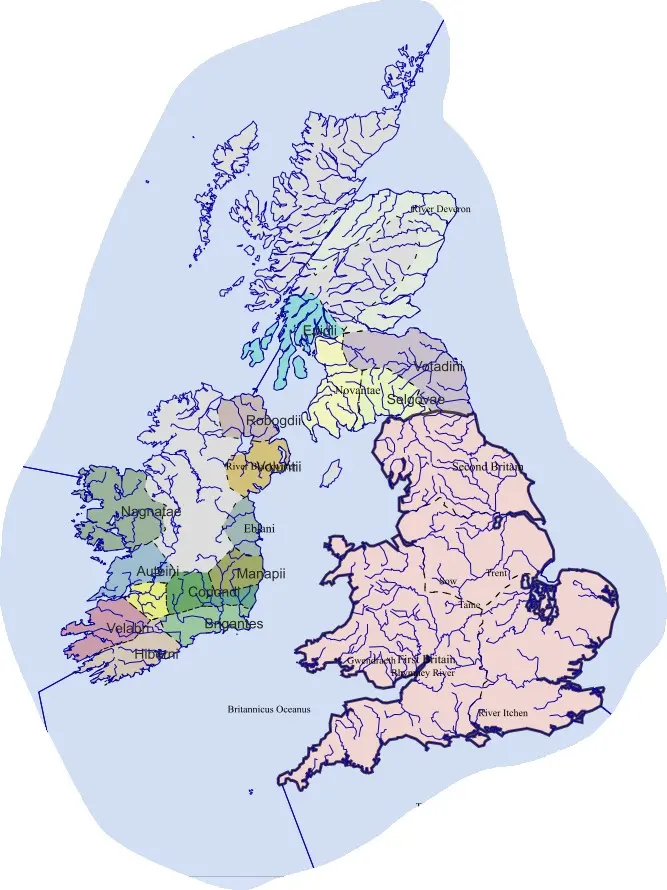
The southern lowlands and the narrower northern corridors place the fort and town network within a physical landscape. This is particularly helpful when comparing the initial conquest with the second-century choice of frontier. The combined network is not a snapshot in which every installation was occupied simultaneously.
Historical record: IR-VII, Antonine context; Dio, Commodan narrative; Historia Augusta, used cautiously alongside material chronology.