Wars · IX. The eastern empire and Justinian's wars
W086 The Anastasian war
Battles and sieges
Fall of Amida to Kavadh 503 ADKavadh I's invasion brought the long-standing eastern rivalry into renewed large-scale war. The capture of Theodosiopolis and the siege and fall of Amida forced the Roman government to mobilize a major response. Several Roman commanders operated in a difficult environment of divided authority, supply pressure and strongholds.
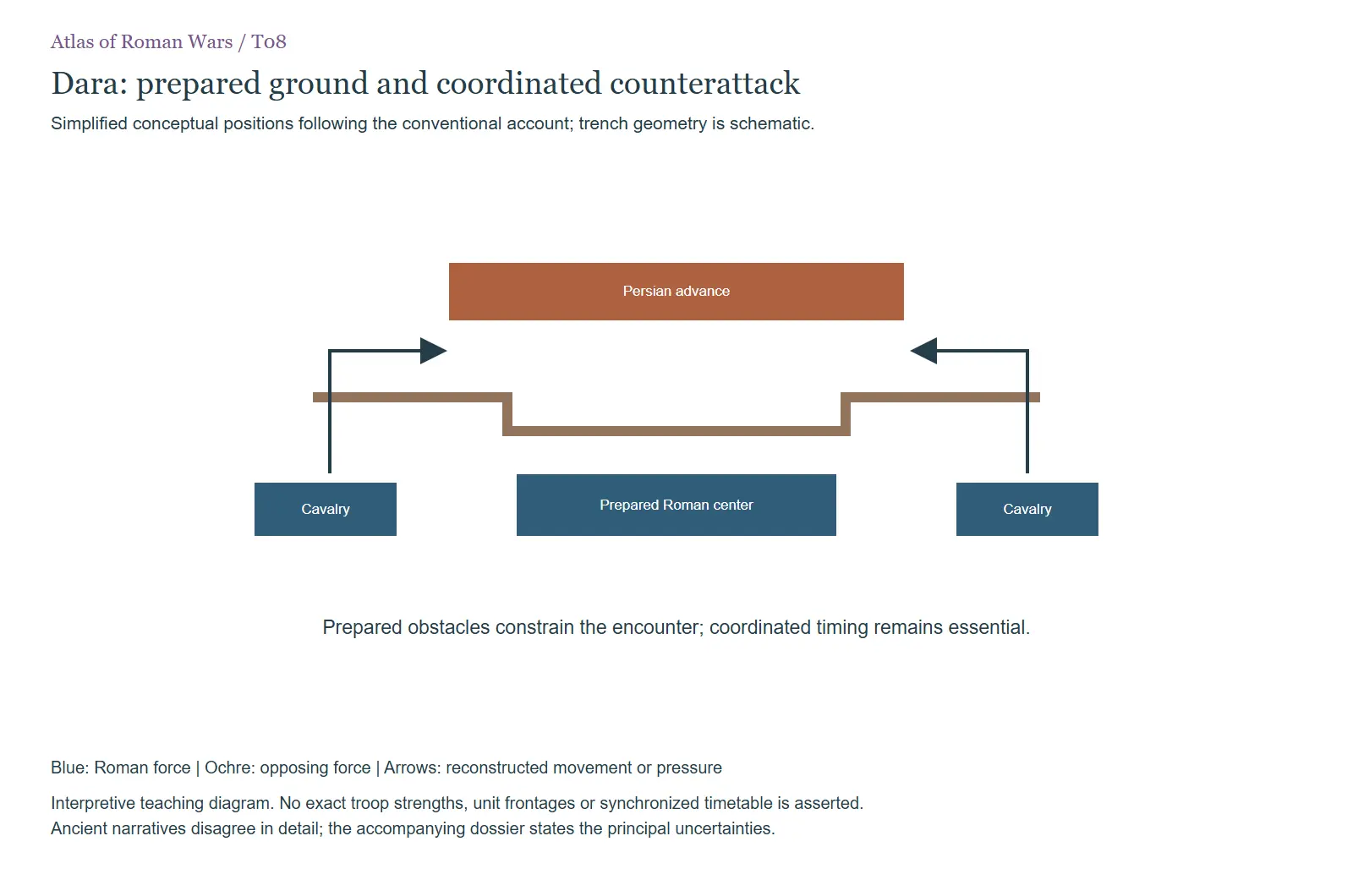
Rome eventually recovered Amida through an agreement involving payment. The peace or truce of AD 506 ended the immediate fighting without resolving every frontier question. The construction of Dara afterward expressed the importance of a fortified Roman base close to Nisibis.
Command, forces and military problem
| Field | Dossier |
|---|---|
| Roman leadership | Anastasius' commanders including Areobindus, Celer and Patricius |
| Opposing or rival parties | Kavadh I and Sasanian forces |
| Forces and capabilities | Large Roman concentrations, fortress garrisons, field armies and siege labor |
| Operational problem | Coordinate divided commands, recover Amida and establish a defensible postwar position. |
Contemporary campaign chronicle
The following substantial selections incorporate Procopius' account in H. B. Dewing's public-domain translation. Ancient book, chapter and section numbers are retained. Speeches, reported figures, judgments and divine explanations are the ancient author's testimony, not independently established modern conclusions. Editorial event-date overlays have been removed.
Kavadh and the siege of Amida
1.7.1. A little later Cabades was owing the king of the Ephthalitae a sum of money which he was not able to pay him, and he therefore requested the Roman emperor Anastasius to lend him this money. Whereupon Anastasius conferred with some of his friends and enquired of them whether this should be done; and they would not permit him to make the loan. For, as they pointed out, it was inexpedient to make more secure by means of their money the friendship between their enemies and the Ephthalitae; indeed it was better for the Romans to disturb their
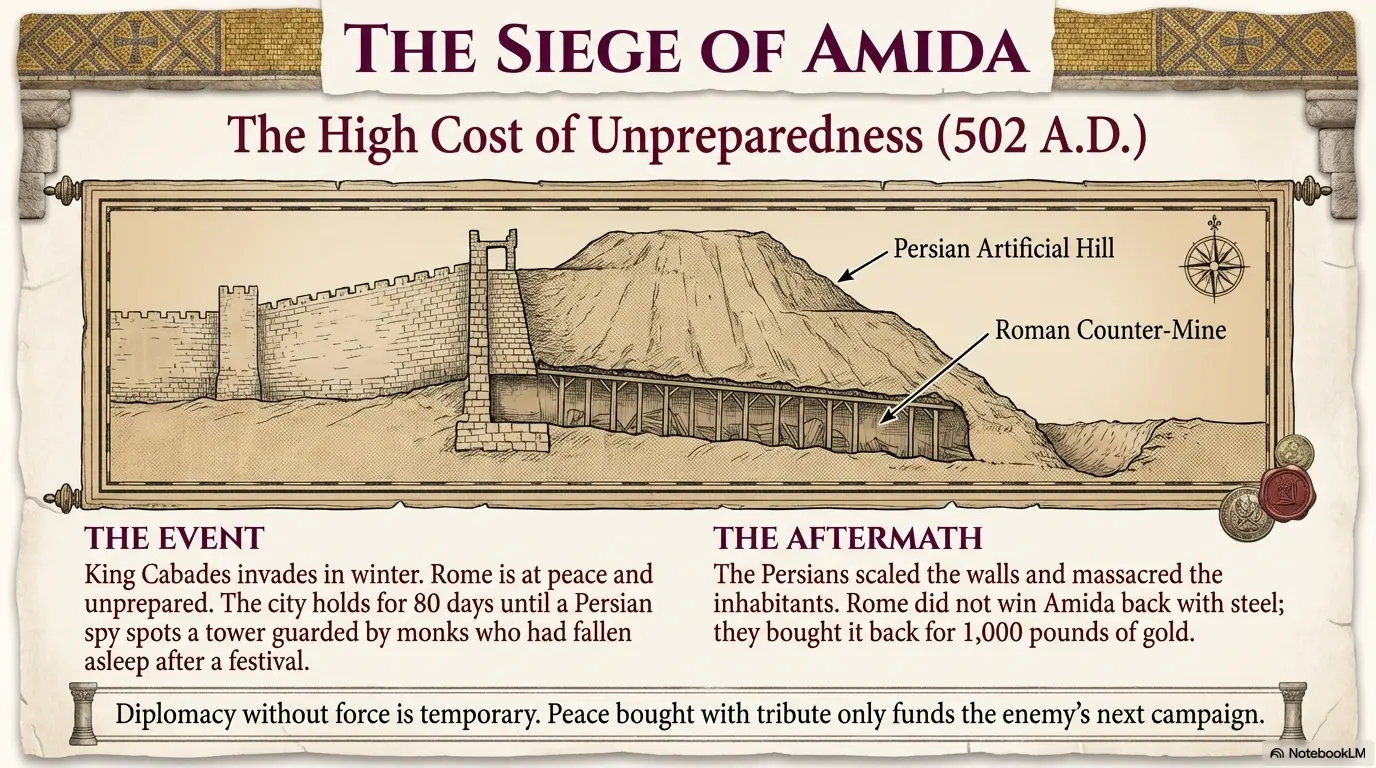
1.7.2. relations as much as possible. It was for this reason, and for no just cause, that Cabades decided to make an expedition against the Romans. 502 A.D. First he invaded the land of the Armenians, moving with such rapidity as to anticipate the news of his coming, and, after plundering the greater part of it in a rapid campaign, he unexpectedly arrived at the city of Amida, which is situated in Mesopotamia, and, although the season was winter, he invested the town. Now the citizens of Amida had no soldiers at hand, seeing that it was a time of peace and prosperity, and in other respects were utterly unprepared; nevertheless they were quite unwilling to yield to the enemy, and shewed an unexpected fortitude in holding out against dangers and hardships. Now there was among the Syrians a certain just man, Jacobus by name, who had trained himself with exactitude in matters pertaining to religion. This man had confined himself many years before in a place called Endielon, a day's journey from Amida, in order that he might with more security devote himself to pious contemplation. The men of this place, assisting his purpose, had surrounded him with a kind of fencing, in which the stakes were not continuous, but set at intervals, so that those who approached could see and hold converse with him. And they had constructed for him a small roof over his head, sufficient to keep off the rain and snow. There this man had been sitting for a long time, never yielding either to heat or cold, and sustaining his life with certain seeds, which he was accustomed to eat, not indeed every day, but only at long intervals.
1.7.8. Now some of the Ephthalitae who were overrunning the country thereabout saw this Jacobus and with great eagerness drew their bows with intent to shoot at him. But the hands of every one of them became motionless and utterly unable to manage the bow. When this was noised about through the army and came to the ears of Cabades, he desired to see the thing with his own eyes; and when he saw it, both he and the Persians who were with him were seized with great astonishment, and he entreated Jacobus to forgive the barbarians their crime. And he forgave them with a word, and the men were released from their distress. Cabades then bade the man ask for whatever he wished, supposing that he would ask for a great sum of money, and he also added with youthful recklessness that he would be refused nothing by him. But he requested Cabades to grant to him all the men who during that war should come to him as fugitives. This request Cabades granted, and gave him a written pledge of his personal safety. And great numbers of men, as might be expected, came flocking to him from all sides and found safety there; for the deed became widely known. Thus, then, did these things take place. Cabades, in besieging Amida, brought against every part of the defences the engines known as rams; but the townspeople constantly broke off the heads of the rams by means of timbers thrown across them. However, Cabades did not slacken his efforts until he realized that the wall could not be successfully assailed in this way. For, though he battered the wall many times, he was quite unable to break down any portion of the defence, or even to shake it; so secure
1.7.13. had been the work of the builders who had constructed it long before. Failing in this, Cabades raised an artificial hill to threaten the city, considerably overtopping the wall; but the besieged, starting from the inside of their defences, made a tunnel extending under the hill, and from there stealthily carried out the earth, until they hollowed out a great part of the inside of the hill. However, the outside kept the form which it had at first assumed, and afforded no opportunity to anyone of discovering what was being done. Accordingly many Persians mounted it, thinking it safe, and stationed themselves on the summit with the purpose of shooting down upon the heads of those inside the fortifications. But with the great mass of men crowding upon it with a rush, the hill suddenly fell in and killed almost all of them. Cabades, then, finding no remedy for the situation, decided to raise the siege, and he issued orders to the army to retreat on the morrow. Then indeed the besieged, as though they had no thought of their danger, began laughingly from the fortifications to jeer at the barbarians. Besides this some courtesans shamelessly drew up their clothing and displayed to Cabades, who was standing close by, those parts of a woman's body which it is not proper that men should see uncovered. This was plainly seen by the Magi, and they thereupon came before the king and tried to prevent the retreat, declaring as their interpretation of what had happened that the citizens of Amida would shortly disclose to Cabades all their secret and hidden things. So the Persian army remained there.
1.7.20. Not many days later one of the Persians saw close by one of the towers the mouth of an old underground passage, which was insecurely concealed with some few small stones. In the night he came there alone, and, making trial of the entrance, got inside the circuit-wall; then at daybreak he reported the whole matter to Cabades. The king himself on the following night came to the spot with a few men, bringing ladders which he had made ready. And he was favoured by a piece of good fortune; for the defence of the very tower which happened to be nearest to the passage had fallen by lot to those of the Christians who are most careful in their observances, whom they call monks. These men, as chance would have it, were keeping some annual religious festival to God on that day. When night came on they all felt great weariness on account of the festival, and, having sated themselves with food and drink beyond their wont, they fell into a sweet and gentle sleep, and were consequently quite unaware of what was going on. So the Persians made their way through the passage inside the fortifications, a few at a time, and, mounting the tower, they found the monks still sleeping and slew them to a man. When Cabades learned this, he brought his ladders up to the wall close by this tower. It was already day. And those of the townsmen who were keeping guard on the adjoining tower became aware of the disaster, and ran thither with all speed to give assistance.
1.7.27. Then for a long time both sides struggled to crowd back the other, and already the townsmen were gaining the advantage, killing many of those who had mounted the wall, and throwing back the men on the ladders, and they came very near to averting the danger. But Cabades drew his sword and, terrifying the Persians constantly with it, rushed in person to the ladders and would not let them draw back, and death was the punishment for those who dared turn to leave. As a result of this the Persians by their numbers gained the upper hand and overcame their antagonists in the fight. So the city was captured by storm on the eightieth day after the beginning of the siege. Jan. 11 503 A.D. There followed a great massacre of the townspeople, until one of the citizens—an old man and a priest—approached Cabades as he was riding into the city, and said that it was not a kingly act to slaughter captives. Then Cabades, still moved with passion, replied: "But why did you decide to fight against me?" And the old man answered quickly: "Because God willed to give Amida into thy hand not so much because of our decision as of thy valour." Cabades was pleased by this speech, and permitted no further slaughter, but he bade the Persians plunder the property and make slaves of the survivors, and he directed them to choose out for himself all the notables among them. A short time after this he departed, leaving there to garrison the place a thousand men under command of Glones, a Persian, and some few unfortunates among the citizens of Amida who were destined to minister as servants to the daily wants of the Persians; he himself with all the remainder of the army and the captives marched away homeward.
1.7.33. These captives were treated by Cabades with a generosity befitting a king; for after a short time he released all of them to return to their homes, but he pretended that they had escaped from him by stealth; and the Roman Emperor, Anastasius, also shewed them honour worthy of their bravery, for he remitted to the city all the annual taxes for the space of seven years, and presented all of them as a body and each one of them separately with many good things, so that they came fully to forget the misfortunes which had befallen them. But this happened in later years.
The Roman counteroffensive and negotiations
1.8.1. At that time the Emperor Anastasius, upon learning that Amida was being besieged, dispatched with all speed an army of sufficient strength. But in this army there were general officers in command of every symmory, while the supreme command was divided between the following four generals: Areobindus, at that time General of the East, the son-in-law of Olybrius, who had been Emperor in the West not long before; Celer, commander of the palace troops (this officer the Romans are accustomed to call "magister"); besides these still, there were the commanders of troops in Byzantium, Patricias, the Phrygian, and Hypatius, the nephew of the emperor; these four, then, were the generals. With them also was associated Justinus, who at a later time became emperor upon the death of Anastasius, and Patriciolus with his son Vitalianus,
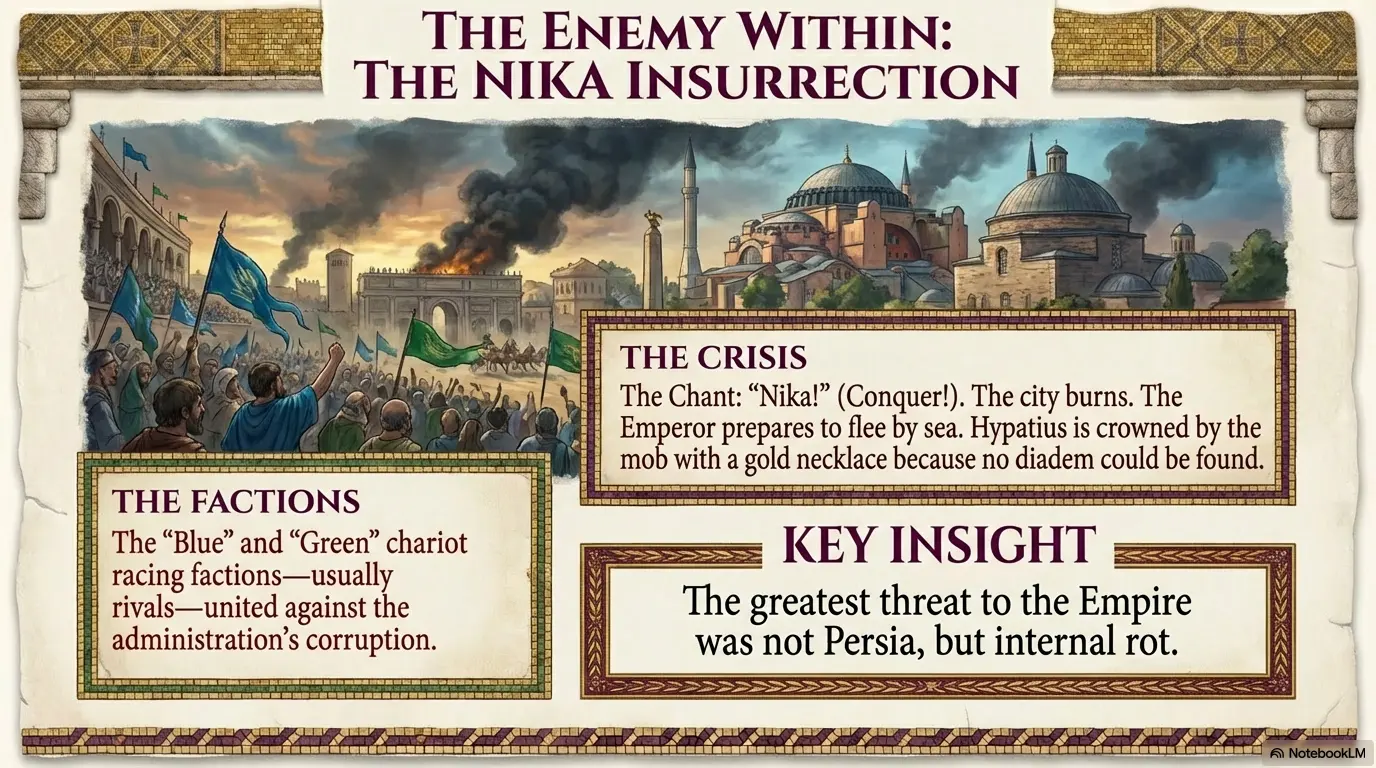
1.8.3. who raised an armed insurrection against the Emperor Anastasius not long afterwards and made himself tyrant; also Pharesmanes, a native of Colchis, and a man of exceptional ability as a warrior, and the Goths Godigisclus and Bessas, who were among those Goths who had not followed Theoderic when he went from Thrace into Italy, both of them men of the noblest birth and experienced in matters pertaining to warfare; many others, too, who were men of high station, joined this army. For such an army, they say, was never assembled by the Romans against the Persians either before or after that time. However, all these men did not assemble in one body, nor did they form a single army as they marched, but each commander by himself led his own division separately against the enemy. And as manager of the finances of the army Apion, an Egyptian, was sent, a man of eminence among the patricians and extremely energetic; and the emperor in a written statement declared him partner in the royal power, in order that he might have authority to administer the finances as he wished.
1.8.6. Now this army was mustered with considerable delay, and advanced with little speed. As a result of this they did not find the barbarians in the Roman territory; for the Persians had made their attack suddenly, and had immediately withdrawn with all their booty to their own land. Now no one of the generals desired for the present to undertake the siege of the garrison left in Amida, for they learned that they had carried in a large supply of provisions; but they made haste to invade the land of the enemy.
1.8.8. However they did not advance together against the barbarians but they encamped apart from one another as they proceeded. When Cabades learned this (for he happened to be close by), he came with all speed to the Roman frontier and confronted them. But the Romans had not yet learned that Cabades was moving against them with his whole force, and they supposed that some small Persian army was there. Accordingly the forces of Areobindus established their camp in a place called Arzamon, at a distance of two days' journey from the city of Constantina, and those of Patricius and Hypatius in a place called Siphrios, which is distant not less than three hundred and fifty stades from the city of Amida. As for Celer, he had not yet arrived.
1.8.11. Areobindus, when he ascertained that Cabades was coming upon them with his whole army, abandoned his camp, and, in company with all his men, turned to flight and retired on the run to Constantina. And the enemy, coming up not long afterwards, captured the camp without a man in it and all the money it contained. From there they advanced swiftly against the other Roman army. Now the troops of Patricius and Hypatius had happened upon eight hundred Ephthalitae who were marching in advance of the Persian army, and they had killed practically all of them. Then, since they had learned nothing of Cabades and the Persian army, supposing that they had won the victory, they began to conduct themselves with less caution. At any rate they had stacked their arms and were preparing themselves a lunch; for already the appropriate time of day was drawing near.
1.8.15. Now a small stream flowed in this place and in it the Romans began to wash the pieces of meat which they were about to eat; some, too, distressed by the heat, were bathing themselves in the stream; and in consequence the brook flowed on with a muddy current. But while Cabades, learning what had befallen the Ephthalitae, was advancing against the enemy with all speed, he noticed that the water of the brook was disturbed, and divining what was going on, he came to the conclusion that his opponents were unprepared, and gave orders to charge upon them immediately at full speed. Aug. 503 A.D. Straightway, then, they fell upon them feasting and unarmed. And the Romans did not withstand their onset, nor did they once think of resistance, but they began to flee as each one could; and some of them were captured and slain, while others climbed the hill which rises there and threw themselves down the cliff in panic and much confusion. And they say that not a man escaped from there; but Patricius and Hypatius had succeeded in getting away at the beginning of the onset. After this Cabades retired homeward with his whole army, since hostile Huns had made an invasion into his land, and with this people he waged a long war in the northerly portion of his realm. In the meantime the other Roman army also came, but they did nothing worth recounting, because, it seems, no one was made commander-in-chief of the expedition; but all the generals were of equal rank, and consequently they were always opposing one another's opinions and were utterly unable to unite. However Celer, with his contingent, crossed the Nymphius River and made some sort of an invasion into Arzanene.
1.8.22. This river is one very close to Martyropolis, about three hundred stades from Amida. So Celer's troops plundered the country thereabout and returned not long after, and the whole invasion was completed in a short time.
1.9.1. After this Areobindus went to Byzantium at the summons of the emperor, while the other generals reached Amida, and, in spite of the winter season, invested it. And although they made many attempts they were unable to carry the fortress by storm, but they were on the point of accomplishing their object by starvation; for all the provisions of the besieged were exhausted. The generals, however, had ascertained nothing of the straits in which the enemy were; but since they saw that their own troops were distressed by the labour of the siege and the wintry weather, and at the same time suspected that a Persian army would be coming upon them before long, they were eager to quit the place on any terms whatever. The Persians, on their part, not knowing what would become of them in such terrible straits, continued to conceal scrupulously their lack of the necessities of life, and made it appear that they had an abundance of all provisions, wishing to return to their homes with the reputation of honour. So a proposal was discussed between them, according to which the Persians were to deliver over the city to the Romans upon receipt of one thousand pounds of gold. Both parties then gladly executed the terms of the agreement, and the son of Glones, upon receiving the money, delivered over Amida to the
1.9.4. Romans. For Glones himself had already died in the following manner.
1.9.5. When the Romans had not yet encamped before the city of Amida but were not far from its vicinity, a certain countryman, who was accustomed to enter the city secretly with fowls and loaves and many other delicacies, which he sold to this Glones at a great price, came before the general Patricius and promised to deliver into his hands Glones and two hundred Persians, if he should receive from him assurance of some requital. And the general promised that he should have everything he desired, and thus dismissed the fellow. He then tore his garments in a dreadful manner, and, assuming the aspect of one who had been weeping, entered the city. And coming before Glones, and tearing his hair he said: "O Master, I happened to be bringing in for you all the good things from my village, when some Roman soldiers chanced upon me (for, as you know, they are constantly wandering about the country here in small bands and doing violence to the miserable country-folk), and they inflicted upon me blows not to be endured, and, taking away everything, they departed,—the robbers, whose ancient custom it is to fear the Persians and to beat the farmers. But do you, O Master, take thought to defend yourself and us and the Persians. For if you go hunting into the outskirts of the city, you will find rare game. For the accursed rascals go about by fours or fives to do their robbery." Thus he spoke. And Glones was persuaded, and enquired of the fellow about how many Persians he thought would be sufficient for him to carry out the enterprise.
1.9.10. He said that about fifty would do, for they would never meet more than five of them going together; however, in order to forestall any unexpected circumstance, it would do no harm to take with him even one hundred men; and if he should double this number it would be still better from every point of view; for no harm could come to a man from the larger number.
1.9.11. Glones accordingly picked out two hundred horsemen and bade the fellow lead the way for them. But he insisted that it was better for him to be sent first to spy out the ground, and, if he should bring back word that he had seen Romans still going about in the same districts, that then the Persians should make their sally at the fitting moment. Accordingly, since he seemed to Glones to speak well, he was sent forward by his own order. Then he came before the general Patricius and explained everything; and the general sent with him two of his own body-guard and a thousand soldiers. These he concealed about a village called Thilasamon, forty stades distant from Amida, among valleys and woody places, and instructed them to remain there in this ambush; he himself then proceeded to the city on the run, and telling Glones that the prey was ready, he led him and the two hundred horsemen upon the ambush of the enemy. And when they passed the spot where the Romans were lying in wait, without being observed by Glones or any of the Persians, he roused the Romans from their ambuscade and pointed out to them the enemy.
1.9.16. And when the Persians saw the men coming against them, they were astounded at the suddenness of the thing, and were in much distress what to do. For neither could they retire to the rear, since their opponents were behind them, nor were they able to flee anywhere else in a hostile land. But as well as they could under the circumstances, they arrayed themselves for battle and tried to drive back their assailants; but being at a great disadvantage in numbers they were vanquished, and all of them together with Glones were destroyed. Now when the son of Glones learned of this, being deeply grieved and at the same time furious with anger because he had not been able to defend his father, he fired the sanctuary of Symeon, a holy man, where Glones had his lodging. It must be said, however, that with the exception of this one building, neither Glones nor Cabades, nor indeed any other of the Persians, saw fit either to tear down or to destroy in any other way any building in Amida at any rate, or outside this city. But I shall return to the previous narrative.
1.9.20. Thus the Romans by giving the money recovered Amida two years after it had been captured by the enemy. And when they got into the city, their own negligence and the hardships under which the Persians had maintained themselves were discovered. For upon reckoning the amount of grain left there and the number of barbarians who had gone out, they found that rations for about seven days were left in the city, although Glones and his son had been for a long time doling out provisions to the Persians more sparingly than they were needed. For to the Romans who had remained with them in the city, as I have stated above, they had decided to dispense nothing at all from the time when their
1.9.22. enemy began the siege; and so these men at first resorted to unaccustomed foods and laid hold on every forbidden thing, and at the last they even tasted each other's blood. So the generals realized that they had been deceived by the barbarians, and they reproached the soldiers for their lack of self-control, because they had shewn themselves wanting in obedience to them, when it was possible to capture as prisoners of war such a multitude of Persians and the son of Glones and the city itself, while they had in consequence attached to themselves signal disgrace by carrying Roman money to the enemy, and had taken Amida from the Persians by purchasing it with silver.
1.9.24. After this the Persians, since their war with the Huns kept dragging on, entered into a treaty with the Romans, which was arranged by them for seven years, and was made by the Roman Celer and the Persian Aspebedes; both armies then retired homeward and remained at peace. Thus, then, as has been told, began the war of the Romans and the Persians, and to this end did it come. But I shall now turn to the narration of the events touching the Caspian Gates.
Outcome and critical assessment
Result and caution: the settlement largely restored the territorial situation rather than delivering a simple decisive Roman conquest. Amida's surrender belongs to the winter of AD 502–503, not to the quite separate siege of AD 359. Ancient accounts of the two sieges belong to different campaigns and political settings.
Historical record: Procopius, Wars 1.7–9; Bury, later Roman history; campaign tables.