Wars · IX. The eastern empire and Justinian's wars
W098 The Isaurian war of Anastasius
Battles and sieges
Cotyaeum 492 ADThe succession after Zeno
Zeno's death left powerful Isaurian interests at court and in the military establishment. Anastasius' accession challenged the position of those associated with the former ruler. Measures against leading Isaurians and their support networks helped turn a struggle over imperial power into a sustained regional war.
Longinus, Zeno's brother, must be distinguished from other commanders and leaders of the same name. Name repetition is particularly dangerous in this conflict: Longinus of Cardala and Longinus of Selinus belong to distinct roles. The revolt's leadership should not be collapsed into one man simply because an index normalizes the names.
From the field to the strongholds
The defeat of the insurgent army near Cotyaeum in AD 492 did not finish the war. Resistance continued in strongholds and difficult country. Imperial commanders including John the Scythian and John the Hunchback faced the need to isolate positions, disrupt support and reduce the leaders' ability to continue fighting.
This is the central operational distinction of the war. A field defeat removed the possibility of success on one scale while leaving the terrain and fortified networks necessary for resistance on another. The duration of the conflict cannot be explained as the mere repetition of the first engagement.
Suppression and political consequence
The capture and removal of leaders in the later 490s broke the main resistance. Repression, transfers of people and the reordering of regional power accompanied the military outcome. Imperial victory consolidated Anastasius' authority and reduced the influence of a powerful military-political network.
The category "Isaurian" describes a regional association that had acquired particular significance in court politics. It should not be used to imply that every inhabitant followed one program or that the conflict was simply an ethnic revolt outside Roman history. Both armies and the contested authority belonged to the imperial system.
Command, forces and military problem
| Field | Dossier |
|---|---|
| Roman leadership | Anastasius; John the Scythian and John the Hunchback |
| Opposing or rival parties | Isaurian leaders, including distinct men named Longinus |
| Forces and capabilities | Imperial field armies, defended strongholds and regional support networks |
| Operational problem | Turn a field victory into the suppression of prolonged stronghold resistance. |
Campaign geography and operational plates
Anatolia: plateaus, cities and the southern mountain barrier
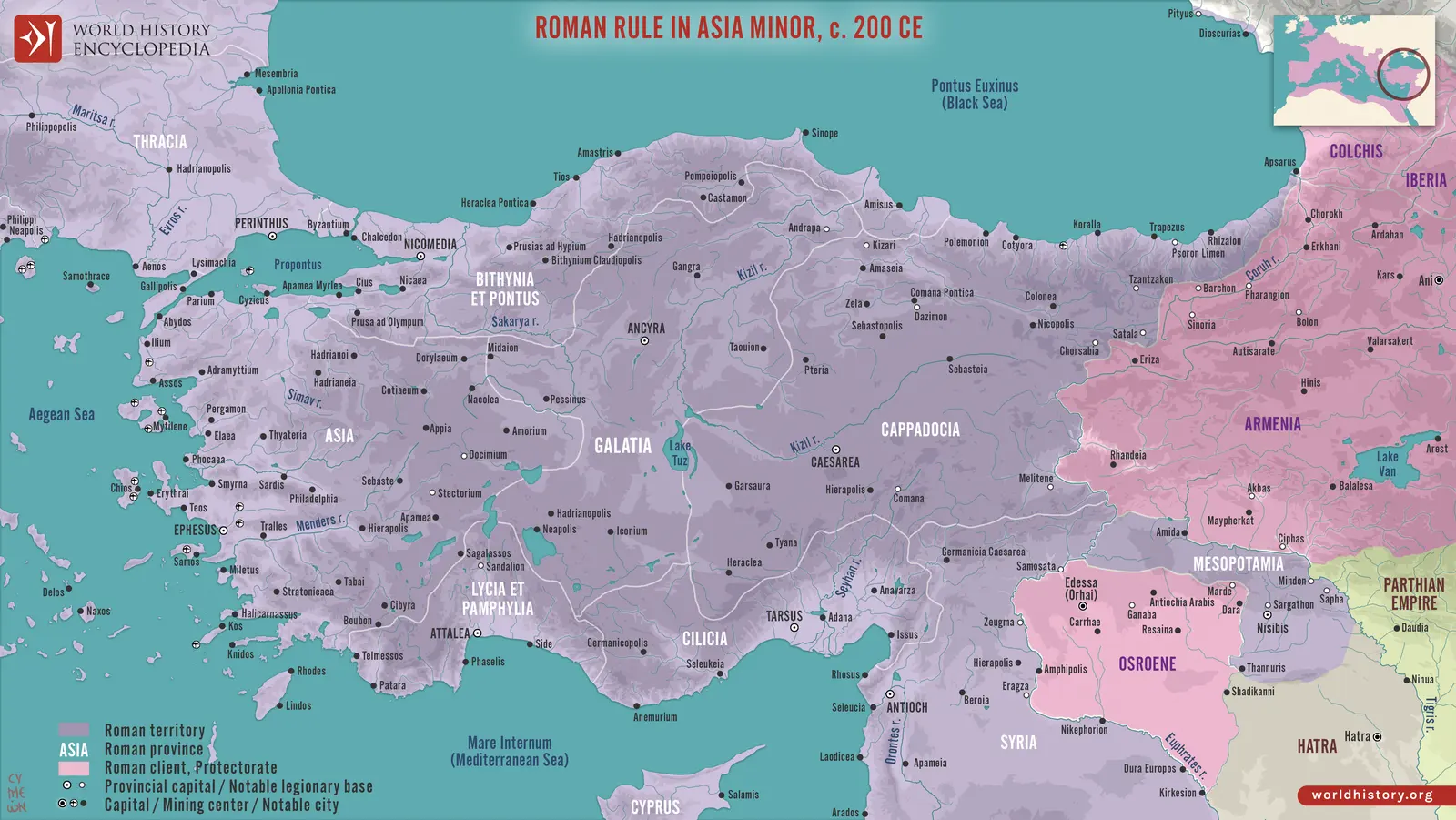
The Taurus region and the distinction between the coastal approaches and the interior help explain both large eastern expeditions and prolonged stronghold resistance. A later provincial map can orient the reader without reconstructing the legal borders of the Mithridatic or Isaurian wars. Routes and dates must still come from their individual dossiers.
Historical record: Bury, volume I, chapter 13; later chronicles and fragmentary narrative witnesses discussed there. The broad sequence is stronger than a complete reconstruction of each mountain operation.