Wars · VII. The fourth-century empire
W073 Julian's Persian expedition
Battles and sieges
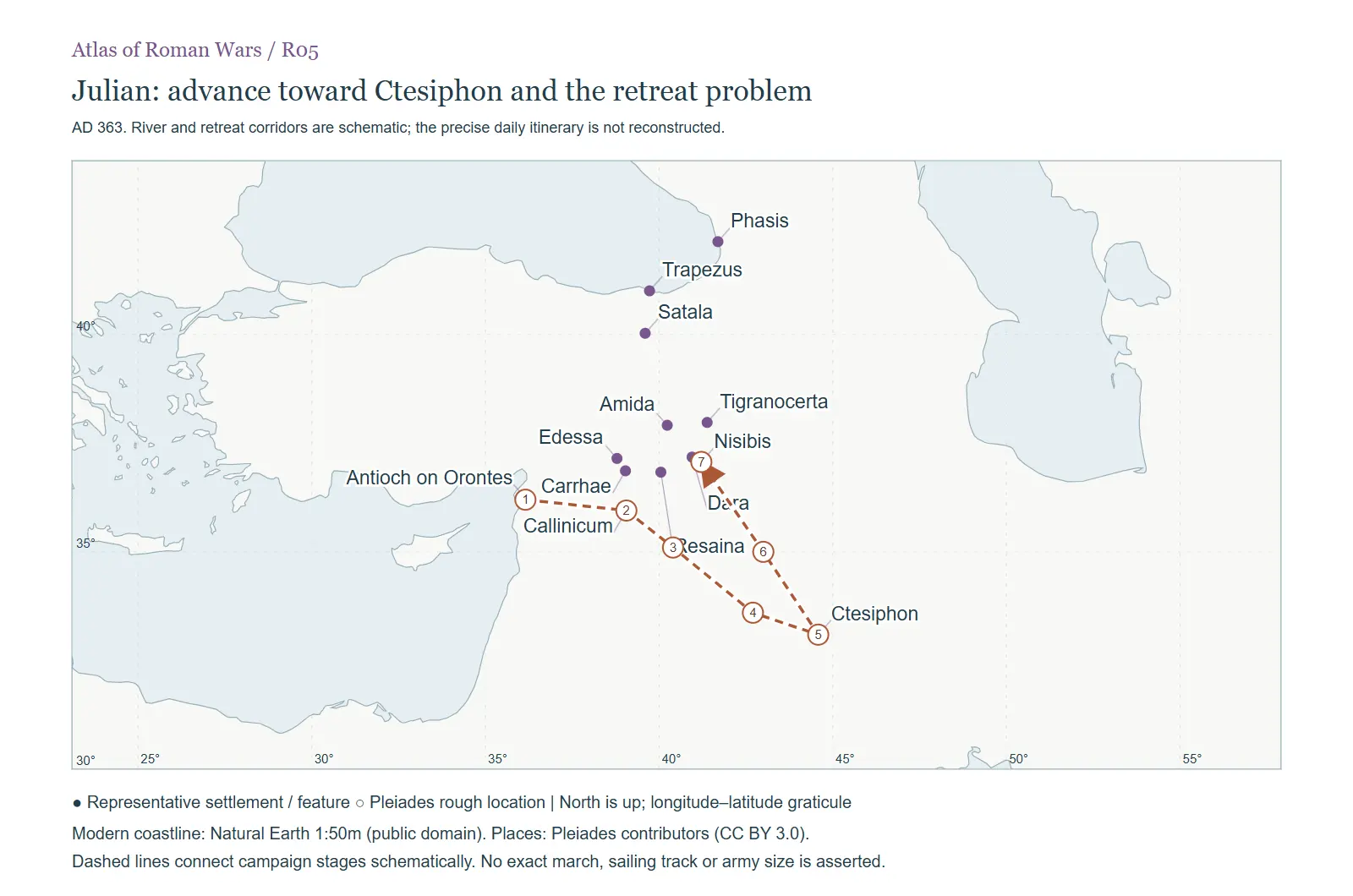
Julian's expedition and retreat 363 ADJulian advanced with a large army and riverborne support toward Ctesiphon, while a separate northern force was intended to operate in connection with Armenia. Roman tactical success near the capital did not produce its capture or a decisive Persian submission. Decisions concerning the fleet and inland movement increased the army's dependence on uncertain supplies and routes.
During the retreat Julian was fatally wounded. Jovian, chosen emperor in the crisis, negotiated a treaty that surrendered important Roman positions, including Nisibis, in order to bring the army out.
Command, forces and military problem
| Field | Dossier |
|---|---|
| Roman leadership | Julian; Procopius and Sebastianus in the separate northern force; Jovian in retreat |
| Opposing or rival parties | Shapur II and Sasanian regional and field forces |
| Forces and capabilities | A large invading army, river fleet and intended northern cooperation |
| Operational problem | Obtain a political decision before supplies, coordination and the retreat situation fail. |
The plan and the divided army
Julian's invasion joined political ambition, confidence in his army and an effort to impose a new eastern result. The main force advanced along the river corridor with a fleet supporting movement and supplies. A separate force under Procopius and Sebastianus was intended to operate through the northern theater in connection with Armenian support. The uncertain coordination between these elements was a central strategic problem.
The river fleet was not merely transport trailing an independent land army. It carried resources, enabled movement and connected the expedition to a particular geographic axis. Decisions that reduced or abandoned that support altered what the army could attempt inland. The source accounts differ in the allocation of responsibility and in what they believed the next operational opportunity to be.
Approaching Ctesiphon
Roman success during the advance and near the Persian capital did not answer the larger question of how to force a final settlement. A defended royal center could survive nearby defeat. The main Persian field forces, the availability of food and the possibility of joining the northern army mattered to every option that remained.
Destroying or leaving the fleet and moving away from the river system increased risk. That is an operational observation, not proof that every earlier choice was obviously irrational. Julian and his officers were acting on incomplete information, while Persian forces could deny resources and apply pressure without offering the decisive battle Rome wanted.
Retreat, succession and negotiation
During the retreat, skirmishing and mounted attacks made movement and protection of the column difficult. Julian's fatal wound created a succession crisis inside an army already in danger. Jovian's immediate task was to preserve the force sufficiently to return it to imperial territory, not to complete the original invasion on unchanged terms.
The treaty's territorial concessions, especially the loss of Nisibis, had lasting consequences for the inhabitants and the eastern frontier. The evacuation of a city was a civilian event as well as a clause in diplomacy. Roman writers could condemn the agreement while acknowledging the situation in which it was made.
The campaign remains a clear example of tactical success failing to produce strategic success. It does not demonstrate that Roman troops were incapable of fighting in Mesopotamia. It demonstrates that winning encounters, sustaining an army, securing a capital and imposing a political result were distinct tasks, and that failure in the latter tasks could outweigh success in the first.
Extended campaign study
The account below develops the operations and their interpretation. Reported numbers and reconstructed tactical details retain the uncertainties described in the dossier.
Julian: Strasbourg and the Persian Catastrophe (355–363)
The reign's last decade belongs to the cousin the massacre spared. Julian — twenty-three, a student of philosophy with no military hour behind him — was created Caesar in 355 and sent to a Gaul wrecked by the civil war's stripping of the Rhine: Cologne fallen, forty-five towns sacked, the Alamanni settled on the left bank.
Outcome and critical assessment
Result and caution: a Roman strategic failure despite successful fighting during parts of the advance. Ammianus participated and admired Julian, yet his narrative also records the expedition's difficulties. The causes of the failure cannot be assigned solely to one betrayal, one burned fleet or one fatal decision. The exact circumstances of Julian's wound remain disputed.
Historical record: IR-VIII, chapter 2; Ammianus, books 23–25, especially 25.7 for the treaty.