Wars · VII. The fourth-century empire
W074 Julian's Gallic campaigns and Strasbourg
Battles and sieges
Strasbourg 357 ADJulian's western command confronted damaged towns, contested routes and pressure from Alamannic groups. Restoring supplies, recovering positions and cooperating—or failing to cooperate—with other Roman commanders were prerequisites to battlefield success.
At Strasbourg, ancient Argentorate, Julian's army defeated an Alamannic coalition associated with Chnodomar. Further operations beyond the Rhine and in Gaul sought to consolidate that result. The emperor-to-be's military reputation developed within the politics of his relationship with Constantius II.
Command, forces and military problem
| Field | Dossier |
|---|---|
| Roman leadership | Julian and other Roman commanders in Gaul |
| Opposing or rival parties | Chnodomar and changing Alamannic coalitions |
| Forces and capabilities | Roman infantry and cavalry, recovered bases and operations across the Rhine |
| Operational problem | Rebuild provincial security and exploit victory without assuming permanent conquest beyond the frontier. |
Rebuilding a western position
Julian inherited more than an enemy army waiting to be defeated. Damaged settlements, insecure routes and the need to provision troops limited Roman options in Gaul. Recovering the ability to move and supply forces was therefore part of the campaign itself. The command relationship with Constantius and cooperation with other Roman generals shaped the use of available forces.
The capture or recovery of fortified places altered control of communications and offered secure bases. Operations beyond the Rhine could punish opponents, recover captives and strengthen bargaining without necessarily aiming at permanent provincial annexation. A military frontier was a zone of repeated interaction, not a wall that Roman troops never crossed.
Strasbourg as a tactical encounter
The Alamannic coalition concentrated an army to contest Roman action near Argentorate. Ammianus describes differences in the performance of cavalry and infantry and gives considerable attention to the restoration of order under pressure. The battle's significance lies partly in the ability of Roman formations to remain effective through an uneven encounter rather than in a claim that every arm performed perfectly.
The capture of Chnodomar offered a visible political result. It did not eliminate other leaders or the ability of northern communities to resist. Follow-up operations and negotiations were necessary to turn the battlefield victory into a stronger regional position.
Reputation and the next civil crisis
Julian's western successes gave him authority among his soldiers and a reputation that mattered in his conflict with Constantius. The army's political relationship with its commander belongs in the explanation of the later acclamation. That relationship was produced by shared campaigning and expectations as well as imperial family status.
Strasbourg can therefore be read on three scales: a battle against a regional coalition, a stage in the recovery of Roman security in Gaul, and an event in the rise of a claimant to the imperial throne. Ammianus' admiration makes the account vivid but does not relieve the historian of distinguishing those scales or questioning the very uneven casualty figures he reports.
Campaign geography and operational plates
Strasbourg: cavalry panic and the infantry’s response
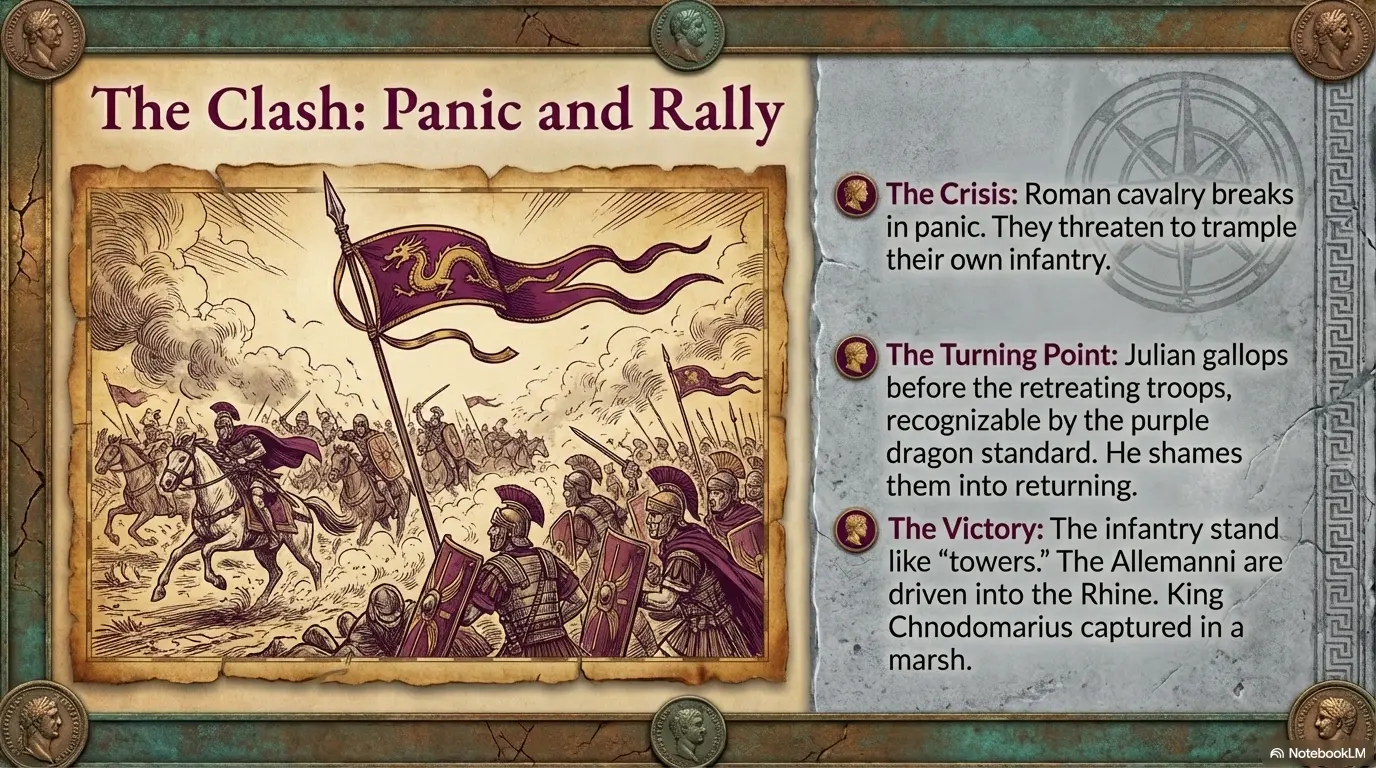
A mounted force falling back could threaten troops behind it even before the enemy reached them. The scene helps explain why control and rallying mattered alongside weapon capabilities. It should be read with the dossier's account of different bodies of troops and the limitations of recovering an exact battlefield sequence from a literary description.
Outcome and critical assessment
Result and caution: Roman security and Julian's prestige improved. Strasbourg was not the permanent destruction of all Alamannic power. Ammianus' detailed battlefield narrative remains a constructed account written later, with strong admiration for Julian; its speeches and precise loss figures have a different status from the fact of a major Roman victory.
Historical record: Ammianus, especially 16.12 and subsequent Gallic books; IR-VIII, chapter 2. Placed here as a thematic western counterpart to the Persian records, rather than as a claim that it followed AD 363.