Legions · The legions, by number
45 Legio XXII Primigenia
The Twenty-second of Fortuna Primigenia
Identity. Founded under Caligula around 39. Its surname invokes Fortuna Primigenia. Capricorn and Hercules occur among its associated imagery.
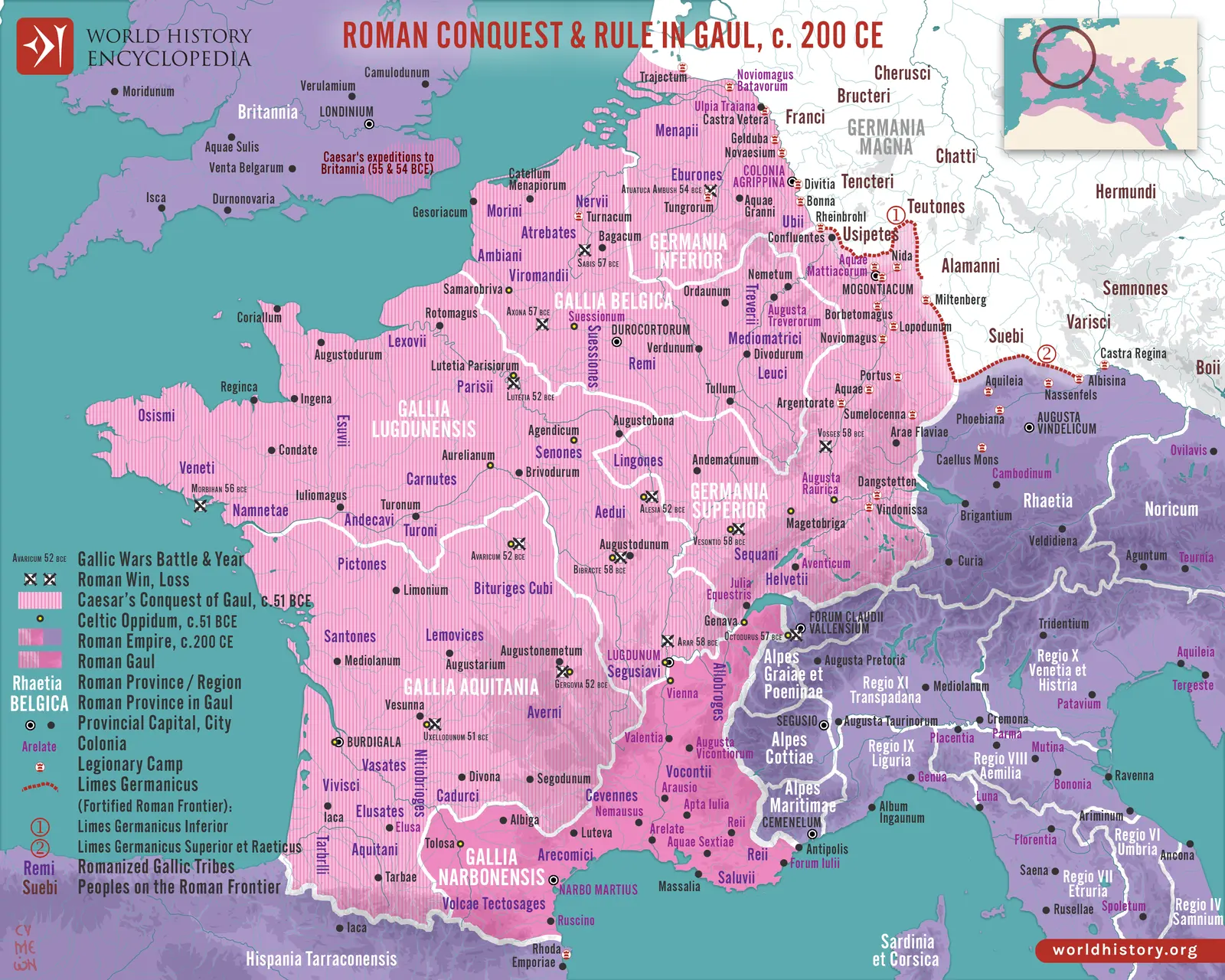
Historical outline. The Twenty-second’s history is inseparable from the Rhine crises of 69–70 and the subsequent imperial reordering. Its enduring Mainz identity included an intervening Lower Rhine phase at Xanten. Tile production, detachments, and political allegiance supply a richer institutional picture than the idea of an unmoving fortress regiment.
Selected chronology
- c.39: recruitment for Caligula’s northern military establishment.
- 40s–60s: Mainz association, including service alongside IV Macedonica.
- 69–70: civil-war detachments and the Rhine rebellion; Gaius Dillius Vocula directed major relief operations.
- After 70: Xanten phase, followed by return to Mainz around the end of the century.
- Third century: changing imperial affiliations and regional crises.
- Early fourth century: continued evidence; a specific destruction at Mursa is a hypothesis, not an established endpoint.
Caligula’s army and the paired fortress
The Twenty-second was created in the setting of Caligula’s northern military ambitions. Mainz became an important early station, shared with IV Macedonica. A paired fortress concentrated manpower, workshops, and command resources, but it also created a political concentration whose behavior mattered during an imperial succession.
In 69 the regiment supplied troops to the Vitellian struggle in Italy while the Rhine establishment became dangerously weakened and divided. The revolt in the river provinces was not simply an external invasion: auxiliary rebellion, local alliances, disputed imperial allegiance, and the movement of legionary detachments interacted.
Vocula and the relief operations
Gaius Dillius Vocula’s attempts to restore the situation show a commander operating amid unreliable support and rapidly changing political conditions. Relief of the besieged Vetera garrison required cooperation between forces whose confidence in one another had been damaged. Maintaining supplies and defending more than one threatened position strained the available army.
The Twenty-second survived the crisis under its own name, unlike several neighboring institutions. Subsequent station at Xanten and later return to Mainz belong to the Flavian and Domitianic reshaping of the Rhine army. The later Mainz identity must not erase the intervening Lower Rhine chapter.
Provincial production and a disputed ending
Tile stamps and other military objects reveal the legion’s construction and supply footprint. Such objects could travel: a stamped tile is evidence of production and distribution, not automatically proof that the whole legion was stationed wherever the tile was found. Its imagery included Capricorn and Hercules in different contexts.
The early-fourth-century record gives way to uncertainty. Destruction at Mursa and proposed relationships to later formations remain reconstructions. The Twenty-second’s ending should therefore be narrated as an unresolved institutional transition, not a secure final battle. Its biography is especially valuable for understanding how a legion’s survival depended on political outcomes as well as battlefield performance.