Legions · The legions, by number
27 Legio VIII Augusta
The Eighth Augustan Legion
Identity. A Caesarian Eighth was already serving in 58 BCE; the later imperial institution passed through disbandment and reconstitution. The bull is associated with its insignia.
Historical outline. The Eighth’s history bridges Caesar’s army, Octavian’s civil wars, the Balkan garrisons, and the Rhine. Its long Strasbourg association belongs to the imperial phase after earlier service elsewhere. It offers a useful corrective to biographies that run directly from Caesar to a late fortress without accounting for the remaking of personnel and command.
Selected chronology
- 58–48 BCE: Gallic and civil-war service in Caesar’s army.
- After Caesar’s death: reconstitution under Octavian.
- Early empire: Balkan service, including Poetovio and later the Lower Danube.
- 69–Flavian period: participation in the civil-war military world and subsequent transfer to the Rhine.
- Later empire: durable Strasbourg association; a dated inscription attests the legion in 371.
- Late horizon: proposed connections with the late military register’s Octavani require distinction between a related field formation and the old fortress establishment.
Caesar’s Eighth in battle
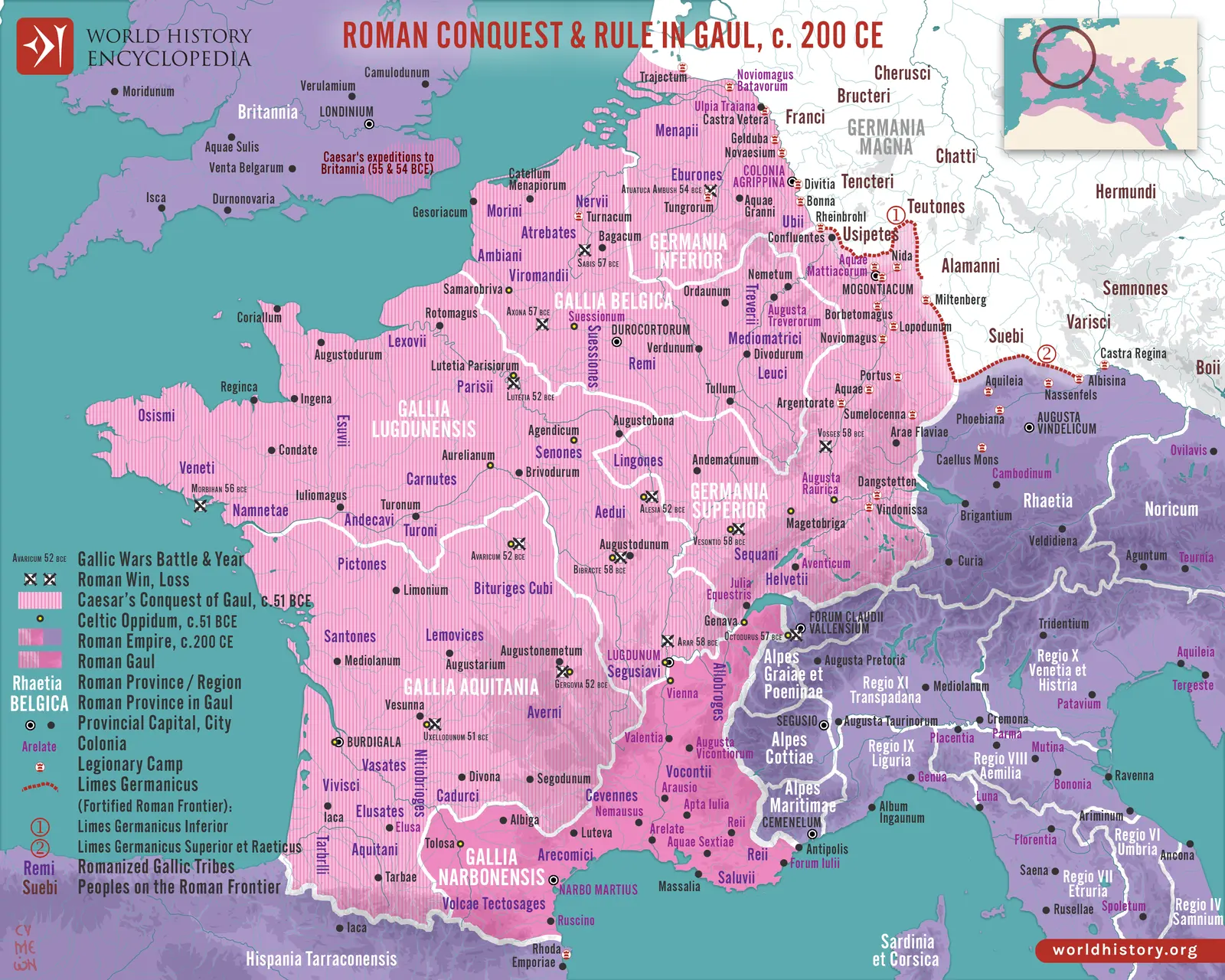
At the Sabis in 57 BCE the Eighth and Eleventh engaged the Viromandui while other legions fought different parts of the coalition. The battle turned on separated sectors, the incomplete preparation of camp, and the rapid movement of reserves. It was not a parade-ground exercise in which every Roman formation acted simultaneously under perfect central control.
The civil war carried the Eighth into operations against Pompey. Heavy losses and the combining of depleted formations show that a legion’s nominal establishment was not its actual battlefield strength. Veterans could be discharged, recalled, and recruited again under a new political patron. Octavian’s reconstitution therefore forms an essential bridge between Caesar’s Eighth and the later VIII Augusta.
The Rhine institution
After Balkan service, the Eighth became associated with the Upper Rhine and Strasbourg. Argentoratum controlled an important crossing and connected the river frontier with interior roads. Its garrison contributed to provincial defense, construction, administration, and the supply economy. A permanent base did not require every soldier to remain within its walls: detachments and individual specialists could serve elsewhere.
The legion’s later evidence places it within the repeated rebuilding and defense of the Rhine zone. A fourth-century Eighth should be visualized in the equipment and military organization of its own era, not automatically in Caesar’s dress. The institution outlasted the men whose service created its earliest reputation.
Memory and the later field army
The bull belonged to the legion’s established imagery. A later formation called Octavani may preserve a relationship with the old Eighth, but the transformation is not documented in every organizational step. It is more accurate to describe a possible descendant or redistributed body than to assume the Strasbourg regiment became a complete field unit on one known date. The Eighth’s biography makes institutional memory tangible: a Caesarian number could remain meaningful after repeated changes of regime, province, personnel, and military function.