Legions · Guide
Battlefield tactics and siegecraft
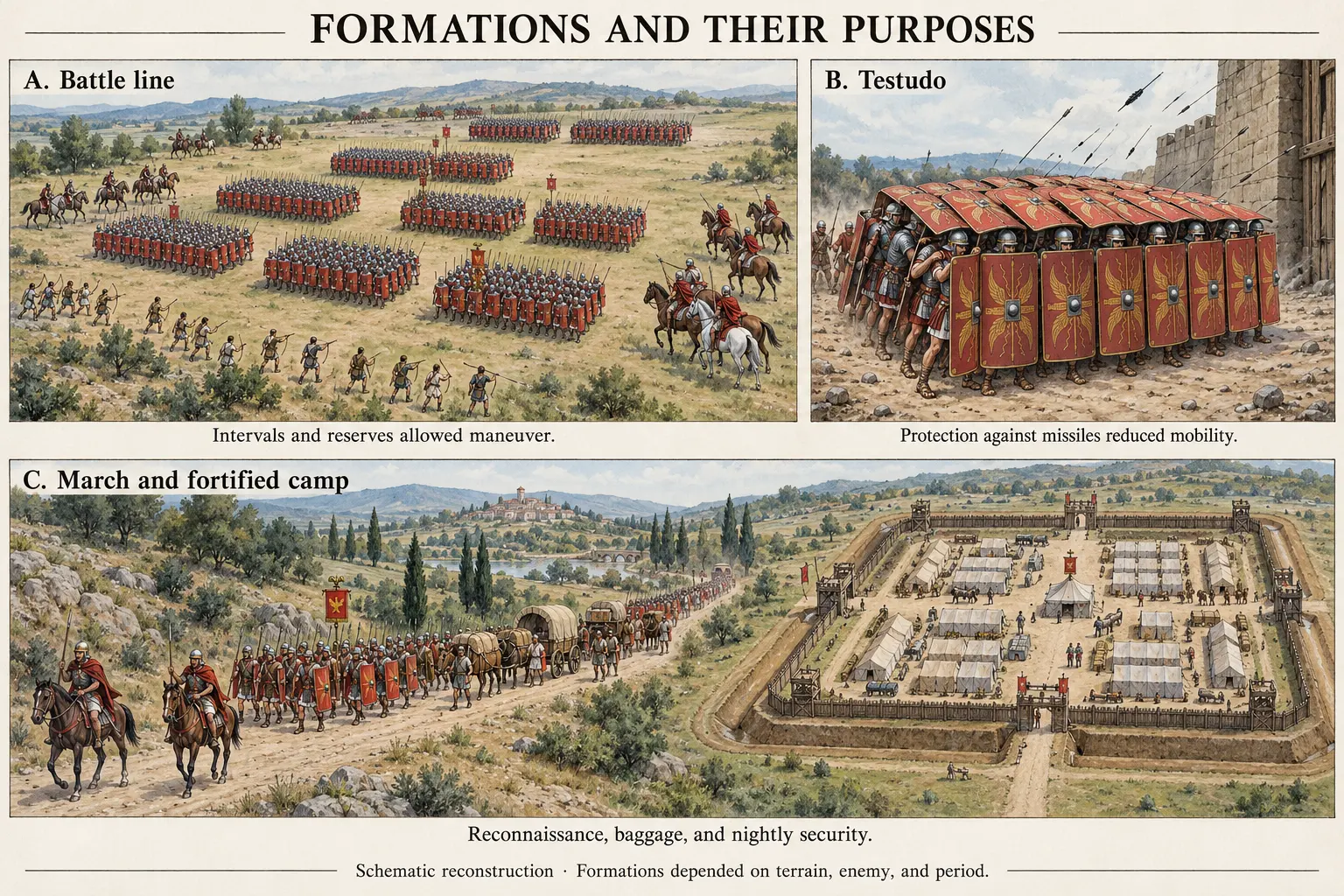
A battle line was an arrangement for a problem
Roman armies could deploy in several lines, retain reserves, leave intervals, extend a front, or modify their arrangement to fit terrain and enemy. The triplex acies is useful terminology for a three-line arrangement, but the phrase should not be used as a complete tactical explanation. The number of cohorts present, their strength, the available ground, and the place of auxiliaries and cavalry mattered.
Missile exchange could precede close fighting. A controlled advance, the protection supplied by shields, the cohesion of smaller units, and the ability to commit a reserve helped an army exploit an opening. None made victory automatic. Roman forces could be surprised while building camp, attacked in a marching column, defeated during retreat, or trapped when they could not form their usual front.
The battle against Boudicca demonstrates the importance of choosing a position and limiting an opponent’s ability to surround a smaller force. The Sabis illustrates emergency response and fighting in separated sectors. The Varian catastrophe illustrates the dangers of movement through contested country with baggage and disrupted communication. The two battles near Cremona show that experience, morale, exhaustion, rumor, and shifting political allegiance could shape engagements between armies with broadly similar military traditions.
Testudo, marches, and camps
The testudo combined shields into a protective arrangement, particularly useful under missiles in certain approaches and siege operations. It reduced movement, visibility, and the ability to use weapons freely. It was not the default way in which a legion charged across every battlefield, nor an invulnerable shell.
Marching exposed an army’s length, baggage, animals, and separated groups. Scouts, guides, advance guards, flank protection, and rear guards helped manage that vulnerability. A camp supplied a controlled space for rest, command, storage, and defense. Entrenchment required labor, but that expenditure could reduce the danger of a surprise attack and provide a secure point from which to resume operations.
An army did not operate in a vacuum between battles. Obtaining water, grazing animals, distributing food, repairing equipment, treating illness, and securing transport could determine whether it reached the next battlefield in a condition to fight. Military discipline included these recurring tasks as well as courage under attack.
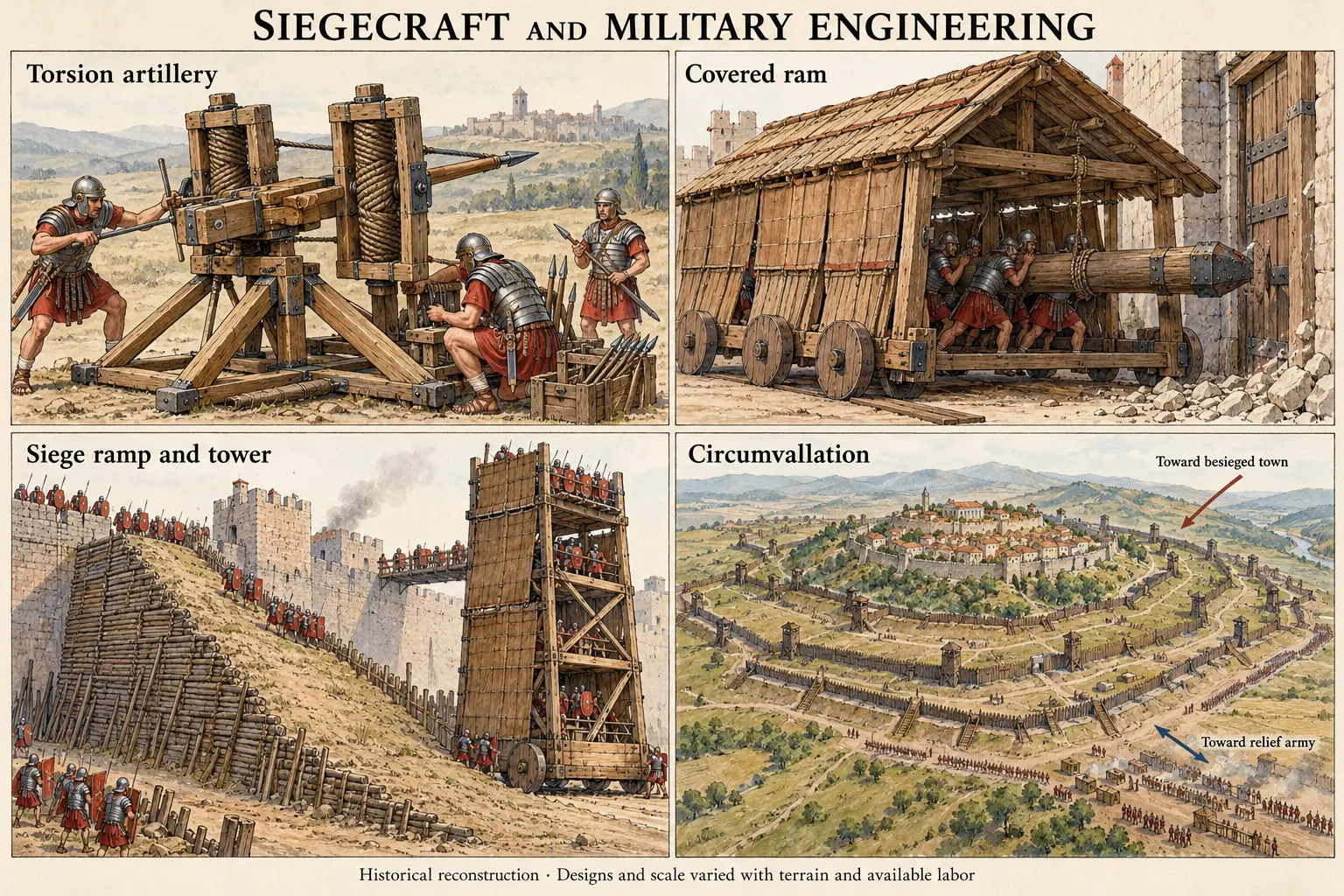
The engineering of coercion
Sieges combined containment, supply, artillery, assault, negotiation, intimidation, and the struggle over labor and time. Ramps could overcome differences of elevation; towers could bring fighting platforms toward a defended wall; covered approaches and rams offered protection for men attacking gates or masonry. Defenders countered with missiles, fire, sorties, repairs, mining, and attacks on the besiegers’ supplies.
At Jerusalem the siege army confronted a large and complex urban position. At Masada, terrain and access made construction and supply central to the operation. At Vetera, Roman legionaries experienced the opposite side of a siege: confinement, hunger, dependence on relief, and eventual surrender. The technical achievements of the Roman army should be described alongside the civilian destruction, enslavement, deportation, and coercive occupation that often followed its victories.