Legions · Guide
Regional deployment atlas
These registers connect legionary biographies with the places where troops lived, supplied armies, crossed frontiers, or operated in temporary campaigns. The entries are diachronic: legions appearing together in a row need not have occupied the same place simultaneously. Dates in the individual dossiers distinguish the relevant phases.
Britain and the northern military zone
| Ancient place | Modern locator | Legionary associations | Military function and historical setting |
|---|---|---|---|
| Camulodunum | Colchester | XX and the early conquest establishment | An early center of occupation; later veteran settlement and the destruction of 60/61 belong to different phases. |
| Lindum | Lincoln | IX Hispana; II Adiutrix | Successive military establishments before the mature northern and western fortress system. |
| Isca Augusta | Caerleon | II Augusta | Long western headquarters with access to the Usk and roads into Wales. |
| Deva | Chester | II Adiutrix; XX Valeria Victrix | Successive legionary occupations; supply connected with the Dee and the western road network. |
| Eboracum | York | IX Hispana; VI Victrix | A northern headquarters and imperial center, with different legionary generations before and after Hadrian. |
| Inchtuthil | Perthshire | Northern Flavian legionary establishment associated with XX | A short-lived phase in Rome’s northern occupation, not a permanently held Scottish province. |
| Hadrian’s Wall | Tyne–Solway frontier | Building detachments of II Augusta, VI Victrix, XX | Collective construction and rebuilding; routine occupation largely involved auxiliary garrisons. |
| Antonine Wall | Forth–Clyde frontier | II Augusta, VI Victrix, XX | A later northern advance, commemorated in legionary distance slabs. |
| Rutupiae | Richborough | Late II Augusta | A coastal assignment within a changed late Roman military establishment. |
Rhine, Alpine approaches, and Gaul
| Ancient place | Modern locator | Legionary associations | Military function and historical setting |
|---|---|---|---|
| Bonna | Bonn | I Germanica; XXI Rapax; I Minervia | Successive Lower Rhine occupations, not one simultaneous permanent garrison. |
| Novaesium | Neuss | XX; XVI Gallica; VI Victrix | A sequence reflecting the army’s repeated Rhine reorganizations. |
| Vetera and the Xanten district | Xanten | V Alaudae, XXI Rapax, XV Primigenia, XXII Primigenia, VI Victrix, XXX | Different fortress generations and units before and after the destruction of 70. |
| Noviomagus | Nijmegen | X Gemina; II Adiutrix; IX Hispana material | Batavian-region military control, rebuilding, and the distinction between a parent legion and a detachment. |
| Mogontiacum | Mainz | IV Macedonica, XIV Gemina, XXI Rapax, XXII Primigenia, I Adiutrix | A major crossing and command center with shifting paired garrisons. |
| Argentoratum | Strasbourg | II Augusta; later VIII Augusta | Successive occupations at an Upper Rhine crossing. |
| Vindonissa | Windisch | XIII Gemina, XXI Rapax, XI Claudia | Successive garrisons linking the Rhine system with routes toward the Alps. |
| Divitia | Cologne-Deutz | A later II Italica branch and other military associations | A bridgehead and example of a detached body acquiring a separate history. |
| Lugdunum | Lyon | Detachments of several Rhine legions | Provincial capital and administrative center, not the permanent home of every regiment represented there. |
Danube, Balkans, and Dacia
| Ancient place | Modern locator | Legionary associations | Military function and historical setting |
|---|---|---|---|
| Castra Regina | Regensburg | III Italica | Raetian legionary center, with the monumental establishment dated to 179. |
| Lauriacum | Lorch/Enns | II Italica | Norican fortress at a river junction and a center for the upper Danubian army. |
| Vindobona | Vienna | XIV Gemina; later X Gemina | Separate occupation phases and long later association with the Tenth. |
| Carnuntum | Petronell-Carnuntum district | XV Apollinaris; VII Galbiana briefly; XIV Gemina later | River crossing, provincial center, and repeated imperial military concentration. |
| Brigetio | Szőny/Komárom | XI Claudia, XXX, and enduring I Adiutrix | Successive early-second-century occupations and a long later First Adiutrix establishment. |
| Aquincum | Budapest | II Adiutrix | Middle Danubian legionary, urban, and administrative center. |
| Poetovio | Ptuj | VIII Augusta; XIII Gemina | Important earlier Balkan headquarters before later redistributions. |
| Burnum | Near Kistanje | XI Claudia; IV Flavia Felix | Dalmatian military center with successive institutional roles. |
| Singidunum | Belgrade | IV Flavia Felix; II Adiutrix in an earlier campaign setting | Confluence of Sava and Danube and communication with the Balkan interior. |
| Viminacium | Kostolac district | VII Claudia | A major Moesian fortress and provincial center. |
| Novae | Near Svishtov | VIII Augusta earlier; I Italica enduring | Lower Danubian headquarters and associated river-sector duties. |
| Durostorum | Silistra | XI Claudia | Long Lower Danubian legionary establishment from the Trajanic period. |
| Transmarisca | Tutrakan | Late XI Claudia subdivisions | Distributed river defense rather than another complete early imperial Eleventh. |
| Oescus | Gigen | V Macedonica | Repeated headquarters before and after the Dacian occupation. |
| Troesmis | Near Iglița/Turcoaia | V Macedonica | Lower Danubian station before the transfer to Potaissa. |
| Potaissa | Turda | V Macedonica | Interior Dacian fortress from the later second century until evacuation. |
| Apulum | Alba Iulia | XIII Gemina | Major legionary center inside Roman Dacia. |
| Ratiaria | Archar | XIII Gemina after the Dacian withdrawal | A new principal geography south of the Danube. |
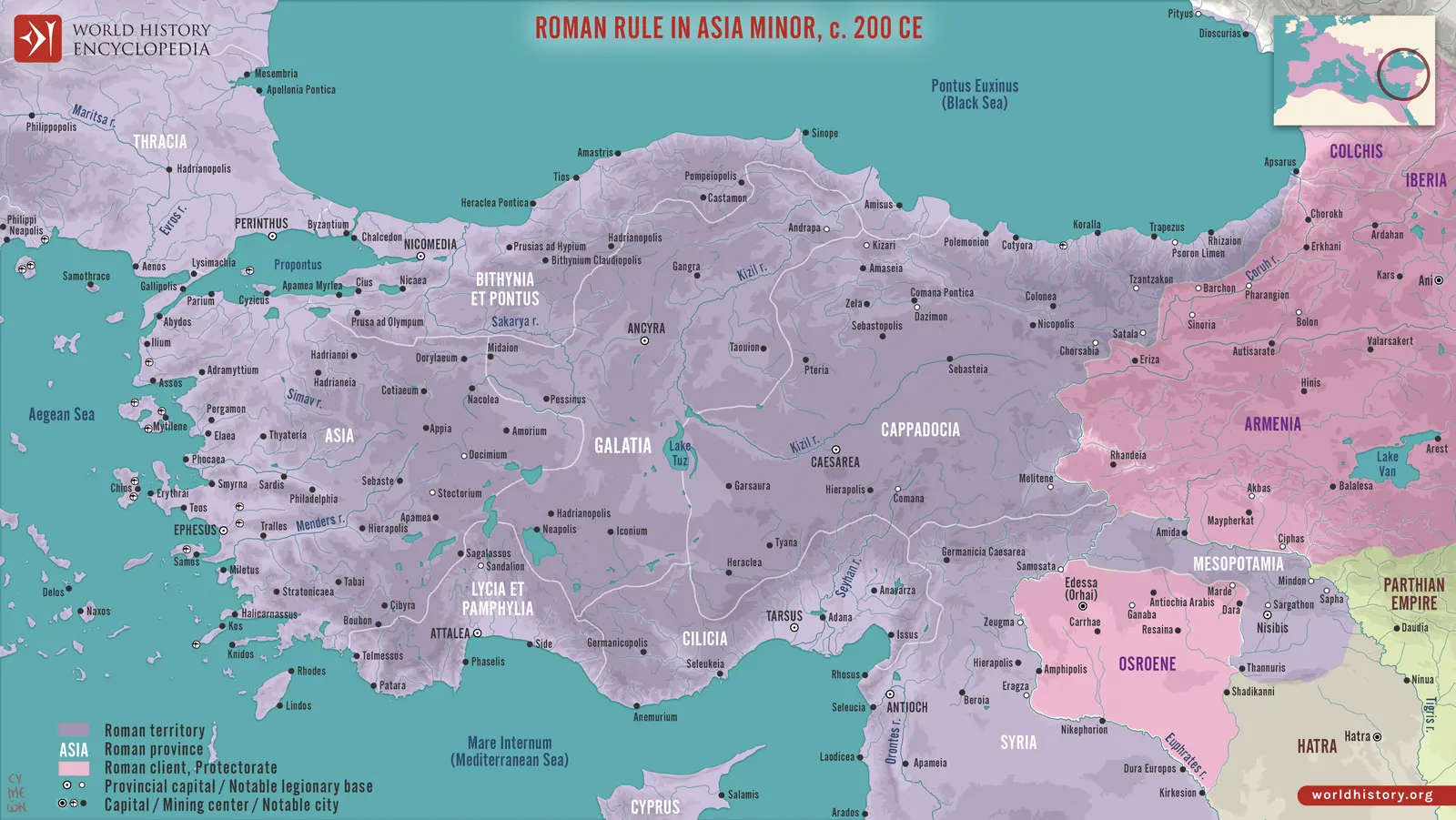
Eastern provinces, Africa, and Egypt
| Ancient place | Modern locator | Legionary associations | Military function and historical setting |
|---|---|---|---|
| Raphanaea | Western Syria | III Gallica; proposed earlier VI Ferrata associations | A specific garrison history distinct from the importance of Antioch as a regional capital. |
| Danaba | Inland Syria | Late III Gallica | Later station; exact site identification remains uncertain. |
| Zeugma | Near Belkıs | IV Scythica | Euphrates crossing and communications center. |
| Oresa | Euphrates region | Late IV Scythica | A changed later station, not another name for Zeugma. |
| Samosata | Old Samsat region | VI Ferrata; later XVI Flavia Firma | Successive roles on the Euphrates and routes through Commagene. |
| Sura | Syrian Euphrates | Late XVI Flavia Firma | Later river headquarters. |
| Satala | Sadak | XVI Flavia Firma earlier; XV Apollinaris later | Northern eastern command facing Armenian routes. |
| Melitene | Malatya region | XII Fulminata | Durable Cappadocian base near Armenian and Euphrates approaches. |
| Ancient place | Modern locator | Legionary associations | Military function and historical setting |
|---|---|---|---|
| Singara | Sinjar region | I Parthica | Mesopotamian fortress captured by Shapur II in 360. |
| Rhesaena | Ras al-Ayn/Ceylanpınar district | III Parthica | Upper Khabur headquarters on the routes between regional centers. |
| Constantina | Viranşehir region | Late I Parthica Nisibena | A later station whose title preserves a different geographical association. |
| Cepha | Hasankeyf region | Late II Parthica | Eastern phase after the legion’s earlier Italian reserve role. |
| Bostra | Bosra | III Cyrenaica | Arabian legionary center and road-network junction. |
| Legio/Caparcotna | Near Megiddo | VI Ferrata | A durable military establishment in the Palestinian interior. |
| Jerusalem | Jerusalem | X Fretensis | Siege and later occupation; the permanent camp’s precise development remains a separate archaeological problem. |
| Masada | Judean Desert | X Fretensis under Silva | Siege camps and works in a difficult elevated landscape. |
| Aila | Aqaba | Late X Fretensis | Northern Red Sea station. |
| Albanum | Albano Laziale | II Parthica | Italian reserve base near the imperial center. |
| Legio | León | VII Gemina | Spanish headquarters with strong regional economic and administrative connections. |
| Ammaedara | Haïdra | III Augusta | Early African headquarters. |
| Theveste | Tébessa | III Augusta | Major headquarters before the enduring Lambaesis phase. |
| Lambaesis | Tazoult | III Augusta | African legionary, administrative, and training center. |
| Alexandria/Nicopolis | Alexandria district | III Cyrenaica, XXII Deiotariana, II Traiana at different periods | A succession of Egyptian garrison arrangements; not one permanent combined roster. |
| Babylon in Egypt | Old Cairo | Late XIII Gemina component | Egyptian branch distinct from the Danubian parent; not Mesopotamian Babylon. |
| Memphis | Near Mit Rahina | Late V Macedonica component | A separate Egyptian presence alongside Danubian continuity. |
| Thebes and Ombos | Luxor and Kom Ombo | III Diocletiana components | Distributed Thebaid establishment. |
The other guides to legions
GuideThe Roman military worldThe legion of the middle Republic was not identical with the institution of the second-century empire. Republican…GuideWeapons and changing equipmentMail armor—commonly called lorica hamata—offered flexible protection and had a long Roman life. Scale armor also…GuideBattlefield tactics and siegecraftRoman armies could deploy in several lines, retain reserves, leave intervals, extend a front, or modify their…GuideAuxiliaries and specialist troopsThe legion was one institution within a larger army. Provincial military power also depended on auxiliary infantry…GuideStandards, symbols, and namesThe aquila embodied the legion’s corporate honor. Its capture could become a catastrophe remembered long after the…GuideGarrisons, logistics, and military societyAn established fortress organized space for command, barracks, stores, workshops, medical care, officers’…GuideRegional deployment atlasThese registers connect legionary biographies with the places where troops lived, supplied armies, crossed frontiers…GuideCampaign chronology and institutional turning pointsThe table is a chronological framework, not an order of battle. A legion’s presence in a campaign theater does not…GuideGlossaryGuideHistorical references and illustration creditsThe institutional narratives draw on Caesar’s Gallic War and Civil War; Tacitus’ Annals, Histories, and Agricola…