Legions · Guide
Auxiliaries and specialist troops
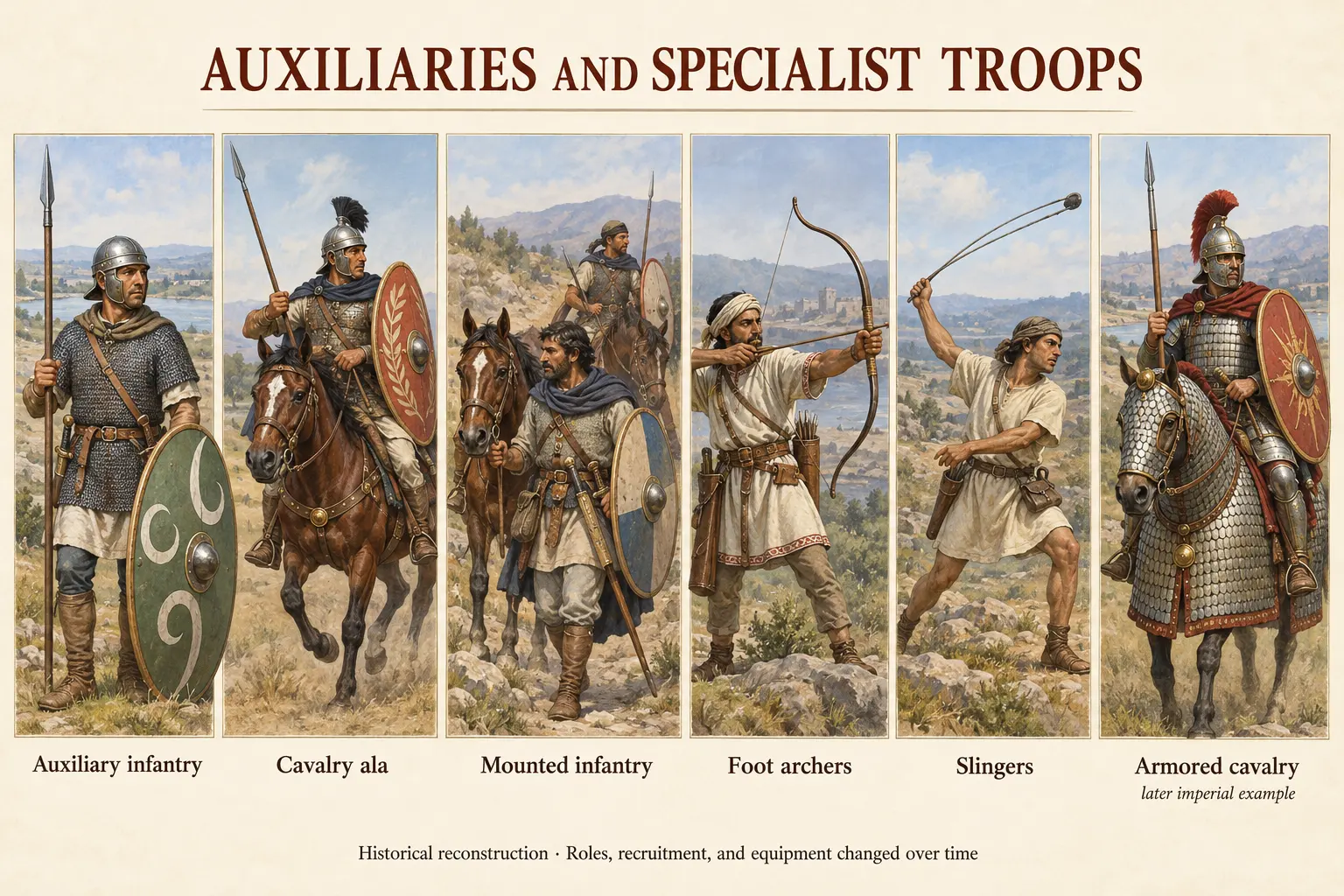
The legion was one institution within a larger army. Provincial military power also depended on auxiliary infantry, cavalry alae, mixed mounted cohorts, archers, slingers, allied rulers’ forces, fleets, guides, transport personnel, and local labor. Some capabilities were concentrated in particular recruiting regions or military traditions, but a unit’s inherited ethnic name did not guarantee that every later recruit came from that people.
| Formation or role | Contribution | Important distinction |
|---|---|---|
| Auxiliary infantry cohort | Holding forts, patrolling, escorting, campaigning, and fighting in infantry formations. | Auxiliaries could fight in the main battle line; “auxiliary” does not mean untrained or tactically insignificant. |
| Cavalry ala | Reconnaissance, screening, communication, flank action, pursuit, and mounted fighting. | A separate cavalry organization, not the small mounted component of a legion. |
| Cohors equitata | Combining infantry with a mounted element for dispersed duties and campaigning. | The infantry did not all become cavalry simply because the cohort was partly mounted. |
| Foot archers | Ranged fire, defense of works, and support in field or siege operations. | The bow was not a substitute for training or tactical coordination. |
| Mounted archers | Mobile missile action, scouting, screening, and harassment where appropriate. | Equipment, organization, and methods varied; they were not one universal ethnic category. |
| Slingers | Projectile fire against people and positions. | Skilled specialists whose weapons and ammunition could leave a distinctive material trace. |
| Armored cavalry | Heavily protected mounted action in selected imperial armies. | Cataphract and related terminology needs a date and context; no universal description covers every formation. |
| Allied or client contingents | Additional manpower and regional military capabilities. | Political arrangements differed from those of regular Roman auxiliary regiments. |
| Fleets and river forces | Transport, communication, movement of supplies, patrol, and combat on water. | A legion operating near a river was not itself a fleet. |
| Artillery and engineering specialists | Preparation and operation of machines, surveying, construction, and repair. | Many specialists served within existing military organizations rather than an independent modern engineering corps. |
In the early empire, citizen status helped distinguish legionary recruitment from much auxiliary service. Military diplomas and retirement grants could make citizenship an important part of an auxiliary soldier’s life. The general grant of citizenship in 212 changed the legal background; it did not instantly erase every organizational distinction or make all forms of recruitment identical.
At Mons Graupius, auxiliary infantry occupied the main fighting line while legionaries remained in reserve. In the Jewish War, allied rulers supplied forces that operated beside the legions. On the Rhine, the Batavian revolt demonstrated how dangerous a breakdown of relations with experienced auxiliary troops could become. A legion’s victories and defeats therefore cannot be explained responsibly without the rest of its army.