Legions · Guide
Weapons and changing equipment
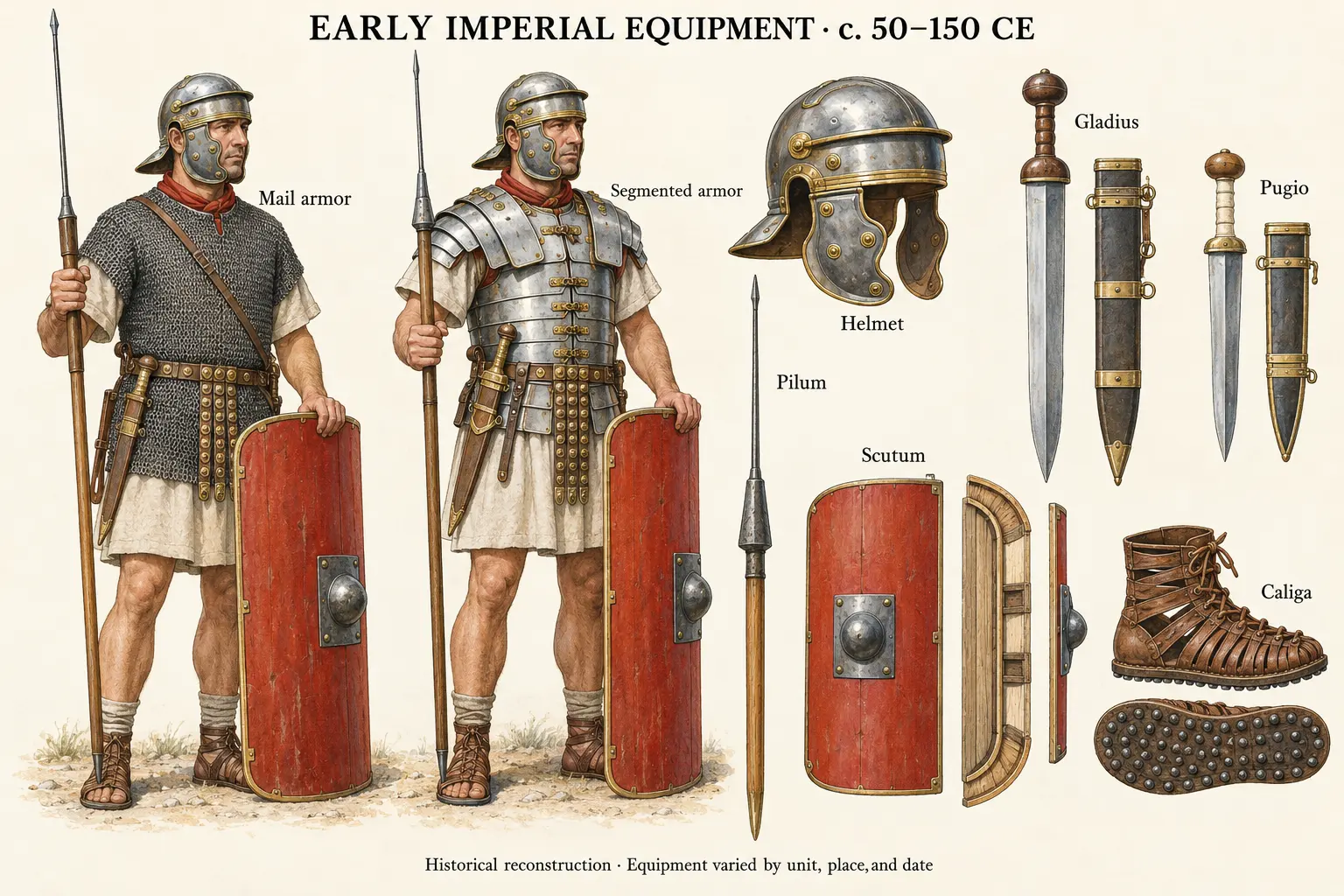
The fighting kit
| Item | Practical function | Historical distinction |
|---|---|---|
| Gladius | A sword suited to close combat; different blade forms occurred. | Especially associated with late Republican and early imperial infantry; not the only Roman sword. |
| Pilum | A heavy throwing weapon with an extended iron shank. | Designs varied; the familiar claim that every pilum was manufactured solely to bend on impact is too simple. |
| Pugio | A dagger carried as a sidearm. | Forms, decoration, and frequency changed; it should not be added automatically to every late soldier. |
| Scutum | A large shield protecting the body and helping maintain a fighting front. | Oval Republican and curved rectangular imperial forms belong to different contexts; the word is not one eternal shape. |
| Hasta and other spears | Thrusting or throwing weapons, depending on the design and use. | Spears remained important across Roman military history and became increasingly conspicuous in later infantry equipment. |
| Spatha | A longer sword, initially strongly associated with mounted service and increasingly used by infantry. | Its spread was gradual, not a single empire-wide replacement order on a known day. |
| Plumbatae | Lead-weighted darts associated with later Roman military practice. | They do not belong in an illustration of Caesar’s ordinary legionary kit. |
| Bow | Ranged fire from foot or horse. | Often linked with specialist troops, but weapon categories did not map perfectly onto one legal troop category. |
| Sling | Ranged discharge of stones or manufactured projectiles. | Its use demanded practice; slingers were not merely untrained men without proper weapons. |
| Artillery | Bolt-throwing or stone-projecting support against people, works, or buildings. | Different machines used different mechanical arrangements; not every device was a giant crossbow. |
Armor and protection
Mail armor—commonly called lorica hamata—offered flexible protection and had a long Roman life. Scale armor also appeared in several military contexts. Segmented plate armor—usually called lorica segmentata in modern writing—became a conspicuous early imperial form, but never supplies a safe universal dress code for all legionaries. Monumental art can simplify distinctions, and archaeological survival is uneven.
Helmets changed in construction, protection, and appearance. Earlier forms, Imperial Gallic and Italic traditions, and later ridge helmets should not be mixed without explanation. Crests could carry rank, display, or ceremonial significance in particular contexts; an ordinary infantryman need not be depicted with an enormous transverse crest. The same caution applies to decorated cavalry masks, which often belong to display and exercise equipment rather than routine combat dress.
Footwear included the familiar hobnailed caligae, but shoes, boots, leg coverings, and clothing varied with time and circumstance. Wool, linen, leather, iron, bronze fittings, padding, and replacement parts all had to move through an army’s supply system. A soldier’s equipment was maintained, repaired, reused, and occasionally passed through several owners. It was not necessarily issued as a perfectly matching modern uniform set.
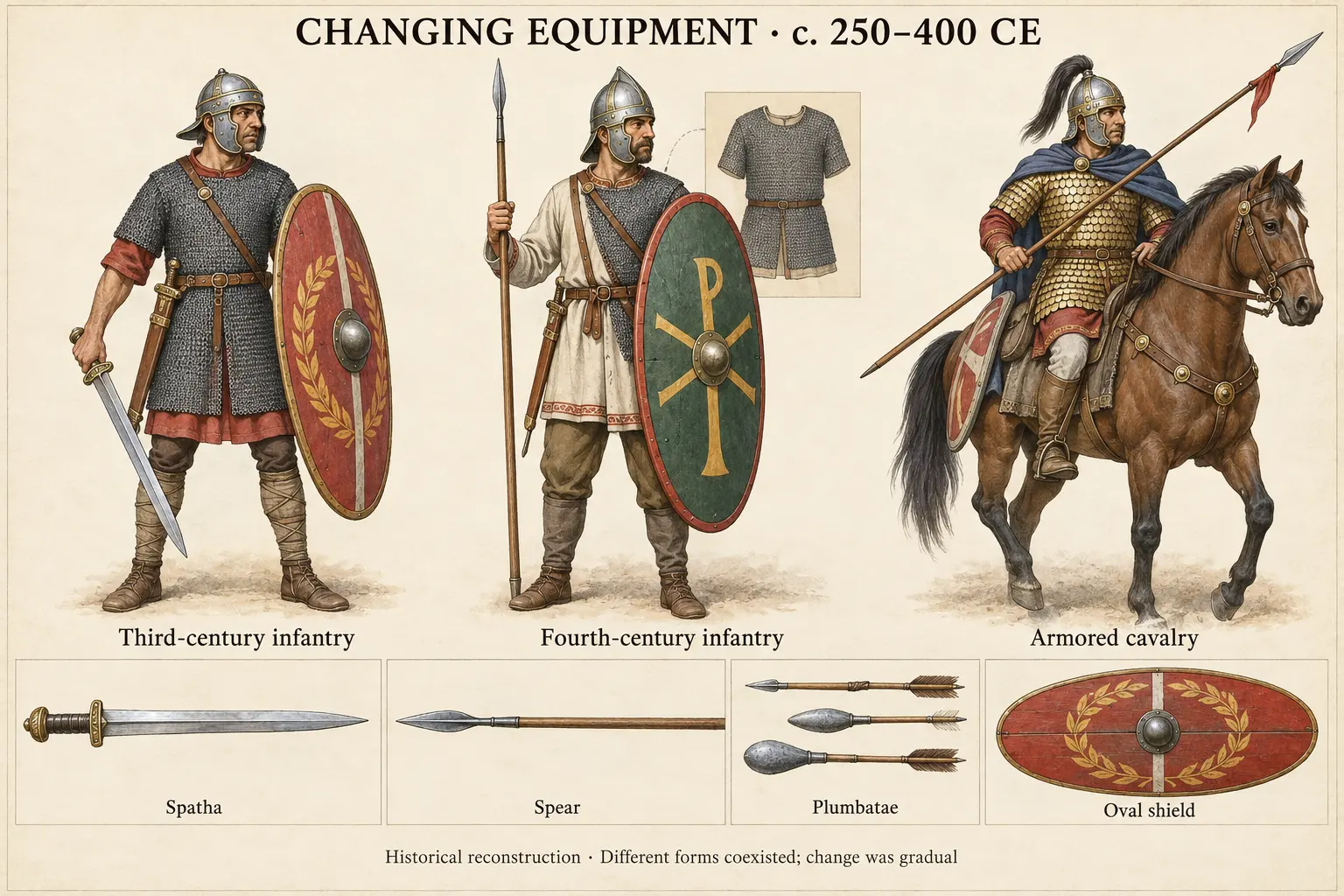
Applying equipment to an individual dossier
The correct first question is which century and which role? Caesar’s XIII, Hadrian’s XIII Gemina at Apulum, and an Egyptian XIII Gemina component in late antiquity should not all be illustrated with the same helmet and sword. A legion’s name could survive while its military material changed considerably.
Likewise, a badge does not identify a special weapon. Ferrata does not prove that VI Ferrata alone wore iron armor. Fulminata does not identify an exclusive projectile system. A boar, lion, or Capricorn belongs to corporate representation; the soldier carrying that symbol normally fought within the equipment and tactical possibilities of his own period.