Wars · VII. The fourth-century empire
W070 Constantine and the wars of the tetrarchic succession
Battles and sieges
Milvian Bridge 312 ADChrysopolis 324 ADThe succession arrangements of the tetrarchy broke down amid competing dynastic and military claims. Constantine secured a western base, invaded Italy in AD 312 and defeated Maxentius at the Milvian Bridge. Other struggles among Maximinus Daia, Licinius and rival claimants shaped the imperial order simultaneously.
Constantine and Licinius subsequently fought in two main phases, culminating in the campaigns of AD 324. Land operations near Adrianople, naval operations in the Hellespont and the battle of Chrysopolis brought Constantine sole rule. These are connected wars, not one continuous advance from Britain to Constantinople.
Command, forces and military problem
| Field | Dossier |
|---|---|
| Roman leadership | Constantine and allied commanders including Crispus |
| Opposing or rival parties | Maxentius, Licinius and other rivals within the succession wars |
| Forces and capabilities | Roman field armies, city defenses, river crossings and fleets in the straits |
| Operational problem | Eliminate competing courts and connect land victories with maritime control. |
The connected land and naval decision of AD 324
Constantine's final campaign against Licinius depended on more than the pursuit of a defeated army across the Balkans. The straits connected European and Asian positions. Naval success under Crispus reduced Licinius' freedom to move and support forces between them. The land battle at Chrysopolis completed a campaign in which maritime control had already altered the strategic situation.
The victory eliminated a rival imperial government, not an external civilization. Soldiers, officials and provincial populations then had to be incorporated into the victorious order. The execution of a defeated colleague and the later representation of sole rule belong to its political aftermath. The military course and the theological interpretation offered by court-friendly authors should remain connected without being treated as identical kinds of evidence.
Campaign geography and operational plates
Constantine: successive civil-war theaters
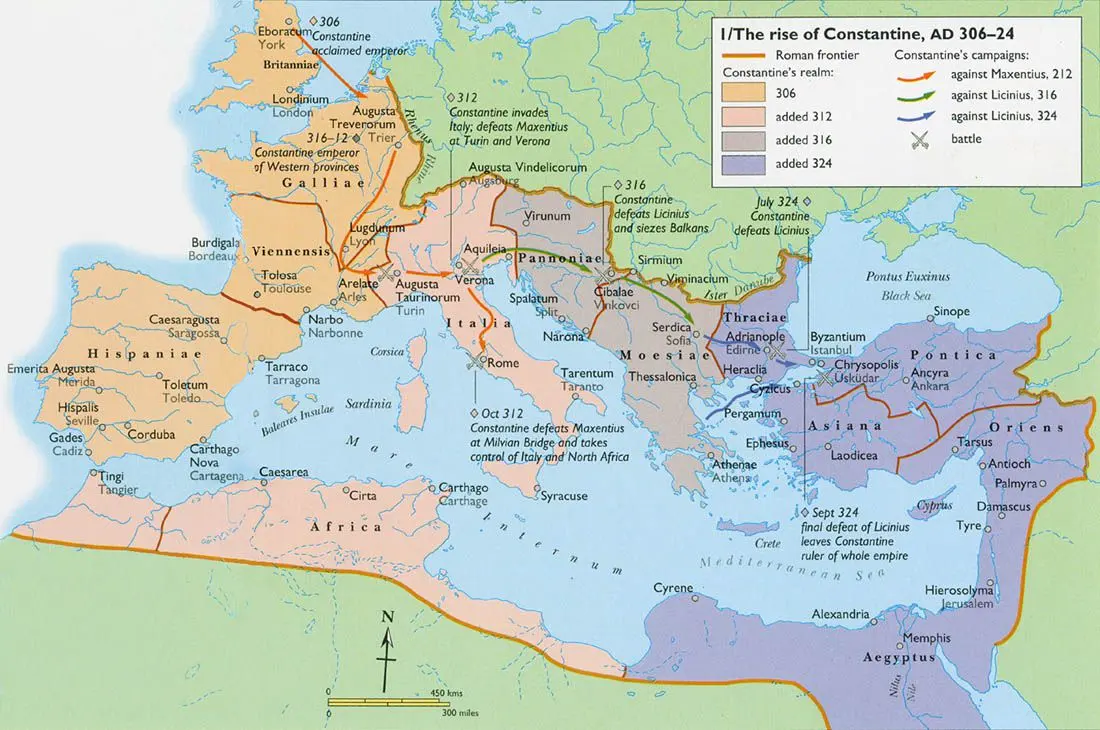
The progression from western bases toward Italy, the Balkans and the straits explains how successive victories changed the scale of Constantine's resources. The map is especially useful for separating the war against Maxentius from the later contests with Licinius. They did not share one opponent, one battlefield or one settlement.
Extended campaign study
The account below develops the operations and their interpretation. Reported numbers and reconstructed tactical details retain the uncertainties described in the dossier.
Constantine: The Civil Wars and the Christian Army (306–337)
The wars that ended the Tetrarchy occupied eighteen years and remade the world's religion, and the narrative relates them as what they operationally were: the reunification of the empire by its best general. Constantine, acclaimed by his father's army at York in July 306, spent six years consolidating Gaul and Britain — Frankish kings thrown to the beasts at Trier, the Rhine bridged in stone at Cologne — while the system collapsed elsewhere (six Augusti at one point in 310, the count itself the verdict); in 312 he struck into Italy against Maxentius with a small, veteran field force, took Turin and Verona in the campaign's real fighting, and arrived before Rome, where Maxentius — abandoning the Aurelian walls that had defeated Galerius's and Severus's armies against every strategic logic, on the day of his accession-anniversary, with the Sibylline oracle promising the death of Rome's enemy — gave battle at the Milvian Bridge with the Tiber at his back and his bridge of boats behind him. The battle was brief: Constantine's cavalry broke the wings, the mass collapsed onto the pontoon crossing, the bridge failed, and Maxentius drowned in the press, his body recovered next day for its head. The eastern reckoning came in two wars against Licinius — Cibalae and Campus Ardiensis in 316–317, the decade of armed truce, then the great campaign of 324: Adrianople stormed by feint and river-crossing in July, the Hellespont cleared by Crispus's fleet against Licinius's larger one, and the decision at Chrysopolis in September, after which the last colleague was interned at Thessalonica and, within the year, hanged.
Outcome and critical assessment
Result and caution: the empire was reunited under Constantine, with lasting political and religious consequences. The vision and dream traditions differ and belong to the history of imperial representation as well as belief. The battle at Adrianople in AD 324 is a different event from Valens' defeat there in AD 378.
Historical record: IR-VIII, chapter 1; Eusebius, Constantinian works; Eutropius, book 10; other partisan witnesses identified in the manuscript.