Legions · The legions, by number
22 Legio V Macedonica
The Fifth Macedonian Legion
Identity. Probably a formation of the civil-war period around 43 BCE; its earliest identity and the origin of its surname require reconstruction. The bull is an associated badge.
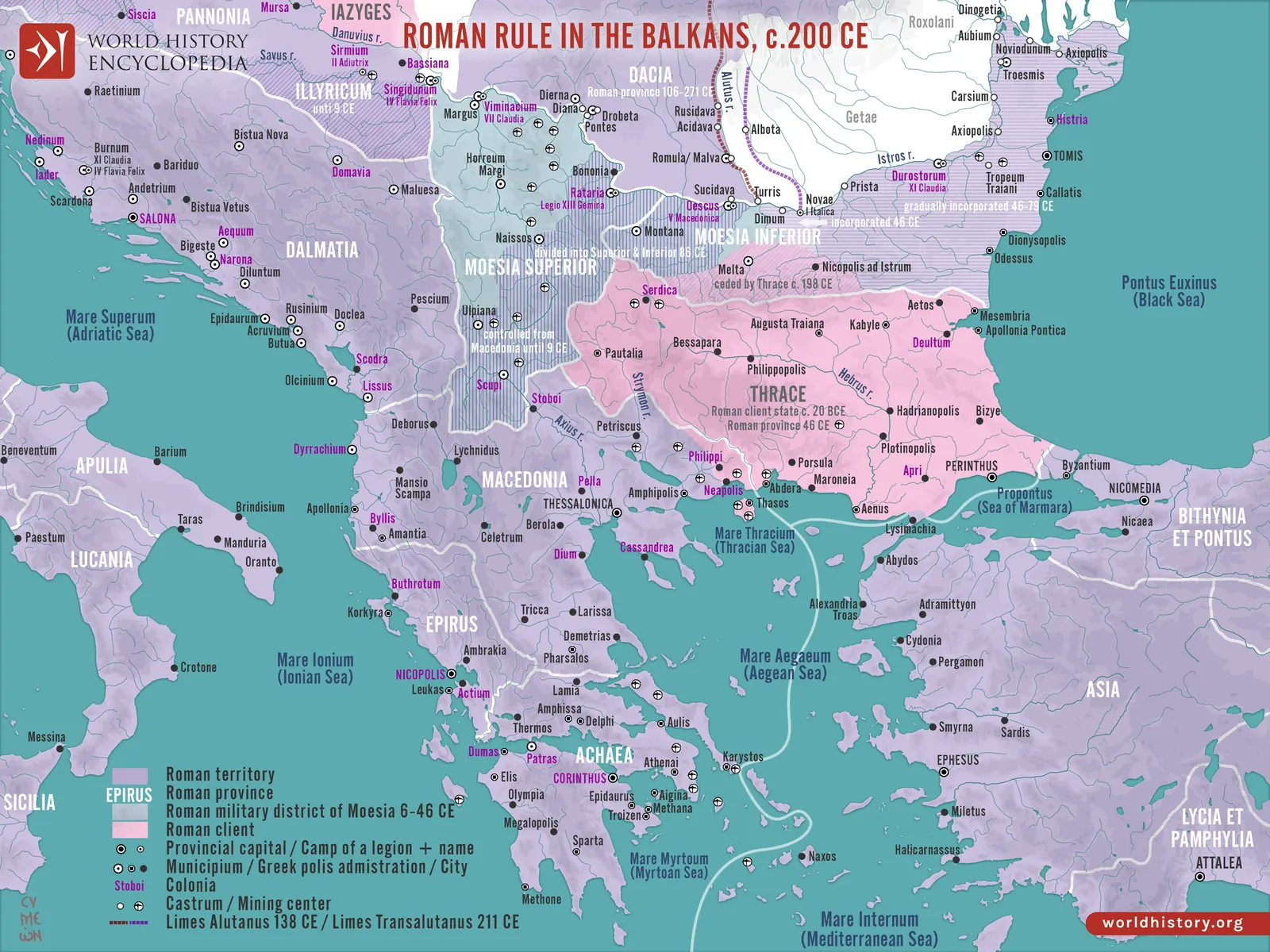
Historical outline. Few legion histories show the connection between provincial occupation and repeated redeployment more clearly. The Fifth served on the Lower Danube, campaigned in the East, occupied Dacia, and returned south of the river when Rome abandoned the trans-Danubian province. An Egyptian component later appears alongside the Danubian establishment.
Selected chronology
- Early empire: a long association with Oescus.
- 60s–70: eastern service and participation in the Jewish War.
- Early second century: Dacian campaigning and establishment at Troesmis.
- c.168 onward: station at Potaissa following eastern service.
- Early 270s: withdrawal from Dacia and return to the Lower Danube; avoid insisting on a single universally accepted evacuation year.
- Late horizon: V Macedonica appears at Oescus and neighboring Danubian posts, at Memphis in Egypt, and as a named field formation.
The eastern expedition and the Jewish War
The Fifth’s temporary eastern service took it far from its Danubian home. In the Jewish War it joined X Fretensis and XV Apollinaris in Vespasian’s principal legionary force. The fighting included the reduction of fortified towns, operations in rough country, and the control of routes rather than one continuous march toward Jerusalem. On Mount Gerizim, Cerealis’ force surrounded the Samaritans before the final confrontation. The episode belongs to the coercive extension of Roman control, not simply a catalogue of honors won by the legion.
The interruption caused by Nero’s death and the subsequent civil war reveals the imperial scale of the regiment’s obligations. An army could remain in a provincial war while its commander became a contender for Rome. The Fifth eventually returned to the Danubian system; eastern service did not erase its older geographical identity.
Oescus, Troesmis, and Potaissa
Oescus guarded a Lower Danubian junction connected with routes into Dacian territory. Troesmis placed the legion farther downstream, within the military geography of the lower river and its neighboring peoples. Potaissa represented a different assignment: occupation inside Roman Dacia, where the garrison supported routes, provincial administration, and the security of a territory projecting north of the Danube.
Together with XIII Gemina, V Macedonica became one of Dacia’s defining military institutions. The two regiments could provide combined detachments, but their fortresses and corporate identities remained distinct. The army’s withdrawal in the early 270s ended the Potaissa phase and returned the Fifth to a river-based defensive system south of the old province.
A long name with several late lives
The Egyptian component at Memphis and the named field formation demonstrate the later multiplication of a once more centralized identity. They are not proof that the whole legion marched from Dacia to Egypt. Bull and eagle imagery belong to its remembered corporate presentation. The Fifth’s significance lies in its ability to connect conquest, occupation, evacuation, and administrative redistribution across several centuries without requiring an invented final heroic battle.