Legions · The legions, by number
20 Legio IV Scythica
The Fourth Scythian Legion
Identity. Usually associated with Antony’s military establishment after 42 BCE; its earliest history is incompletely known. The surname refers to a historical Scythian association, not a permanent ethnic composition.
Historical outline. The Fourth moved from the Danubian world into Rome’s eastern military system. Its long connection with Zeugma made an Euphrates crossing central to its institutional geography. Its defeat alongside XII Fulminata under Paetus was an important episode, but later survival shows why one defeat cannot be treated as the end of a legion.
Selected chronology
- Early imperial period: Lower Danubian service and engineering activity.
- Nero’s reign: transfer east during the Armenian wars.
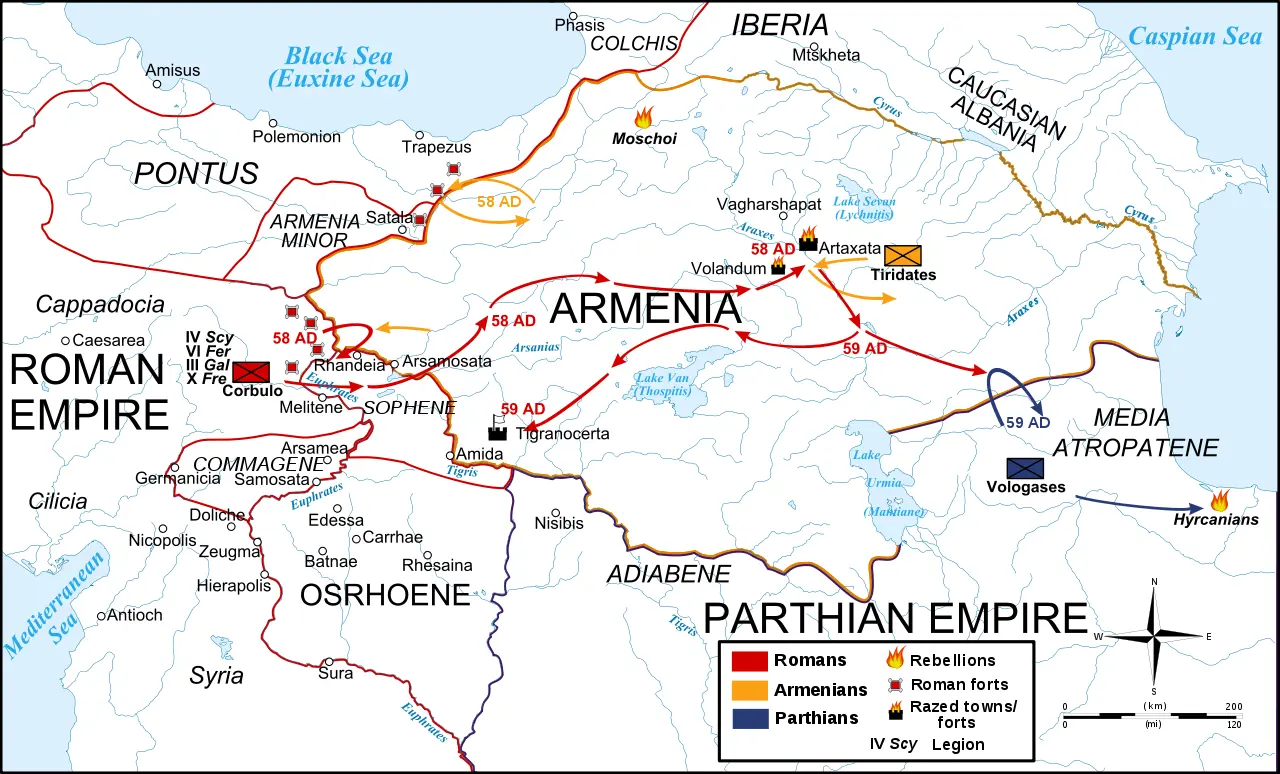
- 62: involvement in Paetus’ failed Armenian campaign and surrender at Rhandeia.
- Later first–third centuries: station at Zeugma; association with eastern campaigns and provincial works.
- Late horizon: late military records place IV Scythica at Oresa.
From the Danube to the Euphrates
The Fourth’s Scythian name preserved northern associations after the regiment became an eastern garrison. Early Danubian service included the military occupation of recently incorporated territories, road works, and cooperation with other regiments. Its later transfer was part of the empire’s recurring need to shift substantial forces between major theaters.
The Armenian war exposed the consequences of dividing command and operating in difficult country. Paetus’ army suffered defeat and surrender at Rhandeia in 62. IV Scythica’s participation became a stain on its reputation, yet the institution survived. Roman military history includes recovery after humiliation as well as annihilation after defeat.
Zeugma as a military landscape
Zeugma’s significance lay in crossing the Euphrates and connecting Syria with routes eastward. A legion stationed there belonged to a broader economy of transport, provisioning, merchants, and regional settlements. River conditions and the control of crossing points affected strategic movement. The garrison also formed one part of the provincial army available to support major eastern expeditions.
Septimius Severus’ earlier command of IV Scythica links its working provincial history with a later imperial career. That association does not require assuming that every honorific or subsequent eastern victory was earned by this legion as a complete body. Detachments, replacement troops, and combined commands complicate such assignments.
Later service and identity
The move to Oresa belongs to the reorganization of eastern defense. It should not be treated as disappearance followed by the accidental reuse of a number, nor as a completely documented transfer with a known date and marching route. The legion’s durable identity is clear; the detailed late sequence is not. Its history illustrates a repeated Roman pattern: a regiment acquired a geographical name in one theater, made its longest home in another, survived serious defeat, and later continued from a different headquarters.