Legions · The legions, by number
05 Legio I Minervia
The First under Minerva’s protection
Identity. A Domitianic foundation, conventionally dated around 82. Minerva supplied its divine association; Minerva and Capricorn occur among its symbols.
Historical outline. I Minervia became one of the defining military institutions of the Lower Rhine. Its long connection with Bonn coexisted with expeditionary service and construction work across the province. Hadrian commanded it during Trajan’s Dacian campaigns. Later cooperation with XXX Ulpia Victrix illustrates how neighboring legions shared provincial duties without losing their separate identities.
Selected chronology
- Domitian’s reign: recruitment and establishment at Bonn.
- 89: loyalty to Domitian against Saturninus brought an imperial loyalty title.
- 101–106: participation in the Dacian wars; Hadrian’s command belongs to this phase.
- Second–third centuries: provincial building, administrative work, and distant campaigning; changing imperial honorifics.
- Fourth century: evidence continues through the Rhine crises; the final dissolution cannot be fixed confidently.
A legion built around an imperial patron
Minerva’s association with Domitian gave the new legion a conspicuous political and religious identity. The titles surrounding the goddess’s name could change with the emperor’s fortunes. After Domitian’s murder, removing a personal imperial designation did not require the regiment to abandon its military past or its Bonn establishment. The enduring name preserved a selective version of that past.
The rising of Saturninus in 89 shows the Rhine army as a network of neighboring but politically distinct commands. Lower Rhine formations opposed the revolt in the Upper German command. A title proclaiming loyalty commemorated a choice in a particular crisis; it did not bind every later generation to one interpretation of imperial legitimacy.
Bonn, labor, and the provincial military economy
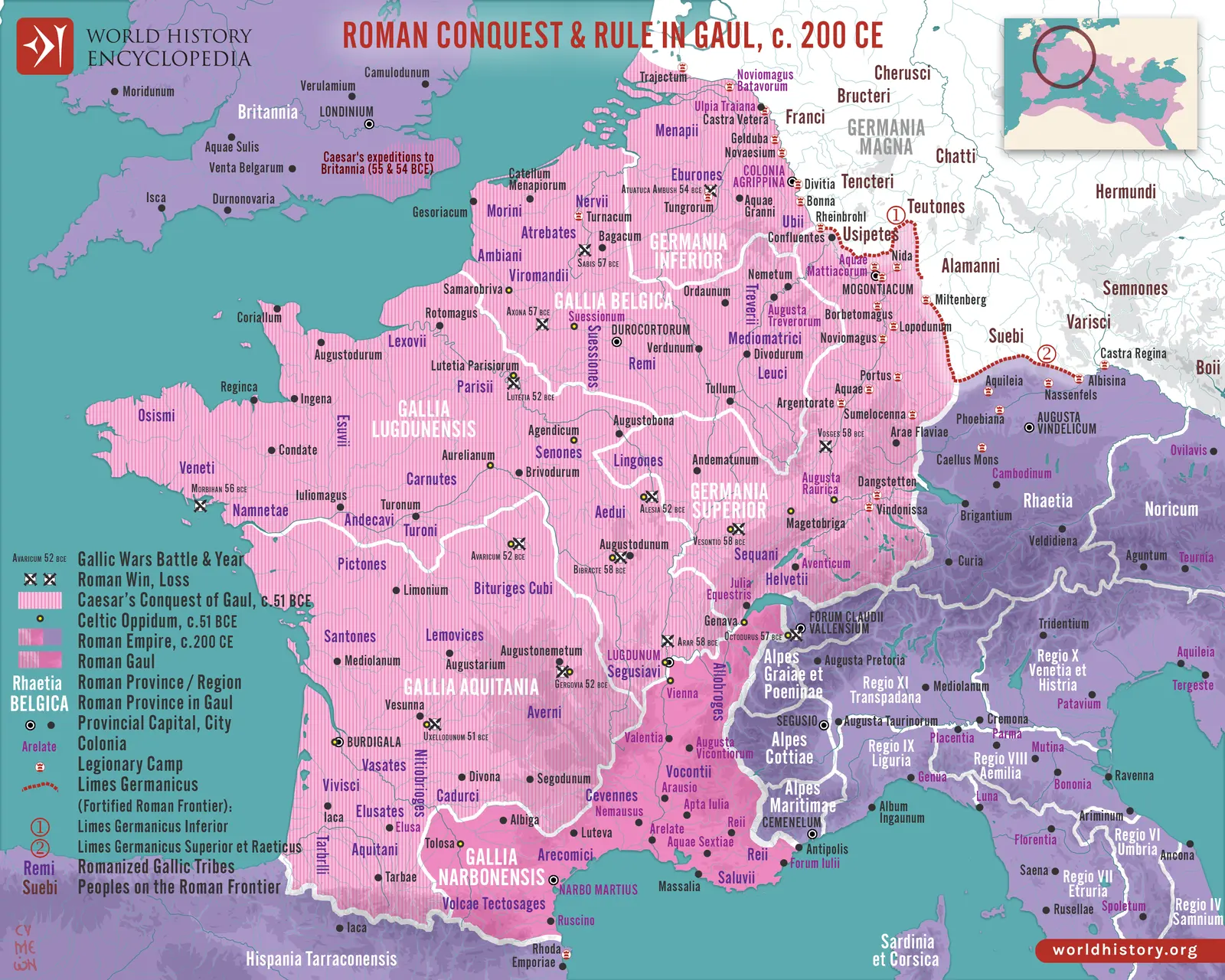
Bonna was positioned beside the Rhine and close to the provincial capital at Cologne. Its soldiers could move by river, supply outlying posts, and perform duties in the governor’s administrative world. The garrison’s material footprint extended into quarries, kilns, roads, and settlements. Construction and supply labor were recurring military responsibilities, not interruptions of the legion’s authentic purpose.
I Minervia and XXX Ulpia Victrix formed the principal legionary pair of the mature Lower German establishment. Shared projects and detached service linked them without merging their headquarters or standards. Hadrian’s earlier command of I Minervia during the Dacian wars illustrates how a provincial legion also served as a stage in an imperial career.
Battlefield identity and later transformation
The legion’s long chronology requires several equipment horizons: the mail and segmented armor of the earlier empire cannot be carried unchanged into its fourth-century life. Nor should a later formation called Minervii be assumed to reproduce the Bonn legion’s original establishment. The secure historical theme is resilience through changes in emperor, manpower, deployment, and frontier organization. Its final disappearance belongs to an uncertain sequence of late Roman transformations rather than a single securely identified last stand.