Legions · The legions, by number
03 Legio I Italica
Its biography joins imperial ambition to provincial permanence: an army unit intended for a major new campaign became a fortress institution with dispersed regional duties.
Endpoint: late Roman administrative survival; a precise final discharge or destruction date is not established here. Related identities: the First legions of Germanica, Minervia, Adiutrix, and Parthica.
Selected chronology
- 66: Neronian foundation, with 67 proposed in some reconstructions.
- 69: service for Vitellius in the succession war.
- Flavian period: establishment at Novae.
- Second–third centuries: enduring Lower Danubian headquarters and detached service.
- Late Roman period: distributed river-sector identity.
An expedition that changed purpose
Nero’s First Italian legion began as a formation associated with an ambitious eastern project. Imperial recruitment, inspection, and the presentation of standards created a new corporate body before the projected campaign could give it a battlefield tradition. The crisis of 68 redirected that body into the struggle over imperial power.
Its participation in the fighting of 69 supplied an early operational identity. The two battles near Cremona were separate engagements with changing armies and political circumstances. The First’s service for Vitellius did not prevent its later incorporation into Vespasian’s provincial military order. Redistribution after victory was more useful than indiscriminate destruction of trained manpower.
Novae and the Lower Danube
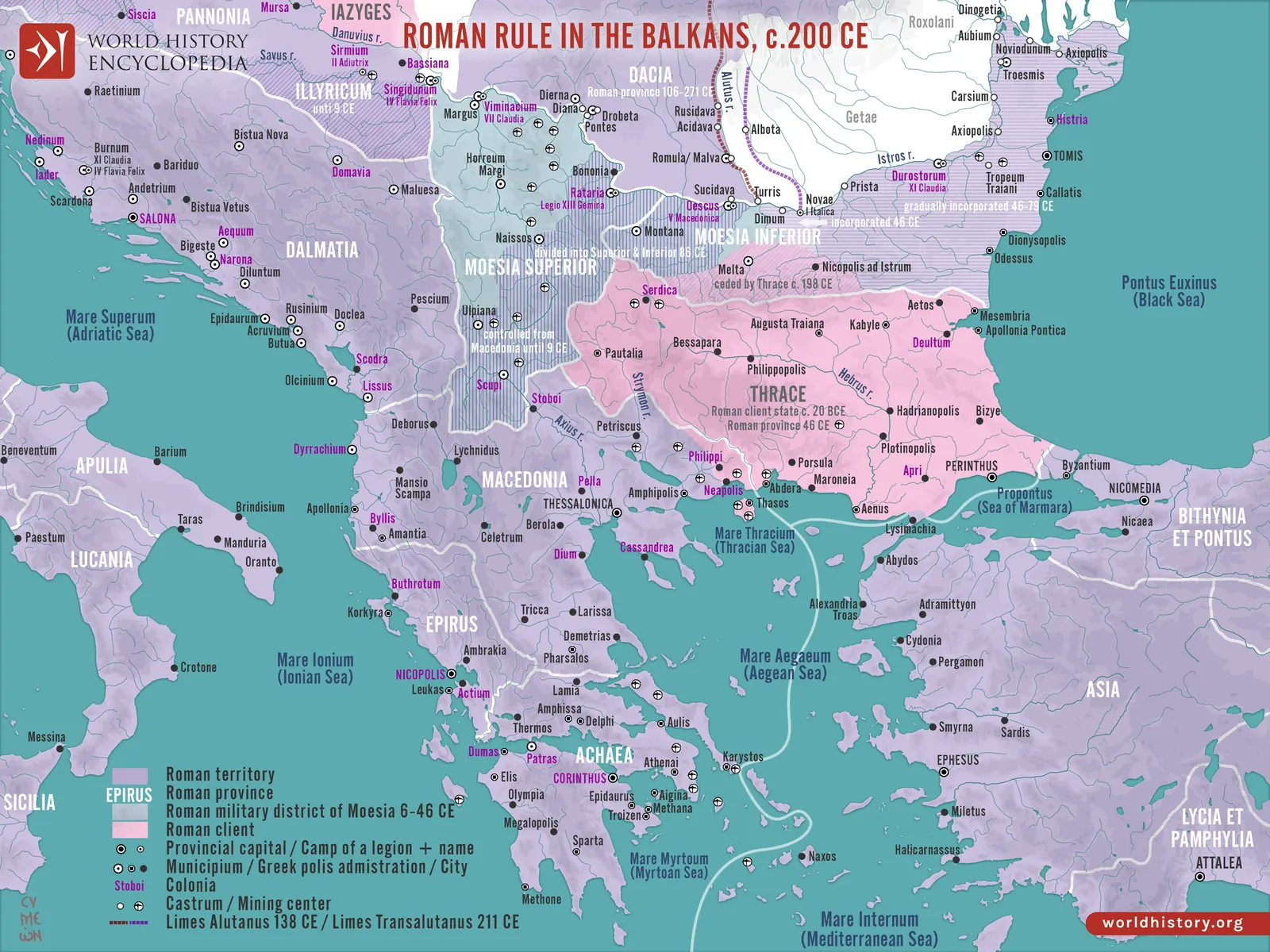
At Novae the legion occupied a position on the Danube linked to roads through Moesia. The garrison could support river crossings, cooperate with neighboring troops, and contribute detachments to major campaigns. The fortress’s barracks, stores, headquarters, hospital facilities, and workshops belonged to a system of sustained military presence rather than a temporary invasion camp.
Service in the Lower Danubian army also involved relations with the Black Sea and northern approaches. Auxiliary forces, cavalry, and river transport extended the reach of the legionary establishment. Its changing opponents and duties should not be reduced to one permanent assignment against a single people.
A long institutional afterlife
The late division into separate river sectors shows the continuing usefulness of the First’s administrative identity. It does not certify the survival of the original early imperial establishment at full strength. Its biography is distinctive because a new legion raised for an unrealized offensive became one of the enduring institutions of a different frontier. The term Italica preserved the memory of formation while the social and military center of gravity became Moesian.