Legions · The legions, by number
02 Legio I Germanica
The First played a prominent role in Vitellius’ accession struggle. Fabius Valens, its commander, was a central political and military actor in 69. The following Rhine rebellion broke the old institutional settlement. The conventional reconstruction places surviving personnel in the combined formation that became VII Gemina; this is a personnel and successor relationship rather than the survival of I Germanica under its own name.
Endpoint: loss of its separate institutional identity in the reorganization of 70. Related identities: I Minervia, a later Bonn legion.
Selected chronology
- c.48 BCE: conventional Caesarian foundation.
- Augustan period: Spanish and then Rhine service.
- 14: participation in the troubled Rhine military establishment after Augustus’ death.
- 69: Vitellian civil-war service under Valens.
- 70: loss of separate identity during Flavian reconstruction.
The Rhine after Varus
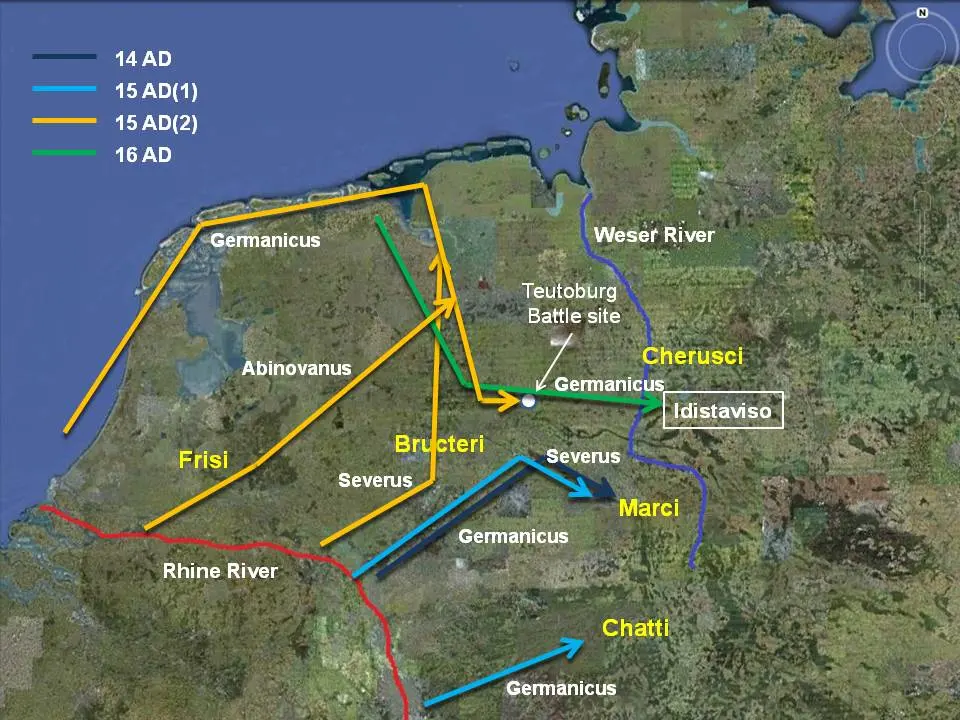
The catastrophe of 9 did not destroy every Roman formation in the German theater. I Germanica belonged to the surviving military establishment used to secure the Rhine and protect the provinces behind it. This role differs from the subsequent punitive campaigns east of the river: holding crossings and restoring confidence were immediate necessities before any renewed advance could be contemplated.
The mutinies after Augustus’ death exposed tensions over service, discharge, discipline, and reward. Germanicus had to recover obedience in an army whose soldiers were political actors as well as subjects of command. The First’s institutional identity therefore included collective bargaining and coercion within the army, not merely external victories.
Bonn and the Vitellian cause
Bonn placed the regiment within the Lower German network, close to the provincial center at Cologne. River transport, roads, neighboring auxiliary forces, and supplies from the provincial hinterland supported its deployment. The same concentration made the Rhine army a powerful force in imperial succession.
Fabius Valens’ role in Vitellius’ acclamation and march to Italy gave the First an importance disproportionate to the number of ordinary battles preserved in its history. Campaigning troops departed while men left at the frontier confronted deteriorating local conditions. The resulting crisis was simultaneously a civil war, a provincial rebellion, and a failure of military coordination.
The end of a separate identity
After surrender and the collapse of the old command, Flavian reconstruction redistributed surviving manpower. Incorporation into VII Gemina preserved soldiers and experience while ending I Germanica’s independent institutional life. This was not physical annihilation of every man, nor a simple transfer of an intact regiment to Spain. Its place in the compendium is a lesson in how institutions could be dissolved through political settlement while their personnel continued serving elsewhere.