Wars · I. The making of Roman Italy
W001 The wars attributed to the kings
Later Roman narratives associate Romulus with Caenina, Antemnae, Crustumerium, the Sabines, Fidenae and Veii; Tullus Hostilius with Alba Longa; and the later kings with Latin and Sabine expansion. Stories of captured towns, population transfer, treaties and spoils describe how Romans imagined the construction of their civic community. The encounter between the Horatii and Curiatii belongs to this literary and commemorative landscape.
The strategic setting is intelligible even where individual episodes cannot be recovered: river crossings, nearby hill settlements, agricultural land and access to the coast mattered to an expanding community. The proper archival object is the tradition of each conflict, not an invented campaign calendar based on a king's conventional reign.
Command, forces and military problem
| Field | Dossier |
|---|---|
| Roman leadership | Romulus and the successive kings in the literary tradition |
| Opposing or rival parties | Neighboring Latin, Sabine and Etruscan communities |
| Forces and capabilities | Community levies; exact organization and equipment cannot be assigned from later legionary practice |
| Operational problem | Secure crossings, land and alliances while incorporating people and territory. |
The landscape behind the royal narratives
The Tiber made Rome a meeting point between inland routes and access to the Tyrrhenian coast. Settlement on defensible heights did not remove the importance of the low ground between them: crossings, pasture, cultivated land and paths between neighboring communities were resources over which an expanding city could compete. The early stories repeatedly return to nearby places rather than to distant imperial frontiers. Fidenae, Veii, the Sabine approaches and the Alban country form a geographic horizon appropriate to a community establishing regional power.
That setting does not authenticate every named expedition. The regal accounts were organized to explain the Roman community's origins, its mixed ancestry and the authority of institutions familiar to later writers. Romulus' wars connect military success to the incorporation of outsiders. Tullus' Alban war explains both destruction and the transfer of families into Rome. The later kings' campaigns connect spoils, construction, political expansion and religious authority. These are central historical ideas in the narratives even where the original course of events cannot be recovered.
Forces, violence and incorporation
An exact order of battle would be false precision. The armies of this period should not be populated with numbered imperial legions, permanent auxiliary regiments or the equipment of Caesar's soldiers. The defensible general picture is of communities able to mobilize armed men with unequal equipment and resources, operating in a setting of raiding, confrontation, fortified settlements and alliances. Archaeological evidence can illuminate weapons and settlement, but it does not automatically attach an excavated object to a named king's campaign.
The stories themselves present victory as a means of acquiring people as well as land. Captives, migrants, allied households and transferred elites are fundamental to their explanation of Roman growth. The opposition between "Roman" and "foreign" is consequently unstable: a defeated community could become part of the later citizen body. The resolution of the Sabine conflict by union is a particularly clear expression of that idea.
What can be concluded
The royal war-cycle belongs in the atlas because it shaped Roman political memory and because it concerns the territory from which later Rome emerged. It cannot support a precise route map, a complete battle calendar or numerical force tables. The atlas therefore preserves the named conflicts and their geographic relationships while distinguishing the historical growth of an early city from the literary biography of a founder.
Campaign geography and operational plates
Latium: a landscape of communities and remembered peoples
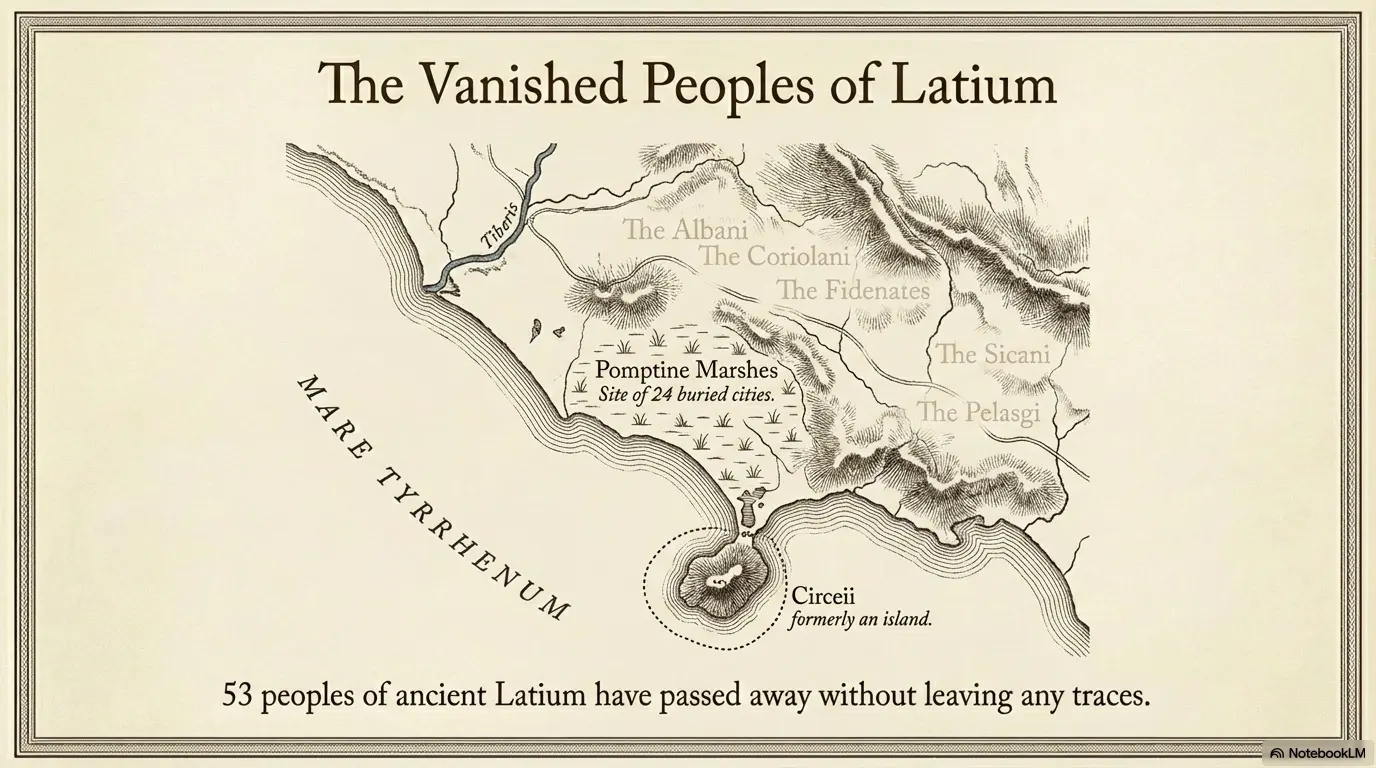
Rome's early wars took place among neighboring communities whose political relationships changed over time. The illustration supplies a sense of that densely named landscape. It does not establish that every place or people described in later geographical writing can be located securely or assigned to a particular legendary campaign.
Outcome and critical assessment
Result and caution: Roman tradition presents incorporation and territorial expansion. Exact years, troop organizations, heroic duels and speeches are not independently established by that narrative. Do not treat every battle assigned to Romulus as an event of 753 BC.
Historical record: Livy, book 1; conquest chronology, early regal rows. The table is a finding aid; Livy's account is evidence for the transmitted tradition.