Wars · I. The making of Roman Italy
W003 The Aequian, Volscian, Sabine and Fidenate wars
These wars were a recurring contest over towns, pastures, farming land, mountain approaches and the ability to raid or protect the Roman plain. They should not be flattened into one continuous campaign. Livy's annual narratives alternate levies and battles with disputes over debt, land and political office, reminding the reader that domestic conflict and military mobilization shared the same citizen body.
Cincinnatus at Mount Algidus, the Fabian disaster on the Cremera, and Cossus' encounter with Lars Tolumnius are famous episodes within this larger setting. The capture and recapture of Fidenae mattered because a hostile settlement close to the Tiber–Anio junction endangered Rome's immediate approaches.
Command, forces and military problem
| Field | Dossier |
|---|---|
| Roman leadership | Successive magistrates; Cincinnatus, the Fabii and Cossus in famous episodes |
| Opposing or rival parties | Aequi, Volsci, Sabines, Fidenates and Veientine forces in separate conflicts |
| Forces and capabilities | Seasonal civic levies, allies, town garrisons and raiding forces |
| Operational problem | Protect fields and nearby routes while fighting repeated, locally varied wars. |
A frontier close to home
These campaigns operated within a landscape measured in relatively short distances from Rome. Short distance did not make them trivial: a raid could damage a harvest, isolate a town or interrupt the levy of a community whose fighting men were also farmers. Repeated annual entries in the annalistic narrative represent a world in which the boundary between a seasonal incursion and a wider war could be fluid.
The Aequi and Volsci are associated with different inland approaches and settlements. Treating them as a single permanently united enemy erases the possibility of separate bargains and uneven Roman success. Sabine and Etruscan affairs created additional pressures. A Roman commander might therefore confront the need to protect one approach while campaigning on another, a small-scale anticipation of later problems of simultaneous threats.
Cremera, Algidus and Fidenae
The Fabian disaster at the Cremera, traditionally dated to 477 BC, was remembered through the extraordinary prominence of one aristocratic family. The tradition itself makes the episode a question about private initiative and public warfare. The numerical and genealogical neatness of the story should not be confused with an intact contemporary roster.
Cincinnatus' intervention at Mount Algidus, traditionally in 458 BC, made emergency command and voluntary return to private life into a Roman political ideal. The military setting involves the relief of a trapped force and the encirclement of its opponents. Its celebrated speed belongs to the story's exemplary structure and does not establish a universal Roman daily marching or construction rate.
Fidenae offered a different recurring problem: a nearby hostile position tied to the Tiber and Anio could threaten communications and enable cooperation with Veii. Accounts of mines and surprise capture concern siege technique, while the repeated wars indicate the difficulty of converting a capture into stable control.
Costs and lasting consequences
Roman internal disputes about land, debt and political representation were not separate from these campaigns. War created demands for service and opportunities for booty; defeat could deepen household distress, while conquest raised questions about the distribution of land. The archive therefore needs the civilian and political consequences as well as the exemplary commanders. The broad outcome was expanding Roman influence, achieved through repeated conflict and negotiated relationships rather than a continuous sequence of uncontested annexations.
Campaign geography and operational plates
Latium: a landscape of communities and remembered peoples
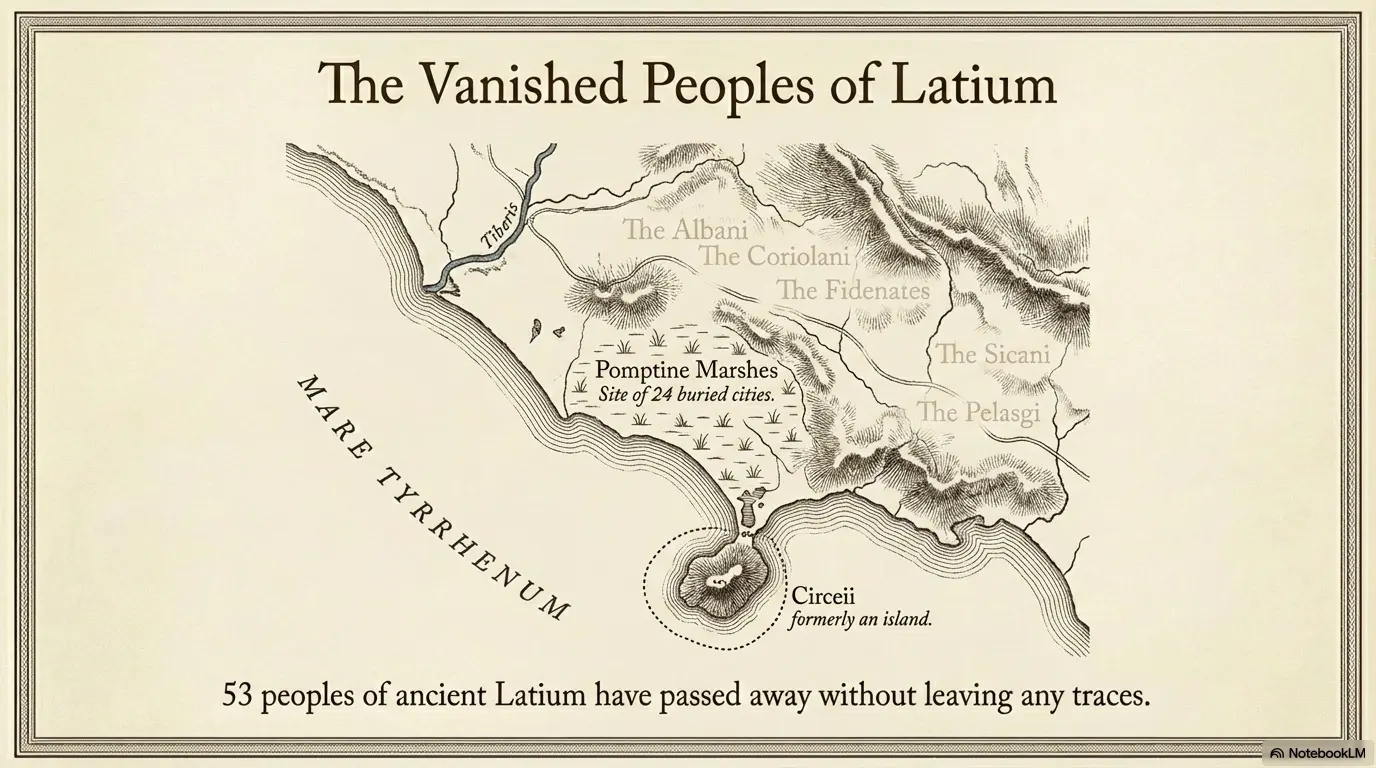
Rome's early wars took place among neighboring communities whose political relationships changed over time. The illustration supplies a sense of that densely named landscape. It does not establish that every place or people described in later geographical writing can be located securely or assigned to a particular legendary campaign.
Outcome and critical assessment
Result and caution: Roman influence expanded unevenly. Repeated conquests in the literary record can represent renewed resistance, different settlements or duplicated traditions. Anecdotes about exceptionally brief campaigns should not become measured operational plans. The date and character of Cossus' achievement were debated already in antiquity.
Historical record: Livy, books 2–4, especially the Cremera, Algidus and Fidenae narratives. Campaign tables preserve leads but also compress distinct episodes.