Legions · The legions, by number
43 Legio XXI Rapax
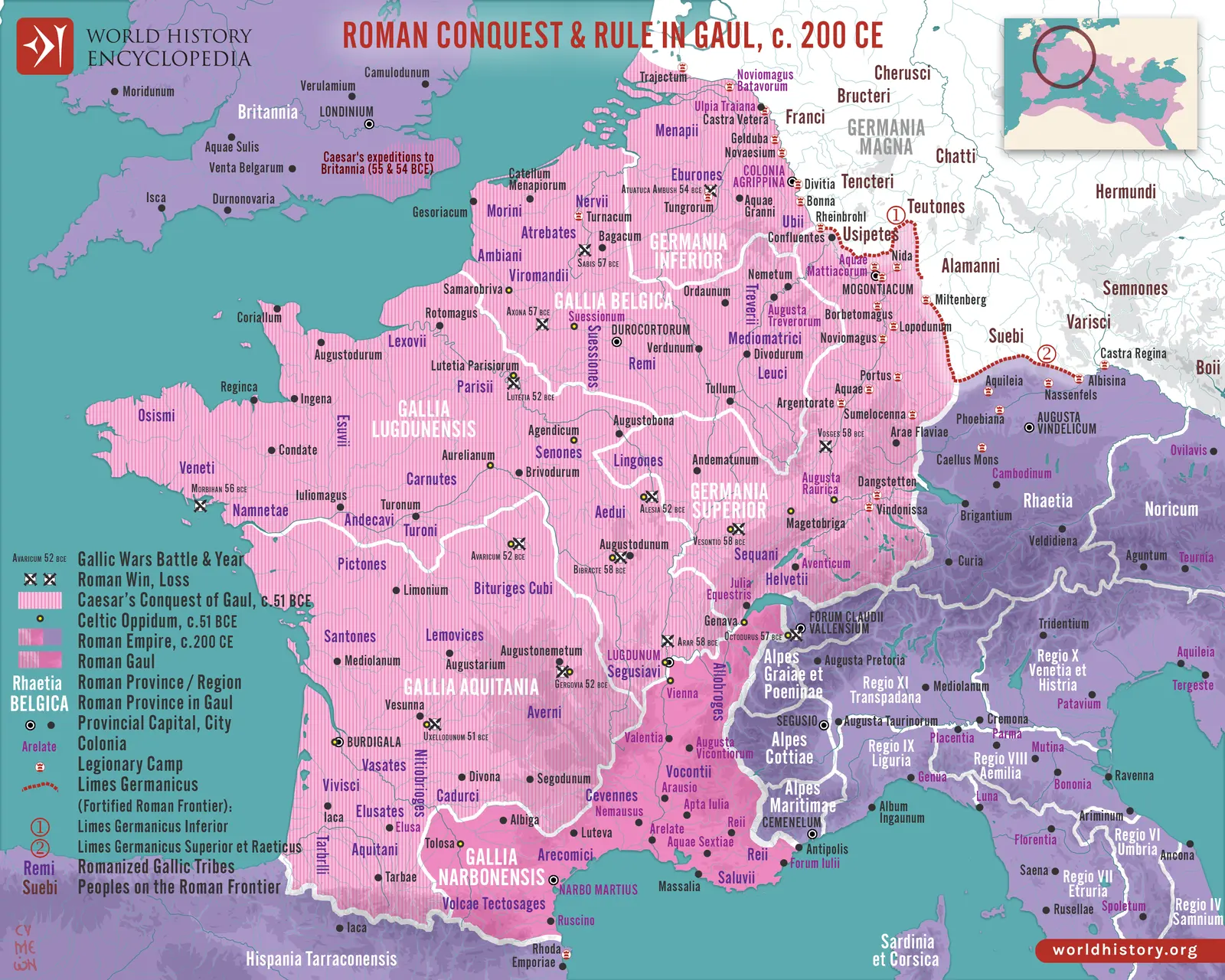
The Twenty-first fought in the civil war of 69 and the recovery of the Rhine. It later supported Saturninus’ failed revolt in 89 and was transferred toward the Danubian theater. Its disappearance is usually connected with the Sarmatian war around 92, but the exact circumstances should be distinguished from the general account of a Roman legionary disaster under Domitian.
Endpoint: probable loss around 92 in the conventional reconstruction. Related identities: XXII Primigenia, which continued under its own identity.
Selected chronology
- Augustan period: foundation and early continental service.
- First century: Rhine and Vindonissa establishments.
- 69–70: civil-war service and recovery of the Rhine.
- 89: support for Saturninus’ failed rebellion.
- c.92: probable loss in the Sarmatian war.
From an Augustan creation to the Rhine army
XXI Rapax’s early station sequence is less secure than its later association with the Rhine and Vindonissa. Proposed Spanish origins must remain distinct from better-established continental assignments. The corporate name proclaimed an aggressive military identity but does not prove a unique tactical doctrine or a permanent social reputation.
At Vindonissa the legion occupied a position connecting the Upper Rhine region with routes toward the Alps. As elsewhere, the fortress supported a wider military economy and a population of soldiers, veterans, dependents, and suppliers. The garrison’s importance cannot be measured only by how many celebrated battles are attached to its name.
Civil war and rebellion
The Twenty-first was a major participant in the fighting of 69, including the confrontation with I Adiutrix near Bedriacum. A standard’s loss or recovery carried enormous significance inside such an engagement because it affected morale, reputation, and the public memory of the regiment.
Later service in the recovery of the Rhine was followed by new stations and political risks. Support for Saturninus in 89 placed XXI Rapax on the losing side of a rebellion and contributed to its separation from the Mainz concentration. Transfer toward Pannonia brought it into another frontier emergency.
The probable final loss
The conventional ending connects the regiment with the Sarmatian disaster around 92. The broad military context is firmer than every detail of the Twenty-first’s final action. A critical biography therefore records probable destruction without inventing a particular formation, commander’s speech, or number of survivors. Capricorn is associated with its imagery. Its history combines several themes of the atlas: an inherited corporate name, geographically mobile service, standards as objects of honor, political rebellion, and an ending reconstructed from incomplete evidence.