Legions · The legions, by number
34 Legio XIV Gemina Martia Victrix
The Fourteenth Twin Legion, Martial and Victorious
Identity. Caesarian Fourteenth legions form part of its antecedent history; the relationship between successive destructions, replacements, and the imperial legion must remain explicit. Capricorn is an associated emblem.
Historical outline. The Fourteenth’s most celebrated early imperial episode was the suppression of Boudicca’s revolt. Its later history returned it to the continent, through Rhine service and a short Vienna phase to Carnuntum. These stations belong to a long series of redeployments rather than a fixed Danubian identity stretching back to Caesar.
Selected chronology
- Caesarian period: early Fourteenth formations, including a destroyed formation and replacement recruitment.
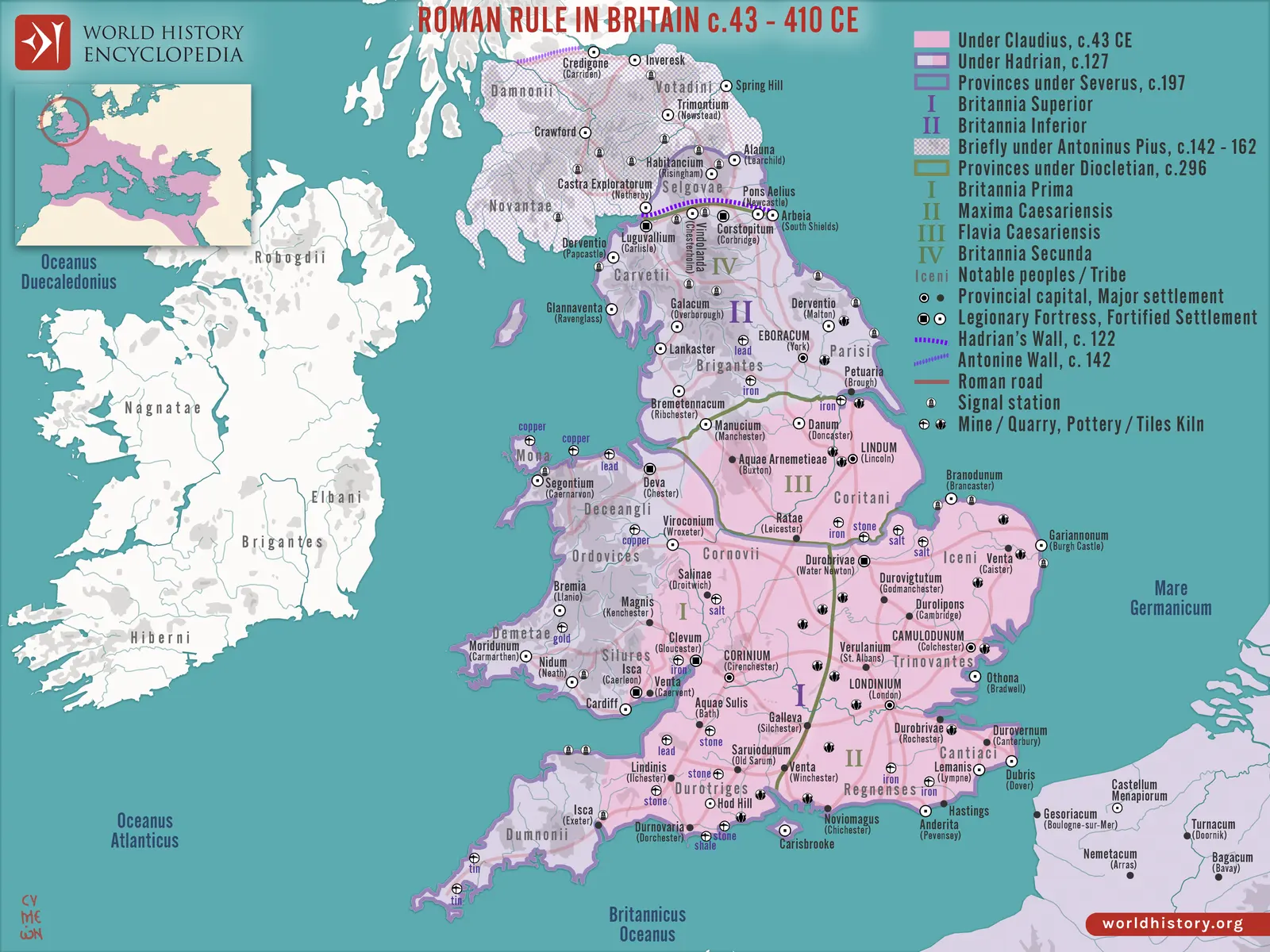
- 43: service in the invasion of Britain.
- 60/61: principal legion in Suetonius Paulinus’ victory over Boudicca.
- Late 60s–70s: departure from Britain and continental campaigning.
- 89: involvement in Saturninus’ unsuccessful revolt while associated with Mainz.
- Late first–early second centuries: Vindobona phase followed by Carnuntum.
- Late horizon: subdivisions of the Fourteenth remain in the late military register’s Danubian commands.
Boudicca’s revolt and the battle army
The Fourteenth’s British reputation centered on the army assembled by Suetonius Paulinus in 60/61. The regiment, a detachment of the Twentieth, and auxiliary troops faced a much larger rebel force in a chosen position. Restricted approaches and the protection of the flanks mattered to the Roman plan. Missile discharge, controlled advance, and close fighting belong to the reconstruction of the battle; enormous ancient enemy totals should not be converted into precise modern statistics.
The result restored Roman military control after the destruction of major settlements and the Ninth’s earlier defeat. The Fourteenth’s fame must therefore be understood against the scale of the provincial catastrophe and the violence of its suppression. Martia Victrix proclaimed martial victory without preserving an eyewitness technical account of every maneuver.
Rhine politics and Danubian relocation
After leaving Britain, the Fourteenth passed through continental service and the Rhine command. Its support for Saturninus in 89 placed it on the losing side of an imperial rebellion. The regime’s response separated potentially dangerous concentrations of troops and altered the army’s geographical arrangements. A long military reputation did not insulate a legion from the consequences of political allegiance.
Vindobona and Carnuntum belong to separate Danubian stages. Carnuntum’s location connected the legion with river crossings, northern routes, and a substantial civilian and military settlement. Imperial visits and campaigning headquarters enhanced the region’s importance but did not make every army assembled there part of XIV Gemina.
The late Fourteenth
River-sector and naval-associated subdivisions show how the older institution adapted to the later Danubian establishment. The Capricorn supplied a durable motif while imperial honorifics changed. Its final disappearance cannot be fixed simply by choosing a date when a modern map’s frontier line is usually drawn as collapsing. The Fourteenth’s history instead joins celebrated battlefield success with rebellion, reassignment, and the endurance of an institutional name after its organization changed.