Legions · The legions, by number
33 Legio XIII Gemina
The Thirteenth Twin Legion
Identity. Caesar raised the Thirteenth in 57 BCE; the imperial legion emerged through later reconstitution and combination. The lion is an associated badge.
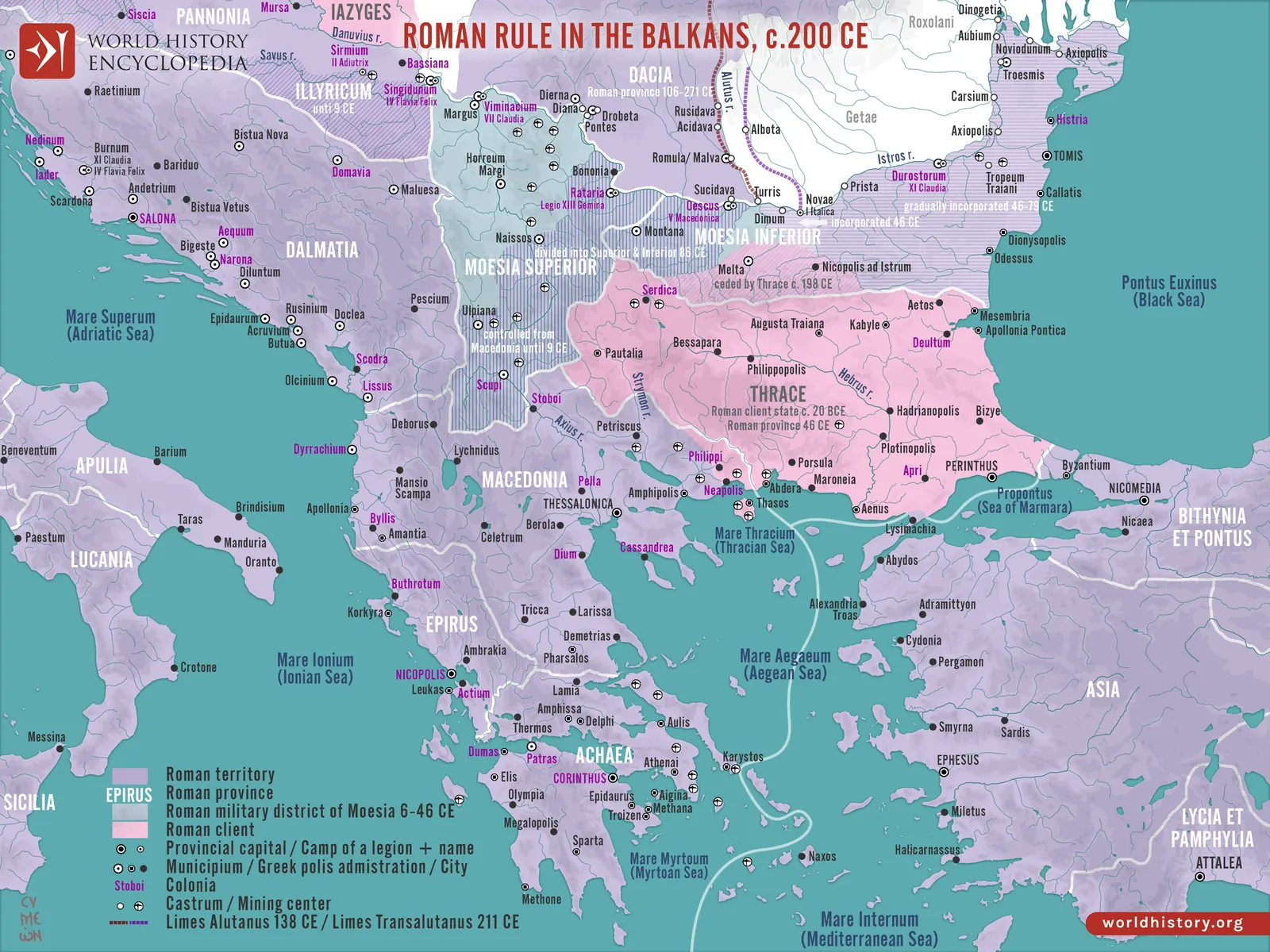
Historical outline. The Thirteenth’s memory begins with Caesar’s civil war, but its long provincial biography runs through Alpine and Balkan stations into Roman Dacia. Apulum became a major institutional center after Trajan’s conquest. Withdrawal to Ratiaria and the establishment of a separately listed Egyptian component transformed its late geographical footprint.
Selected chronology
- 57–49 BCE: recruitment in the Gallic-war period and presence with Caesar at the opening of the civil war.
- Later civil wars: disbandment/refoundation stages before imperial establishment.
- Early empire: Vindonissa and Poetovio phases.
- After 106: Apulum-based occupation of Dacia.
- Early 270s: withdrawal from trans-Danubian Dacia; later base at Ratiaria.
- Late horizon: several Danubian subdivisions and a XIII Gemina entry at Babylon in Egypt.
The legion at Caesar’s opening gamble
The Thirteenth was with Caesar when the constitutional crisis became open war in 49 BCE. His initial force was small in comparison with the armies mobilized afterward. The advance to Ariminum gained importance because it transformed a dispute over command and office into military action in Italy. The famous Rubicon episode belongs to the larger political meaning of that opening rather than a fully recoverable theatrical scene.
The regiment’s subsequent civil-war service, discharge, and later reconstitution require separation. A later legion could preserve the memory of Caesar’s Thirteenth while incorporating men who had never served under him. Gemina expressed combination, not biological continuity between every generation of soldiers.
Apulum and Roman Dacia
After the conquest of Dacia, Apulum became the center of a major legionary establishment. Roads connected the fortress with provincial settlements, mining districts, and other garrisons. XIII Gemina helped maintain an occupation that depended on secure internal movement as well as defense against attacks from beyond the province.
The legion’s relationship with V Macedonica included the supply of mixed detachments. Such a force could travel on imperial service while the parent headquarters remained in Dacia. Its history belongs to the broader Roman practice of drawing expeditionary troops from several provincial armies rather than constantly moving entire legions.
Evacuation and divergent descendants
Rome’s withdrawal from trans-Danubian Dacia shifted the Thirteenth’s principal geography to Ratiaria and other Danubian posts. The change marked a strategic contraction, but the institution’s name and administrative traditions survived. A separately recorded Egyptian component at Babylon illustrates another path taken by part of the legion’s manpower or identity.
The lion distinguishes its familiar imagery from the bulls associated with several other Caesarian lineages. Neither the lion nor the inherited number establishes a uniform equipment style across six centuries. Its distinctive biography connects Caesar’s seizure of the initiative, long occupation in Dacia, imperial withdrawal, and a late military identity divided between different regions.