Legions · The legions, by number
31 Legio XI Claudia Pia Fidelis
The Eleventh, Loyal and Faithful to Claudius
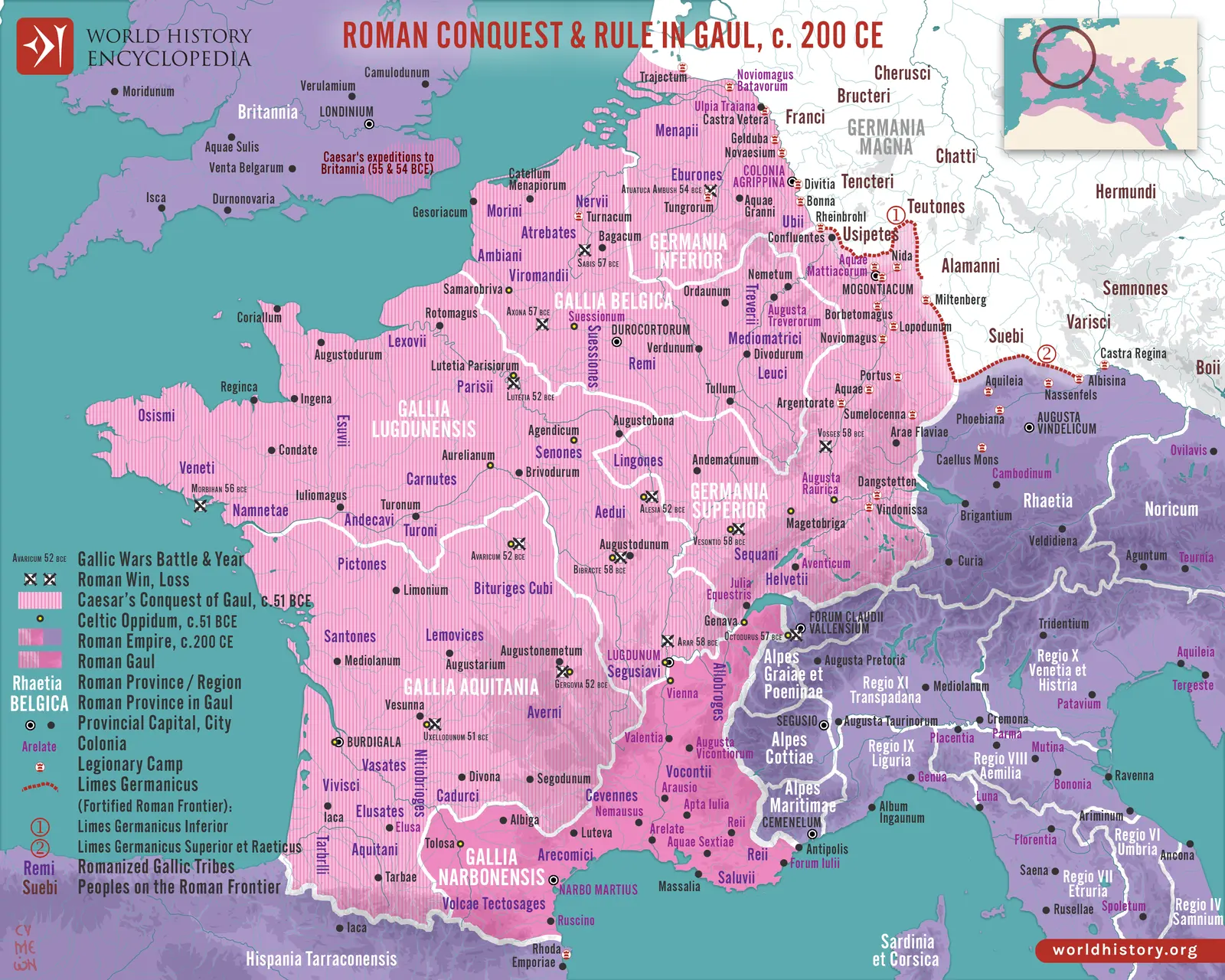
Identity. Descended through reconstitution from Caesar’s Eleventh of 58 BCE. The Claudian loyalty title commemorates the defeat of Scribonianus’ challenge in 42.
Historical outline. The Eleventh’s successive geographical lives belong to the Gallic wars, civil-war remaking, Dalmatian occupation, Rhine reorganization, and Lower Danubian defense. Burnum, Vindonissa, and Durostorum should therefore appear as historical stages. The familiar Claudian name records a political choice made long before its mature Danubian station.
Selected chronology
- 58–45 BCE: Caesarian service and eventual demobilization.
- Triumviral period: reconstitution and renewed civil-war service.
- Early empire: Dalmatian establishment.
- 42: refusal to sustain Scribonianus’ revolt; Claudian honorifics.
- After 70: occupation of Vindonissa following the Rhine reorganization.
- Trajanic period: transfer to the Lower Danube; the exact arrival date at Durostorum remains debated.
- Late horizon: late military register entries at Durostorum and Transmarisca.
The Eleventh before its Claudian title
The Eleventh’s Caesarian history includes the Gallic campaigns and the civil war. Demobilization did not remove all the military networks formed by service: veterans could re-enlist, commanders could mobilize old loyalties, and a regiment could be reconstructed around an inherited number. The imperial institution emerged through these processes rather than through the untouched preservation of one original body of recruits.
In Dalmatia, the legion formed part of the occupation and communications system linking coastal centers with the interior. Roads, construction sites, and regional detachments spread its presence beyond Burnum. The rejection of Scribonianus’ revolt in 42 supplied the political episode commemorated by Claudia Pia Fidelis. The title rewarded a decision whose consequences mattered at Rome as well as in the province.
Through Vindonissa to Durostorum
The Flavian reorganization brought the Eleventh to Vindonissa. The fortress guarded approaches through a landscape connecting the Rhine, Swiss plateau, and Alpine routes. Its later transfer to the Lower Danube answered another strategic need. Movement between such stations transferred an administrative and social institution as well as a field force.
Durostorum anchored the legion’s long Lower Danubian life. The river was a transport corridor, a defended crossing zone, and a meeting ground between provincial settlements and peoples beyond Roman control. Patrols, supply, fort maintenance, and cooperation with auxiliary and river forces were essential to this system.
A divided late establishment
The separate commands at Durostorum and Transmarisca reflect the distribution of the later institution along the frontier. They do not imply several full early imperial Eleventh legions. The name Claudia could remain useful long after the events of 42 had ceased to be living memory. Its legacy is therefore both political and geographical: the remembered loyalty of an early imperial regiment became attached to centuries of work in a very different Danubian military world.